Last updated on October 24th, 2026 at 04:50 am
Quick Answer: The best solar lights for the Australian climate have an IP65 or higher rating, UV-resistant materials and a replaceable battery.
Table of Contents
“More sun means better solar lights.” Not quite.
Most people think a sunny country is paradise for solar lights. It makes sense. Sun in, light out.
But Australia gives solar lights more than sun. It gives them heat, extreme UV, salt spray and the occasional hailstorm. The sun charges the light, and the same sun slowly cooks it.
So the best solar lights for the Australian climate are the ones built to take a beating, not the ones with the biggest lumen claim on the box.
Key Takeaways
- Look for a rating of IP65 or higher for open garden spots.
- Heat shortens battery life, so choose a light with a replaceable battery.
- Face the panel north and keep it clear of shade.
- On the coast, check what the metal parts are made of.
- In the far south, winter days are short, so expect shorter runtimes.
How this guide was built: I compiled the advice from government, weather and standards sources, named at the end. For the product picks, I read specs from maker and retailer listings in October 2026. We haven’t run lab tests on any of them, so “best for” means best fit for a job, not a ranking.
Why UV and heat matter more than you think
Australia gets some of the highest UV levels in the world. In January, average UV Index values are forecast at 11 or more across most of the country on clear-sky days, according to ARPANSA and Cancer Council Australia. Anything over 11 counts as “extreme.”
UV doesn’t take a day off when it’s cloudy. Cloud can reduce UV, but thin or scattered cloud may have little effect. Your light sits outside and takes it all, every day.
That’s why housing material matters. Makers often advertise UV-resistant plastics or stainless steel. Cheap plastic that goes brittle and chalky after one summer is a familiar sight in Aussie gardens.
What to do: Check the product page for UV-resistant materials. If the listing only says “waterproof,” it hasn’t answered the sun question.
Key Takeaways
- UV is extreme across much of Australia in summer.
- Cloud doesn’t switch UV off.
- “Waterproof” doesn’t mean “sun-proof.”
Rain, hail and hose-downs: how to read an IP rating
IP ratings come from the international standard IEC 60529. The first digit covers solid objects and dust. The second covers water.
Here is what the common ones mean in plain English:
| Rating | Dust | Water |
|---|---|---|
| IP44 | Blocks objects over 1 mm | Splashes won’t harm it |
| IP65 | Dust-tight | Handles low-pressure water jets from any direction |
| IP67 | Dust-tight | Survives immersion between 15 cm and 1 m |
IP44 can work under a covered patio. For an open garden bed, a wet-season downpour or a tropical storm, aim for IP65 or higher. Choose IP67 for spots that flood, like low garden beds or pool surrounds.
Be careful with “weatherproof” and “waterproof.” They aren’t official ratings. Only the IP number tells you what was tested.
The battery is the real weak point
Your solar light’s panel rarely fails first. The battery does.
Heat hurts batteries. Battery University notes that prolonged exposure to high temperatures shortens battery life, and gives an example where running at 30°C cuts cycle life by 20 percent compared with a more moderate temperature. Now picture a small battery inside a closed plastic housing in direct summer sun.
Lifespan figures vary a lot. Commonly cited estimates put the practical life of nickel-based batteries in solar lights at one to four years, with hot summers pushing toward the short end. Treat that as a guide, not a guarantee.
You’ll see marketing for lithium-iron-phosphate (LiFePO4) cells in premium lights. Sources disagree on exactly how much better they cope with heat, so don’t pay extra on the claim alone. Instead:
- Check that the battery type is listed in the specs.
- Prefer lights with a replaceable battery.
- Look for a warranty that covers the battery, not only the casing.
A light with a replaceable AA cell can live for a decade. A sealed one often can’t.
Key Takeaways
- Heat shortens battery life.
- Lifespan figures are estimates, so check the warranty.
- Replaceable batteries beat sealed ones.
Winter: the south gets a short day
Solar lights only run on what they bank by day. In winter, “by day” shrinks fast the further south you go.
On the 2026 winter solstice, Australian capital city day lengths ranged from about nine hours in Hobart to just over 11 hours 20 minutes in Darwin, a gap of almost 2.5 hours, according to Weatherzone. Sydney gets just under ten hours.
That gap shows up in your garden as a light that fades early on a cold June night. It may not be faulty. It may simply be short on sun.
What to do in the south:
- Pick lights with a larger panel and a bigger battery.
- Give the panel the best spot you have (see below).
- Expect shorter runtimes in winter, and don’t panic.
The days start growing again right after the solstice. They keep lengthening until the summer solstice on 22 December.
Coastal homes: salt eats metal
If you live near the sea, salt air is the thing that quietly destroys outdoor fittings.
Australian councils already plan for this. The Sunshine Coast Council, for example, requires 316 marine-grade stainless steel for coastal sites east of the Bruce Highway, and allows 304 grade in hinterland areas. The first sign of corrosion on stainless steel in marine conditions is often a brown discolouration called tea staining.
That’s guidance for fences and handrails, not lights. But it’s a handy rule of thumb: if a council wants 316 stainless on the coast, a cheap coated-steel light stake probably won’t last either.
What to do near the coast:
- Look for 316 stainless steel or marine-grade aluminium parts.
- Check screws and spikes, not only the head of the light.
- Rinse the light with fresh water now and then.
Placement: where you put it matters as much as what you buy
You can buy the best light in the shop and still lose to a bad spot.
In Australia, the sun tracks across the northern sky. The Australian Government’s Your Home guide says the main solar access comes from the sun’s path to the north. The same logic applies to your tiny garden light panel. Victoria’s government advises that it’s generally best to face solar panels north. That advice covers rooftop systems, but the sun’s path is the same for a garden light.
Quick placement rules:
- Face the panel north.
- Keep it out of shade from eaves, fences and thick trees.
- Wipe the panel now and then. Dust and bird mess block sunlight.
- Don’t bury the light body in deep mulch where heat gets trapped.
South-facing walls get the least sun in Australia. A light mounted there will sulk. Move it, and it will thank you.
Got a block full of tall trees? Dense canopy is a different challenge, and we cover it in our guide to solar lights for forest areas and what actually works under tree cover.
Which solar lights suit your part of Australia?
| Region | Main challenge | What to prioritise |
|---|---|---|
| Tropical north (Darwin, Cairns) | Heat, humidity, wet-season downpours | IP65–IP67, UV-resistant housing, heat-tolerant battery |
| Subtropical east (Brisbane, Sydney) | Storms, summer UV, humidity | IP65+, replaceable battery, good panel placement |
| Temperate south (Melbourne, Hobart) | Short winter days, cold snaps | Larger panel, bigger battery, sunniest spot possible |
| Arid inland and Perth | Extreme UV and heat, dust | UV-resistant materials, easy-to-clean panel |
| Anywhere on the coast | Salt spray | 316 stainless or marine-grade parts, rinse regularly |
Match your light to your local problem, not to the biggest brand name.
Solar lights worth a look: best picks for the Australian climate
These picks are matched to the advice above. I read the specs from each maker’s or retailer’s listing in October 2026. Specs and prices change, so check the listing before you buy.
Arlec 7W Integrated Solar Sensor Floodlight (Bunnings)

Best for: driveways and security in an open, sunny spot.
- 800 lumens, IP65 rating, 3,600 mAh battery
- 6 m detection range, 120° scan, two night modes
- Up to 16 hours of run time, per the listing
Watch out: the panel is built in, so the whole light has to sit in the sun. The listing doesn’t state the warranty or whether you can replace the battery.
Arlec Solar Hybrid floodlights, Surnia and Ketupa (Bunnings)
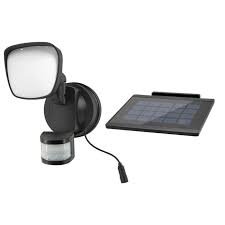
Best for: wet seasons, cloudy spells and short southern winters.
- Solar power with a Type C alkaline backup (batteries not included)
- The panel sits on a 3 m lead, and the maker says to face it true north
- 10 m motion sensor, 120° angle
- Surnia: 500 lumens (single head) or 900 lumens (twin). Ketupa: 800 or 1,000 lumens.
- For the Surnia, the maker says the two power sources together can run for up to six months on the alkaline batteries.
Watch out: the Surnia single head is listed at IP44 only. Check the IP rating on the exact model you pick.
Arlec 200 Lumen Solar Sensor Floodlight (Bunnings)

Best for: a low-cost light on a sheltered wall.
- 200 lumens, 6 m detection range
- “Welcome” mode gives a steady low glow of 10 lumens, and “Full Light” mode switches on with movement
- IP44 rating
Watch out: IP44 only covers splashes. Mount it under an eave, not on an exposed post.
Hoselink Solar Festoon Lights

Best for: alfresco areas and patios.
- IP65 rating, 240 lumens, warm 2200K glow
- 8 m cable with 25 bulbs, 8 to 10 hours of light, 1-year warranty
- The same Hoselink set includes a table lantern at IP44 with a replaceable battery.
Watch out: the maker’s spec sheet says the festoon battery isn’t replaceable, so the light’s life depends on that small 220 mAh cell.
Lexi Lighting Solar Fairy Lights (JB Hi-Fi)

Best for: covered patios and seasonal decoration.
- IP44 rating, 8 lighting modes, 12-month warranty
- 420 LEDs on a string about 30 m long
- The maker says run time drops in winter and the panel needs plenty of direct sun to recharge fully.
Watch out: IP44 again, so keep the string under cover in storm-prone areas. The panel must not sit in shade.
Stainless steel solar step lights, IP65 (Lighting Style)

Best for: steps and paths where you want metal and glass instead of plastic.
- IP65 rating, stainless steel body, tempered glass
- 2-year warranty
- About 4 to 6 hours of light, per the listing
Watch out: the listing doesn’t state the grade of stainless steel. If you live near the coast, ask the seller whether it’s 316. These cost far more than garden stakes.
Orca Solar Lighting bollards

Best for: coastal homes and anyone who wants the long game.
- The maker says they are Australian made, rated IP68, with 316 stainless fasteners and marine-grade aluminium poles
- The maker lists a 10-year warranty and at least four nights of battery backup
Watch out: these target council and commercial projects. Expect a quote, not a shelf price. Treat them as the benchmark for what “built for Australia” looks like.
How they score: none of these ticks every box on the checklist below. The Arlec 7W and the Hoselink festoon reach IP65. The Hoselink lantern has a replaceable battery. Only the Orca bollards combine marine-grade parts with a long warranty. Pick the trade-off that suits your spot.
Your buying checklist
Before you buy any solar light for Australian conditions, tick these off:
- IP rating of IP65 or higher for open spots
- UV-resistant housing named in the specs
- Battery type listed, and replaceable if possible
- Warranty that covers the battery
- Panel size that fits your winter sun (bigger in the south)
- Corrosion-resistant metal if you’re coastal
- Real lumen figure, not just “super bright”
- Warm white or cool white to match your style
If a listing hides half of these, ask why.
Quick glossary
- IP rating: A two-digit code showing how well a device resists dust (first digit) and water (second digit), defined by IEC 60529.
- UV Index: A scale measuring ultraviolet radiation. 11 or above counts as “extreme.”
- LiFePO4: Lithium iron phosphate, a battery type used in some premium solar lights.
- NiMH: Nickel-metal hydride, a common rechargeable battery in budget garden lights.
- Lumens: A measure of how much light a source puts out.
- 316 stainless steel: A marine-grade stainless steel with better salt resistance than 304.
- Solar north: The true north used for sun-angle planning, not magnetic north.
FAQs
Do solar lights work in Australian winter?
Yes, but runtime drops. Days are shorter, especially in the south. In Hobart, the shortest day is about nine hours. Pick a larger panel and a sunny, north-facing spot.
Are solar lights safe in heavy rain?
They are if the rating matches the weather. IP65 handles low-pressure water jets from any direction. IP44 suits sheltered spots only.
Do solar lights charge on cloudy days?
They still collect some light, but less. Expect dimmer or shorter output after a run of gloomy days. Hybrid lights with a backup battery, like the Arlec Surnia and Ketupa, are built for this.
How long do solar light batteries last?
It depends on the battery type, quality and heat. Common estimates for nickel-based batteries are one to four years. Hot summers push it toward the low end.
Which solar lights are best for coastal homes?
Look for marine-grade parts such as 316 stainless steel, an IP65+ rating and a replaceable battery. Rinse them occasionally.
Should the panel face north?
Yes. In Australia the sun travels across the northern sky, so north-facing panels get the most light.
Summary
The best solar lights for the Australian climate aren’t the cheapest or the flashiest. They’re the ones with a solid IP rating, UV-resistant materials, a battery you can replace, and a spot where the panel actually sees the sun.
Choose for your region, place the panel well, and your garden will glow for years instead of one summer.
Sources
- ARPANSA and Cancer Council Australia, UV Index guidance
- Battery University, “Discharging at High and Low Temperatures”
- Weatherzone, 2026 winter solstice day lengths
- Australian Government, Your Home, “Orientation”
- Sustainability Victoria, “Install solar power”
- Sunshine Coast Council, “Materials, fixings and finishes”
- IEC 60529, Degrees of protection provided by enclosures (IP Code)
- Bunnings product listings for Arlec solar lights
- Hoselink product specification sheet
- JB Hi-Fi product listing for Lexi Lighting
- Lighting Style product listings
- Orca Solar Lighting product information