Last updated on October 25th, 2026 at 08:44 am
Quick Answer: Choose IP65 or higher for water protection, a monocrystalline panel and a replaceable battery with decent capacity. IP65 means protection against a low-pressure water jet of 12.5 liters per minute from any direction. Pick IP67 if water pools where the light sits.
Table of Contents
Myth: rain kills solar lights. Not quite. Weak seals and grey skies do the real damage.
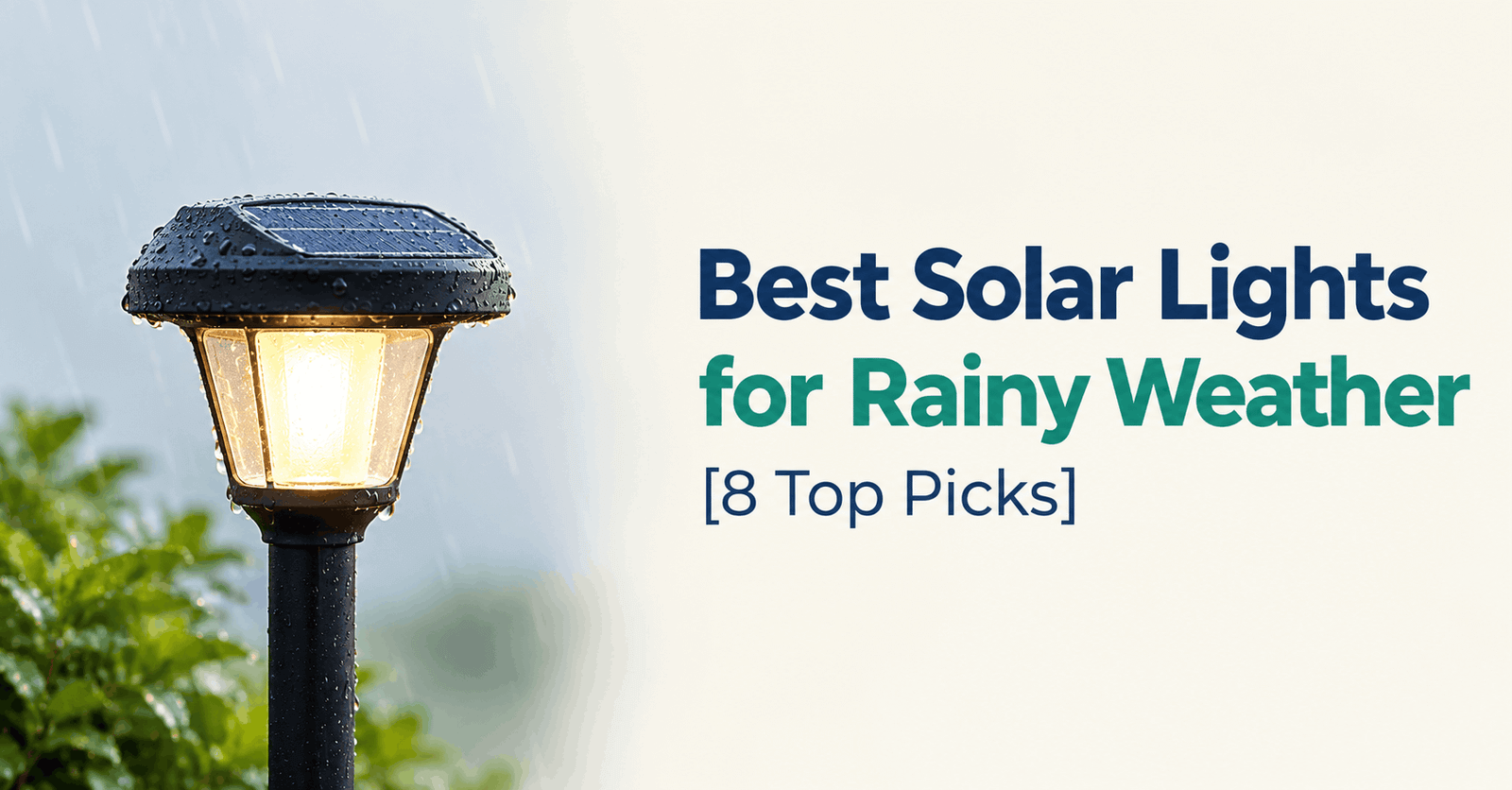
So the best solar lights for rainy weather do two jobs. They keep water out (look for IP65 or higher). They also keep charging on cloudy days (look for an efficient panel and a decent battery). Our top three picks are Best Overall, Best for Heavy Rain and Best for Low Sun.
Best Solar Lights for Rainy Weather at a Glance

These are pick profiles, not brand names. Use the specs as your shopping filter.
| Pick | Target IP rating | Panel | Battery | Price tier* | Best for |
|---|---|---|---|---|---|
| Best Overall | IP65+ | Monocrystalline | Replaceable, mid-to-large capacity | Mid | Most gardens in wet climates |
| Best for Heavy Rain | IP65, or IP67 if water pools | Monocrystalline preferred | Replaceable | Mid | Storm-prone or puddle-prone spots |
| Best for Low Sun and Overcast | IP65+ | Monocrystalline | Larger capacity | Mid to higher | Shady yards, grey skies |
| Best Budget | IP44 to IP65 | Often unlisted | Small NiMH | Low | Light showers, decorative use |
| Best Solar String Lights | IP65+ on string and panel unit | Check listing | Check listing | Low to mid | Patios, fences |
| Best Floodlight / Motion Sensor | IP65+ | Monocrystalline | Larger capacity | Mid to higher | Entrances, driveways |
| Best Path Lights | IP65+ | Monocrystalline preferred | Replaceable | Low to mid | Walkways, borders |
| Best Hybrid (Solar + USB) | IP65+, with a capped USB port | Monocrystalline preferred | Replaceable | Mid | Long grey spells |
*Price tiers are relative and come from my own reasoning, not market data.
Why no “runtime” column? No source can give one honest overcast runtime for every light. The section on days without sun explains how to estimate it.
Why Solar Lights Fail in Rainy Weather: Two Different Problems
Most people blame “the rain” for everything. That lumps two separate failures together.
Problem 1: Water Getting Inside
This is the leak problem. A cracked housing, a weak gasket or a damaged seal lets moisture in.
One solar-light repair guide tells owners to open the battery compartment and look for moisture, corrosion or condensation inside. The same guide says a light fog or water droplets inside means moisture has breached the seal, and that stops the panel from charging properly.
Why does fog appear inside a closed light? One lighting maker explains that warm, moist air turns to water when it meets a cold surface inside a fixture. A fast temperature change also creates a pressure difference that can pull in more damp air.
Seals matter for this reason. A Bunnings Workshop team member points out that outdoor lamps depend on a rubber gasket to keep humid air out, and that a missing or perished seal can explain condensation.
Problem 2: Not Enough Charge on Cloudy Days
The housing can be perfect and the light can still die early. If the panel gets too little light, the battery runs low. Then the light fades out by midnight.
Why You Need to Solve Both
A high water rating does nothing for weak charging. A big panel does nothing for a leaky seal. The best solar lights for rainy weather handle both, so check both.
Key Takeaways
- Problem 1 is about seals, gaskets and the IP rating.
- Problem 2 is about panel, battery and placement.
- Fix one and ignore the other, and the light still fails.
How We Chose and Tested These Lights
Let’s be upfront: we did not run rain tests for this guide. There is no test location, no test dates and no lab data here. We would rather tell you that than invent numbers.
Instead, we did a source review in October 2026. We read:
- IEC 60529 ingress-protection explanations from testing laboratories
- A university energy-centre study and a 2024 peer-reviewed assessment of panel types
- Battery and maintenance guides for solar garden lights
- A manufacturer instruction manual
- Repair and troubleshooting guides
Whenever a number appears in this article, it comes from one of those sources. Whenever something is our own reasoning, we say so.
Want to test a light yourself? Here is a simple home check. Charge it fully, then leave it under a cloudy sky for a day. Note when it dims that night. Then check inside after the next storm for water. That tells you more than any listing.
What to Look For: A Rain-Ready Checklist
IP Ratings Explained
IP stands for Ingress Protection. The IP code comes from IEC 60529. The first digit covers solids such as dust, and the second digit covers water. Here is what the water digit means for the ratings you will see on solar lights:
- IP44: protected against splashing water from all directions.
- IP65: protected against a low-pressure water jet of 12.5 liters per minute from all directions.
- IP67: covers temporary immersion up to 1 meter for about 30 minutes.
- IP68: covers continuous immersion beyond 1 meter, under conditions the manufacturer sets.
Our reasoning: IP44 may cope with light showers. IP65 gives you a safer margin for heavy, wind-driven storms. IP67 suits spots where water collects.
Three IP myths to drop:
- “Higher always means better.” An IP67 product passed an immersion test, but it has not necessarily passed the IP65 or IP66 jet tests.
- “IP68 means it works underwater.” Many people assume IP67 or IP68 lets a device run while submerged. The rating is about keeping water out.
- “The test covers every liquid.” IP water tests use fresh water. If you live by the sea, be extra careful with salty spray. That is our inference, not a tested claim.
Solar Panel Type: Monocrystalline vs Polycrystalline
Panel type matters most on grey days.
- Monocrystalline: tends to perform slightly better in low light than polycrystalline. A study from KNUST’s Brew Hammond Energy Centre found monocrystalline panels delivered higher output than polycrystalline ones at lower sunlight levels.
- Polycrystalline: preliminary findings from a 2024 study describe it as cost-effective and stable in direct sun, but less efficient in low light.
- Amorphous (thin-film): the same study found it resilient under varying light conditions.
Many listings never name the panel type. If the page says monocrystalline, that is a good sign. If it says nothing, ask the seller.
Battery Capacity and Chemistry
Panels get the credit. Batteries do the work, and they wear out.
Most small solar garden lights use rechargeable AA or AAA NiMH cells, often 600 to 1000 mAh. Lifespan guides say:
- NiMH lasts roughly 1 to 3 years.
- Li-ion lasts roughly 2 to 5 years.
None of this means a light is broken. Swapping batteries counts as standard solar-light maintenance. Replace like for like, unless the lamp says another chemistry works.
Cold adds a twist. A patent filing on cold-weather solar batteries notes that NiMH and Li-ion batteries typically charge only above 0 °C, even though they can still discharge in the cold. Guides disagree on which chemistry copes best, so check the maker’s stated charging range.
How Many Days Can a Light Run Without Sun?
Short answer: there is no universal number. Runtime depends on battery capacity, how bright the light runs and how much charge it got.
One guide says a typical solar garden light with a 600 mAh NiMH battery gives about 6 to 8 hours of soft light when fully charged. Another notes that NiMH runtime can drop in cold or cloudy conditions.
Our reasoning: many small lights are built for one night at a time. If the battery gets only a partial charge, you get a shorter night. Several grey days in a row compound the problem. A bigger battery buys you more buffer.
Ask the seller this: “What is the runtime after one cloudy day, not after full sun?”
Build Quality: Seals, Materials, Lens
Look for tight seams, a solid lens and no cracks. Gaskets matter, as covered earlier. One lighting maker’s maintenance sheet says a cracked glass or a deteriorated seal makes a fixture unusable until you repair it with original parts.
Keep it simple: if the housing looks flimsy in the photos, it likely is.
Useful Extras: USB Backup, Removable Battery, Power-Saving Mode
- Removable battery: you will need to swap it eventually, as shown above.
- USB backup: useful in long grey spells. If a light has a USB port, check that it has a protective cap. A bare port invites water.
- Power-saving or dimming mode: some lights stretch runtime by dimming. Ask how much brightness you lose, because maker claims vary.
Key Takeaways
- IP65 or higher is a sensible floor for rain. IP67 suits spots where water pools.
- Monocrystalline panels are a good sign for grey weather.
- Budget for a battery swap every 1 to 3 years.
- Ask for cloudy-day runtime, not full-sun runtime.
The Best Solar Lights for Rainy Weather: Our Picks
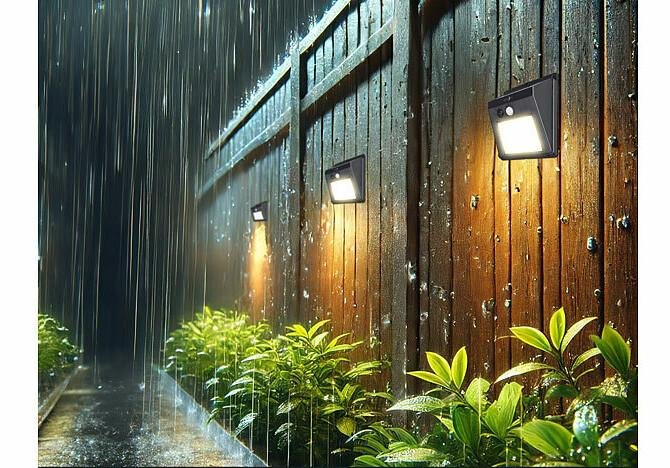
These picks are profiles. Match a light’s listing to the specs below. Each pick shows key specs, what to confirm, pros, cons and who should skip it.
1. Best Overall
- Key specs: IP65+, monocrystalline panel, replaceable battery, auto dusk-to-dawn sensor.
- Confirm: the panel type and a cloudy-day runtime claim.
- Pros: balanced for both problems and fits most gardens.
- Cons: costs more than basic lights.
- Skip if: you only want decorative glow on a covered porch.
2. Best for Heavy Rain
- Key specs: IP65 at minimum, IP67 where water pools, intact gasket, capped ports.
- Confirm: that the IP rating appears in the spec sheet, not just the title.
- Pros: the safest choice for storm-prone or low spots.
- Cons: a high water rating does not fix weak charging.
- Skip if: your spot stays dry and your main problem is shade.
3. Best for Low Sun and Overcast Days
- Key specs: monocrystalline panel, larger battery capacity, IP65+.
- Confirm: the battery capacity in mAh and the chemistry.
- Pros: more buffer through grey weeks.
- Cons: pricier, and a bigger battery still needs light to fill it.
- Skip if: the light sits in deep shade all day. Move it first.
4. Best Budget
- Key specs: IP44 to IP65, small NiMH battery.
- Confirm: that the battery is replaceable.
- Pros: cheap and easy to find.
- Cons: small NiMH cells in garden lights often need replacing every 1 to 2 years.
- Skip if: the spot needs dependable light through weeks of storms.
5. Best Solar String Lights for Rain
- Key specs: IP65+ on the panel unit and the string connectors.
- Confirm: that the rating covers the whole set, not just the bulbs.
- Pros: quick to hang and good for patios.
- Cons: more joints mean more places for water to enter. That is our reasoning.
- Skip if: you want maintenance-free lighting in a storm-heavy area.
6. Best Solar Floodlight / Motion Sensor
- Key specs: IP65+, a larger battery, a panel placed where it gets light.
- Confirm: how long the light stays on after each trigger.
- Pros: a motion sensor can save battery by lighting only when triggered. That is our reasoning, so verify the model’s behavior.
- Cons: busy entrances drain the battery faster.
- Skip if: you need constant light all night.
7. Best Solar Path Lights
- Key specs: IP65+, sturdy stakes, replaceable battery.
- Confirm: that the lower housing is sealed, since ground lights get splashed.
- Pros: easy to install and cheap to replace.
- Cons: low panels suffer from shade and mud splatter.
- Skip if: your path floods.
8. Best Hybrid (Solar + USB Charging)
- Key specs: IP65+, a capped USB port, replaceable battery.
- Confirm: that the port cap seals properly.
- Pros: you can top up the battery during long grey spells.
- Cons: it needs your attention, which defeats “set and forget”.
- Skip if: you will never plug anything in.
Do Solar Lights Work When It Rains or Is Cloudy?
Yes, but they charge more slowly. Solar lights run on daylight, not heat, so rain and cloud do not switch them off. They simply collect less energy. A light that lasts all night after a sunny day may fade early after a grey one. A bigger battery and an efficient panel help most.
Now the detail. If there is daylight, solar panels can generate power even while it rains. Cloudy-day output is lower than in clear skies.
How much lower? Guides disagree, and that is a clue in itself:
- One guide puts it at roughly 10 to 25 percent of normal output.
- Another gives a wider range, from 10 to 60 percent, depending on cloud density.
Treat any single number with suspicion. Cloud thickness, location and season all change the result.
One caution: those figures describe full-size panels. A garden light has a tiny panel and a small battery. In our view, a run of dark days hits it harder. That is reasoning, not lab data.
One small win for rain: rain reduces sunlight, but it can also help wash dust off panels. Rain is not your lights’ enemy. A thick grey week is.
Rain is only one part of the story, though. Frost and summer heat also shorten a light’s life. Our guide to solar lights for all weather shows how to keep lights running through every season.
Key Takeaways
- Solar lights charge in cloud and rain, just slower.
- No exact “cloudy-day percentage” is reliable.
- A string of dark days is the real stress test for small lights.
How to Get the Best Performance from Solar Lights in Rainy Season
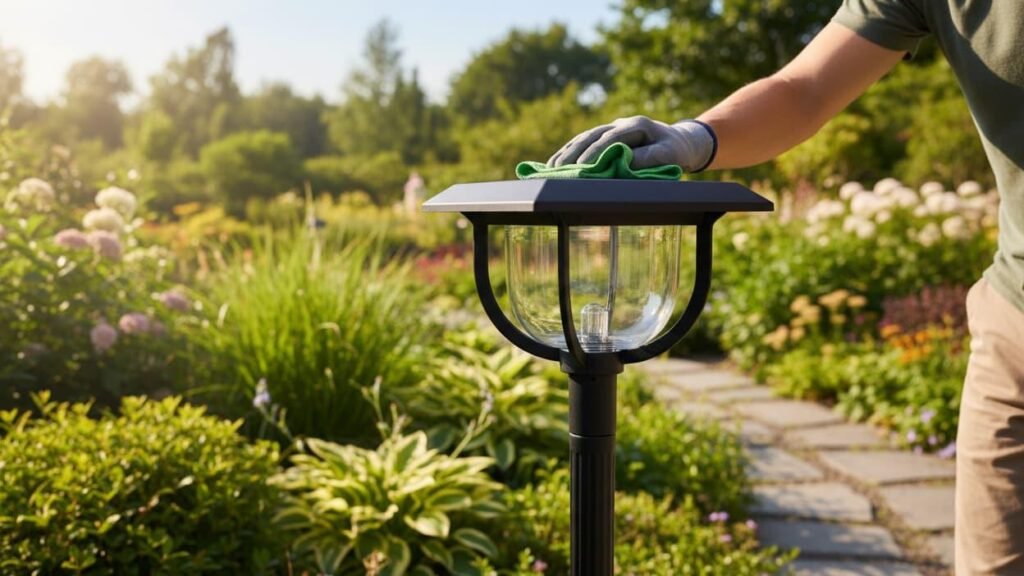
Placement costs nothing, so use it well.
- Face the sun’s path. Panels collect the most light when they point toward it: south in the northern hemisphere, north in the southern.
- Dodge shade. Walk the spot at different times of day before you commit. A fence or tree can steal the light you need.
- Give it sun when you can. One guide suggests 8 to 10 hours of direct sun daily for best charging. Rainy weeks will not deliver that, so pick the brightest spot you have.
- Charge new lights first. One manufacturer manual advises an initial 10 to 12 hours of full-sun charging, and 8 to 12 full charge-and-discharge cycles to reach maximum battery capacity.
- Keep the panel clean. The same manual says to wipe the panel with a damp cloth and keep debris and snow off it.
- Avoid other light sources. The manual also warns that a panel near other lights can cause problems.
- Before a big storm, check that every lid, cap and USB cover sits snug. Do not crush the gasket by overtightening. That is common-sense advice, not a tested rule.
Common Problems After Rain and How to Fix Them
Before you bin a light, run this check.
- Light will not turn on: check the on/off switch, because rain can shift it. Also look for moisture and corrosion in the battery compartment. Common causes include a dirty panel, poor sun, water inside, corroded terminals and a faulty switch.
- Flickering or switching on at odd times: water droplets or dew on the light sensor can scatter light and confuse it. Dry the light completely before testing again.
- Fog or condensation inside: moisture is getting in. Check the gasket. If the seal is cracked or missing, replacement is the honest answer.
- Corroded battery contacts: clean what you can, then swap the battery for the same type.
- Dies far too early: the battery may be worn, or it may not be getting enough light. Clean the panel first. If that fails, replace the battery.
When Solar Lights Aren’t the Right Choice
Be honest with yourself. If a spot needs reliable light every night, such as stairs, a gate or a security point, a long grey spell may leave it dark.
In that case, wired low-voltage lighting is the safer plan. A hybrid light with USB backup can also work if you will actually top it up. This is a judgment call, not a rule.
Solar still shines for decorative paths, borders and places where a dark night is an inconvenience, not a risk.
Which Solar Lights Suit Your Climate?
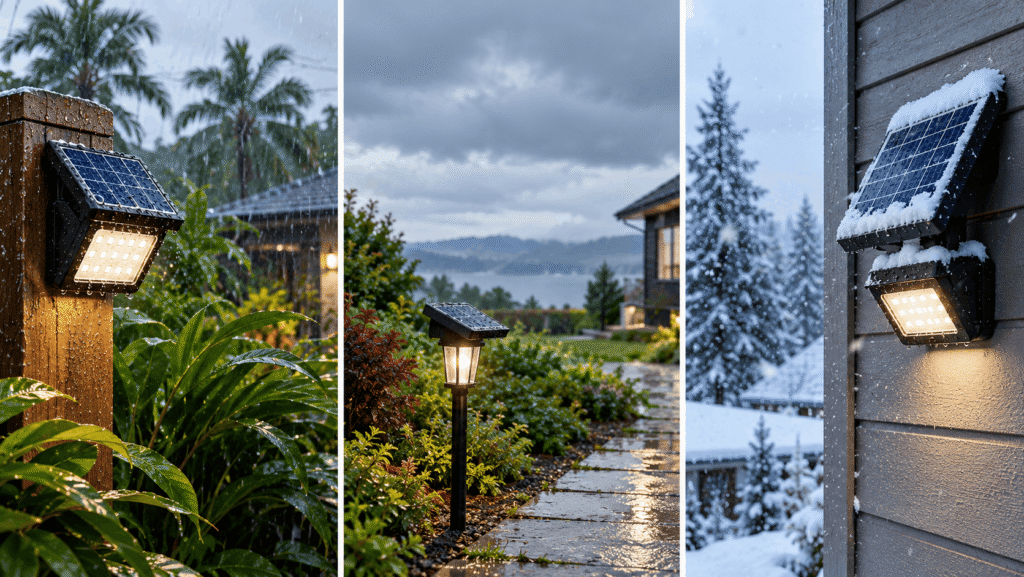
Monsoon and Tropical Climates
Heavy rain, humidity and heat arrive together. A regional rainy-season guide recommends IP65 as a minimum, monocrystalline panels and a bigger battery for overcast days. Heat matters too. A lamp baking in sun inside a dark housing can run hot.
Temperate Rainy Climates
You get frequent cloud and shorter days in the off-season. Prioritize a monocrystalline panel, a larger replaceable battery and a spot that catches every bit of light.
Cold and Wet Climates
Winter brings fewer daylight hours, a lower sun, snow on panels and cold that can cut battery performance. Check the battery’s charging temperature range. Brush snow off the panel. Expect shorter runtimes in deep winter.
FAQs
Can I leave solar lights outside all year?
Often yes, if the light has a suitable IP rating and a replaceable battery. In cold climates, check the battery’s charging range and clear snow off the panel.
Why did my solar lights stop working after rain?
Common causes are water inside, a dirty panel, corroded terminals, a worn battery or a shifted switch.
How long do solar lights last without sun?
It depends on battery size and brightness. One guide estimates 6 to 8 hours of soft light from a full 600 mAh NiMH charge. After a cloudy day, expect less.
Are solar lights waterproof or only water-resistant?
Not automatically waterproof. IP ratings describe tested protection levels, and IP67 does not guarantee jet-test performance. Read the digits, not the marketing word.
What IP rating do solar lights need for rain?
IP65 or higher is a sensible floor, based on how the test works. Choose IP67 where water pools.
Final Verdict: Which Should You Buy?
- Most gardens: choose Best Overall (IP65+, monocrystalline, replaceable battery).
- Storm-prone or puddle-prone spots: choose Best for Heavy Rain, with IP67 if water pools.
- Shady yards and grey skies: choose Best for Low Sun, with a larger battery.
- Tight budget: choose Best Budget, and plan to swap the battery in 1 to 2 years.
The best solar lights for rainy weather keep water out and keep enough charge through dull days. Check both before you buy.
Sources
- IEC 60529 ingress-protection explanations from testing laboratories (TÜV, Kiwa) and technical guides
- KNUST Brew Hammond Energy Centre study on low-light panel performance
- 2024 peer-reviewed assessment of monocrystalline, polycrystalline and amorphous panels
- Battery lifespan and replacement guides for solar garden lights
- A patent filing on low-temperature solar battery operation
- A manufacturer instruction manual for a solar garden light
- Solar-light repair and troubleshooting guides