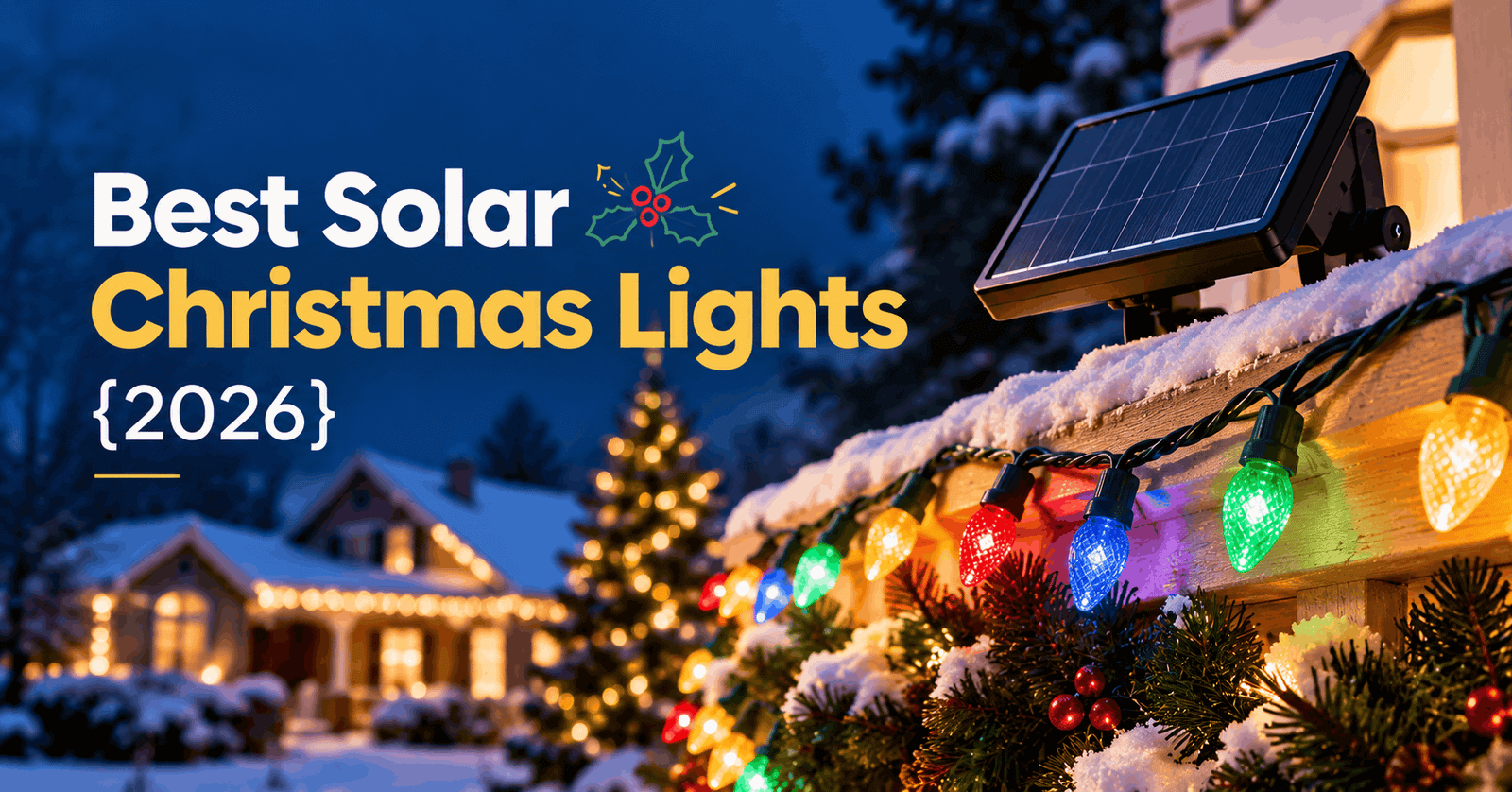
Quick answer: the best solar Christmas lights for you are the ones whose panel, battery and waterproof rating match your yard. A bigger LED count on the box won’t save a string stuck in the shade.
Table of Contents
Editor’s note: this guide explains how to choose. It does not rank individual brands, because no products were hands-on tested for it. Every figure below links to a source at the end.
What to Buy by Situation
Start with where the lights will hang. The shape decides most of the experience.
| Best for | Light type | What to check first |
|---|---|---|
| Trees, fences, railings | String or fairy lights | String length and distance from the panel to the first bulb |
| Rooflines and gutters | Icicle lights | Panel placement, since the roof edge may be shaded |
| Bushes and hedges | Net lights | Mesh size versus the plant you want to cover |
| Windows, decks, outlines | Rope lights | Flexibility and the IP rating |
| Walkways and driveways | Pathway stake lights | Stake strength and battery type |
| Walls and facades | Projector lights | Beam distance and sensor placement |
No single product wins everywhere. A tree string and a roofline set solve different problems.
How Do Solar Christmas Lights Work?
A small solar panel collects daylight. A rechargeable battery stores it. At dusk, a light sensor switches the LEDs on.
There is no plug and no extension cord. That is the main selling point.
The panel is the weak spot. It needs sun, and December gives you less of it.
Do Solar Christmas Lights Work in Winter?
Yes, but with less charge. Fewer daylight hours, a lower sun angle, snow on the panel and cold temperatures all reduce charging and battery performance, according to a battery supplier’s guidance for solar lights.
The same guidance notes that a small panel may not fully charge a very large battery on shorter fall and winter days. So a bigger battery isn’t automatically better.
Practical takeaways:
- Put the panel where it gets direct sun.
- Brush snow and leaves off it.
- Expect shorter runtime on cloudy days.
Solar lights are like houseplants. They will survive a dull week, but they won’t be at their best.
Are Solar Christmas Lights Worth It?
If you’re buying them to cut your electricity bill, probably not. Plug-in LEDs already cost very little to run.
The Canada Energy Regulator compared the two in a 2015 market snapshot. It found LEDs use about 85% less electricity than incandescent lights. In Quebec, $10 of electricity powered 161 LED strings, versus 19 incandescent ones. In New Brunswick, it was 100 versus 11. Prices have changed since 2015, but the gap between the technologies hasn’t reversed.
The logic is simple. If LED strings already cost pennies to run, solar can’t save you much more.
So the real reasons to go solar are different:
- No outlet near the tree, fence or bush.
- No cords across the lawn.
- Easy placement in places mains power can’t reach.
Buy solar for convenience. Don’t buy it for a savings spreadsheet.
How to Read a Product Listing
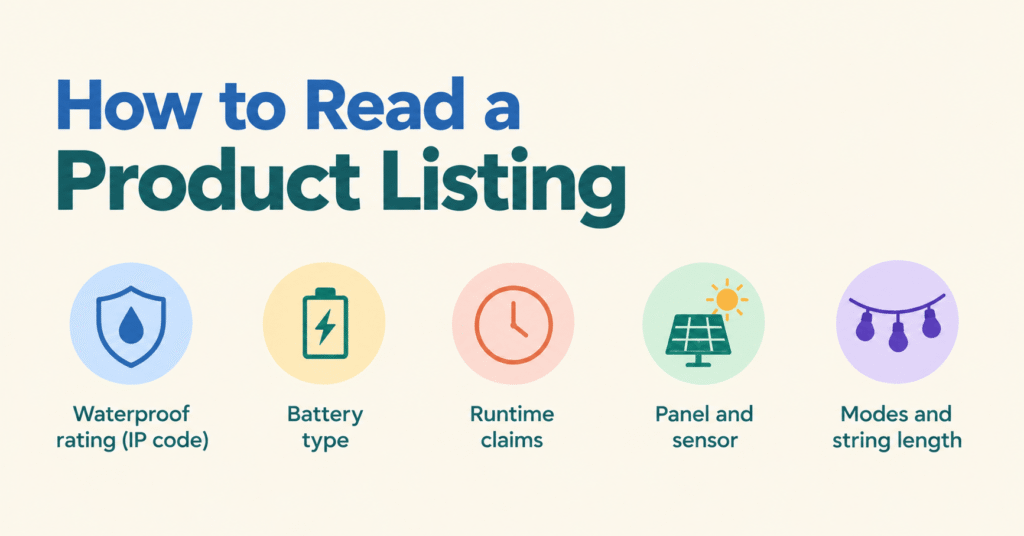
Listings love big numbers. Here are the ones that matter.
Waterproof rating (IP code)
The IP code comes from the international standard IEC 60529. It has two digits. The first covers solids and dust. The second covers water.
For example, in IP65 the 6 means dust-tight. The 5 means protection against low-pressure water jets from any direction. In IP44, the second 4 means protection against splashing water from all directions, with limited ingress allowed.
A listing that says only “waterproof” with no IP code tells you very little. Look for the code.
Battery type
Most small solar lights use rechargeable AA or AAA NiMH batteries. One supplier says basic NiMH cells in small solar lights often last about one to two years. Plan for a replacement, and check that the battery is removable.
Runtime claims
Runtime depends on charge, weather and battery condition. Claims vary a lot between sellers. Treat any “up to X hours” figure as a best case, not a promise.
Panel and sensor
A larger panel can recharge faster in weak light. The auto on/off sensor matters too. A manufacturer manual for a solar light warns that a panel installed near other light sources may keep the lights from turning on in the evening.
Modes and string length
Eight lighting modes sound exciting. You will probably use one. Measure your tree or roofline first, then match the string length.
Placement and Setup
Follow these steps for a better first night:
- Check the panel position. Direct sun beats “mostly bright”.
- Charge before use. One manufacturer manual recommends 10 to 12 hours of full-sun charging for the first charge.
- Keep the panel away from porch lights and street lamps.
- Keep snow and debris off the panel.
- Use a remote panel (if the set has one) to separate the lights from the sun spot.
A remote panel lets the lights sit in a shaded tree while the panel catches sun elsewhere.
Safety Basics
Solar lights skip the extension cord, which removes one common hazard. They are not a free pass, though. The National Fire Protection Association (NFPA) says U.S. fire departments responded to an average of 835 home-structure fires per year that began with holiday decorations, not counting Christmas trees. Those fires caused about $14 million in direct property damage, as reported by a utility company citing NFPA.
NFPA’s guidance for lights is worth following:
- Check whether a set is rated for indoor use, outdoor use, or both.
- Use clips, not nails, to hang lights.
- Read the manufacturer’s instructions on how many strands can connect.
- Bring outdoor lights inside after the holidays.
Your solar set is battery powered, so the strand-connection limit applies to any plug-in sets sharing the display.
Making Them Last More Than One Season
A few habits go a long way:
- Remove the batteries before long-term storage, as battery guidance for solar lights advises.
- Store the set dry and untangled.
- Wipe the panel with a damp cloth before the next season.
- Replace the battery when runtime drops. Many small solar lights use standard NiMH cells.
Check the warranty too. One manufacturer manual we reviewed listed two years for defects in materials or workmanship. Warranty terms vary by product.
Who Should Skip Solar Christmas Lights?
Solar may disappoint you if:
- Your yard is mostly shade in December.
- Your region has long stretches of cloud or heavy snow.
- You want a bright, dense, all-night display.
In those cases, plug-in LED lights are the more dependable pick. They cost little to run, as the Canadian data shows.
A hybrid works well: plug-in LEDs for the main display, solar for the far corners.
FAQs
Why won’t my solar Christmas lights turn on?
Common causes include a poorly charged battery, a worn battery, or a panel placed near another light source. Snow cover on the panel can also stop charging.
Do I need to charge them before use?
Usually yes. One manufacturer manual recommends 10 to 12 hours of full-sun charging at the start. Check your own product’s manual.
Can solar Christmas lights stay outside all season?
Only if the product is rated for outdoor use. Look for an IP code and read the manufacturer’s instructions.
How long do solar Christmas lights stay on?
It depends on the battery, the panel and the day’s weather. Treat seller claims as best-case figures.
Do solar Christmas lights work on cloudy days?
Yes, they charge, but less efficiently. Expect a shorter runtime after a dull day.
Glossary
Solar panel: the small photovoltaic cell that turns daylight into electricity.
NiMH (nickel-metal hydride): a common rechargeable battery type in small solar lights.
mAh (milliamp-hour): a battery capacity rating. A higher number holds more charge, but the panel must be able to fill it.
IP rating: a two-digit code from IEC 60529. The first digit is solids and dust. The second is water.
Dusk-to-dawn sensor: a light sensor that switches the LEDs on in the evening and off in the morning.
Remote panel: a panel on a separate cable, so you can place it in sun while the lights hang in shade.
Sources
- Canada Energy Regulator, “Market Snapshot: LED Christmas lights are cost and energy saving compared to incandescent” (2015): https://cer-rec.gc.ca/en/data-analysis/energy-markets/market-snapshots/2015/market-snapshot-led-christmas-lights-are-cost-energy-saving-compared-incandescent.html
- National Fire Protection Association, holiday decorating safety facts: https://newportbeachca.gov/home/showpublisheddocument/75762/638681448059300000
- FirstEnergy Corp., “Deck the Halls Safely” (citing NFPA’s 835 fires per year figure): https://newsletter.rismedia.com/tracking/view/33369/null/%7BSubscriberID%7D/124597
- IEC 60529 IP Code, testing overview, Kiwa: https://www.kiwa.com/en/de/services/testing/ip-xx-testing-solid-objects-and-dust-intrusion-up-to-ip-6x/
- IP rating digit definitions, Clarion UK: https://clarionuk.com/?p=6714
- IP rating water-protection index, CableOrganizer: https://www.cableorganizer.com/articles/ip-ratings.php
- Battery guidance for solar lights (winter effects, NiMH lifespan), Vatrer Power: https://www.vatrerpower.com/en-ca/blogs/news/what-batteries-do-i-use-in-my-solar-lights
- Solar light manufacturer manual (initial charge, snow and light-source tips, warranty): https://images.thdstatic.com/catalog/pdfImages/d9/d9409729-13f9-4766-a67e-69174e22acd0.pdf