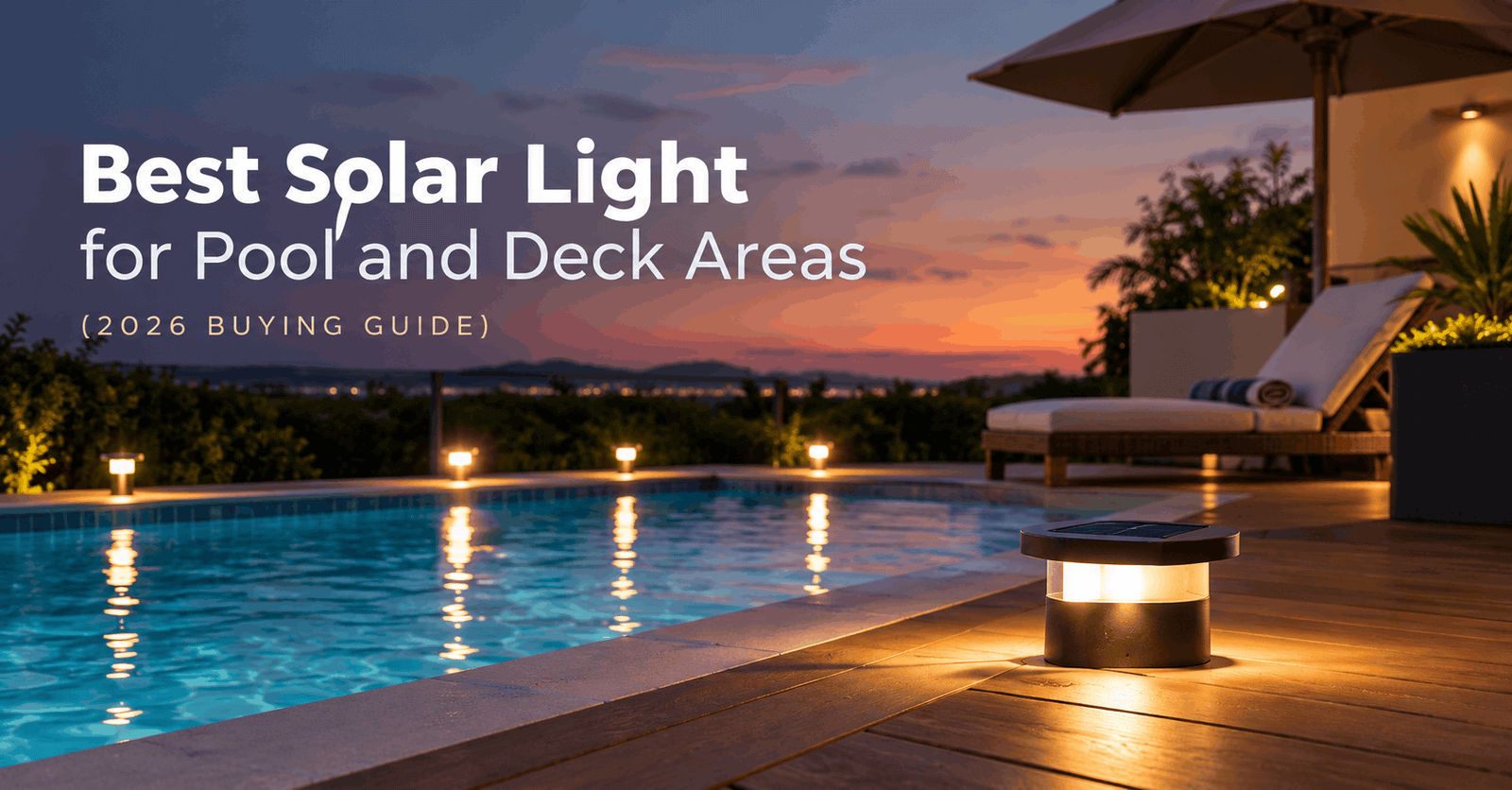
Quick Answer: The best solar light for pool and deck areas are IP68-rated floating lights for the water and IP65-or-higher step, rail, and post-cap lights for the deck, placed where the solar panel gets direct sun.
Table of Contents
You want light around the pool and deck. You don’t want an electrician, a trench, or a cable snaking toward the water. Solar fixes all three problems, with one catch: cheap units die fast, and water is brutal on them.
This guide is research-based. We didn’t run hands-on tests, so we won’t pretend we did. We compared published standards, safety agencies, and independent roundups instead.
Which Solar Light Fits Your Space?
| Best For | Light Type | Minimum to Look For |
|---|---|---|
| In the pool | Floating lights | IP68 |
| Pool edge and coping | Perimeter or stake lights | IP65 or higher |
| Deck steps | Step lights | IP65 or higher |
| Deck rails | Rail or rope lights | IP65 or higher |
| Deck posts | Post cap lights | IP65 or higher |
| Ambiance over seating | String lights | Weather-rated, shatter-resistant |
Not sure where to start? Start with the IP rating. It decides whether a light lives or dies near water.
What an IP Rating Actually Means
The IP code comes from the international standard IEC 60529. It grades protection against solid objects and dust (first digit) and water (second digit).
For water, here is the short version:
- IP65: resists water jets, such as a hose.
- IP67: survives temporary immersion up to 1 metre for 30 minutes.
- IP68: covers continuous immersion, under conditions the manufacturer defines.
That last point matters. The manufacturer decides the extra conditions behind an IP68 claim, so two IP68 lights can differ. Treat the rating as a floor, not a guarantee.
Best Solar Lights for the Pool
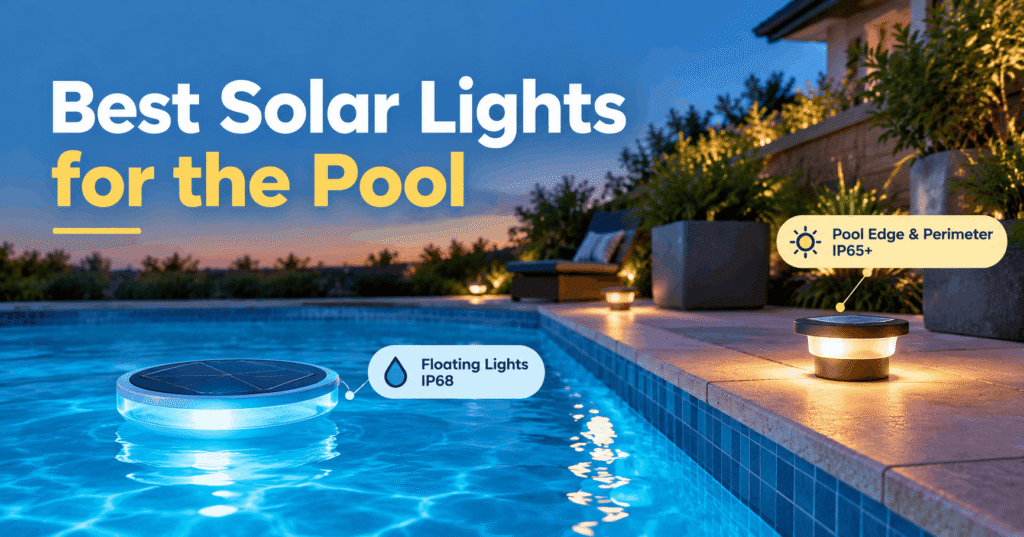
Floating Lights
Floating lights sit on the surface and need no installation. Choose IP68, because they live in the water all night.
Chlorine is a strong oxidizer, so cheap plastic can yellow or crack over a season. If you close your pool for winter, take the lights out and store them dry.
Pool Edge and Perimeter
Lights on the coping or deck edge only splash and drip. IP65 is a sensible minimum here. Pick stake or surface-mount designs that sit away from foot traffic, so nobody trips at 11 p.m.
A Note on Brands
We found no trustworthy independent pool-light roundup to base named picks on. Most pool-specific “best of” lists we saw were thin affiliate pages. So we won’t invent a winner. Use the checklist below and read current listings.
Best Solar Lights for Deck Areas
Independent publisher roundups sort deck lights into the same groups: step lights, post caps, rail lights, string lights, and lanterns. One major roundup, for example, splits its picks into overall, value, post cap, rail, motion-sensing, string, and lantern categories.
Models that appeared across those roundups include:
- Step lights: JACKYLED, Siedinlar
- Post caps: Siedinlar, VOLISUN
- Rail lights: Brightown rope lights
- String lights: Brightech Ambience Pro
- Lanterns: TomCare
One caution from the same research: reviewers admit solar deck lights are hard to review because weather varies so much. Another editor warns that solar lights are often flimsy. Check the current listing for specs and recent reviews before you buy.
Are Solar Lights Safer Around Pools?
Water and mains electricity are a bad mix. The U.S. Consumer Product Safety Commission has warned that electrical hazards around pools can cause deaths and injuries, and urges GFCI protection for pool lights, receptacles, and switches. Extension cords, outlets, and underwater lights are all places where electricity shows up near pools.
Self-contained solar lights skip the outlet and the cord. That removes one risk, but it doesn’t make wiring advice go away. The CPSC also advises a qualified electrician to inspect any existing pool electrical system.
Note that the CPSC release we used dates from 2003. The core advice still stands, but check your local code.
Do Solar Lights Work on Cloudy Days?
Yes, with limits. A lighting-industry article says solar collection is poor on cloudy days, so the battery may have to carry the system for days. The same article notes that larger panels and batteries improve the odds.
One editor found a string light still turned on under overcast skies, but performed best after hours of full sun.
Practical takeaway: place the panel where it gets direct sun. A shaded deck corner is a poor home for a solar panel, no matter how pretty the light is.
How to Choose: Five Specs That Matter
- IP rating: IP68 in the water, IP65+ near it.
- Panel placement: Can the panel face the sun even if the light sits in shade?
- Battery: Check whether it is replaceable. A dead sealed battery means a dead light.
- Brightness mode: Step lights need enough light to show edges. Pool ambiance needs far less. Glare is annoying, not “extra safe.”
- Warm vs. cool white: Warm white feels calmer around seating. Cool white suits stairs.
How Many Lights Do You Need?
We found no reliable published standard for this, so here is simple logic rather than a “rule.” Light every step edge, and space rail or post lights so each pool of light touches the next. Add one, stand back at dusk, and judge it by eye.
Common Mistakes
- Buying on IP rating alone, without checking panel placement
- Putting string lights over the water without checking safety
- Leaving floating lights in a closed pool all winter
- Never wiping the panel (dust steals charge)
FAQs
Can solar lights go in a pool?
Yes, if they are rated for it. Look for IP68 floating or submersible models.
Will chlorine damage them?
It can wear cheap plastic over time. Rinse lights occasionally and store them dry off-season.
Do they last all night?
It depends on the battery, the panel, and how much sun the day gave. Check the listing for runtime, and treat it as a best case.
Is IP67 enough for a pool?
For edge or deck use, usually. For lights that stay in the water, IP68 is the safer choice.
Summary
Match the light to the zone. Use IP68 floating lights in the water, IP65+ lights on steps and rails, and keep panels in the sun. Spend a little more on a sealed, well-reviewed unit instead of replacing a cheap one every summer.
Sources
- IEC 60529 IP code explainer: e-switch.com/blog/all-about-ip-ratings-ingress-protection
- IP68 manufacturer-defined conditions: controleng.com/understanding-proximity-sensor-ip-ratings
- CPSC and American Red Cross pool electrocution warning: cpsc.gov/Newsroom/News-Releases/2003/Dont-Swim-With-Shocks-CPSC-American-Red-Cross-Warn-of-Electrocutions-in-Swimming-Pools-Hot-Tubs-and-Spas
- Illinois Extension pool electrical safety: extension.illinois.edu/news-releases/summer-upon-us-your-swimming-pool-safe
- Solar outdoor lighting design: architectmagazine.com/technology/lighting/solar-powered-outdoor-lighting_o