Last updated on October 24th, 2026 at 04:53 am
Quick Answer: Do solar lights help plants grow? Ordinary solar garden lights don’t. They’re too dim and built for looks, not photosynthesis. For real growth, you need a solar-powered grow light with a published PPFD spec, a battery and panel sized to match, and a timer for 12 to 16 hours of light a day with 8 to 10 hours of darkness.
Table of Contents
Myth: that little solar stake light next to your tomatoes helps them grow.
Reality: it’s a nightlight for your tomatoes. They won’t complain, but they won’t grow faster either.
This guide shows you which solar lights for plants do real work, which ones just look pretty, and how to tell them apart before you spend money.
Key Takeaways
- Regular solar garden lights are made for looks and safety, not plant growth.
- The low intensity of most garden solar lamps does little for growth, and a greenhouse needs real grow lights instead.
- Solar-powered grow lights do exist, but you need to check plant-light specs (PPFD), not lumens.
- Size the solar panel and battery with simple math before you buy.
Which solar light is best for what?
| Best for | What to pick |
|---|---|
| Growing seedlings or vegetables with no mains power | Solar panel + battery + full-spectrum LED grow light (check the PPFD spec) |
| Greenhouse or shed top-up light | Larger solar grow light system with a separate panel, sized by watt-hours |
| Balcony or windowsill plants | Compact solar grow light with its own small panel |
| Lighting garden borders | Firefly garden solar light |
| Spike or bollard lighting | 4lite Antheia solar spike light |
| Highlighting a tree or feature plant | T-Sun solar spotlight |
| Marking beds on a budget | Solar fluted marker lights (10-pack) |
The four garden-light picks come from BBC Gardeners’ World Magazine’s tested Best Buy list, which from 2026 only awards new badges to solar lights scoring 4.5 out of 5 or higher. Those are UK tests, so check that each product is sold where you live.
I left named solar grow light brands out on purpose. I found seller listings and affiliate roundups, but no independent test I would trust. More on how to shop for them below.
Do solar lights help plants grow?
Short answer: ordinary ones don’t.
A decorative solar light has a tiny panel, a tiny battery, and a dim LED. Its job is to help you see your path, not to feed your basil.
Horticulturist comments in Homes & Gardens back this up. Garden solar lamps usually don’t give plants enough light to matter, and plants that need lots of light, like vegetables, still need an LED grow light.
Some online guides still claim otherwise. One gardening blog says outdoor solar lights can increase the growth of your plants, but it offers no evidence. Don’t trust a claim with no numbers behind it.
Plants do need strong light. Outdoor plants average roughly 6 to 8 hours of sunlight a day, and under weaker grow lights they need about 14 to 16 hours to get the same light quantity. A garden stake light can’t come close to that.
Why lumens can’t tell you if a light will grow plants
Here’s the trap. Most light products advertise lumens.
Lumens measure brightness for human eyes. Plants use a different slice of light. Most of the light plants use for photosynthesis falls between 400 and 700 nanometers, and PPFD is the best metric for judging a grow light’s usefulness.
PPFD measures the light your plants actually receive, which makes it a much better yardstick than lumens. A light can look bright to you and still give your plants very little.
So when you shop, look for PPFD or PPF in the specs. If a seller only lists lumens, ask for more data or walk away.
Key Takeaways
- Lumens measure what your eyes see. PPFD measures what plants can use.
- No PPFD or PPF number on a “grow light”? Treat the claim with suspicion.
The three kinds of solar plant lighting
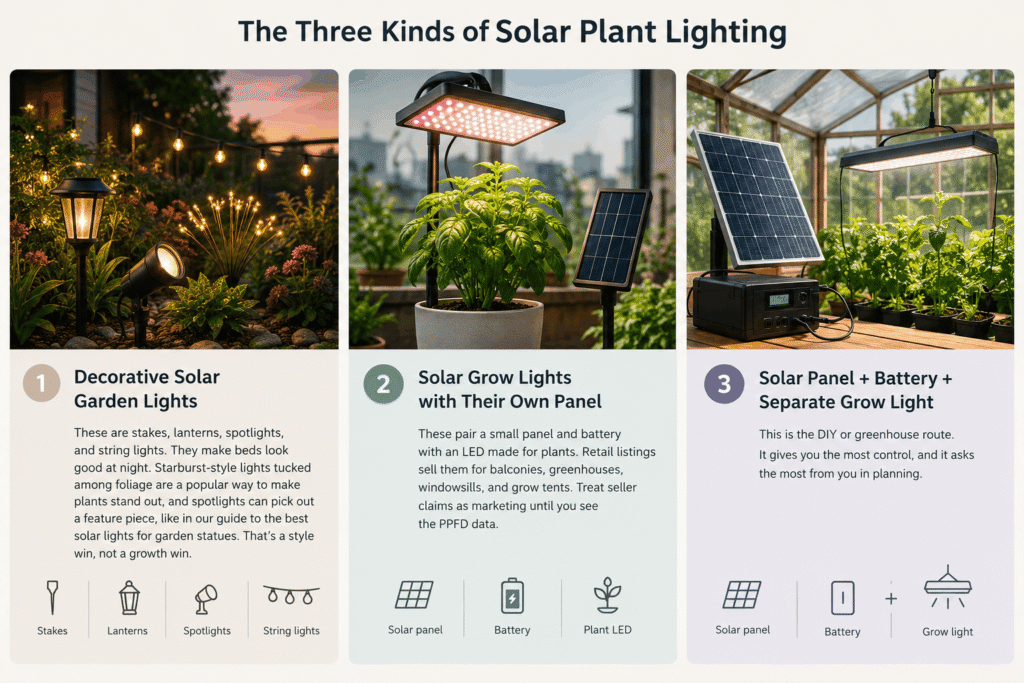
Decorative solar garden lights. These are stakes, lanterns, spotlights, and string lights. They make beds look good at night. Starburst-style lights tucked among foliage are a popular way to make plants stand out, and spotlights can pick out a feature piece, like in our guide to the best solar lights for garden statues. That’s a style win, not a growth win.
Solar grow lights with their own panel. These pair a small panel and battery with an LED made for plants. Retail listings sell them for balconies, greenhouses, windowsills, and grow tents. Treat seller claims as marketing until you see the PPFD data.
Solar panel + battery + separate grow light. This is the DIY or greenhouse route. It gives you the most control, and it asks the most from you in planning.
How to choose a solar grow light
Keep it practical. Check these in order:
- PPFD or PPF. This tells you whether the light is any good for plants.
- Battery capacity. The light must run through its full “day” on stored power.
- Panel size. It has to refill that battery in your local sunshine.
- Weatherproofing. Only matters if the panel or light sits outside.
- A timer or controller. Plants need a dark period, so you want lights that switch off.
The simple math for sizing solar power
You don’t need an engineering degree. You need one multiplication.
Watts × hours = watt-hours. That’s the energy your light uses each day.
Here’s an example, not a product spec. A 50-watt grow light running 14 hours uses 700 watt-hours a day. Your battery and panel must cover at least that, plus losses.
Add a safety margin. Winter and cloudy spells shrink your solar harvest. One off-grid greenhouse guide says winter planning means oversizing the panel array, adding battery capacity, or having a backup charging option for cloudy weeks.
Panel too small for the light? Your plants get short “days.” Battery too small? The light dies at midnight. Both mistakes cost money and growth.
How long to run the light and how close to hang it
Extension advice is clear. For most vegetables and annual flowers, 12 to 16 hours of LED light a day is ideal, and a timer set for 14 to 16 hours works well, with 8 to 10 hours of darkness.
Don’t run grow lights 24 hours a day. Plants need their night.
Distance matters too. Keeping lamps close to the seedlings and raising them as the plants grow gets the most out of a fixture. The same lamp can need roughly half the run time up close compared with farther away, according to University of New Hampshire extension guidance.
Can solar garden lights hurt your plants?
Usually not, but placement matters.
Horticulturists quoted in Homes & Gardens say it’s rare for solar lights to damage plants, but bright ones can interfere with a plant’s day-night timing. Their advice is to choose soft, golden lights over bright ones.
Bigger studies on artificial light at night show why this matters. Plants use the natural cycle of light and dark as a seasonal cue, and artificial night light disturbs that signal. One field experiment on two urban plants found that continuous night lighting significantly inhibited photosynthesis and respiration, with the effect depending on light intensity and plant species.
Those studies cover brighter lighting than a typical garden stake light. Still, the sensible takeaway is simple: use soft, low lights, and keep them away from plants that need real darkness.
Mistakes that waste money
- Buying a decorative light and expecting growth. It won’t happen.
- Trusting lumens. Check PPFD instead.
- Skipping the dark period. Plants need rest, so use a timer.
- Undersizing the battery. Do the watt-hour math first.
- Ignoring winter. Your summer setup may fail in December.
FAQs
Do solar lights help plants grow?
Ordinary solar garden lights don’t. They’re too dim. Solar-powered grow lights with proper plant-spectrum LEDs can help, if the panel and battery are sized right.
Can I use solar path lights as grow lights?
No. Path lights are built for visibility. Their low intensity doesn’t help growth much.
How many hours should a grow light run?
For most vegetables and annual flowers, extension guidance suggests 12 to 16 hours a day, with a consistent schedule and 8 to 10 hours of darkness.
Are solar lights bad for plants at night?
Typically no, but soft, low lights are safer. Bright lights can disturb the day-night cycle that plants rely on.
Summary
Want your garden to look good after dark? Pick a tested decorative light, like the Firefly border light or the T-Sun spotlight, and keep it soft and low.
Want your plants to actually grow? Skip the decorative stuff. Buy a grow light with a published PPFD spec, size your panel and battery with the watt-hour math, and put it on a timer.
Do both, and your garden gets looks and growth. Just don’t ask the stake light to do the grow light’s job.
How this guide was built
I did not hands-on test any product in this article. The garden-light picks come from Gardeners’ World’s published tests. The plant-light advice comes from university extension and peer-reviewed or institutional sources. Where I couldn’t find an independent test, I said so.
Sources
- BBC Gardeners’ World Magazine, best solar lights: https://www.gardenersworld.com/reviews/best-solar-lights
- Homes & Gardens, are solar lights bad for plants: https://www.homesandgardens.com/gardens/are-solar-lights-bad-for-plants
- Ask Extension, LED light schedule for seedlings: https://ask.extension.org/kb/faq.php?id=918872
- University of New Hampshire Cooperative Extension, growing seedlings under lights: https://uvm.edu/sites/default/files/Extension-Master-Gardener/Growing_Seedlings_Under_lights.pdf
- KidsGardening, Plant Needs Light: https://kidsgardening.org/wp-content/uploads/2020/11/Plant-Needs-Light.pdf
- Michigan State University Extension, lighting metrics (Runkle): https://www.canr.msu.edu/uploads/resources/pdfs/lighting-metrics.pdf
- LED Supply, grow light metrics: https://www.ledsupply.com/blog/breaking-down-the-important-led-grow-light-metrics/
- Volt Lighting, measuring LED grow light output: https://www.voltlighting.com/grow/measuring-light-output-led-grow-lights
- PNAS Nexus, artificial light at night and plant phenology: https://pmc.ncbi.nlm.nih.gov/articles/PMC9802268/
- Wei et al. (2024), artificial light at night and plant photosynthesis: https://agris.fao.org/search/es/records/687a8f8a464818917f3337e5
- Backup Power Hub, off-grid greenhouse solar: https://backuppowerhub.com/solar-power-for-greenhouses-off-grid/