Table of Contents
A 10,000 watt (10kW) solar system produces roughly 30–45 kWh of electricity per day and 11,000–17,500 kWh per year under normal conditions, according to residential solar data from Anker SOLIX and EnergySage. That’s enough to cover a mid-size home’s entire electricity use, run central air conditioning, charge an EV, and keep every major appliance running without much drama.
But “10,000 watts” is a rating, not a promise. Your actual output depends on where you live, how your roof faces the sun, and the weather that day. A system in Phoenix and the same system in Seattle won’t produce anywhere near the same amount of power. We’ll break down exactly why below, then walk through what a 10kW system can realistically run in your home.
10,000 Watt Panel vs. 10,000 Watt System, What’s the Difference?

People use “10,000 watt solar panel” and “10,000 watt solar system” interchangeably. They’re not the same thing, and mixing them up leads to bad expectations.
A single solar panel doesn’t produce 10,000 watts. Modern residential panels top out around 400–450 watts each (EcoWatch, EnergySage). “10,000 watts” almost always refers to the combined output of an entire array, a system made up of many panels wired together.
What “10,000 Watts” Actually Measures
The 10kW figure is the system’s rated capacity under lab conditions, not a guaranteed real-world output. More on that in the next section.
How Many Panels Make Up a 10kW System
Based on today’s panel wattages, a 10kW system typically needs about 22 to 27 panels (Anker SOLIX, Helios Energy). Older or cheaper panels rated at 340W push that number closer to 30 (EcoWatch).
How Much Power Does a 10,000 Watt Solar Panel Actually Produce?
Standard Test Conditions vs. Real-World Output
Solar panels get their wattage rating under Standard Test Conditions (STC): a cell temperature of 25°C and sunlight intensity of 1,000 watts per square meter, lab conditions your roof will rarely match exactly (Sunsave, GreenWatt). Real installations typically produce 75–85% of their rated capacity once you account for temperature, panel angle, dust, and system losses (SolarTech Energy Systems).
In plain terms: your “10,000 watt” system behaves more like a 7,700–8,500 watt system most of the time. That’s normal, not a defect.
Daily and Monthly Output in kWh
Here’s what that translates to in practice:
| Metric | Typical Range | Source |
|---|---|---|
| Daily output | 30–45 kWh | Anker SOLIX |
| Monthly output | 900–1,350 kWh | Anker SOLIX |
| Annual output | 11,000–17,500 kWh | Anker SOLIX |
| Marketplace average (US) | ~14,517 kWh/year | EnergySage, 2026 |
Why Location Changes Your Output by Up to 70%
The single biggest variable is peak sun hours (PSH), the number of hours per day your roof receives sunlight intense enough to count as “full production” (1,000 W/m²). The U.S. national average is about 5.0 peak sun hours per day, based on NREL’s PVWatts data (Unbound Solar).
That number swings hard by region:
| Region | Peak Sun Hours/Day | Rough Annual Output (10kW system) |
|---|---|---|
| Southwest US (Arizona, Nevada, Southern California) | 6.0–7.5 | ~17,000–21,000 kWh |
| National US average | ~5.0 | ~14,000–14,500 kWh |
| Pacific Northwest / cooler climates | 3.5–4.5 | ~9,800–12,600 kWh |
| UK average (national irradiance) | — | ~8,500 kWh (Sunsave) |
If you’re outside the US, don’t panic, the math still works. Just swap in your region’s peak sun hours, which NREL’s PVWatts calculator (US) or the Global Solar Atlas (worldwide) can give you for free.
How Many Watts Does a House Actually Use?
This is where “will 10,000 watts run my house” gets a real answer instead of a shrug.
Average Household Electricity Use (US)
The U.S. Energy Information Administration puts the average American home at 10,791 kWh per year, or about 899 kWh per month (EIA official data, 2022–2025 range). A 10kW system’s typical annual output of 11,000–17,500 kWh comfortably clears that bar in most regions.
Average Household Electricity Use (UK and Beyond)
Here’s a genuinely surprising contrast for anyone reading this outside the US: Ofgem, the UK’s energy regulator, puts the average UK household at just 2,500 kWh of electricity per year as of mid-2026 (Ofgem via OVO Energy, Fuse Energy). That’s less than a quarter of the US average.
Why the huge gap? Most UK homes heat with gas boilers, not electricity, while a large share of US homes use electric heating, electric water heaters, and central air conditioning, all heavy electricity draws. So a 10kW system that’s “about right” for a US home would massively over-deliver for a typical UK one, unless that UK home is switching to electric heating or an EV.
The Bottom Line
For a typical mid-size home, a 10kW system covers daily use comfortably in most sunny-to-average regions. For large homes running central AC, electric heat, and EV charging together, 10kW gets tight, you’ll want the appliance math below before assuming it’s enough.
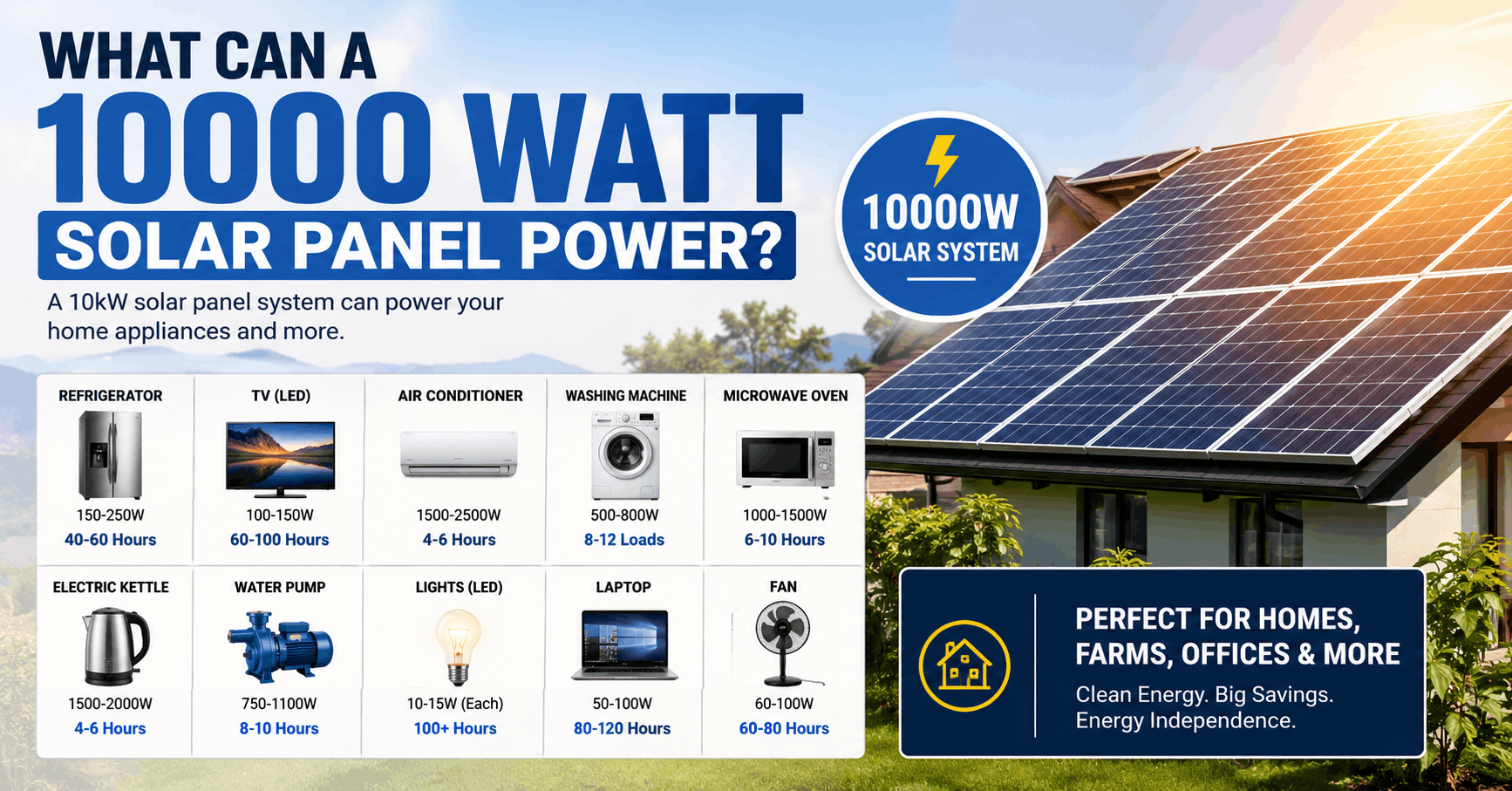
What Can a 10,000 Watt Solar Panel Power? (Appliance-by-Appliance Breakdown)

Wattage tells you the instantaneous draw. Multiply by hours of use and divide by 1,000 to get kWh, that’s the real currency your solar system deals in (DOE Energy Saver method).
Essentials
- Refrigerator: 1–2 kWh/day (WattBunker; nameplate is often ~700W, but the compressor only runs part of the time)
- WiFi, router, phone and laptop charging: roughly 0.3–0.5 kWh/day combined
- LED lighting (whole home): a small fraction of a kWh/day if you’re on LEDs
These barely dent a 10kW system’s daily output.
Heavy Appliances
- Central air conditioning (3-ton unit): draws about 3,000–4,000 watts while running (WattBunker, EnergySage-linked calculators). Running it 8 hours a day can use 24–32 kWh, a serious chunk of your daily production.
- Electric water heater: 4,500–5,500 watts, running 2–4 hours a day for 9–22 kWh (U.S. DOE; WattBunker). This is often the single largest load in an all-electric home.
- Electric clothes dryer: 2,790–5,000 watts per cycle, about 2–4 kWh per load (WattBunker)
Big-Ticket Loads
- EV Level 2 home charger: about 7,200 watts (U.S. Department of Energy, Office of Energy Efficiency). A full overnight charge can use a large share of a day’s solar production, depending on battery size.
- Electric furnace: around 10,000 watts, and up to 20,000 watts in cold climates (U.S. DOE). This alone can rival your entire system’s rated output, it’s why all-electric heating in cold regions usually needs more than 10kW, or a heat pump instead.
- Pool pump: varies widely; single-speed pumps draw far more than ENERGY STAR variable-speed models, which use up to 65% less power (OC Solar).
Can You Run All of This at Once?
Not entirely, and that’s fine, nobody runs a water heater, AC, dryer, and EV charger simultaneously all day. The real question is whether your system’s daily total output (30–45 kWh) covers your household’s daily total usage, which is what the next section digs into with real examples.
| Appliance | Typical Wattage | Typical Daily Use | Feasible on 10kW? |
|---|---|---|---|
| Refrigerator | 700W (intermittent) | 1–2 kWh | Yes, easily |
| LED lighting | Varies | <1 kWh | Yes, easily |
| WiFi + electronics | Varies | 0.3–0.5 kWh | Yes, easily |
| Central AC (3-ton) | 3,000–4,000W | 24–32 kWh (8 hrs) | With caveats — dominates daily output |
| Electric water heater | 4,500–5,500W | 9–22 kWh | With caveats |
| Clothes dryer | 2,790–5,000W | 2–4 kWh/load | Yes |
| EV Level 2 charger | ~7,200W | Varies by battery | With caveats — depends on charge frequency |
| Electric furnace | ~10,000W (up to 20,000W cold climates) | Very high | Usually no — exceeds system capacity alone |
Will a 10,000 Watt Solar System Run an Entire House?
Grid-Tied vs. Off-Grid
This is the single biggest factor in the answer, and most articles skip past it.
A grid-tied 10kW system doesn’t need to cover every watt every second. It draws on the grid during shortfalls (nighttime, cloudy stretches) and can export excess back to it. For a grid-tied home, “will it run my house” really means “will it offset most or all of my annual usage”, and per the EIA numbers above, the answer is usually yes.
Can a 10kW Solar System Run an Entire House Off-Grid?
Off-grid is a different, harder question. Here, the panels have to cover everything, with no grid backup for cloudy days or nighttime. That means:
- Battery storage becomes mandatory, not optional, sized to cover at least one to two days of your household’s usage.
- Climate matters enormously. A cloudy week in a low-PSH region can leave an off-grid system struggling, even with batteries.
- Panel orientation and tilt need to be close to optimal, since there’s no grid safety net to compensate for a shaded or poorly angled roof.
Realistically, most homeowners going fully off-grid on 10kW pair it with a battery bank sized well beyond a single day’s storage and design their usage around sunny-day surplus.
When 10kW Is Not Enough
Large homes (over ~3,000 sq ft) with central AC, electric heating, and EV charging running together often need more than 10kW, home-size alone can push electricity use up 50–70% compared to a smaller home (Electric Choice). If that’s your situation, 10kW is a solid starting point, not necessarily the finish line.
Real-World Examples: What 10kW Powers in Practice
Family of 4 in a Mid-Size Home (Grid-Tied)
A 4-person household typically uses about 30% more electricity than a 1-person household (Electric Choice). Against the EIA’s national average of ~899 kWh/month, that’s a reasonable, grid-tied fit for a 10kW system producing 900–1,350 kWh/month, comfortable in average-to-sunny regions, tighter in low-PSH ones.
Off-Grid Cabin or Workshop
Smaller loads (lighting, a mini-fridge, power tools, maybe a well pump) sit well within a 10kW system’s daily output, even with the STC-to-real-world derate factored in. This is the scenario where 10kW tends to feel oversized rather than tight.
Home With an EV and Central AC
This is where the math gets real. Central AC alone can eat 24–32 kWh on a hot day; an EV charge adds more on top. In a high-PSH region (Southwest US), a 10kW system’s 46–58 kWh/day output can absorb this. In a lower-PSH region, expect the grid to fill meaningful gaps on heavy-use days.
How Much Does a 10,000 Watt Solar System Cost?
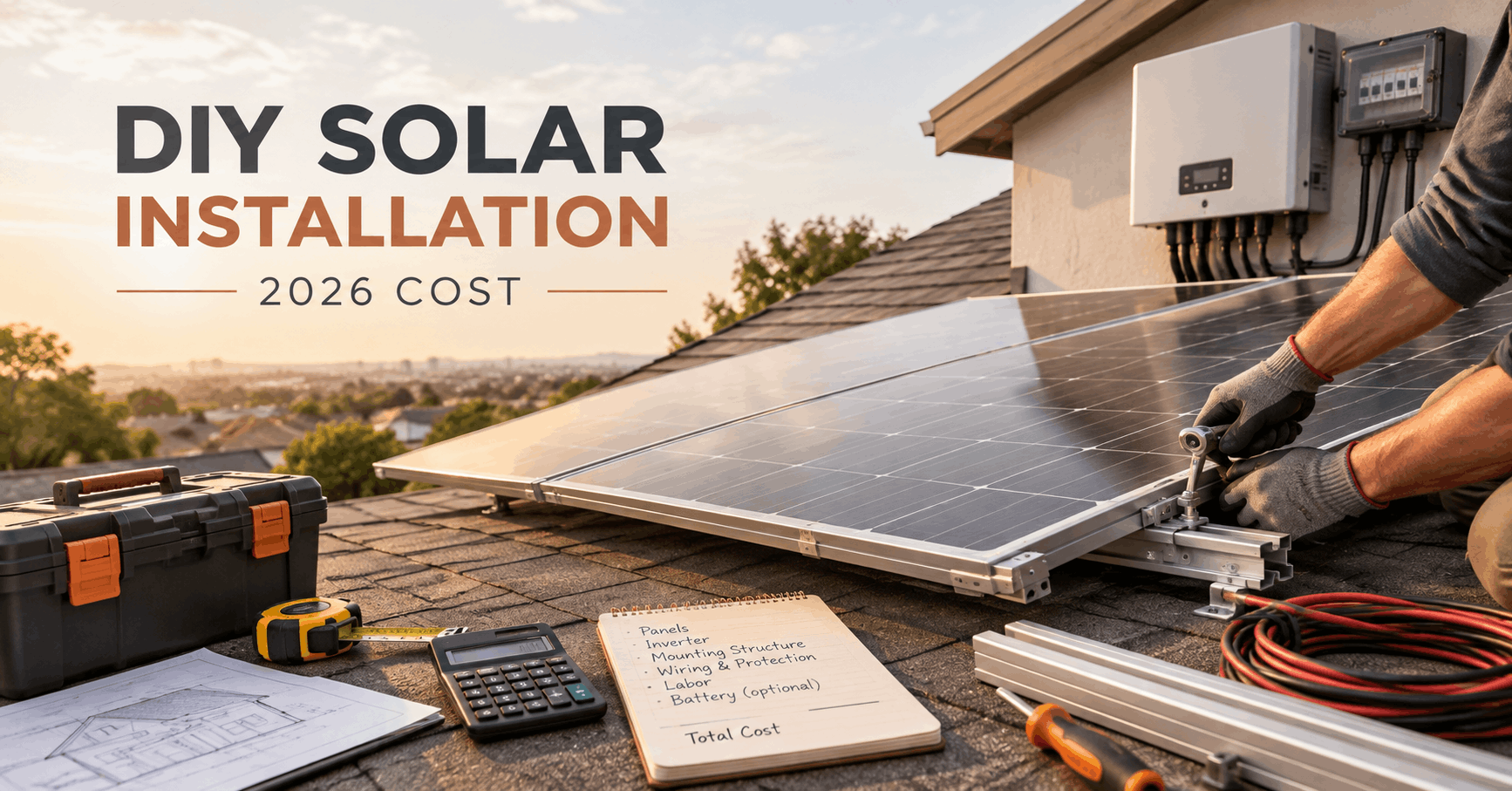
Expect to pay roughly $25,800–$30,000 installed before incentives in 2026, based on EnergySage marketplace data and NREL’s Q1 2024 cost benchmark of $2.50–$3.20 per watt.
One important 2026 change: the federal 30% residential solar tax credit expired on December 31, 2025, under the One Big Beautiful Bill Act. Homeowners installing in 2026 pay closer to full sticker price unless state or local incentives apply (SolarPermitSolutions, Helios Energy). Check your state’s current programs before budgeting, this is exactly the kind of detail that shifts year to year, so treat any number you see as a starting estimate, not a quote.
How Much Roof Space Does a 10kW System Need?
With modern 370–450W panels, a 10kW system needs roughly 22–27 panels (Anker SOLIX, Helios Energy). At standard panel dimensions of around 17–18 square feet each, that works out to approximately 400–500 square feet of usable, unshaded roof space, call it a two-and-a-half to three-car garage footprint. Older, lower-wattage panels need more panels and more space to hit the same 10kW total.
FAQs
Will 10,000 watts run a house?
For most grid-tied homes, yes — a 10kW system’s typical annual output (11,000–17,500 kWh) exceeds the US average household usage of about 10,791 kWh/year (EIA). Off-grid is a stricter test that depends heavily on battery storage and location.
What can 10,000 watts power?
Everything from a refrigerator and lighting to central AC, an electric water heater, and EV charging — though not necessarily all at once. See the appliance breakdown table above for specific feasibility.
How many solar panels make up a 10kW system?
Typically 22 to 27 panels with modern 370–450W modules (Anker SOLIX, Helios Energy).
Is a 10kW solar system enough for a family of four?
In most average-to-sunny regions, yes, for grid-tied homes. A 4-person household uses roughly 30% more than a 1-person household (Electric Choice), which still fits comfortably within typical 10kW output.
How much power does a 10,000 watt solar panel produce per day?
Roughly 30–45 kWh per day nationally, with real-world output landing at about 75–85% of the 10,000W rated capacity due to Standard Test Conditions vs. actual weather and roof conditions (Anker SOLIX; SolarTech Energy Systems).
Can a 10kW system run an AC unit and refrigerator at the same time?
Yes. A refrigerator’s 1–2 kWh/day draw is small next to a 10kW system’s 30–45 kWh/day output, even with central AC’s 24–32 kWh/day running alongside it — though on a hot day, AC alone can use most of your daily production.
What’s the difference between a 10,000 watt panel and a 10,000 watt system?
A single panel maxes out around 400–450 watts. “10,000 watts” refers to a full system — an array of roughly 22–27 panels wired together.
Do I need batteries with a 10kW solar system?
Not for grid-tied setups, where the grid covers shortfalls. For off-grid use, batteries are essential, sized for at least one to two days of household usage to ride out cloudy stretches.