
Last updated on November 1st, 2026 at 03:30 pm
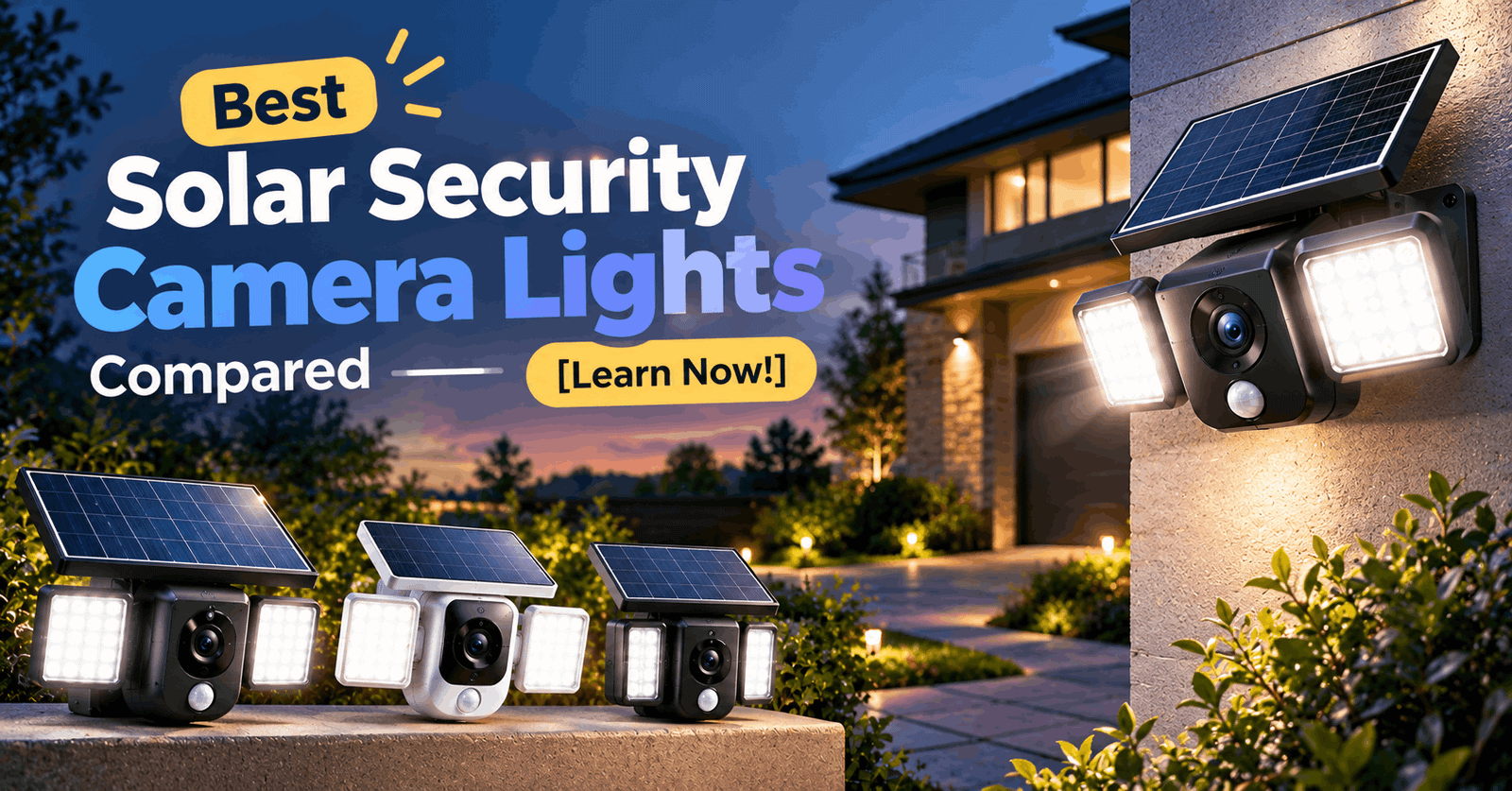
Quick answer: The best solar perimeter light for most U.S. homes is the HMCITY 120 LED, a motion-sensing, IP65-rated wall light with 270° coverage. For maximum brightness, choose the Tuffenough 2500LM. For the longest motion range (up to 72 ft), choose the LEPOWER 1600LM. For long fences on a budget, choose the Aootek 6-pack. For a soft decorative fence glow, choose the Othway Solar Fence Post Lights.
Table of Contents
Your property line sits a long way from the nearest outlet. That’s exactly where solar perimeter lights earn their keep. No trenching. No electrician. No extension cord snaking across the lawn.
But solar lights also have a reputation for dying young. So we compared five popular models on published specs, independent reviews and real buyer feedback, then added the U.S.-specific details most guides skip: sun hours by region, local lighting rules and what the crime data actually says.
Quick Answer: Best Solar Perimeter Light by Use Case
| Best for | Pick | Why it stands out |
|---|---|---|
| Best overall | HMCITY 120 LED | 270° coverage, IP65, three modes, 18-month warranty |
| Brightest | Tuffenough 2500LM | 2,500 lumens listed, three adjustable heads, remote control |
| Longest motion range | LEPOWER 1600LM | Adjustable sensor up to 72 ft, separate solar panel |
| Best value for long fences | Aootek 120 LED (6-pack) | Six lights for roughly $26 |
| Best decorative fence line | Othway Solar Fence Post Lights | Soft warm glow, roughly $21 for four |
Why Solar Perimeter Lights Make Sense for U.S. Homeowners
American yards run long, and the back fence often sits far from the house. Here’s why solar fits that reality.
No trenching, no permits. Running power to a far fence line usually means digging and wiring. A commercial lighting planning guide notes that solar perimeter fixtures go up quickly, without utility coordination, electrical permits or trenching. Most homeowner lights mount with a few screws.
Sunlight varies a lot across the country. NREL-based data puts the U.S. average near 5 peak sun hours a day. Washington sits near 4, and Alaska near 3.2. Winter is harder still: peak sun hours can run 25–50% below the annual average. We cover this in the winter section below.
It’s one layer of security, not the whole plan. The FBI estimated about 779,500 burglaries in 2024, down 8.6% from 2023. Roughly 405,800 of them hit homes, and about 53% of those happened in the daytime. A motion light helps at night. It won’t replace good locks, cameras and neighbors who pay attention.
Your power bill won’t shrink much. With the U.S. Energy Information Administration projecting a 2026 residential rate near 18.2 cents per kilowatt-hour, a 10-watt LED running 12 hours a night costs about $8 a year. Solar saves that. The real win is putting light exactly where you need it.
Local rules matter. Many U.S. cities and HOAs now regulate outdoor lighting. We cover that below, because a few popular picks use very cool, bright light.
What Counts as a Perimeter Light?
“Perimeter light” covers a few different jobs:
- Motion-sensor floodlights light up a driveway, side yard or back fence when something moves. (HMCITY, Tuffenough, LEPOWER, Aootek)
- Fence and post lights mark the boundary with a soft glow. (Othway)
- Smart or camera-integrated lights add video. (Ring’s solar floodlight is one example.)
- Pole-mounted solar area lights cover large lots and commercial sites.
Most homeowners want the first two. This guide focuses on them.
7 Specs That Actually Matter
1. Brightness. Manufacturers list lumens, which measure total light output. Treat the number as a rough guide, not a promise. One hands-on review of the LEPOWER notes that its 1,600 lumens are the combined output of all heads, not 1,600 per head.
2. Battery. Most brighter lights use lithium-ion cells (the Tuffenough lists 2,000mAh; the LEPOWER lists 2,400mAh). Higher capacity helps, but only if the panel can fill it. Check whether the battery is replaceable.
3. Solar panel. Look for monocrystalline panels. HMCITY and Aootek both list a 20.5% efficient monocrystalline panel. A bigger panel in full sun matters more than any marketing claim.
4. Waterproof rating. IP65 means dust-tight and protected against low-pressure water jets from any direction. It doesn’t cover submersion. IP67 covers temporary immersion. For a wall or fence light, IP65 is the common standard (it comes from IEC 60529).
5. Motion sensor. Check the range, the angle and the modes. Sensors tend to catch sideways movement better than movement walking straight toward them, so aim accordingly.
6. Color temperature. DarkSky International recommends warm light at 3000K or below, and 2700K or lower for homes. Several popular security lights run 5500K–6500K. They work, but they’re harsh, and some cities restrict them.
7. Warranty. HMCITY lists 18 months. One Aootek listing shows one year. Longer coverage tells you how much the maker trusts its battery.
5 Best Solar Perimeter Lights
We chose these five because they show up repeatedly in independent roundups and carry large review counts. Specs come from manufacturer and retailer listings, so verify them on the product page before you buy.
1. HMCITY 120 LED Solar Lights: Best Overall
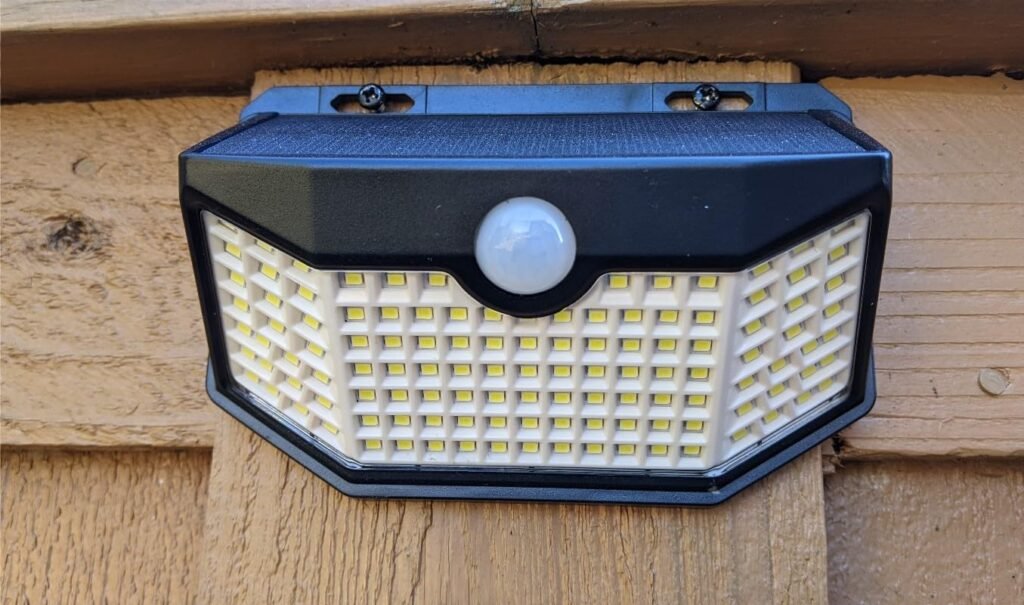
Best for: Fences, garage walls, side yards and gates.
Specs:
- 120 LEDs with a 270° wide-angle beam
- About 800 lumens on the common 2-pack listing (other pack sizes list higher figures)
- IP65, three lighting modes including motion sensing
- 20.5% monocrystalline panel
- 18-month warranty, wall mount
- Roughly 4.4 stars from tens of thousands of ratings (at time of research)
Pros:
- Wide coverage from a single unit
- Three modes let you trade brightness for battery life
- Simple wall mounting
- One buyer reported it still charged on cloudy and snowy days
Cons:
- Lumen figures differ between listings, so check the exact pack
- A few buyers report a dud unit, including one with a button that didn’t work
- One reviewer said battery life seemed shorter on a newer order
What buyers say: Amazon buyers praise the brightness, the easy install and a sensor that picks up motion from a good distance. Complaints are occasional dead units and lights that shut off early when they don’t get direct sun.
2. Tuffenough 2500LM Solar Security Lights: Brightest
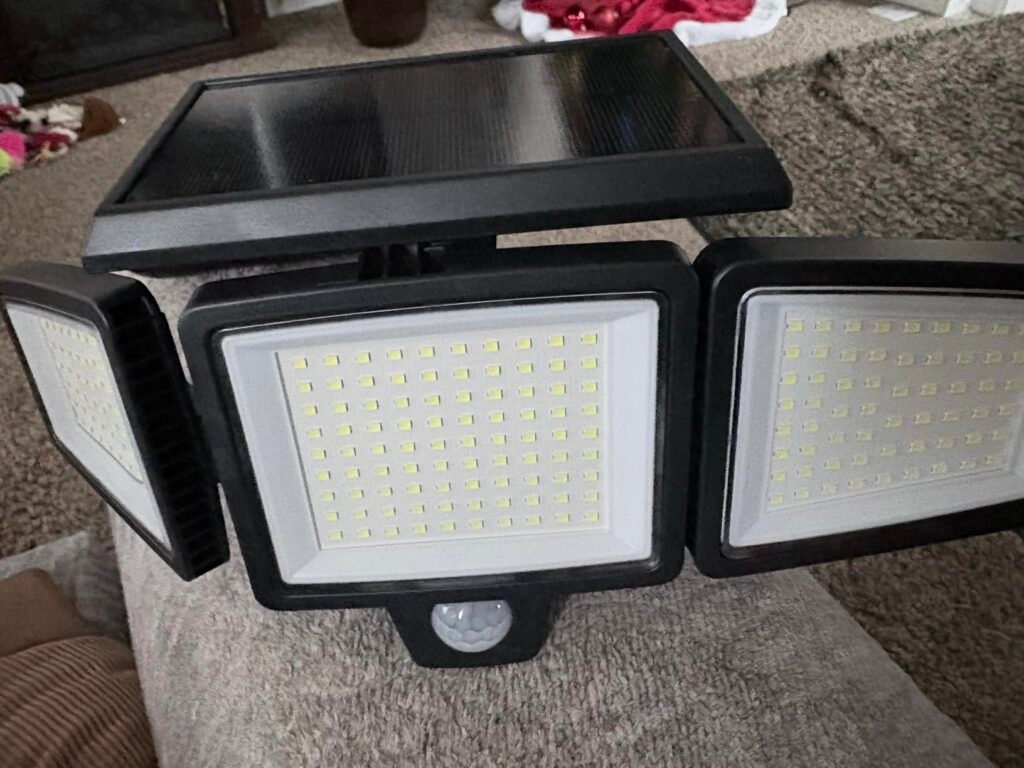
Best for: Driveways, backyards and wide-open areas that need real light.
Specs:
- 2,500 lumens listed, 210 LEDs, cold white (about 6500K)
- Three adjustable heads, 270° PIR motion sensor
- Sensor range listed up to 26 ft
- IP65, 2,000mAh rechargeable battery
- Remote with three lighting modes
- Roughly $40 in one roundup, about 4.3 stars from tens of thousands of ratings
Pros:
- Very bright for the price
- Adjustable heads let you aim light where you need it
- Remote makes mode changes easy after you mount it high
- Buyers call it easy to install with a screwdriver
Cons:
- Cold white light can feel harsh and may clash with local dark-sky rules
- One buyer reported about half their units failing within three months
- Another reported water getting into a unit after rain
- One listing says the built-in battery isn’t replaceable
What buyers say: Many love the brightness and the remote, and one said a single light covers a whole deck. The trade-off is durability: several buyers report failures after a few months.
3. LEPOWER 1600LM Solar Security Light: Longest Motion Range
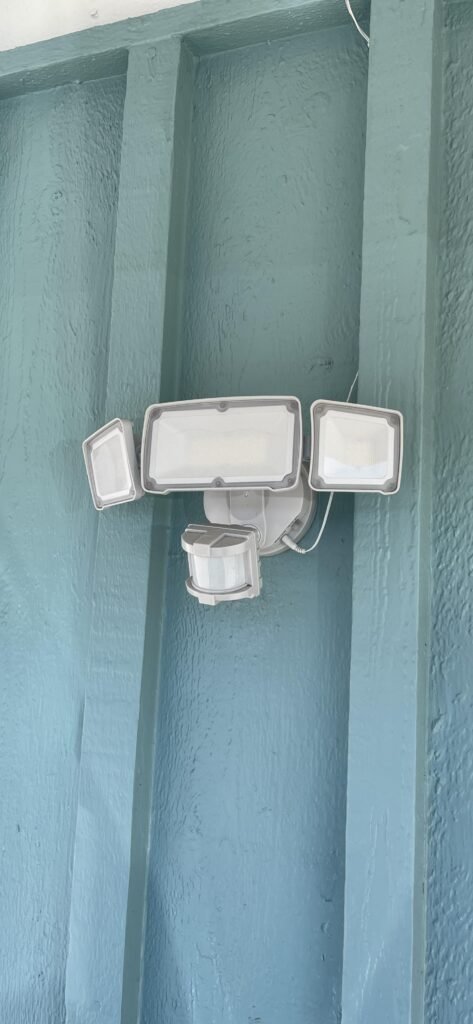
Best for: Long driveways, shaded eaves and places where the light and panel can’t share a spot.
Specs:
- 1,600 lumens total, 5500K white light
- Three adjustable heads, 180° sensor angle
- Adjustable sensing distance from 0 to 72 ft
- Separate solar panel on a 15 ft cable, 2,400mAh battery
- IP65
- Roughly $46 in one retail listing
Pros:
- The separate panel lets you mount the light under an eave and the panel in full sun
- Adjustable sensor range and a test mode help you dial it in
- A buyer mounted it about 8 ft high on middle sensitivity and called it bright and easy to set up
Cons:
- The maker says the sensor is less sensitive to movement walking straight toward it
- One hands-on review lists runtime in constant “on” mode at roughly 50 minutes, so run it in motion mode
- Cool white light and a higher price than the multi-packs
What buyers say: Buyers like the brightness and flexible placement. The detection range depends heavily on how you aim the sensor.
4. Aootek 120 LED Solar Motion Lights (6-Pack): Best Value
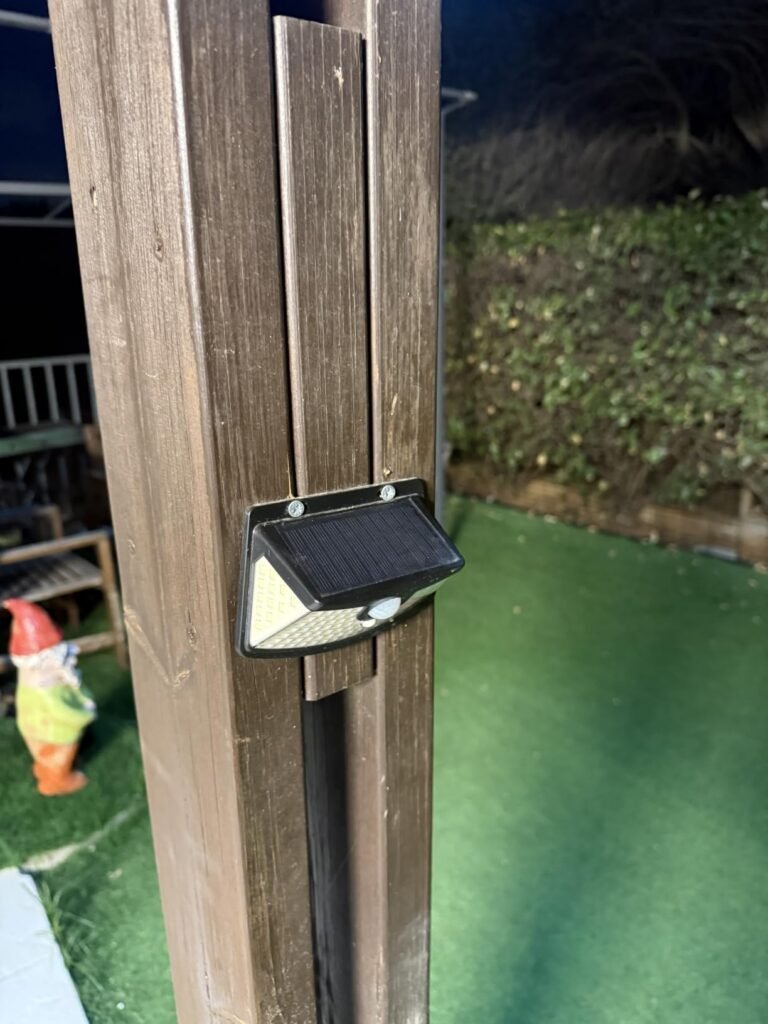
Best for: Long fence lines and renters who want cheap, easy coverage.
Specs:
- 120 LEDs, 270° reflector, PIR sensor up to 26 ft
- Listed at 800 lumens (some listings show 500, so check your model)
- IP65, three modes, lithium-ion battery
- 1.2W monocrystalline panel, 20.5% efficiency
- One-year warranty on one listing
- About 4.4 stars from more than 50,000 ratings
- Roughly $26 for six, with deals near $20 in 2025
Pros:
- Lowest cost per light on this list
- Buyers call it easy to install (one used outdoor double-sided tape on a fence)
- Several owners report lights still working after two years
Cons:
- A newer version uses a smaller panel, and reviewers report dimmer light and shorter battery life
- One shopper said the battery won’t last until morning without 6–8 hours of direct sun
- Some buyers report individual LEDs or whole units failing
What buyers say: Happy buyers highlight brightness for the price and reliable motion detection. Unhappy ones point to the smaller panel and mixed durability.
5. Othway Solar Fence Post Lights: Best for Decorative Fence Lines
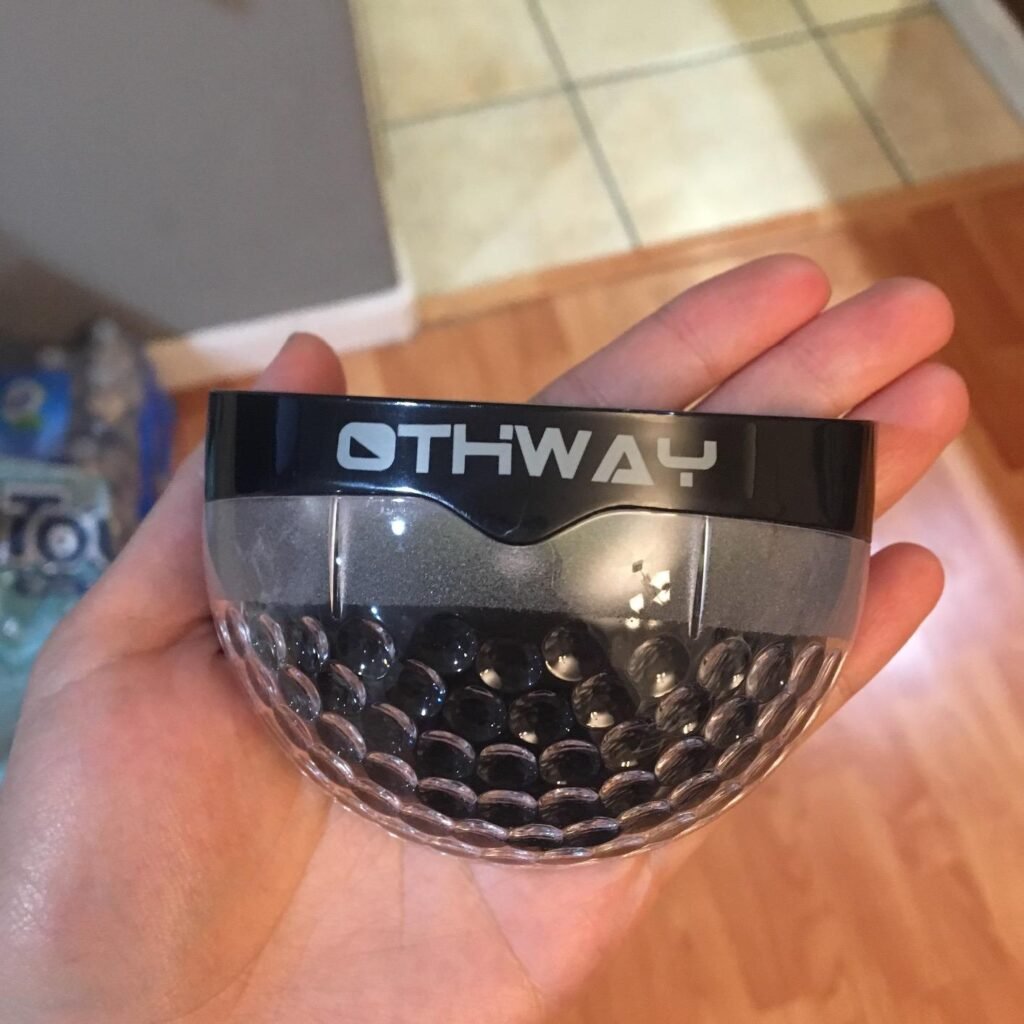
Best for: Deck posts, fence panels and a soft boundary glow (not security).
Specs:
- Warm white, about 12 lumens
- Plastic housing with mounting hardware included
- Listed with a 22% monocrystalline panel and IP65
- Roughly $21 for a four-pack
Pros:
- Warm light is easy on neighbors and fits dark-sky guidance
- Cheap and quick to mount
- One independent review scored setup at 4.5 out of 5 and value at 4.7 out of 5
Cons:
- It’s decorative. Twelve lumens won’t light a yard
- One buyer called them decorative and wished for something larger
- Plastic housing
What buyers say: They look good and work as accent lighting. Pair them with one of the motion lights above if you want real visibility.
How Many Lights Do You Need, and Where Should They Go?
Here’s a simple planning example. Say you have a 100-foot fence and a light with a 26-foot rated sensor, like the Aootek or Tuffenough. Space them so the detection zones overlap, roughly every 20–25 feet. That’s five or six lights, which a 6-pack covers. This is a planning estimate based on listed ranges, not a measured result. Real detection range is shorter at awkward angles.
For placement:
- Mount at the right height. Manufacturer guidance for motion lights runs from about 6.5 to 10 feet. Check your manual.
- Face the panel south in the Northern Hemisphere, and keep it out of shade. Even partial shading can cut energy absorption sharply.
- Charge before you rely on it. One maker suggests 2–3 days in the sun before first use.
- Test the sensor at dusk by walking across the beam, not toward it.
Do Solar Perimeter Lights Work in Winter and Cloudy Weather?
Yes, but they work harder for less. Peak sun hours measure usable sunlight, not daylight. A summer day in Phoenix can deliver about 7.5 peak sun hours. A cloudy winter day in Seattle can deliver about 1.2.
| Location | Average peak sun hours per day (NREL-based, annual) |
|---|---|
| U.S. average | About 5.0 |
| Minnesota | About 4.6 |
| Oregon | About 4.1 |
| Washington | About 4.0 |
| Alaska | About 3.2 |
Winter values can sit 25–50% below these annual averages. In northern or cloudy areas, choose a larger panel, the lowest-power mode, or a light with a separate panel like the LEPOWER. Brush snow off panels. One buyer reported that a snow-covered HMCITY worked perfectly once wiped clean.
Do Solar Lights Really Deter Intruders?
Sometimes, and the evidence is more nuanced than marketing suggests.
A systematic review of 13 U.S. and UK studies found improved street lighting linked to a 21% drop in crime. But the U.S. results were mixed: four studies found an effect and four found none. That research covers streets, not home lights. A 2025 registered report on darkness and crime found that darkness raised the risk of burglary, among other offenses. Even so, the researchers described the overall evidence as mixed.
And remember the FBI numbers above: more than half of residential burglaries happen in daylight. Light is one layer. A motion light won’t stop someone who shows up at 2 p.m. with a clipboard. Pair it with locks, cameras and good neighbors.
Check Local Rules Before You Mount
Many U.S. communities follow DarkSky International’s five principles for responsible outdoor lighting: useful, targeted, low-level, controlled and warm-colored. Some cities write them into law. Malibu, California, for example, requires motion-controlled security lighting to switch off within 10 minutes and caps color temperature at 3000K.
Several of our picks run 5500K–6500K. If your city or HOA has a lighting ordinance, check it first. Aim lights downward, use motion mode instead of constant-on, and keep light off your neighbor’s windows.
How Much Do Solar Perimeter Lights Cost, and How Long Do They Last?
Cost. Expect roughly $20–$26 for the Othway four-pack or the Aootek six-pack, and about $40–$46 for the Tuffenough or LEPOWER. Prices change often, so check the listing.
Lifespan. The plastic shell usually outlasts the battery. Typical battery life runs about 1–3 years for NiMH and roughly 2–5 years for lithium-ion. Better LiFePO4 cells can run 5–10 years in quality products. Check whether the battery is replaceable before you buy, and budget for replacements or a whole new set.
What shortens life: shade, dirty panels, heat, constant full-brightness mode and poor seals.
Common Problems and Fixes
Lights won’t charge. Wipe the panel, move it into direct sun and make sure the power switch is on. Give a new light 2–3 days to charge.
Lights dim or shut off early. The battery may be aging, the panel may be shaded or you may be in a low-sun season. Switch to a lower-power mode.
False triggers or missed motion. Adjust the height and angle. Remember that sensors favor sideways movement.
Water inside the unit. IP65 resists jets, not submersion. Tighten the sensor head nut after adjusting, as the LEPOWER instructions advise, and seal screw holes.
Beyond the Boundary: More Solar Lighting Ideas
Perimeter lights handle the edges. For the rest of the yard, see our guide to the best solar lights for garden statues for focal points, or the best solar hanging lights outdoor for patios and pergolas.
FAQs
Do solar lights stop burglars?
They can help, but evidence is mixed, and many residential burglaries happen in daylight. Use them alongside locks and cameras.
How long do solar lights last?
Batteries usually fail first. Expect about 1–3 years from NiMH and roughly 2–5 years from lithium-ion, depending on quality and use.
Are 6500K security lights allowed?
It depends on where you live. DarkSky International recommends 3000K or lower, and some cities enforce that. Check your local code and HOA rules.
Is IP65 enough for outdoor lights?
For wall and fence lights, yes. IP65 means dust-tight and protected against low-pressure water jets. It doesn’t cover submersion, so avoid spots where water pools.
Do solar lights work in winter?
Yes, with less runtime. Winter peak sun hours can run 25–50% below the annual average. Keep panels clear of snow and use a lower-power mode.
How many solar lights do I need for a fence?
As a planning guide, one light every 20–25 feet works for lights with a 26-foot sensor range. A 100-foot fence needs five or six. Adjust for obstacles and angles.
What is the best solar perimeter light?
For most homes, the HMCITY 120 LED offers the best balance of coverage, rating and price. Choose the Tuffenough for brightness, the LEPOWER for range and the Aootek 6-pack for long fences.
How We Chose These Picks
We haven’t lab-tested these lights. We selected five models that appear repeatedly in independent roundups and carry large buyer review counts. We checked specs against manufacturer and retailer listings and read buyer feedback for recurring praise and complaints. Specs and prices change, so confirm them on the product page. We update this page regularly.
Sources
- FBI, Crime in the Nation 2024 (Uniform Crime Reporting summary)
- Farrington, D. and Welsh, B., “Improved Street Lighting and Crime Prevention: A Systematic Review” (2007), via the National Criminal Justice Reference Service
- PLOS ONE (2025), “Does darkness increase the risk of certain types of crime?” registered report
- DarkSky International and the Illuminating Engineering Society, Five Principles for Responsible Outdoor Lighting; DarkSky home lighting guidance
- City of Malibu, “Outdoor Lighting Basics” (dark-sky ordinance example)
- IEC 60529, Degrees of Protection Provided by Enclosures (IP Code)
- NREL National Solar Radiation Database and PVWatts peak-sun-hour data
- U.S. Energy Information Administration, residential electricity price projection for 2026
- Manufacturer and retailer product listings for HMCITY, Tuffenough, LEPOWER, Aootek and Othway (checked November 2026)