Last updated on October 29th, 2026 at 11:50 am
Quick Answer: For most buyers, the NIORSUN 400W is the best pick here. It has the largest owner review base of the six (about 4.2 stars from roughly 640 ratings) and consistent specs across its listings. But “400W” is a marketing label, not measured power. Claimed output across these six lights runs from 800 to 40,000 lumens, so judge each one by lumens, battery, and IP rating, not by the wattage in the title.
Table of Contents
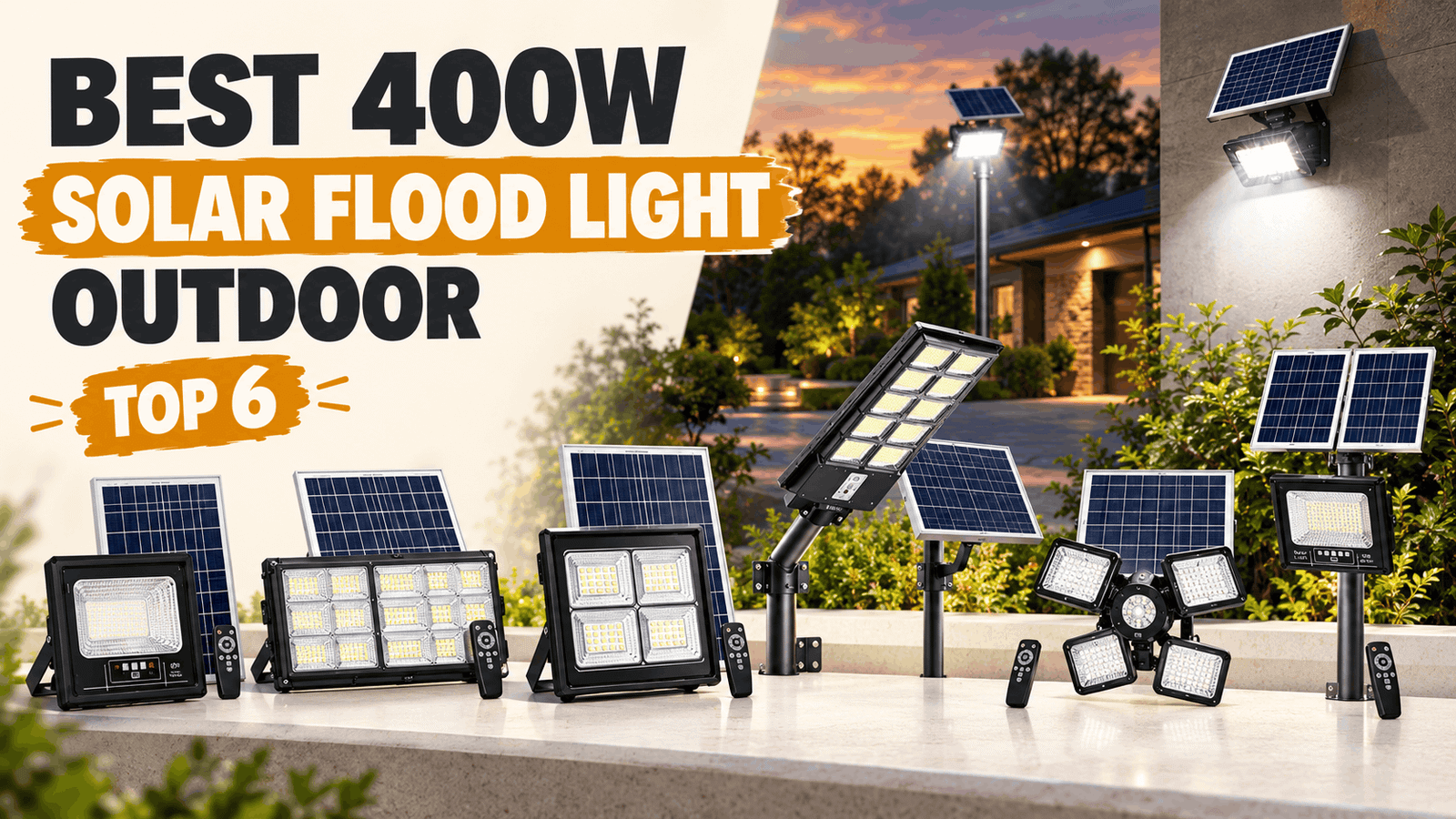
Top 6 at a Glance
| Product | Claimed lumens | Battery | IP rating | Owner rating | Best for |
|---|---|---|---|---|---|
| NIORSUN 400W Solar Street Light | 10,000 | Not listed | IP67 (per title) | ~4.2 (about 640 ratings) | Best overall |
| TIN SUM 400W Solar Security Flood Lights | 4,000 or 40,000 (listing conflicts) | Lithium-ion, included | IP66 | ~4.0 (about 300 ratings) | Flexible mounting |
| 400W Solar Flood Lights, 26,000 Lumens, 478 LEDs | 26,000 | Not listed | IP66 | 3.6 (41 ratings) | Wide, close-range wash |
| VEVOR 400W Solar Street Light, 800LM | 800 | Not listed | IP66 | Positive brand-store comments | Light-duty, honest specs |
| 400W Stepless Dimming Solar Flood Light, 14000mAh | Not listed | 14,000 mAh | IP65 | Seller-page comment only | Warm, dimmable light |
| JINDIAN 400W Dual-Panel Solar Flood Light, 432 LEDs | 40,000 | Lithium phosphate (36,000 mAh in title) | IP66 | No written reviews found | Dual-panel setups |
Prices change daily, so check the current listing before you buy. Ratings come from the listings as we found them in October 2026.
What “400W” Really Means on a Solar Light
A “400W” label on a solar light is like a “World’s Best Dad” mug. Sweet sentiment, zero audit.
Here is the problem. The same keyword covers lights with wildly different output. The six lights in this guide claim anywhere from 800 to 40,000 lumens. We also saw other “400W” listings claiming 150,000 and even 450,000 lumens. Those numbers do not survive basic arithmetic.
The energy math. A true 400-watt load running 8 hours uses 3,200 watt-hours (3.2 kWh). Now look at one of the lights below. Its listing shows a 3.7V, 14,000 mAh battery. That stores about 52 watt-hours (3.7 × 14). A real 400W draw would empty it in roughly 8 minutes. Its solar panel is rated 5 watts, so on a good day it might add around 25 watt-hours.
That is a calculation from the listing, not a lab test. But it makes the point: the “400W” describes marketing, not what the panel or battery can deliver.
What to look at instead:
- Lumens measure light output. This is the number that matters.
- Battery capacity (mAh or Wh) decides runtime.
- Panel size decides how well the battery refills.
- IP rating decides how long the light survives rain.
When one listing shows two different lumen figures (the TIN SUM does), treat the lower figure as the safer expectation.
The 6 Best 400W Solar Flood Lights
1. NIORSUN 400W Solar Street Light: Best Overall

Best for: Buyers who want the most owner feedback behind a purchase.
Spec block (as listed):
- 864 LEDs, 10,000 lumens claimed
- 6V solar setup, 7000K bright white
- Motion sensor and remote control
- Wall or pole mounting, with a 24.6-inch metal pole in the box
- IP67 in the product title
- Assembly required
Owner experience: The listing carries about 4.2 stars from roughly 640 reviews, the biggest sample in this guide. One buyer called it very bright with a big panel, then noted the price is not low, so expectations run high. Another buyer said most lights are worse, but recommended it mainly for people with some mechanical skill.
Pros:
- Largest review base of the six
- Consistent specs across listings
- Remote and motion sensor included
- Pole included
Cons:
- Assembly takes some DIY comfort
- 7000K is a cold, blue-white light
- Priced above most others here
2. TIN SUM 400W Solar Security Flood Lights: Best for Flexible Mounting

Best for: Properties where the sunny spot sits far from the dark spot.
Spec block (as listed):
- 600 LEDs, 6500K
- Lumens: the description says 40,000, while the product data field says 4,000
- IP66, with a lightning-protection feature listed
- 5–6 hour charge, 8–12 hours of light on a full charge
- 18 ft cable between panel and light
- Remote with brightness and timer; motion sensor with a 120° angle and about 16–23 ft range
Owner experience: Ratings hover around 4.0 stars from roughly 300 reviews. One owner reported three years of use and said it still works well.
Pros:
- Long 18 ft panel cable lets you put the panel in full sun
- Remote with timer and brightness control
- Reports of multi-year use
Cons:
- The 4,000 vs 40,000 lumen conflict is a red flag
- Listing claims 3,229 sq ft of coverage, which we could not verify
- Battery capacity is not stated
3. 400W Solar Flood Lights, 26,000 Lumens, 478 LEDs: Best for a Wide Wash at Close Range

Best for: Yards, patios and walls where you want even light, not a long throw.
Spec block (as listed):
- 478 LEDs, 26,000 lumens claimed, 6000K
- IP66, dual remote control, dusk to dawn
- Long, strip-style front for a wider spread
Owner experience: Rated 3.6 out of 5 from 41 ratings on the US listing. Reviews split. One buyer felt a cheap battery lantern gave more light, even at every brightness setting. Another liked the long front as a wash light, but said it does not throw light far.
Pros:
- Wide strip design spreads light evenly
- Dual remotes
- IP66 rating
Cons:
- Lowest rating in this group
- Mixed brightness reports
- Short throw distance
4. VEVOR 400W Solar Street Light, 800LM: Best for Light-Duty Use With Honest Specs

Best for: Small yards, garage doors and paths where 800 lumens is enough.
Spec block (as listed):
- 800 lumens
- IP66, infrared remote, motion sensor
- Marketed for gardens, paths, garages and parking areas
Owner experience: Comments on the brand’s own store call it a great light that shines all night, at a reasonable price. We did not find a large Amazon-style rating count, so treat this as light evidence.
Pros:
- Publishes a realistic lumen figure
- IP66 rating
- Motion sensor and remote
Cons:
- 800 lumens will not light a large lot
- Limited review volume
- “400W” in the name still says nothing about real power
5. 400W Stepless Dimming Solar Flood Light, 14000mAh: Best for Warm, Dimmable Light
Best for: Patios, campsites and courtyards where harsh white light feels wrong.
Spec block (as listed):
- 6V 5W monocrystalline panel
- 3.7V, 14,000 mAh lithium battery (about 52 Wh)
- White, yellow and stepless dimming modes
- 360° rotating head, battery display, IP65, ABS housing
- Listed at $89.85 on a seller page
Owner experience: One buyer on the seller page said it brightens the backyard and lasts through the night. This is a seller-page comment, not an Amazon review, so weigh it accordingly.
Pros:
- Warm and dimmable modes
- Battery level display
- Lower price than most lights here
Cons:
- A 5W panel is slow to refill a 52 Wh battery, especially in winter
- IP65 only, so heavy storms are a bigger risk
- Thin review evidence
6. JINDIAN 400W Dual-Panel Solar Flood Light, 432 LEDs: Best for Dual-Panel Setups

Best for: Shoppers who want extra charging capacity and accept an unproven product.
Spec block (as listed):
- 432 LEDs, 40,000 lumens claimed
- Dual solar panels, remote control
- Lithium phosphate battery; 36,000 mAh in the product title
- IP66
Owner experience: We found one five-star video review calling it very bright, but no written reviews at the time of checking.
Pros:
- Dual panels for faster charging
- Lithium phosphate chemistry is a durable choice
- IP66 rating
Cons:
- Almost no review history
- The 40,000 lumen claim looks unrealistic for this build
- Hard to judge long-term reliability
Why These Lights Matter for Homes and Properties Across the United States
1. Electricity costs keep climbing. The U.S. Energy Information Administration puts the average residential price at about 18 cents per kWh in 2026. State rates vary widely, from about 12.7 cents in Louisiana to 48 cents in Hawaii in July 2026.
Here is the math for a hardwired light drawing a true 400 watts for 10 hours a night:
- 0.4 kW × 10 hours × 365 nights = 1,460 kWh per year
- At 18 cents: about $263 per year
- At Hawaii’s 48 cents: about $700 per year
A solar light has no electric bill. That said, most of the lights above are much weaker than a real 400W fixture, so compare lumens, not wattage.
2. Many US properties are big and dark. Barns, gravel drives, rural lots, ranch gates and mobile home parks often sit far from a power source. Running cable to them costs money. A solar light needs a bracket, a pole or a wall, plus sun.
3. Solar keeps working when the grid does not. Storms and winter outages can cut power to wired lights. A charged solar light with its own battery keeps running, as long as the battery has charge.
4. Sunshine varies a lot by state. NREL-based data puts the national average near 5 peak sun hours per day. Arizona gets about 6.5. Alaska gets about 3.2. Winter averages across the continental US fall to roughly 4 to 4.5 peak sun hours. A cloudy December day in Seattle can drop to about 1.2.
Bottom line: Southwest buyers can lean toward bigger lights with confidence. Northern buyers should pick a larger panel and battery, or accept shorter winter runtimes.
How We Reviewed These Lights
We did not run lab tests for this guide. We reviewed product listings, published specs and owner feedback, then checked the numbers against basic energy math.
Our picks were weighed by:
- Spec consistency. Does the listing contradict itself?
- Owner feedback. How many ratings, and what do buyers actually complain about?
- Protection rating. IP65, IP66 or IP67.
- Realistic output. Lumens beat wattage claims.
We skipped lights that claimed more than 100,000 lumens from a small panel, because the energy math does not support them.
How to Choose a 400W-Class Solar Flood Light
Lumens first. Aim for the lumen figure you actually need, not the wattage. A small yard path needs far less than a parking area.
Battery and panel. Look for a stated battery capacity and a panel that matches it. A tiny panel on a big battery refills slowly.
IP rating. IP65 handles dust and water jets. IP66 handles powerful jets. IP67 survives brief immersion, up to 1 meter for 30 minutes. Pick IP66 or higher for storms.
Color temperature. Around 6000–7000K gives cold, bright white. Warmer light reads friendlier at home.
Mounting height. One 400W listing recommends 5 to 8 meters (about 16 to 26 feet) for its street-style light. Check the manual for yours.
Panel placement. Put the panel where it gets direct sun for most of the day. Avoid shade. A longer cable gives you more freedom.
Motion sensing. If you want a light that reacts to movement, our guide to the best solar motion sensor lights walks through how they compare.
If you want smaller, easier-to-install lights for a yard, see our review of solar LED flood lights compared for every yard.
FAQs
Is IP66 enough for heavy rain?
IP66 is designed to resist powerful water jets, so heavy rain is generally fine. Check seals and mounting for water traps, which buyers report on some budget lights.
Do solar flood lights work in winter or cloudy weather?
Yes, but with less charging. Winter peak sun hours drop across the US. Expect shorter runtimes and use a lower brightness mode when sun is scarce.
How long does a solar flood light stay on after a full charge?
Listings for these lights commonly claim 8 to 12 hours. Real runtime depends on brightness mode, battery health and temperature.
Is a 400W solar light really 400 watts?
Usually not. The label is a marketing term. A true 400W load would drain most small solar batteries in minutes.
How bright is a 400W solar flood light?
It depends on the product. The six lights above claim between 800 and 40,000 lumens. Treat claims above about 20,000 lumens from a small panel with caution, and check for a battery capacity figure.
Conclusion
- Best overall: NIORSUN 400W Solar Street Light, for its review base and consistent specs.
- Best for flexible mounting: TIN SUM 400W Solar Security Flood Lights, for the 18 ft cable.
- Best for a wide, close-range wash: the 26,000-lumen, 478-LED light, if you accept mixed reviews.
- Best light-duty option: VEVOR 400W Solar Street Light 800LM, for realistic numbers.
- Best warm and dimmable: the 400W Stepless Dimming 14000mAh light, for patios and camps.
- Best dual-panel option: JINDIAN 432-LED dual-panel light, only if you accept limited reviews.
Skip these lights if you need to light a full parking lot with certainty. For that job, a hardwired fixture or a professionally specified solar pole system is a safer bet. Solar flood lights can carry big yards, gates and driveways. They are less proven as stadium-grade fixtures.
Sources and Method
- U.S. Energy Information Administration: residential electricity prices (2026) and state rate data
- National Renewable Energy Laboratory (NREL): peak sun hour data and seasonal solar resource
- IP rating definitions (IEC protection-rating standard)
- Manufacturer and retailer product listings for each light, reviewed October 2026
Disclosure: This guide reviews listings and owner feedback. It is not a laboratory test. Prices, ratings and availability change often, so confirm them on the product page before buying.