Table of Contents
Your yard turns into a black hole after sunset, and stumbling over the same garden hose every night gets old fast. Solar LED flood lights fix this without an electrician, a trench, or a bigger power bill. The hard part isn’t deciding whether to buy one. It’s picking the right one out of hundreds of nearly identical listings on Amazon.
This guide skips the sales copy and gets straight to the numbers you need: lumens, detection range, waterproof rating, and battery performance. Every spec below comes from verified product listings and real buyer reviews, not guesswork. By the end, you’ll know exactly which solar LED flood light fits your driveway, backyard, or barn, and why.
The Best Solar LED Flood Lights at a Glance
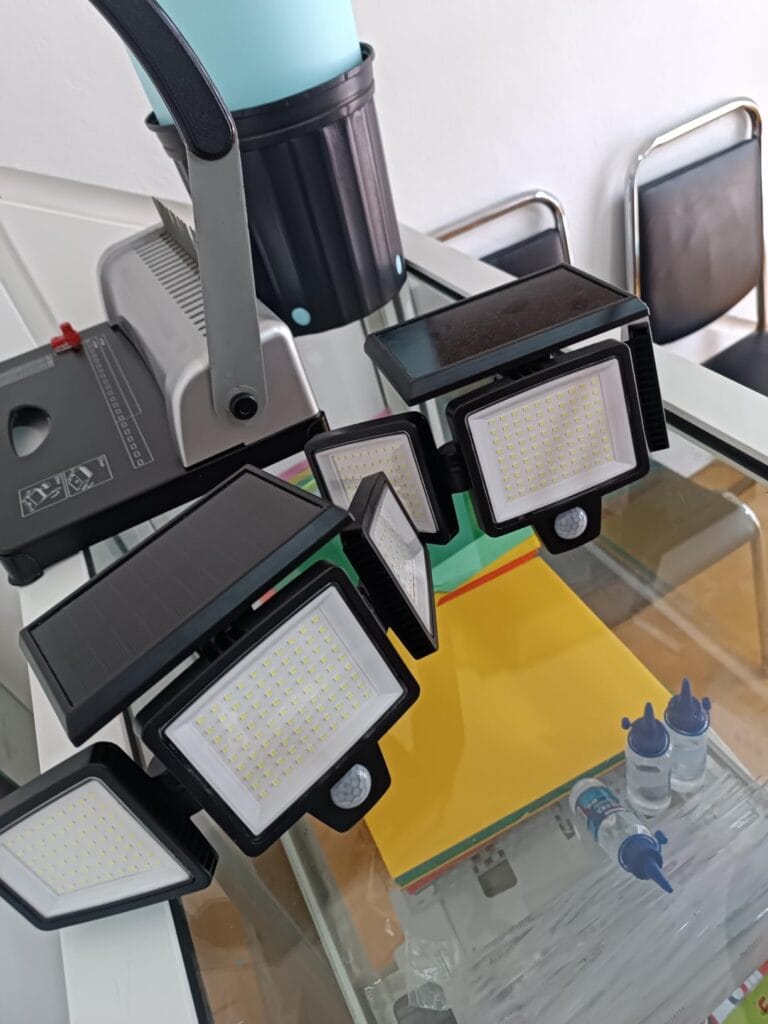
Short on time? Here’s the quick answer before the full breakdown.
| Pick | Best For | Output | Detection Range | Rating |
|---|---|---|---|---|
| Tuffenough 2500LM (2-Pack): Best Overall | 2,500 lumens | 26 ft | 4.4/5, ~38,000 reviews | |
| URPOWER 40 LED (4-Pack): Best Budget Pick | 40 LEDs | 16-26 ft | 4.4/5, ~22,000 reviews | |
| LEPOWER 1600LM (3-Head): Best for Long Driveways | 1,600 lumens | Up to 72 ft (adjustable) | 4.4/5, ~8,600 reviews | |
| TBI Security 216 LED: Best Multi-Head Coverage | 2,200 lumens | 40 ft, 355° rotation | 4.4/5, ~2,100 reviews | |
| Enkman 208 LED 3200LM: Brightest Option | 3,200 lumens | 12-20 ft | 4.3/5, ~3,700 reviews | |
| 100W Dusk-to-Dawn Kit: Best Dusk-to-Dawn | 5,000 lumens (continuous) | No motion sensor | 4.0/5, ~295 reviews |
Ratings and review counts shift over time. Check the current listing before you buy.
How to Choose the Right Solar LED Flood Light
A solar flood light lives outside for years, so the spec sheet matters more than the product photo. Here’s what to check before you add one to your cart.
How Many Lumens Do You Need?
Lumens measure the light itself. Watts measure the power a bulb pulls, and LED count only tells you how many small bulbs sit inside the fixture. A 40-LED light with efficient chips will often outshine a 100-LED light built with cheaper diodes. Judge a solar flood light by its lumen rating, not the LED number printed on the box.
Here’s a rough guide:
- Small patio or garden path: 400 to 600 lumens
- Driveway, backyard, or side entrance: 1,000 to 2,000 lumens
- Large perimeter or wide yard: 2,000+ lumens
Motion Sensor vs. Dusk-to-Dawn: Which One Fits Your Situation?
Motion sensor lights sit in standby and fire at full brightness when the PIR sensor picks up movement. Battery use stays low, and the sudden flash of light doubles as a deterrent for anyone lurking near your property. This is the right pick for most homes.
Dusk-to-dawn lights run continuously from sunset to sunrise. They need a bigger solar panel and a much larger battery to survive the whole night, which pushes the price up. Farms, parking areas, and storage yards benefit most from this style, since constant light matters more than motion-triggered alerts.
Detection Range: Matching It to Your Driveway or Yard
Detection range on solar flood lights runs from about 16 feet on entry-level models to 70+ feet on adjustable units. Match the range to the space you’re covering instead of grabbing the longest number on the shelf. A short driveway doesn’t need a 70-foot sensor, and a long one will feel dim with a 16-foot unit, since it only triggers once you’re already at the door.
Mounting height matters too. Eight feet off the ground hits the sweet spot for most homes. Go lower, and the sensor starts firing every time a cat crosses the yard. Go higher, and it might miss a person walking below the detection angle.
IP Rating Explained: What “Waterproof” Means
The IP rating tells you how well a fixture handles dust and water. The first digit covers dust, the second covers water. IP65 handles rain and low-pressure water jets from any direction, which covers standard outdoor exposure in most climates. IP67 adds protection against brief submersion, useful only if the fixture sits somewhere it might flood or sit in standing water.
For a wall-mounted or fence-mounted flood light, IP65 covers you. Save IP67 for ground-level installs in rainy or coastal regions.
Warm White vs. Cool White: Which Suits Your Home
Most solar flood lights ship in 6500K, a cool, blue-tinted white built for a security look. It’s bright and clinical, which works well on a garage or a commercial building. Homes with a softer, welcoming feel often look better under 5000K to 5500K, and outdoor lighting trends for 2026 are leaning further into warm 2700K to 3000K tones for anything closer to living space. Check the color temperature before you buy. A blinding blue floodlight over your front porch reads more like a prison yard than a welcome mat.
Does Your Location Change What You Should Buy?
Solar panels charge off available daylight, and daylight isn’t equal everywhere. A homeowner in Arizona or Queensland gets long, strong sun most of the year, so a standard-capacity battery recharges fully most days. A homeowner in the UK, the Pacific Northwest, or most of Canada deals with shorter winter days and weaker sun angles, which cuts into how much charge the panel pulls in.
If you live somewhere with long winters or frequent cloud cover, prioritize a model with a larger battery capacity (2200mAh or higher) and a separate, adjustable solar panel you’re able to angle toward true south for maximum exposure. A fixed all-in-one unit mounted on a north-facing wall will struggle to hold a charge through a UK or Canadian winter, no matter how good the spec sheet looks.
Our Top Solar LED Flood Light Picks
1. Tuffenough 2500LM Solar Outdoor Lights (2-Pack with Remote): Best Overall
Close to 38,000 buyer reviews back this one up, with a 4.4-star average. This volume of feedback gives a far more reliable read on real-world durability than a newer product with a handful of five-star ratings. At 2,500 lumens across three adjustable heads, with 270-degree coverage and a 26-foot detection range, it handles most driveways, yards, and entryways without trouble.
The included remote switches between three lighting modes from indoors: dim it for an evening on the patio, then switch back to full motion-sensor mode before bed. IP65 waterproofing and a 6500K cool-white output round out the spec sheet.
Good for: Homeowners who want a well-proven, do-everything option with remote control.
Watch out for: 6500K runs cool and bright, not the warm look some homes prefer.
2. URPOWER 40 LED Solar Lights (4-Pack): Best Budget Pick
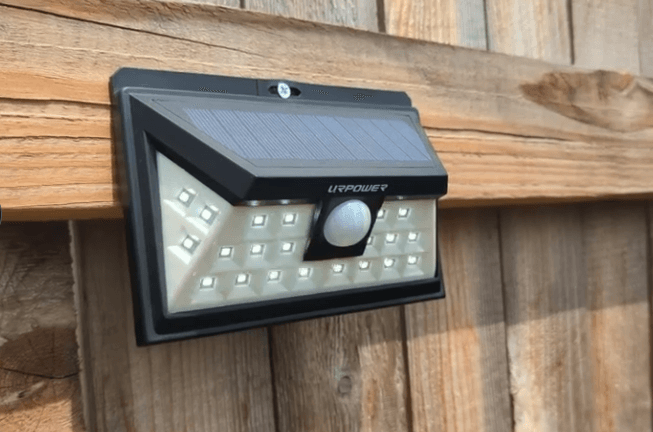
At 4.4 stars across roughly 22,000 reviews, the URPOWER earns its spot as the most trusted budget pick on this list. Four units per pack cover multiple access points, fence lines, or garden borders for less than the cost of a single premium flood light. Installation takes minutes: no wiring, no electrician, only a screw mount and clear sun exposure.
The 40-LED count keeps output modest, so don’t expect flood-level brightness across a wide yard. This is a pathway and perimeter light, not a driveway floodlight.
Good for: Lighting multiple smaller spots, like a garden border, gate, or deck stairs, on a budget.
Watch out for: Limited brightness for large, open areas.
3. LEPOWER 1600LM Solar Security Lights (3-Head): Best for Long Driveways
The LEPOWER’s standout feature is a motion sensor with an adjustable range from 0 to 72 feet, the longest on this list by a wide margin. This is enough to cover a full-length driveway from a single mounting point. Three independently adjustable heads aim light at the door, the walkway, and a side entrance all at once.
At 1,600 lumens and 5500K, the output runs slightly warmer than the cool-white competition. It carries an Amazon’s Choice badge, a 4.4-star rating, and around 8,600 reviews.
Good for: Long driveways or properties where one mounting point needs to cover several angles.
Watch out for: All three heads share one solar panel, so output drops faster on cloudy days compared to multi-panel setups.
4. TBI Security 216 LED Solar Lights (2-Pack): Best Multi-Head Coverage
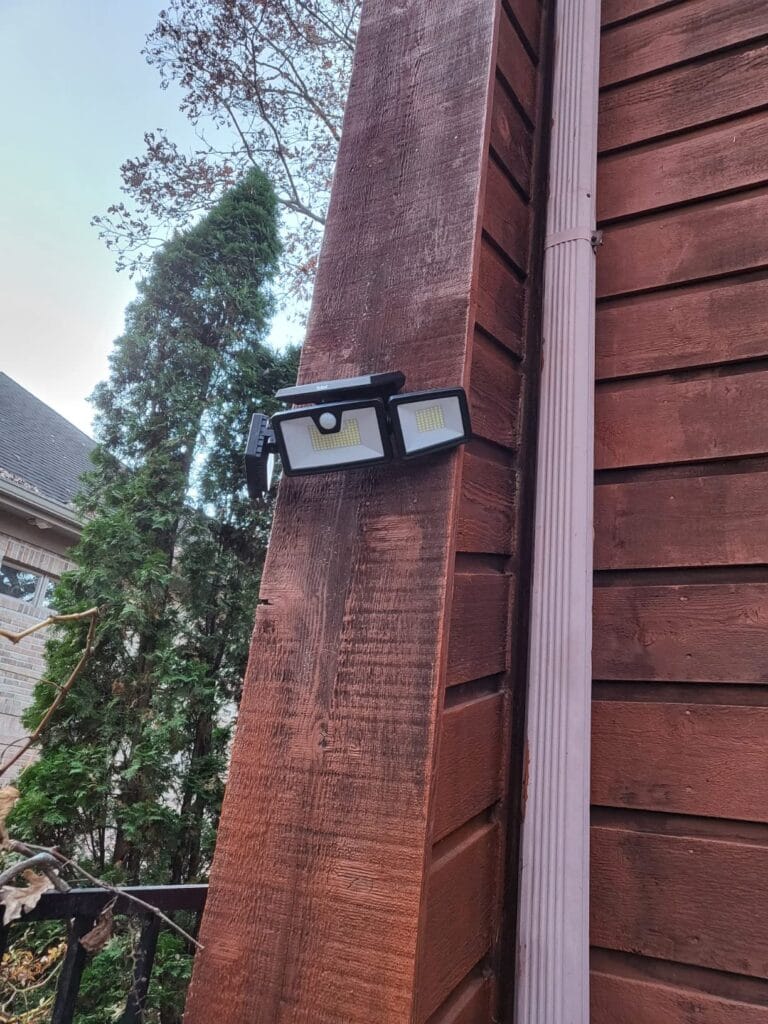
The TBI’s 355-degree horizontal rotation sets it apart from every other adjustable-head design on this list. Mounted on a corner or a central post, it covers close to a full circle from one fixture. At 2,200 lumens and a 40-foot detection range, it outperforms most competitors on raw coverage, and the 2-pack rates for up to 800 square feet combined.
Reviews sit at 4.4 stars across roughly 2,100 ratings, a smaller sample than the top picks above but still a solid base to judge from.
5. Enkman 208 LED Solar Lights 3200LM (2-Pack): Brightest Option
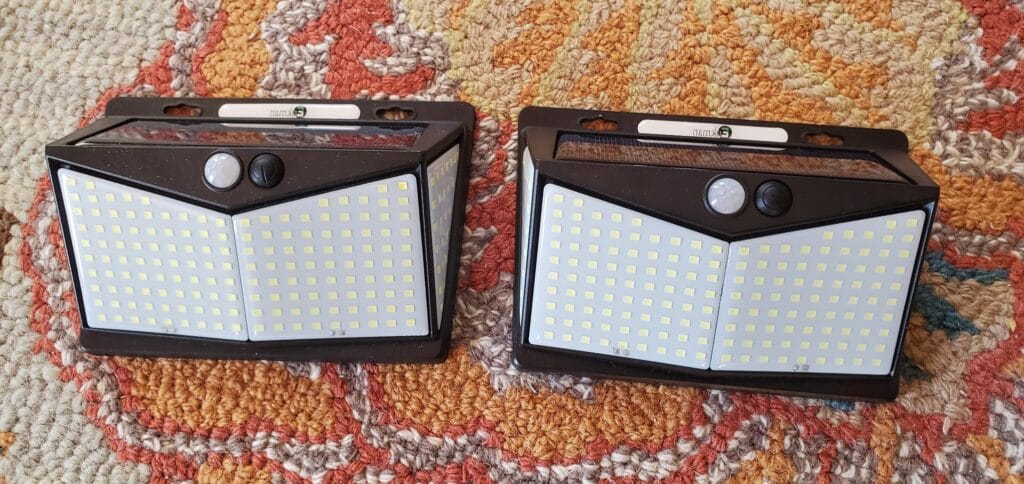
If raw brightness tops your priority list, the Enkman delivers more lumens than anything else here: 3,200 per unit, paired with 270-degree coverage. Three lighting modes give you control over battery drain, including a dim-always-on setting: a low background glow runs all night, with a brighter flash on motion.
At 4.3 stars and roughly 3,700 reviews, it’s well-regarded but carries a smaller sample size than the Tuffenough or URPOWER.
Good for: Wide, open areas needing maximum brightness in one unit.
Watch out for: The 12-20 foot detection range runs shorter than several other picks here, so it’s built for brightness over reach.
6. 100W Solar Flood Light Dusk-to-Dawn Kit: Best Dusk-to-Dawn
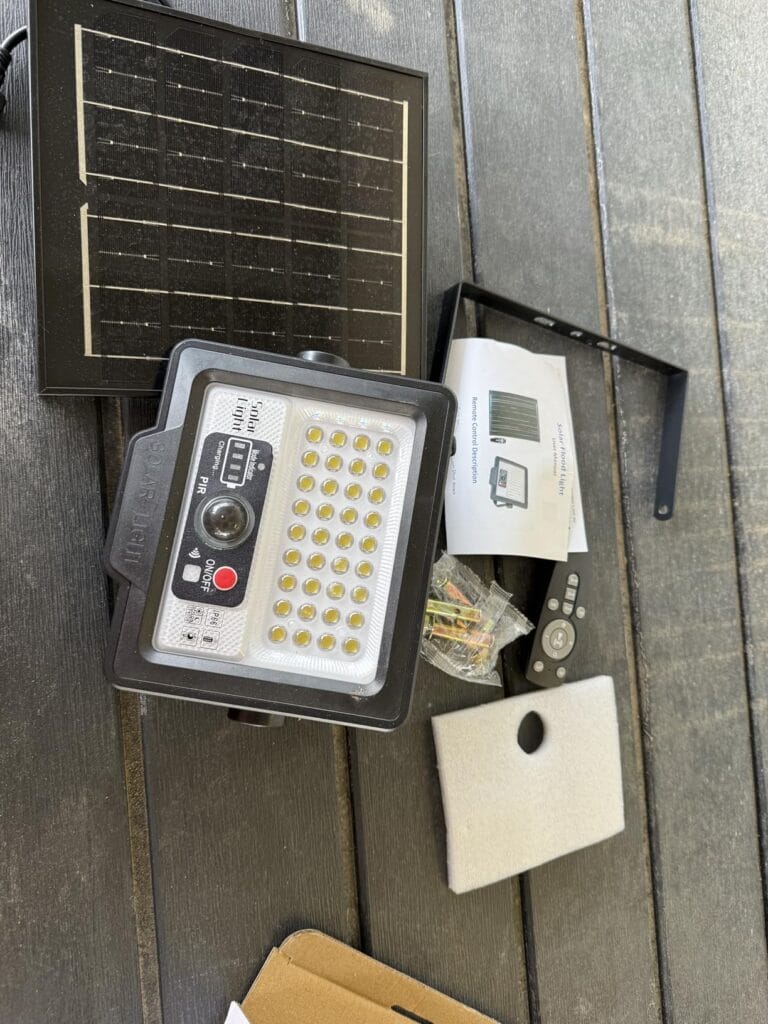
Every other pick on this list waits for motion. This one doesn’t. It runs continuously from sunset to sunrise at 5,000 lumens, powered by a 100W solar panel and a 36,000mAh battery good for roughly 10 hours of runtime on a full charge. A 5-meter extension cable mounts the panel and light head separately, which matters for continuous-output units needing consistent sun exposure.
Reviews sit lower here, at 4.0 stars across around 295 ratings, reflecting how demanding this category is on installation conditions. It needs close to 8 hours of direct sun for a full charge, so shaded or overcast locations will underperform.
Good for: Farms, parking areas, or storage yards needing constant light rather than motion-triggered alerts.
Watch out for: Requires strong, consistent daily sun. A shaded or cloudy-climate install falls short of the advertised runtime.
Solar LED Flood Lights Compared Side by Side
| Model | LEDs | Lumens | Color Temp | Detection Range | IP Rating | Battery | Pack |
|---|---|---|---|---|---|---|---|
| Tuffenough 2500LM | 210 | 2,500 | 6500K | 26 ft | IP65 | Not published | 2 |
| URPOWER 40 LED | 40 | Not published | Not published | 16-26 ft | IP65 | 2200mAh | 4 |
| LEPOWER 1600LM | Multi-head | 1,600 | 5500K | 0-72 ft (adjustable) | IP65 | Not published | 1 |
| TBI Security 216 LED | 216 | 2,200 | 6500K | 40 ft | IP65 | 2200mAh | 2 |
| Enkman 208 LED | 208 | 3,200 | Not published | 12-20 ft | IP65 | 2200mAh | 2 |
| 100W Dusk-to-Dawn | 324 | 5,000 | Not published | No sensor | Not published | 36,000mAh | 1 |
“Not published” means the manufacturer’s listing doesn’t disclose the spec. Treat missing data as a caution flag, not a bonus.
Common Problems and How to Fix Them
Light Won’t Turn On or Charge
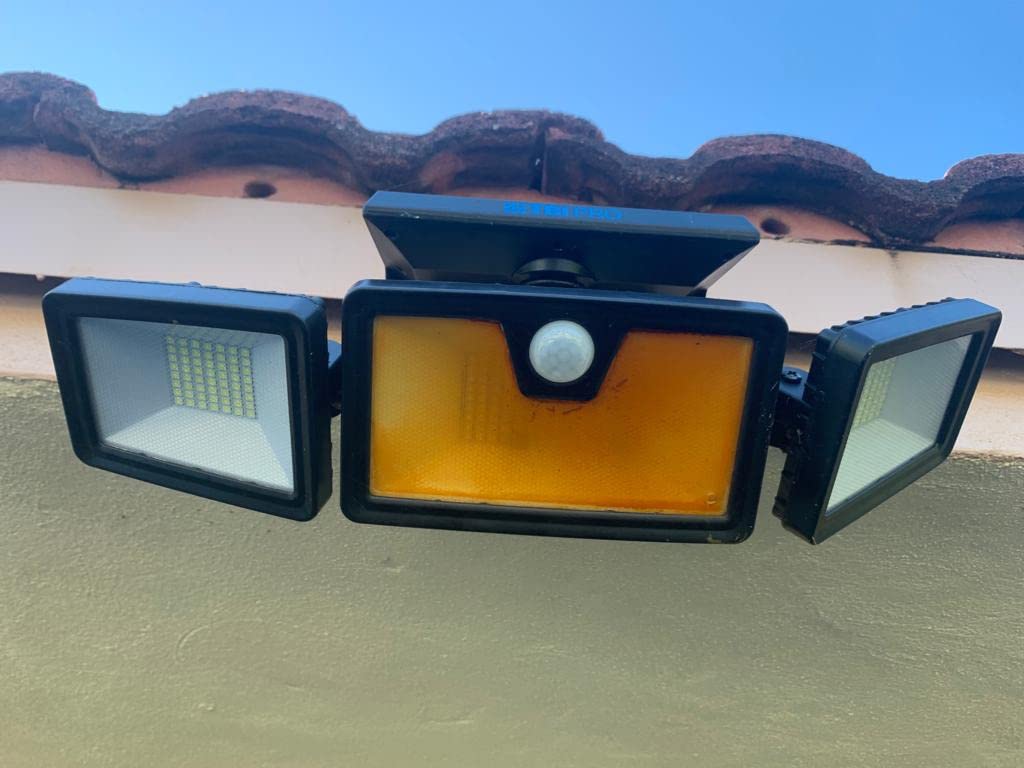
Check sun exposure first. A solar panel needs direct, unobstructed sun for most of the day to build a full charge, and even light shade from a nearby tree or roof overhang cuts output significantly. Move the panel to a clearer spot facing south (Northern Hemisphere) before assuming the unit is faulty. If exposure looks fine, check the on/off switch, since many units ship switched off, and wipe the panel surface clean of dust or pollen buildup.
Light Keeps Triggering on Animals or Shadows
Raise the mounting height closer to 8 feet. PIR sensors near ground level pick up cats, rabbits, and blowing branches far more often than sensors mounted higher, which better isolate human-sized heat signatures. If your model includes a sensitivity dial, lower it a notch. Angling the sensor away from hedges and low ground cover helps too.
Light Turns Off Too Early at Night
This usually points to a battery not holding a full charge. Confirm the panel gets a complete day of sun, since a partial charge means a partial night of runtime. Switch to a lower brightness or motion-only mode instead of always-on to stretch the battery further. If the light has run for a year or more, a worn rechargeable battery is a normal wear point, and most models allow a battery swap.
FAQs
How long do solar LED flood lights stay on at night?
Motion-triggered lights activate for 20 to 30 seconds per trigger and reset to standby, letting them fire hundreds of times a night without draining the battery. Dusk-to-dawn models run continuously and typically last 8 to 12 hours on a full charge, depending on battery size and brightness setting.
Do solar flood lights work in winter or cloudy climates?
Yes, though output drops. Shorter days and lower sun angles mean less daily charging time, and cold temperatures temporarily reduce battery capacity. In regions with mild winters, the difference stays minor. In areas with long winters or heavy cloud cover, expect noticeably shorter runtime from late fall through early spring.
Do solar flood lights work in winter or cloudy climates?
For motion-triggered home security in a location with reasonable sun exposure, performance runs close to a wired equivalent, with zero installation cost and no ongoing electricity bill. The gap shows up with continuous, all-night lighting needs, where a wired system doesn’t depend on weather.
What’s the difference between IP65 and IP67?
IP65 protects against low-pressure water jets from any direction, covering rain and normal outdoor exposure. IP67 adds resistance to brief submersion. Standard wall or fence mounting only needs IP65. Save IP67 for ground-level spots at risk of flooding or standing water.
How many lumens is good enough for security lighting?
For genuine security coverage across a driveway or yard, aim for 1,000 lumens or higher. Anything above 2,000 lumens covers larger perimeters and wider open spaces.
Final Verdict: Which One Should You Buy?
For most homes, the Tuffenough 2500LM earns the top spot. It balances brightness, coverage, and a review base large enough to trust, with remote control as a genuine convenience feature rather than a gimmick. Budget-focused buyers covering multiple smaller spots should look at the URPOWER 4-pack instead. Long driveways favor the LEPOWER’s 72-foot adjustable range, corner or perimeter installs favor the TBI Security’s 355-degree rotation, and anyone chasing raw brightness should look at the Enkman. Farms and commercial spaces needing constant overnight light, not motion triggers, are the only real case for the 100W dusk-to-dawn category.
Match the pick to the space, check the sun exposure at your mounting spot, and the right solar LED flood light will outlast its wired alternative on both performance and cost.
Summary
This guide compares 6 top solar LED flood lights by lumens, detection range, IP rating, and battery performance, using verified specs and real buyer reviews. It covers how to pick the right lumens, sensor type, and waterproof rating for your space, plus troubleshooting for common issues like short runtime and false triggers. Includes a full side-by-side comparison table and FAQ section.