Quick Answer: Cash purchase gives the highest long-term savings on solar, with payback in 9-13 years, since the federal tax credit for buyers expired December 31, 2025. Solar loans offer similar ownership benefits but add 6-10% APR interest. Leases and PPAs need $0 down and no maintenance, and their providers can still claim a separate 30% federal tax credit, making them more competitive than before.
Table of Contents
Most articles will tell you buying solar beats leasing it. That used to be simple advice. It isn’t anymore.
Here’s the myth: get a 30% federal tax credit no matter how you pay for solar. That was true through 2025. It is not true in 2026.
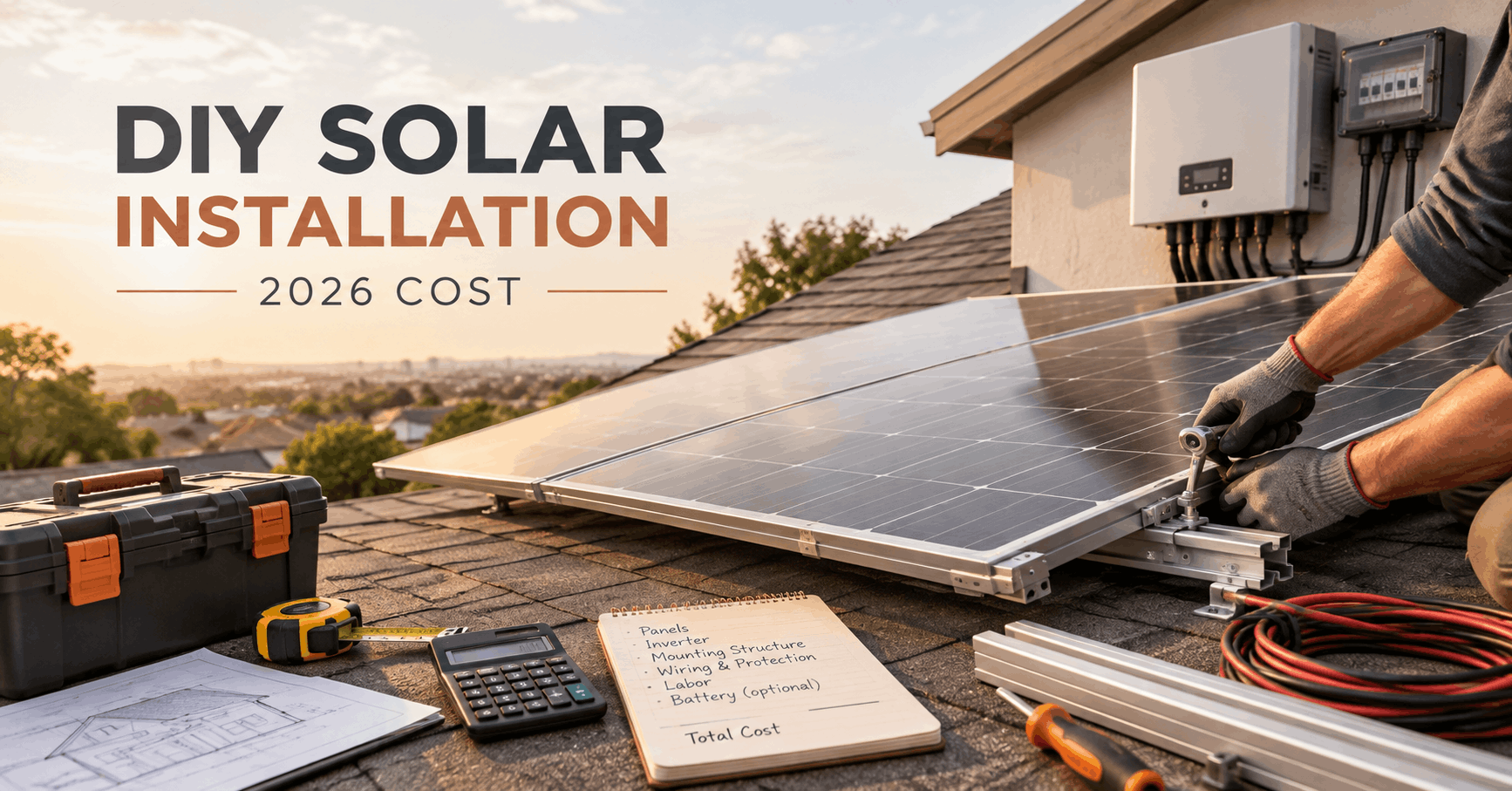
The average solar system costs $30,505 before any incentives. Without a tax credit, cash buyers now hit payback in roughly 9 to 13 years, depending on their state and electricity rate. That’s a real shift from a few years ago, and it changes which financing option actually wins for you.
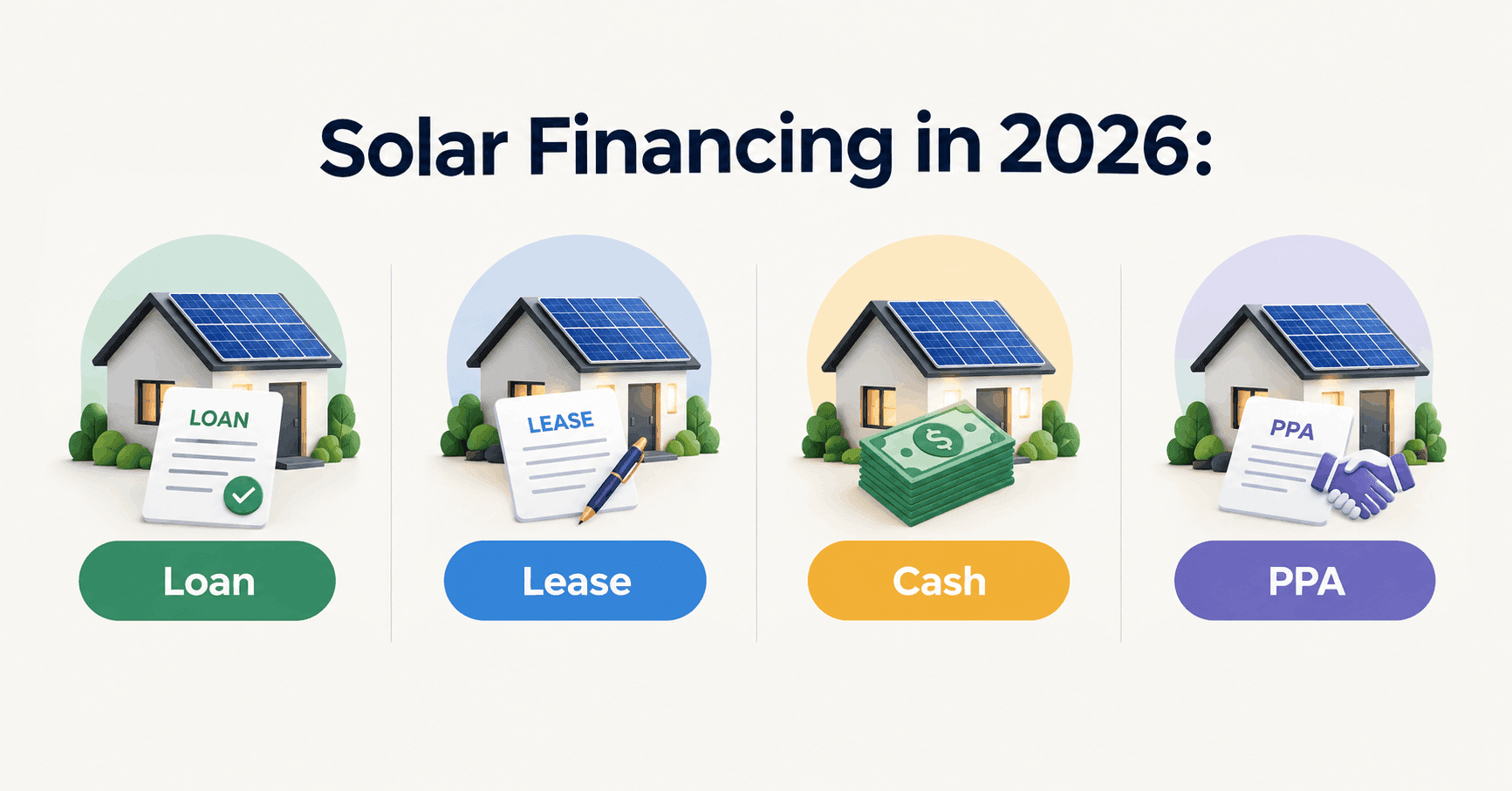
This guide breaks down all four ways to pay for solar, cash, loan, lease, and PPA, using current 2026 numbers, not recycled 2022 advice.
Key Takeaways
- The federal residential solar tax credit (Section 25D) expired on December 31, 2025. Cash and loan buyers get $0 from the IRS in 2026.
- Lease and PPA providers can still claim a 30% federal credit (Section 48/48E) because they own the system — and competitive providers pass some of that savings to you.
- Solar loan APRs in 2026 run roughly 6% to 10% for most borrowers, Marketplace data, but watch for dealer fees that quietly inflate your loan balance by 15% to 30%.
- Cash still wins on total 25-year savings. Lease and PPA win on day-one affordability and zero maintenance.
- If you’re selling your house within 5-10 years, ownership structure (cash/loan vs. lease/PPA) matters a lot more than the sticker price.
How I Put This Together
I’m not going to pretend I surveyed 500 installers. I didn’t. What I did do: pulled current numbers from Marketplace data, IRS guidance on the federal tax credit, the Consumer Financial Protection Bureau’s solar loan disclosures, and DOE resources, then cross-checked the loan APR and dealer-fee figures against multiple independent 2026 sources before putting a single number in this article. Where the data disagreed, I used the range, not a made-up average. I’ll link sources at the bottom so you can check my work.
Quick Answer: Which Option Is Best For You?
| Your Situation | Best Financing Option |
|---|---|
| You have $25,000+ available and plan to stay 10+ years | Cash Purchase |
| You want ownership but don’t have cash upfront | Solar Loan (from a credit union, not an installer-partnered lender) |
| You want $0 down and zero maintenance hassle | Lease |
| You want to pay only for the electricity you actually use | PPA |
| You’re planning to sell your home within 5 years | Cash or Loan (lease/PPA can complicate a sale) |
Talk to a solar advisor before signing anything, a good one will run your actual roof, rate, and credit numbers instead of a generic estimate. Marketplaces let you compare real installer quotes side by side for free, which is a smarter starting point than taking one salesperson’s word for it.
The 2026 Game-Changer: The Tax Credit Is Gone for Buyers
For over a decade, the pitch was simple: buy solar, get 30% back from the IRS, done. That credit, Section 25D of the tax code, expired December 31, 2025.
If you buy a system in 2026 with cash or a loan, you get zero federal tax credit. That raises the real cost of ownership compared to a year ago.
Here’s the part most homeowners don’t know: lease and PPA companies are not affected the same way. Because they own the equipment on your roof, they still qualify for a separate federal credit, Section 48/48E, the commercial version of the ITC. A competitive lease or PPA provider will fold that 30% savings into your monthly rate.
In plain terms: third-party ownership just got noticeably more competitive against buying, and it happened almost overnight.
Solar Financing Options Compared
| Cash | Loan | Lease | PPA | |
|---|---|---|---|---|
| Who owns the system | You | You | Provider | Provider |
| Upfront cost | Full price | $0 down (usually) | $0 down | $0 down |
| Federal tax credit access (2026) | None | None | Indirect, via provider | Indirect, via provider |
| Monthly payment | None | Fixed loan payment | Fixed monthly fee | Based on kWh produced |
| Maintenance responsibility | You | You | Provider | Provider |
| Adds to home value | Yes | Yes | Rarely | Rarely |
| Typical contract length | N/A | 10-25 years | 20-25 years | 20-25 years |
| 25-year savings potential | Highest | High | Moderate | Moderate |
Cash Purchase: Best For Long-Term Owners With Capital on Hand

Best for: homeowners who can cover the upfront cost and plan to stay put for a decade or more.
How it works
You pay the full system cost upfront. You own it outright from day one. No interest, no monthly bill, no landlord.
The real numbers
A typical 12 kW system runs $30,505 before incentives, according to 2026 marketplace data. Without the federal credit, most homeowners see payback in 9 to 13 years, depending on local electricity rates. After that, the electricity is essentially free for the rest of the system’s 25+ year lifespan.
Pros and cons
Pros: no interest paid, highest lifetime savings, adds to home resale value, no third party involved in your roof.
Cons: you need a large amount of cash sitting around, and that money isn’t available for anything else while it’s tied up in your roof.
Solar Loan: Best For Owners Who Want the Tax-Free Cash Flexible
Best for: homeowners who want to own the system but don’t want to drain their savings.
How it works
You borrow the money, install the system, and own it immediately, same benefits as cash, minus the interest cost.
The real numbers (and the trap to avoid)
Marketplace data puts current solar loan APRs in a 6% to 10% range for most credit profiles, with rates from credit unions often landing on the lower end. That part is straightforward.
Here’s what isn’t straightforward: many installer-partnered loans advertise a very low headline rate, sometimes under 2%, by quietly building a dealer fee into the loan. That fee, typically 15% to 30% of the system cost, gets rolled into what you’re actually financing. The Consumer Financial Protection Bureau has flagged this exact practice as a common source of confusion for solar borrowers.
Funny how a “great rate” can cost more than a normal one once you actually run the math. Always ask for the cash price of the system and the total amount financed, not just the monthly payment.
Pros and cons
Pros: you own the system, keep any state-level incentives your area still offers, and spread the cost out.
Cons: you pay interest, and a hidden dealer fee can erase a chunk of your expected savings if you don’t check for it.
Solar Lease: Best For Zero-Hassle, Zero-Down Simplicity
Best for: homeowners who want predictable bills and don’t want to think about maintenance, ever.
How it works
A solar company installs the system on your roof, keeps ownership, and charges you a fixed monthly fee, usually 10% to 30% lower than your current electric bill.
The escalator clause, read this part twice
Most leases include an annual rate increase called an escalator, typically 1% to 3% per year. It sounds small. Over 20 years, it adds up.
Quick example: a $100/month lease with a 3% escalator costs about $175/month by year 20. A 1% escalator on the same lease costs about $122/month in year 20. Same starting price, very different ending price. Before you sign anything, ask for the exact escalator rate in writing.
Pros and cons
Pros: no upfront cost, no maintenance responsibility, immediate savings, provider can now pass along the commercial tax credit.
Cons: you never own the system, it rarely adds to home value, and leases can complicate selling your house.
PPA: Best For Paying Only for What You Actually Use
Best for: homeowners who want a usage-based bill instead of a flat fee.
How it works
Same third-party ownership as a lease, but instead of a fixed monthly fee, you pay per kilowatt-hour produced — closer to how your utility bill already works.
One catch: PPAs aren’t legal or available everywhere. Around 15 states have unclear or restrictive rules on third-party electricity sales, so check availability in your area before assuming it’s an option.
Pros and cons
Pros: usage-based pricing feels more intuitive to some homeowners, $0 down, provider handles maintenance.
Cons: same resale complications as a lease, and your bill can vary month to month with sunlight and production.
What Happens When You Sell Your House?

Cash or loan: the system is yours. It typically adds to your home’s value, and you can sell like any other home improvement, assuming any loan balance is paid off or rolled into the sale.
Lease or PPA: the buyer either needs to qualify to take over your contract, or you need to buy out the remaining term before closing. This has stalled real estate deals before. If you’re not planning to stay 15+ years, factor this in seriously.
Quick Glossary
APR — Annual Percentage Rate. The real yearly cost of borrowing, including interest.
Escalator clause — A built-in annual increase in your lease or PPA payment, usually 1-3%.
ITC (Investment Tax Credit) — The federal tax credit for solar. Section 25D (homeowner version) expired in 2025. Section 48/48E (commercial version) is still active and used by lease/PPA providers.
PPA (Power Purchase Agreement) — A contract where you pay a third party per kilowatt-hour of solar electricity produced on your own roof.
TPO (Third-Party Ownership) — The umbrella term for leases and PPAs, where a company, not you, owns the panels.
Dealer fee — A cost some installers add to a solar loan in exchange for offering a lower advertised interest rate.
FAQs
Do I still get a tax credit if I lease solar in 2026?
Not directly. The lease company claims the 30% commercial credit and may pass some savings to you through a lower monthly rate.
Is a solar loan or lease better for home resale?
A loan, generally. You own the system, so it’s treated like any other home improvement instead of an assumable contract.
What’s a reasonable escalator rate for a lease?
Aim for 0% to 1%. Be cautious of anything above 3%, since it compounds significantly over a 20-25 year term.
Can I switch from a lease to buying later?
Some providers allow a buyout partway through the contract. Ask for buyout terms and pricing before you sign, not after.
Summary
If you have the cash and plan to stay long-term, buying still wins on total savings, the math hasn’t flipped that far. But the gap has narrowed since the tax credit expired, and for a lot of homeowners, a lease or PPA is now a genuinely competitive choice, not just a fallback for people without savings.
Get quotes for more than one option before deciding. A solar advisor who runs your specific roof, rate, and credit profile will tell you more than any general guide, including this one.