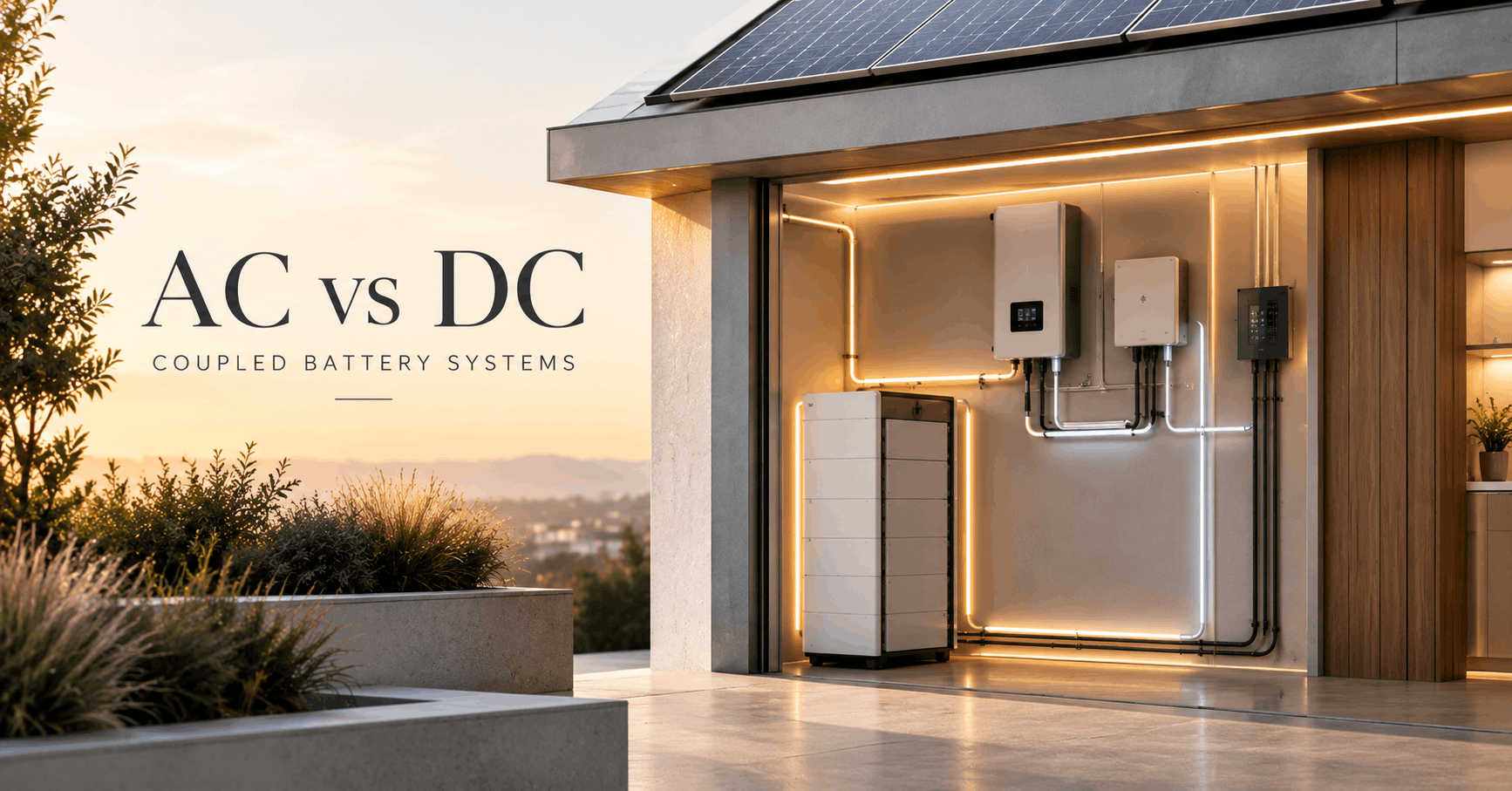
Quick Answer: AC-coupled battery systems use two separate inverters and are best for adding storage to solar panels you already own, with round-trip efficiency around 90–92%. DC-coupled systems use one hybrid inverter, offer higher efficiency (95–99%), and work best when solar and battery are installed together. Choose AC-coupled for retrofits and DC-coupled for new installations.
Table of Contents
The Myth We Need to Kill First
Here’s a line you’ll hear from installers, YouTube comment sections, and every third Facebook solar group: “DC coupling is the smart, modern choice. AC coupling is the old, wasteful way.”
That’s not true. It’s not even close to true.
AC coupling isn’t a leftover from the past. It’s a different engineering trade-off, and for a huge number of homes, it’s the right one. DC coupling wins on efficiency. AC coupling wins on flexibility, retrofits, and redundancy. Neither one is “outdated.” Plenty of installers describe AC coupling as “stylish simplicity,” not a compromise.
So let’s stop treating this like a good-vs-bad choice. It’s a fit question. Your home, your budget, and your existing equipment decide the answer — not internet opinions.
Key Takeaways
- AC-coupled systems use two separate inverters (one for solar, one for the battery). They’re the easiest way to add storage to a solar system you already own.
- DC-coupled systems use a single hybrid inverter. They’re more efficient but work best when installed alongside new solar panels.
- DC coupling typically hits 95–99% round-trip efficiency. AC coupling typically lands around 90–92%, because power gets converted three times instead of once.
- U.S. residential electricity averaged about 18 cents per kWh in early-to-mid 2026, according to EIA data, and it’s trending upward, which is exactly why this efficiency gap matters more each year (U.S. EIA).
- There is no universal “winner.” Your existing solar setup, your budget, and your backup-power needs decide which coupling type makes sense.
- Always confirm your specific numbers with a licensed installer or a human energy advisor before signing a contract. This article gives you the framework, not a quote.
Why This Decision Matters Right Now
Let’s talk numbers before we talk engineering.
The average U.S. household now pays somewhere around 18 cents per kilowatt-hour, and the EIA expects that number to keep climbing through 2026 as grid upgrades and rising demand push costs onto customer bills (ConsumerAffairs, citing EIA). That rate varies a lot by state, homeowners in Hawaii and California pay far more than those in North Dakota or Texas (JouleIO, EIA data).
Most solar-plus-battery homeowners break even somewhere around the 10-year mark, though this depends heavily on local rates, incentives, and system size.
Here’s why coupling type matters inside that payback math: a few efficiency percentage points don’t sound like much. But stretched across 10-plus years of daily charge-and-discharge cycles, that “small” gap becomes real money, especially as electricity prices keep rising instead of falling.
This isn’t a spec-sheet detail. It’s a decision that quietly shapes your bill for the next decade.
What Is an AC-Coupled Battery System?
Picture two separate boxes doing two separate jobs.
Box one is your existing solar inverter. It takes the DC electricity from your panels and turns it into AC electricity your home can use.
Box two is a battery inverter. If there’s extra solar power left over, it grabs the AC electricity, converts it back to DC, and stores it in the battery. When you need that power later, it converts it back to AC again.
That’s three conversions total: DC to AC, AC to DC, DC to AC. Each conversion loses a little energy as heat, the same way your phone charger gets warm while it works.
Why people choose it anyway: if you already have solar panels installed, AC coupling lets you bolt on a battery without touching your existing inverter. No rewiring your whole system. No compatibility gymnastics. Just add the battery and go.
What Is a DC-Coupled Battery System?
Now picture one box doing everything.
A DC-coupled system uses a single hybrid inverter that manages both your solar panels and your battery at the same time. Solar electricity flows straight from your panels to your battery in its original DC form, no detour through AC and back.
The power only converts to AC once: right before it leaves the system to power your home or the grid.
Fewer conversions mean less energy lost to heat. That’s the entire efficiency advantage in one sentence.
The catch: because everything runs through one hybrid inverter, DC coupling works best when you’re installing solar and battery storage at the same time. Bolting it onto an existing, older solar inverter is possible but often means replacing equipment you already paid for.
AC vs DC Coupled: The Comparison Table
| Factor | AC-Coupled | DC-Coupled |
|---|---|---|
| Inverters needed | Two (solar + battery) | One (hybrid) |
| Round-trip efficiency | ~90–92% | ~95–99% |
| Best for | Adding storage to existing solar | New solar + battery installs |
| Installation complexity | Lower for retrofits | Lower for new builds |
| Hardware cost | Higher (two inverters) | Lower (one inverter) |
| Redundancy if one part fails | Higher, solar or battery can keep working independently | Lower, a hybrid inverter failure can affect both |
| Grid charging | Generally straightforward | Depends on the specific hybrid inverter |
| Scalability | Easy to add solar or battery separately later | Can be more rigid, especially for older hybrid inverters |
Efficiency: Where the Power Actually Goes
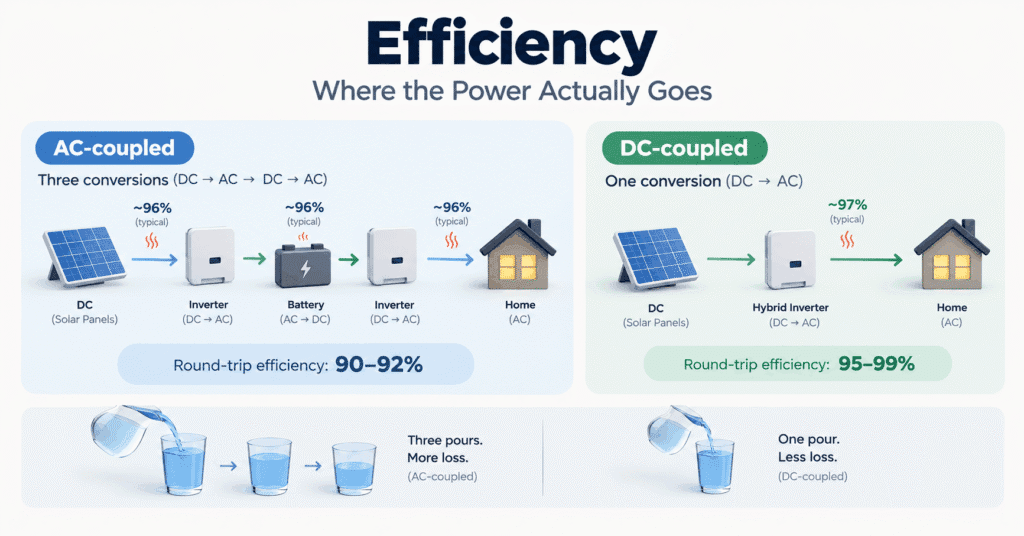
Every time electricity gets converted between AC and DC, some of it turns into heat and disappears. That’s just physics, inverters aren’t 100% efficient, and each conversion typically loses a small percentage of the power passing through it.
AC-coupled systems: three conversions (DC → AC → DC → AC). Reported round-trip efficiency generally falls around 90–92% (Clean Energy Reviews).
DC-coupled systems: one conversion (DC → AC). Reported round-trip efficiency generally lands between 95–99%, depending on the hybrid inverter (SolarInsure).
Think of it like pouring water between glasses. Pour it once, you barely spill any. Pour it three times, and you’ve lost a noticeable amount by the last glass, even if each individual pour looks fine.
Over a year, that gap is small in absolute terms. Over 10–15 years of daily cycling, and with electricity prices trending upward, it adds up to a real number on your utility bill, not a dramatic one, but a real one.
Cost: What You’ll Really Pay
AC coupling typically costs more in hardware, because you’re buying two inverters instead of one. DC coupling saves on hardware but can cost more in labor if it requires replacing an existing solar inverter to make everything compatible.
Neither system is universally cheaper. The math depends on:
- Whether you already own solar panels
- Your existing inverter’s age and compatibility
- Local labor rates and permitting requirements
- Which specific battery and inverter brand you choose
This is exactly the kind of number that varies by ZIP code and roof, which is why we keep pointing you toward a real quote instead of a generic price tag.
Retrofit vs New Build: The Question That Actually Decides This
Forget efficiency for a second. Ask yourself this one question first:
Do you already have solar panels installed?
- Yes, and you’re happy with your current inverter → AC coupling is almost always the simpler, cheaper path. You add a battery without disturbing your existing setup.
- No, you’re planning a new solar-plus-battery system from scratch → DC coupling is worth strong consideration, since you’re not fighting existing equipment and you get the efficiency advantage from day one.
This single question eliminates about 80% of the “which one is right for me” confusion floating around forums and comment sections.
Backup Power and What Happens When Something Breaks
Nobody wants to think about equipment failure. But it’s worth thirty seconds of your attention.
In an AC-coupled system, your solar inverter and battery inverter operate independently. If the battery inverter needs a service visit, your solar panels can often keep powering your home in the meantime. Many installers describe this as genuine redundancy: one part keeps working while the other waits for a repair.
In a DC-coupled system, everything runs through one hybrid inverter. If that single inverter fails, solar generation and battery storage can both go down together until it’s fixed.
This doesn’t make DC coupling unreliable, hybrid inverters are built to a high standard. It just means the failure mode is different. AC coupling spreads the risk across two boxes. DC coupling concentrates everything into one.
If whole-home backup during outages is your top priority, ask your installer directly how each option handles a single-point failure. It’s a fair question, and a good installer won’t dodge it.
Real Products: Who Makes What
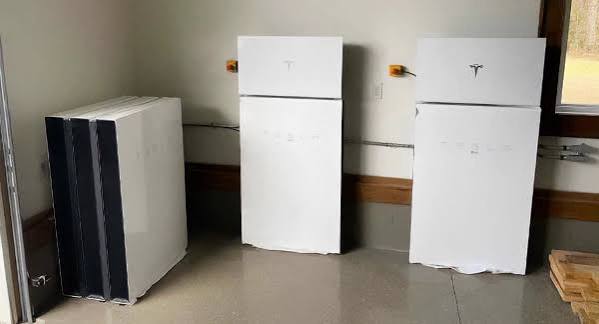
Coupling type isn’t just theory, it’s baked into specific products you’ll actually see quoted.
| Product | Brand | Coupling Type |
|---|---|---|
| Powerwall 2 / Powerwall+ | Tesla | AC-coupled |
| Powerwall 3 | Tesla | DC-coupled (hybrid inverter) |
| IQ Battery | Enphase | AC-coupled |
| Home Battery | SolarEdge | DC-coupled |
| Hybrid Inverter Systems | Sol-Ark | DC-coupled |
| aPower / aGate | Franklin WH | Both configurations available |
| RESU Series | LG Chem | DC-coupled (via compatible hybrid inverters) |
Always confirm current specs directly with the manufacturer or your installer, product lineups change.
Which One Should You Pick?
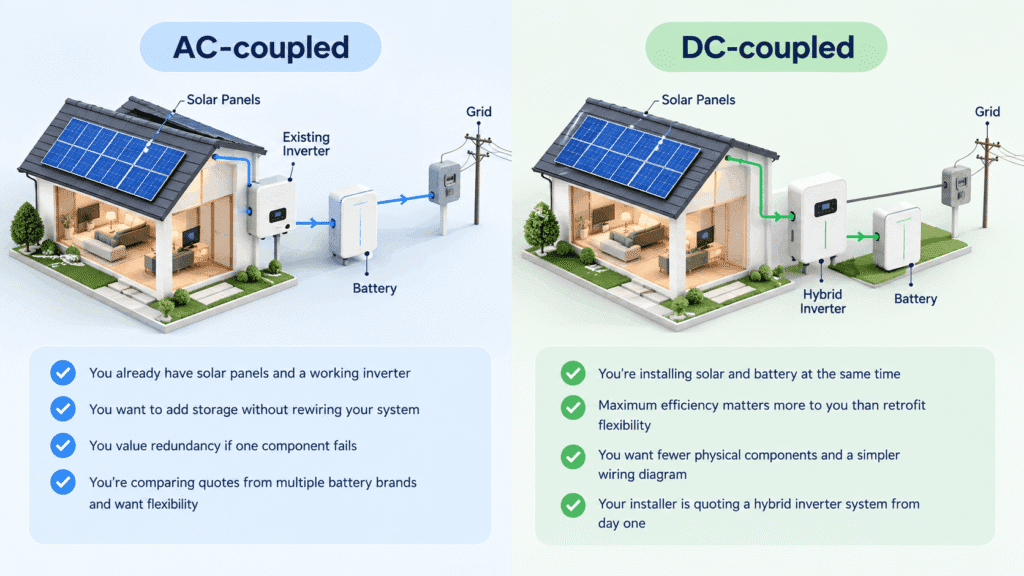
Choose AC-coupled if:
- You already have solar panels and a working inverter
- You want to add storage without rewiring your system
- You value redundancy if one component fails
- You’re comparing quotes from multiple battery brands and want flexibility
Choose DC-coupled if:
- You’re installing solar and battery at the same time
- Maximum efficiency matters more to you than retrofit flexibility
- You want fewer physical components and a simpler wiring diagram
- Your installer is quoting a hybrid inverter system from day one
Talk to a Real Advisor Before You Sign Anything
Everything in this article is the framework. It is not a substitute for someone who can look at your roof, your panel age, your utility rate plan, and your breaker box.
Before you commit to either coupling type, talk to a licensed solar or energy advisor and ask them to walk you through:
- Whether your current inverter (if you have one) supports AC coupling
- What your actual round-trip efficiency would look like with the specific battery you’re considering
- Your real payback period based on your local electricity rate, not a national average
- What backup power actually looks like during an outage with each option
A good advisor will answer these plainly, without pushing you toward whichever product pays them the biggest commission. If they can’t explain the trade-offs in plain language, get a second opinion.
Common Misconceptions
“DC coupling is always cheaper.” Not necessarily, it depends on whether you’re retrofitting or building new.
“AC coupling is outdated technology.” No. It’s a different architecture, still widely manufactured and installed today, including in brand-new Tesla and Enphase products.
“Efficiency difference doesn’t matter.” It’s not huge, but it’s not nothing either, especially as electricity prices keep climbing year over year.
“You can’t mix AC and DC coupled equipment.” In many cases you actually can, depending on your inverter and battery brand. Ask your installer specifically about your equipment combination.
Glossary
AC (Alternating Current): Electricity that flows back and forth, used by the grid and most home appliances.
DC (Direct Current): Electricity that flows in one direction, produced by solar panels and stored in batteries.
Inverter: A device that converts electricity between DC and AC.
Hybrid Inverter: A single inverter that manages both solar panels and battery storage together, the core of a DC-coupled system.
Round-Trip Efficiency: The percentage of energy you get back out of a battery compared to what you put in, after accounting for conversion losses.
Retrofit: Adding a battery (or any new component) to a solar system that’s already installed and operating.
Coupling: The method by which a battery connects to the rest of your solar system, either through AC or DC electricity.
FAQs
Is DC coupling always more efficient than AC coupling?
Generally yes, because it involves fewer power conversions. But the real-world gap depends on the specific hybrid inverter and battery you choose.
Can I add a DC-coupled battery to my existing solar panels?
Sometimes, but it often requires replacing your current inverter with a compatible hybrid inverter, which adds cost. AC coupling usually avoids this issue.
Which is cheaper, AC or DC coupled storage?
It depends on whether you’re retrofitting (AC often wins on total cost) or building new (DC often wins on total cost). Get quotes for both before deciding.
Do off-grid homes use AC or DC coupling?
Both are used off-grid, though DC coupling has traditionally been common in smaller off-grid and mobile setups, while AC coupling is often used in larger off-grid systems with high daytime loads.
Does electricity price actually affect which coupling type I should choose?
Yes, indirectly. Higher electricity rates make efficiency losses more expensive over time, which can tip the math toward DC coupling for new installs, but retrofit compatibility still often decides the choice first.
This article is for general education. Confirm specifications, pricing, and compatibility with a licensed installer before purchasing any solar or battery equipment.