Table of Contents
Solar lights promise a simple deal: free light, no wiring, no monthly bill. Walk into any hardware store, though, and you’ll face a wall of options — stake lights, spotlights, string lights, step lights, all labeled “solar” as if that one word makes them interchangeable. It doesn’t.
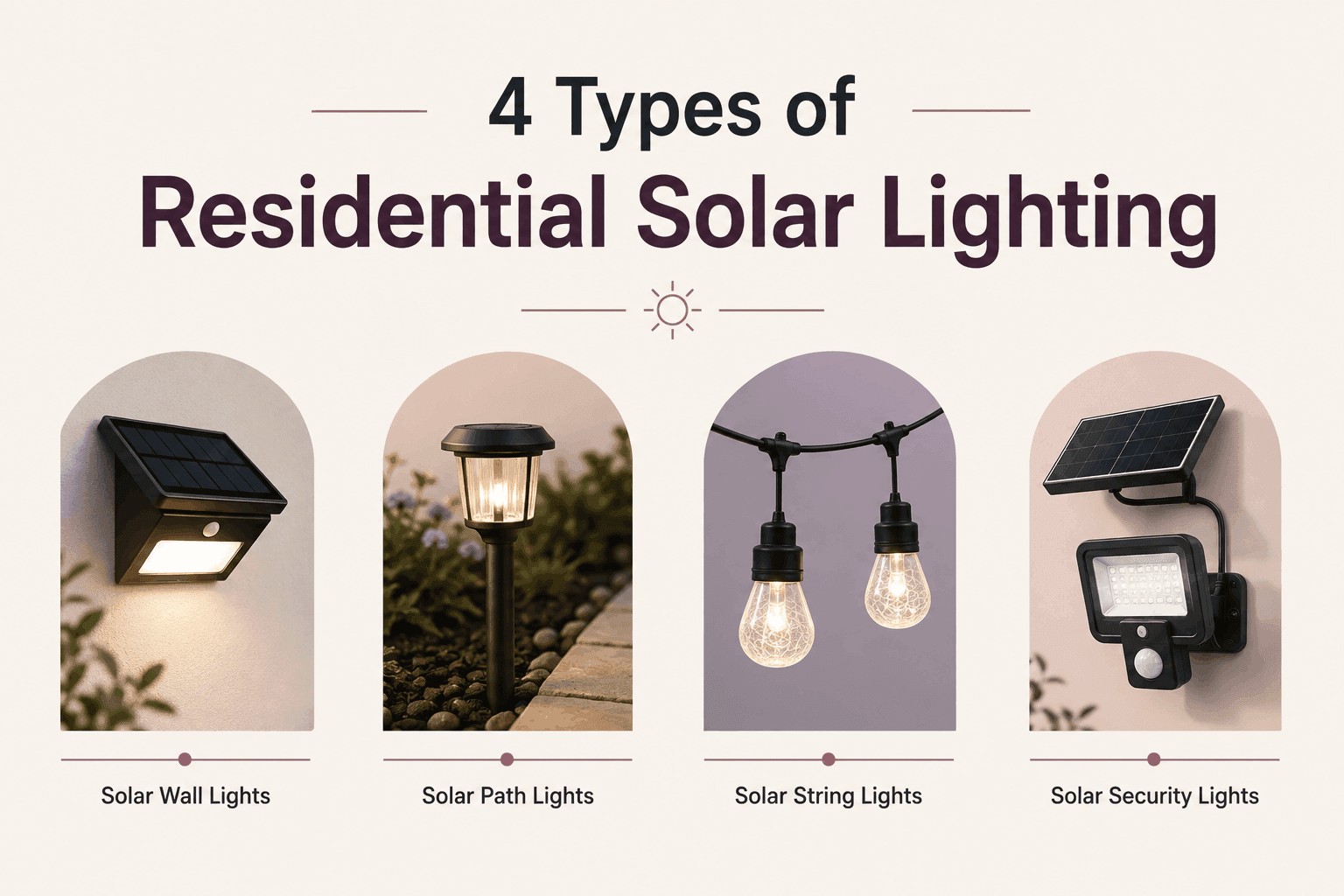
This guide breaks residential solar lighting into the four types that actually matter for a home: path lights, spotlights and security lights, string and decorative lights, and deck and step lights. Each one solves a different problem, runs on different brightness levels, and fails in a different way when you buy the wrong one.
Here’s the pattern behind most bad solar-light reviews online: someone buys a set of decorative fairy lights, hangs them by the driveway, and complains they “don’t light up anything.” They’re right, fairy lights were never built for that job. The fixture wasn’t broken. The type was wrong. Sort your yard by function first, and solar lighting stops being a gamble.
How Solar Lights Actually Work (Quick Primer)
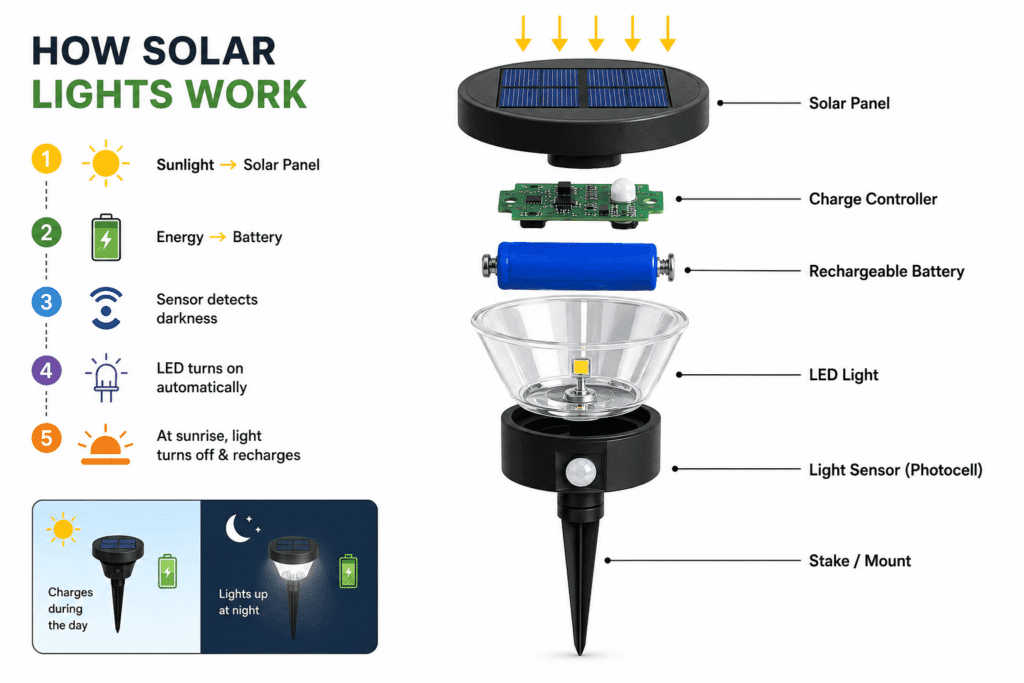
Every solar light, regardless of type, runs on the same three parts: a small photovoltaic panel, a rechargeable battery, and an LED. The panel converts daylight into electricity, the battery stores it, and a light sensor switches the LED on once it gets dark. Understanding the weak link in that chain explains almost every “why did my solar light stop working” complaint.
The battery is usually the limiting factor, not the panel. Most residential solar lights ship with NiMH (nickel-metal hydride) batteries — they’re inexpensive, don’t contain the heavy metals found in older NiCd batteries, and handle daily solar charge cycles well. Higher-end fixtures, especially ones marketed for cold climates, increasingly use lithium-ion or LiFePO4 batteries, which hold voltage more consistently as they drain and perform better in freezing temperatures than NiMH cells.
The LED is the part that lasts. According to the U.S. Department of Energy, residential LED lighting uses at least 75% less energy and lasts up to 25 times longer than incandescent lighting. ENERGY STAR notes that LEDs don’t typically “burn out” the way older bulbs do — instead, they gradually dim over tens of thousands of hours, a process called lumen depreciation. That’s why an old solar light usually isn’t “broken” so much as its battery has degraded long before the LED itself would fail.
This matters when you’re comparing types: a cheap $8 path light and a well-built $8 path light use the same LED technology, but a weak battery or an undersized panel will make the cheap one look dim and unreliable within a season.
What Are the 4 Main Types of Solar Lights for Homes?
| Type | Main Job | Typical Brightness | Best Use |
|---|---|---|---|
| Path Lights | Guide foot traffic | 50–200 lumens | Walkways, driveways, garden borders |
| Spotlights & Security Lights | Deter and illuminate | 200–3,000+ lumens | Entry points, driveways, dark corners |
| String & Decorative Lights | Set the mood | 5–50 lumens per bulb | Patios, pergolas, trees |
| Deck & Step Lights | Prevent trips | 50–200 lumens | Stairs, railings, deck edges |
That brightness column swings from 5 lumens to 3,000+. That’s the entire reason “solar lights” can’t be shopped as one category. A light bright enough to make a driveway visible from the street will absolutely ruin a quiet patio dinner.
1. Solar Path Lights
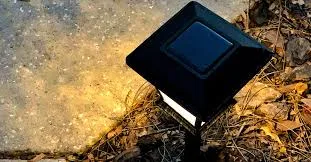
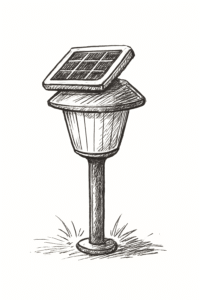
Path lights are the ones most people picture first, small stake-mounted fixtures lining a walkway like tiny street lamps for garden gnomes.
Their job is narrow: mark the edge of a path so nobody steps into the mulch bed at 10 p.m. They don’t need to flood an area with light. Lighting supplier guidance consistently places pathway fixtures around 100 lumens as the sweet spot, enough to separate the walkway from the surrounding lawn without creating glare that actually makes it harder to see the ground.
Quick specs:
- Brightness: 50–200 lumens for most residential fixtures, up to around 300 lumens on driveway-grade models
- Coverage: roughly 5–15 square feet per fixture at typical output
- Runtime: 6–10 hours on a full summer charge, noticeably shorter in winter
- Spacing: 6–8 feet apart along a path gives even, overlapping light without dark gaps
Where path lights shine:
- Walkways and garden borders
- Driveway edges
- Marking the transition between lawn and patio
Where they struggle:
- Wide driveways that need real security-level brightness
- Areas with heavy tree cover, since the small panel on top needs several hours of direct sun to recharge
A quick reality check before you buy a dozen of them: location decides everything. A path light stuck under a maple tree looks sad and dim by 9 p.m., no matter how good the fixture is. Our guide to the best locations for solar lights walks through exactly where sun exposure works and where it doesn’t.
And before buying any solar light., path or otherwise, it’s worth reading what to actually consider before buying solar lights, because most buyer’s remorse traces back to skipping this step.
2. Solar Spotlights & Security Lights
This type does the heavy lifting. Spotlights and security lights aren’t there to look pretty, they’re there to make your driveway visible at midnight and make anyone lurking near your fence reconsider their evening plans.
The brightness range here is the widest of any type. Accent spotlights used to highlight a tree or house number typically sit around 200–300 lumens. Motion-activated security lights are a different animal, most manufacturer and lighting-supplier guidance places the effective range for security and motion lighting between 700 and 1,500 lumens, with premium fixtures reaching 3,000–4,000 lumens for larger properties.
That’s not a small difference. A 3,000-lumen fixture puts out roughly the light of 20+ standard path lights combined. Buy the wrong output here, and you either can’t see your own driveway or you accidentally light up the whole street, and possibly your neighbor’s bedroom window.
Quick specs:
- Accent spotlights: roughly 200–300 lumens
- General security/motion lights: roughly 700–1,500 lumens
- High-output driveway or perimeter units: 3,000–4,000+ lumens on premium models
- Most run on motion sensors specifically to conserve battery, only hitting full brightness when triggered
Where spotlights and security lights shine:
- Front doors, garages, and side entrances
- Dark corners where intruders (or raccoons) like to hide
- Driveways and carports
Wattage and lumens aren’t the same thing, and this trips people up constantly, a higher-watt panel doesn’t automatically mean a brighter light if the battery or LED driver is weak. Our breakdown of what makes solar lights brighter covers the real factors that decide brightness and how long it holds through the night.
If you’ve narrowed it down to wattage specs, the 9W vs 12W solar light comparison explains which one is overkill for a side path and which one is the right call for a driveway.
One more thing worth settling before installation: solar security lights run on low-voltage battery power rather than household current, which is part of why they’re generally considered safe for close-range home use. Our full explainer on whether solar lights are safe for home use covers the details, including what to check before mounting near a kids’ play area.
3. Solar String & Decorative Lights
String lights don’t guide anyone anywhere, and they definitely don’t scare off intruders. Their entire job is ambiance, and they’re very good at that one job.
These run on far lower lumen counts than any other type here, often just 5 to 50 lumens per individual bulb. That’s intentional. String lights are meant to be looked at directly, not used as functional illumination, so blasting them with path-light brightness would just make a patio look like a parking lot at midnight.
Where string and decorative lights shine:
- Pergolas, patios, and outdoor dining areas
- Wrapped around trees or railings
- Backyard get-togethers and evening hangouts
Where they don’t belong:
- Anywhere you actually need to see clearly (stairs, driveways, tool sheds)
- As a stand-in for security lighting, they simply don’t produce enough lumens for that job
A common question with this type: should they run all night, or is that a waste of battery? The honest answer depends on battery capacity and how much sun the panel gets during the day. We cover the trade-offs in should solar lights stay on all night, including when leaving them on actually shortens battery lifespan.
If you’re still deciding whether decorative lighting is worth the investment, it helps to step back and ask what the purpose of solar lights really is, ambiance and function are two different purchase decisions, and conflating them is how people end up with the wrong fixture.
4. Solar Deck & Step Lights
Deck and step lights are the quiet workhorses of residential solar lighting. Nobody pins pictures of them to a Pinterest board, but they do a job that actually matters: keeping people from missing a step in the dark.
Like path lights, they typically sit in the 50–200 lumen range, enough to define the edge of a stair without creating harsh shadows that make the next step harder to judge. They mount into railings, post caps, or the stair riser itself, which means installation looks closer to a small construction project than “stick it in the ground.”
Where deck and step lights shine:
- Deck stairs and railings
- Raised patios with a drop-off edge
- Fence posts and boundary markers
Where they get complicated: This is the one type where setup genuinely matters more than the fixture itself. Mount the panel on the wrong side of the railing and it won’t charge. Wire multiple units together incorrectly, and half the steps stay dark.
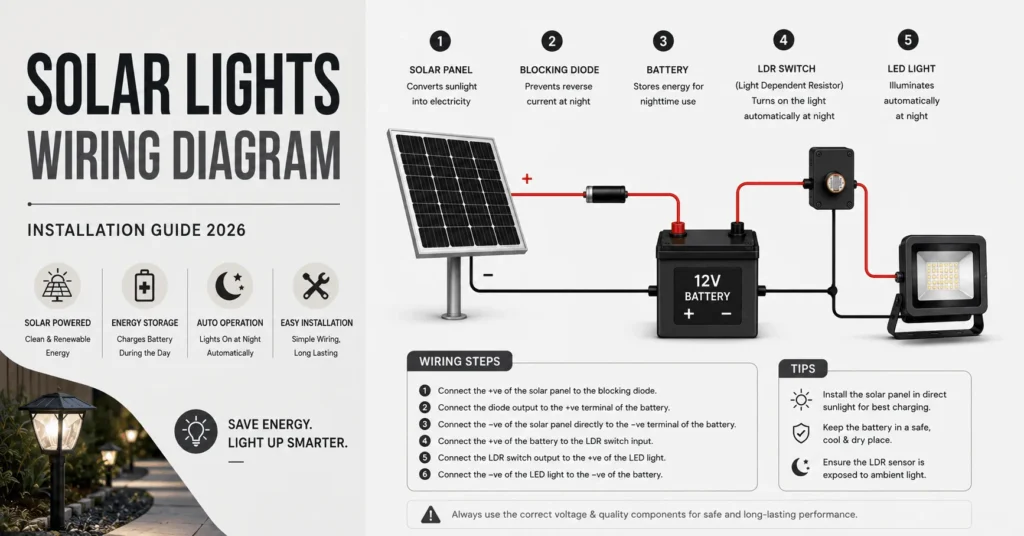
If you’re setting these up as part of a small connected system rather than standalone units, our guide to setting up a small solar panel lighting system walks through the process. And if your deck lights are wired together at all, the solar lights wiring diagram guide is worth reading before you start drilling.
How to Choose the Right Type for Your Home
Match the type to the problem, not the product photo on the box.
- Can’t see the walkway at night? Path lights.
- Worried about break-ins or dark corners? Spotlights or security lights.
- Want the backyard to feel inviting for evening hangouts? String and decorative lights.
- Someone keeps nearly falling on the deck stairs? Step lights, no debate.
Most homes end up using two or three of these types together, and that’s normal, a driveway might get a security light at the entrance and path lights along the edge. The real mistake isn’t mixing types; it’s buying one type and expecting it to solve every lighting problem in the yard.
Two things decide whether any of these types actually perform well, regardless of category: sun exposure and weather resistance.
Common Mistakes That Make Any Type Underperform
Even the right fixture in the right spot can disappoint if the basics get skipped. A few patterns show up constantly in homeowner complaints:
- Mounting the panel in shade. Trees grow. A spot with full sun in spring can be shaded by July.
- Skipping the initial full charge. Most solar lights need a longer first charge before the battery reaches full capacity, running them the first night straight out of the box often gives a misleadingly dim first impression.
- Leaving the plastic pull-tab on the battery. It sounds obvious, but it’s one of the most common reasons a brand-new light “doesn’t turn on” at all.
- Ignoring the on/off switch. Many units ship in “off” mode for shipping safety and need a manual switch flipped before they’ll charge or activate at dusk.
Our full breakdown of common mistakes when installing solar lights outdoors covers the complete list, and the first-time setup guide walks through the correct order of operations so you’re not troubleshooting a light that was simply never charged.
Weatherproofing: The Spec Everyone Skips
Every solar light lives outside permanently, through rain, snow, and whatever the sprinkler system throws at it. That makes the IP (Ingress Protection) rating one of the few specs worth actually reading instead of skimming.
The rating is two digits, governed by the international IEC 60529 standard. The first digit covers dust protection; the second covers water. For outdoor lighting, the water digit is what matters:
- IP65: dust-tight and protected against low-pressure water jets (rain, splashing). This is the practical minimum for anything mounted outdoors.
- IP66: handles stronger, wind-driven water jets. A safer bet in exposed or storm-prone areas.
- IP67: survives temporary submersion, roughly up to one meter of water for about 30 minutes. Useful for ground-level fixtures that might sit in a puddle after heavy rain.
- IP68: rated for continuous submersion at a depth and duration the manufacturer specifies. This is pool- and pond-light territory, not typical yard lighting.
For most path, spotlight, and step lights, IP65 handles normal rain and sprinkler exposure fine. If a fixture sits low to the ground where puddles collect, or storms in your area mean actual standing water, IP67 is the safer buy.
We’ve written a full walkthrough on this in IP67 solar lights and why they handle real weather, plus a dedicated answer to the most common version of this question: are solar lights actually waterproof.
Battery Life and Realistic Lifespan
This is the part most solar-light marketing glosses over, so here’s the straight version.
Battery type drives real-world performance more than the LED does. NiMH batteries remain the industry default for entry-level and mid-range solar lights, they’re affordable, don’t contain toxic heavy metals, and handle daily solar charge-discharge cycles reliably in moderate climates. Their main weakness is cold weather: capacity drops noticeably below freezing. Lithium-ion and LiFePO4 batteries cost more but hold voltage more consistently as they discharge and perform better in cold climates, which is why more premium security and spotlight fixtures use them.
The LED itself will likely outlast the rest of the fixture. As noted above, DOE and ENERGY STAR data put quality LED lifespans at tens of thousands of hours with gradual dimming rather than sudden failure. In practice, that means the battery, not the LED, is almost always the part that needs replacing first in a solar light that’s a few years old.
What actually shortens battery life:
- Letting the battery fully drain repeatedly rather than recharging in normal daily cycles
- Leaving cheap NiMH batteries in freezing temperatures without a cold-rated alternative
- Buying units with mismatched panel size and LED wattage, which forces the battery to work harder than it was designed for every single night
Explore Every Topic in Depth
This article covers the four types at a high level. For deeper reading on buying, installing, weatherproofing, or budgeting for solar lights, here’s where each topic lives on the site.
Solar Lighting Fundamentals
- Solar light lumens guide: how many you actually need
Setup & Installation
- Best angle for solar panels and lights
Safety & Waterproofing
- Solar light waterproof rating chart (IP guide)
Cost & Value
- Solar light warranty guide: what’s covered
FAQs
Can I mix different types of solar lights in one yard?
Yes, and most homes should. Path lights along a walkway, a security light at the driveway entrance, and string lights over the patio all serve different purposes and don’t compete with each other.
Which type of solar light lasts the longest?
Lifespan depends more on battery quality and LED efficiency than on the type of fixture itself. A cheap security light and a cheap path light will both fail early; a well-built version of either will last for years, with the battery typically wearing out before the LED does.
Do solar lights work in winter?
They work, but shorter days and lower sun angles mean less charging time, and NiMH batteries lose capacity in cold weather. Expect reduced runtime in winter months regardless of which type you’re using, especially at higher latitudes.
Is a higher lumen count always better?
No. More lumens means the fixture needs a bigger battery and panel to sustain that brightness, and a light that’s too bright for its job, like an 800-lumen “path light”, usually looks harsh rather than helpful. Match lumens to the job, not the biggest number on the box.
What’s the difference between NiMH and lithium-ion batteries in solar lights?
NiMH is the industry default: affordable, free of toxic heavy metals, and reliable in moderate climates. Lithium-ion and LiFePO4 batteries cost more but hold their charge more consistently and perform better in cold weather, which is why they show up more often in premium security and spotlight fixtures.
Do I need an electrician to install any of these types?
No. All four types run on standalone solar power with no household wiring involved, which is the main appeal over traditional hardwired landscape lighting.
What IP rating should I look for?
IP65 is the practical minimum for any outdoor fixture. Choose IP67 for ground-level lights in areas prone to puddling or heavy storms, and reserve IP68 for anything actually submerged, like pond or fountain lighting.
Summary
Four types, four jobs: path lights guide your feet, spotlights and security lights protect the property, string lights make the backyard feel like somewhere you want to sit down, and step lights keep you from missing a stair. Buy based on the problem you’re solving, check the IP rating before committing to a spot, and give the panel real sunlight — the single most common reason any solar light underperforms has nothing to do with the fixture and everything to do with where it’s planted.Sources