Table of Contents
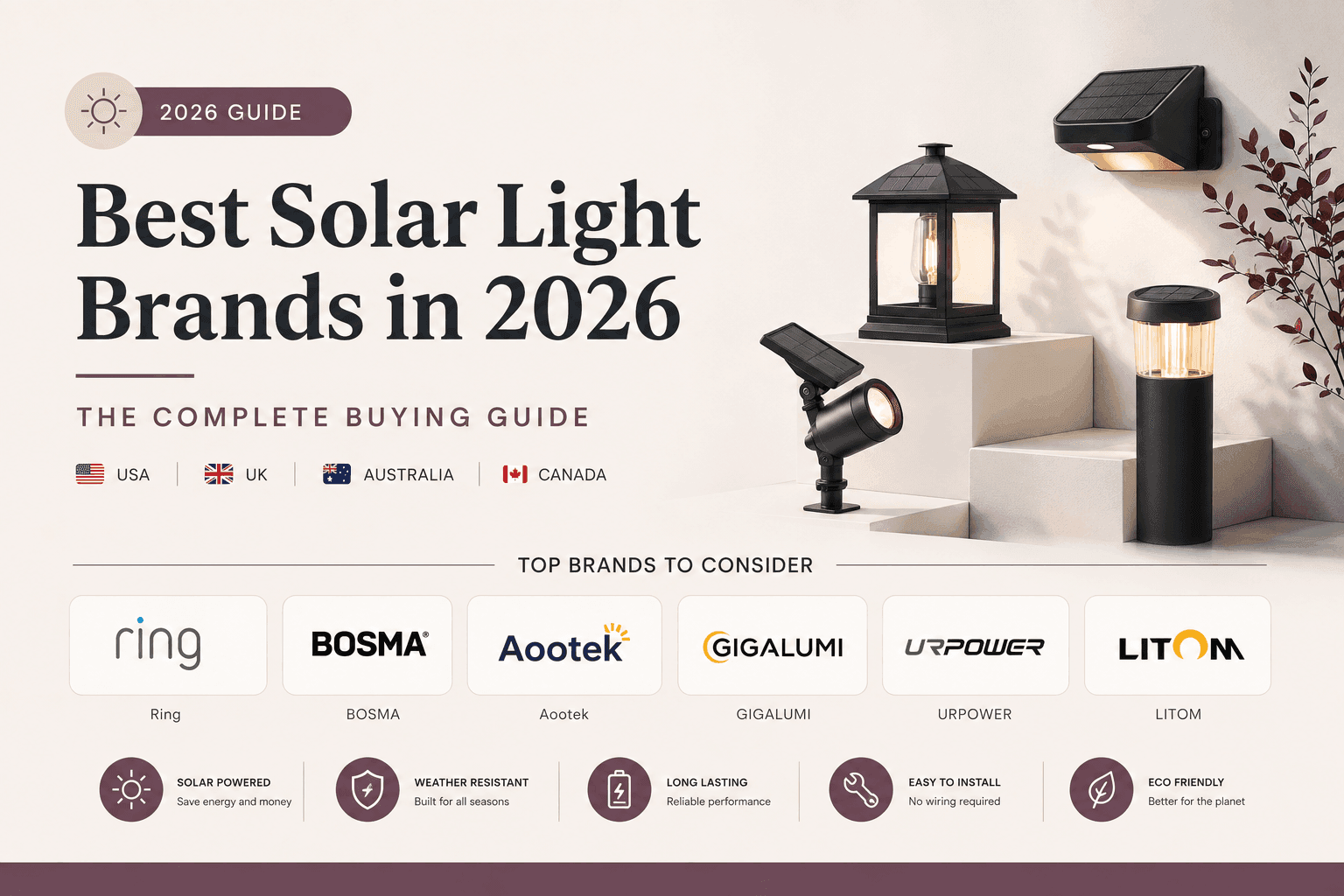
Buying a solar light shouldn’t feel like buying a used car. But with hundreds of brands using near-identical stock photos and inflated lumens claims, most buyers end up guessing, and a lot of them guess wrong.
Here’s the short version: the brand on the box matters less than three other things, where you’re buying it from, what you’re lighting up, and how the battery inside is actually built. This guide walks through all three, and points you toward our full hands-on reviews as you go. By the end, you’ll know exactly what separates a light that survives three summers from one that quietly dies in a drawer by September.
Quick Answer: Where to Start Based on What You Need
Not everyone needs to read 3,000 words to buy a garden light. If you already know what you’re after, jump to the right section: product reviews if you have a specific model in mind, retailer guides if you’re loyal to a particular store, company guides if you’re weighing a bigger solar investment rather than a single light, or regional guides if you’re outside the US. Everyone else, keep reading from here.
How We Evaluate Solar Light Brands
Before recommending anything on this site, we run it through the same checklist every time. These are the factors that actually separate a light that survives three summers from one that dies in three months: real-world brightness against the lumens number printed on the box, the IP rating (not marketing words like “weatherproof”), the battery chemistry inside, the solar panel type doing the charging, verified buyer feedback from wherever the product is actually sold, and how easy the warranty is to actually use.
Where a specific review is built on long-term ownership data or hands-on testing, that’s called out in the post itself, this page is the map, not the territory.
Why Solar Light Quality Varies So Much Between Brands (Even at the Same Price)
Here’s something most buying guides don’t tell you: a huge share of solar lights on the market come out of a relatively small pool of factories, mostly concentrated in a few manufacturing regions, and get rebadged under dozens of different brand names before they reach a store shelf. Two lights sitting next to each other in a hardware aisle, priced $10 apart, can share the same internal components, same LED chip, same driver board, sometimes even the same mold for the housing.
That doesn’t mean brand doesn’t matter. It means brand matters for different reasons than most people assume. A recognizable brand isn’t necessarily buying you better hardware, it’s often buying you better quality control on top of the same hardware pool, a real customer service line when something fails, and a warranty that doesn’t disappear when the seller does. This is exactly why we spend as much time in our reviews talking about retailer accountability and return policy as we do talking about lumens.
It also explains why you’ll sometimes see wildly different reviews for what looks like “the same light” under two different names. The base components might be identical, but the assembly quality control, battery cell grading, and sealing process can vary between production runs, even from the same factory. Buying from a brand with a track record of consistent QC is often a better bet than chasing the single highest lumens number you can find.
Solar Light Brand & Company Guides
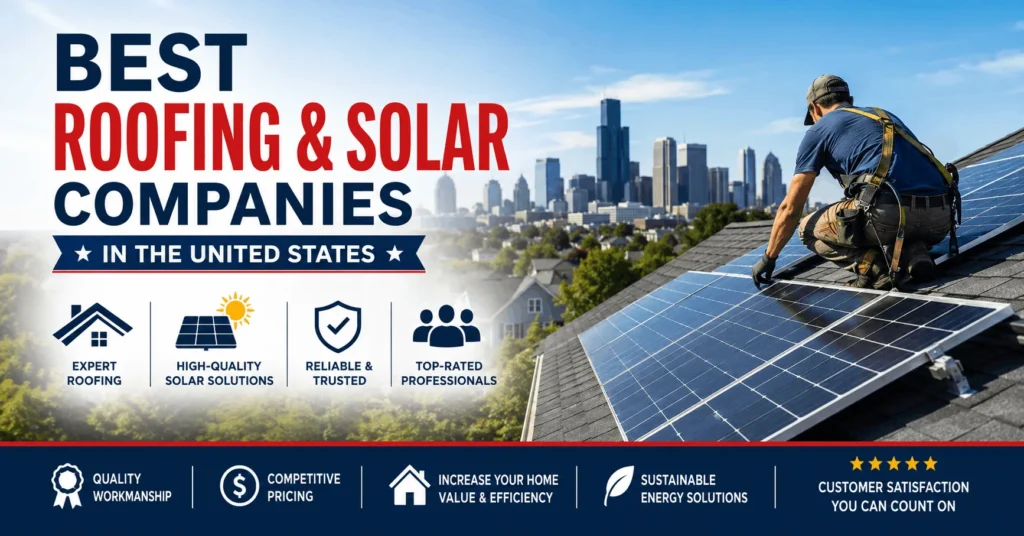
If you’re comparing entire companies rather than a single product, this is where to start. It’s a different kind of decision than picking a garden light, you’re usually weighing a bigger investment, like roof-integrated solar lighting, and the stakes for picking the wrong company are higher than a $20 mistake.
Our breakdown of the top solar companies in 2026 covers the biggest names in the space right now and how to tell a company built for homeowners apart from one built mainly for commercial contracts. If you’re bundling roof work with solar, which usually makes more sense done together than separately, since it means one crew and one warranty conversation instead of two, our roofing and solar companies guide walks through who’s actually worth calling.
We’re also working on a warranty comparison across the biggest solar companies, since that’s the piece most buyers skip past until something breaks.
Solar Light Product Reviews by Model
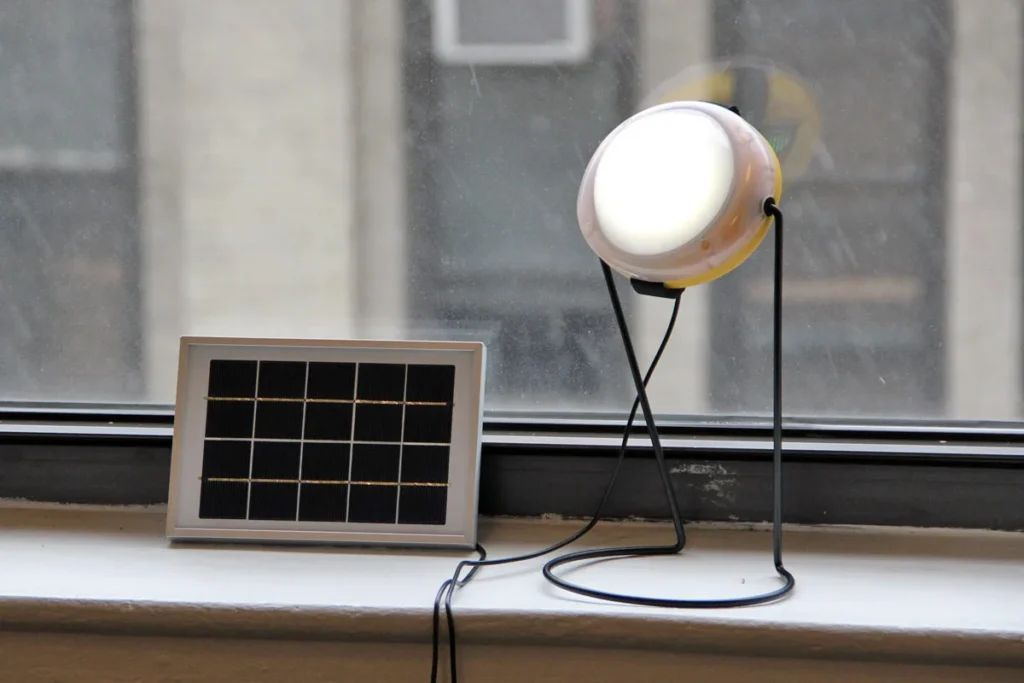
This is the section most people bookmark. Each review is a deep dive into one specific product, not a padded “top 10” list, an honest look at what it’s actually like to own the thing after the first charge wears off and the novelty of “it’s free light!” fades.
If you’ve got the Solar Light ZH-048R on your shortlist, we’ve covered what to know before it shows up at your door. For anyone wearing a Garmin Instinct 2 Solar Tactical, we tested whether it’s still holding up in 2026 or whether newer tech has made it a harder sell. And if you want the no-drilling, no-tools option, our stick-on solar lights review covers exactly where that convenience starts costing you brightness.
We’ve also reviewed the LuminAID solar lantern, the inflatable one that built its reputation on disaster relief work before it became a camping favorite, and the AKT solar street light, where battery life and pricing matter less than knowing how to spot the counterfeit listings riding on the brand’s name (more on that in the buying factors section below).
Two more worth knowing about: the Eufy Solar Wall Cam S120, a solar security camera and light combo that’s a good idea on paper but worth reading up on before you buy, and the Sun King solar light, one of the most widely used solar light brands globally, we break down what its enormous user base has actually learned about it.
A camping lantern comparison is next on our list.
Solar Lights by Retailer, Where to Buy & What to Expect
A lot of “solar light brands” are really retailer house brands, not independent manufacturers. That distinction changes how you should think about warranty claims and returns, because it tells you who’s actually on the hook when something fails.
Take Hampton Bay. It isn’t a separate manufacturer, it’s a private-label brand sold exclusively at Home Depot, launched in the early 1990s and now one of the retailer’s biggest house brands across lighting, ceiling fans, and outdoor furniture. Every warranty claim and every return runs through Home Depot directly, not a third party you’d have to track down. That’s a meaningful advantage if something fails at month eleven of a twelve-month warranty, you’re walking into a store you already know, not emailing a manufacturer overseas and waiting three weeks for a reply.
Aldi works differently. Its rotating “Special Buys” model means solar lights show up seasonally and sell out fast, without always getting restocked once they’re gone, we bought three separate sets to figure out what that buying pattern actually means for shoppers. The upside is genuinely low prices; the downside is that if a specific model fails, there’s no guarantee the identical replacement will still be on shelves next month.
If you’re in the UK, there’s something worth flagging about Argos that’s genuinely new: Sainsbury’s, which had owned Argos since 2016, sold it to Swift Partners, a company set up by former retail executives, in a deal that closed on July 31, 2026. Argos is still trading under its own name with the same stores and website, but if you’ve read older articles about who to contact for warranty issues, that information may be outdated now.
Down in Australia, Bunnings has been owned by the conglomerate Wesfarmers since 1994 and holds a dominant share of the country’s DIY hardware market. That scale is exactly why its solar range is such a mixed bag, massive buying power keeps prices low, but it also means huge batches of budget-tier stock sitting next to genuinely good products. We’ve narrowed down which ones are actually worth buying if Bunnings is where you shop.
And then there’s Costco, whose membership model changes the calculus entirely. Its return policy is famously generous compared to most big-box retailers, which matters a lot for something that lives outdoors, unattended, for years, we checked in on what buyers think after two years of ownership. If a light dies at year three, Costco’s approach to returns means you have options most other retailers won’t offer.
Coming up next in this section: a UK retailer roundup covering Wilko and B&Q, plus a look at what Walmart and Home Depot each offer in-house.
Solar Light Brands Outside the US, UK, Australia & Canada
This guide started as a US-focused resource, but solar lighting isn’t a US-only category. The UK, Australia, and Canada each have their own dominant retailers, climate considerations, and regional brand names “, best in the US” rarely translates directly once you factor in local conditions.
In the UK, the biggest variable is sunlight hours, not temperature. Long stretches of overcast weather, especially through autumn and winter, mean panel size and battery capacity matter more than raw lumens, a light that performs beautifully in a US summer test can underperform noticeably through a British winter. Australia sits at the other extreme: intense, near-constant UV exposure across most of the country means housing material and UV-resistant plastics matter as much as the electronics inside, since cheap plastic casings can turn brittle and crack within a year or two under that kind of sun. Canada adds a third variable neither the UK nor Australia deal with at the same scale, genuinely cold winters, where battery performance drops in low temperatures and housings need to handle freeze-thaw cycles without seals failing.
We’re building out dedicated brand roundups for each of these three markets that account for exactly these differences, rather than just repeating the US recommendations with different currency symbols.
How to Choose the Right Solar Light Brand (Buying Factors)
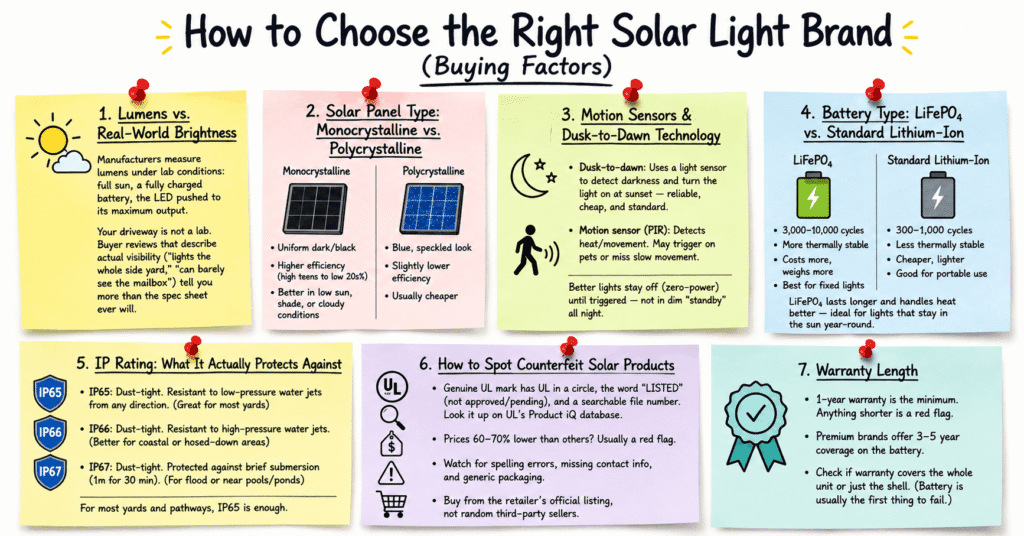
If you skipped straight here, welcome. This is what actually matters when you’re standing in an aisle, or scrolling a product page at midnight, trying to decide.
Lumens vs. Real-World Brightness
Manufacturers measure lumens under lab conditions: full sun, a fully charged battery, the LED pushed to its maximum output. Your driveway is not a lab. A light rated at 1,000 lumens on an overcast afternoon, running on a half-charged battery, can put out a fraction of that number. When you’re comparing products, buyer reviews that describe actual visibility (“lights the whole side yard,” “can barely see the mailbox”) tell you more than the spec sheet ever will.
Solar Panel Type: Monocrystalline vs. Polycrystalline
This spec rarely makes it onto the front of the packaging, but it directly affects how well a light charges on a mediocre day. Monocrystalline panels, recognizable by their uniform dark, almost black color, are generally more efficient, typically converting somewhere in the high teens to low twenties percent of sunlight into usable energy. Polycrystalline panels, with their distinctive blue, speckled appearance, are usually a few percentage points less efficient and slightly cheaper to produce.
For a light that gets full, direct sun all day, the difference is often small enough not to matter much. For anything mounted somewhere partially shaded, or in a region with a lot of cloud cover, monocrystalline’s efficiency edge translates into a noticeably better charge by evening. It’s a small line item to check, but worth checking.
Motion Sensors & Dusk-to-Dawn Technology
Two different sensor types get lumped together under “smart” solar lights, and they do very different jobs. Dusk-to-dawn sensors use a simple light-sensitive resistor to detect ambient darkness and switch the light on automatically at sunset — reliable, cheap, and the standard in almost every solar light worth buying. Motion sensors are a separate system entirely, typically using passive infrared (PIR) technology to detect the heat signature of movement, which is why they sometimes trigger on a cat crossing the yard and sometimes miss a person walking slowly along the edge of their detection cone.
Cheaper lights often combine both poorly, draining battery by staying at a low “standby” brightness all night instead of full off, which defeats the purpose of solar charging in the first place. Better-built lights keep true zero-power standby until motion or darkness actually triggers them. This is one of the details buyer reviews catch far more reliably than spec sheets, which is exactly why we weight real ownership feedback so heavily in our individual reviews.
Battery Type: LiFePO4 vs. Standard Lithium-Ion
This is the spec most buyers skip past, and it’s the one that determines whether your light is still working in year three.
LiFePO4 (lithium iron phosphate) batteries typically deliver somewhere between 3,000 and 10,000 full charge cycles before they lose meaningful capacity. Standard lithium-ion, the kind found in cheaper solar garden lights, usually manages closer to 300 to 1,000 cycles before performance noticeably drops. LiFePO4 is also more thermally stable, which matters a lot for a battery that sits in direct sun, day after day, for years without anyone checking on it.
The tradeoff is cost and weight, LiFePO4 packs cost more upfront and weigh slightly more. For a fixed light you mount once and forget about, that tradeoff is almost always worth it. For something lightweight and portable, like a camping lantern, standard lithium-ion can still make sense.
IP Rating: What It Actually Protects Against
IP ratings look like a secret code, but they’re simpler than they seem. The system is internationally standardized under IEC 60529, so it means the same thing regardless of which brand prints it on the box, no marketing spin possible.
IP65 means dust-tight and resistant to low-pressure water jets from any direction, which covers rain, sprinklers, and normal outdoor exposure just fine. IP66 steps that up to high-pressure water jets, worth it for coastal areas or anywhere lights get regularly hosed down. IP67 adds protection against brief submersion, roughly a meter deep for half an hour, which only really matters if a light sits somewhere water actually pools.
For most yards and pathways, IP65 is genuinely enough. Save the IP67 premium for ground-level lights near pools, ponds, or spots that flood after heavy rain.
How to Spot Counterfeit Solar Products
This is a real problem in this category: cheap knockoffs riding on the name and box art of legitimate brands, sold through third-party marketplace listings that look identical to the real thing.
A genuine UL mark includes the UL logo inside a circle, the word “LISTED” (not “approved” or “pending”), and a searchable file number, you can look that number up directly on UL’s own Product iQ database, and if it doesn’t match what’s in front of you, walk away. Be suspicious of prices that undercut every other listing by 60-70%; legitimate lighting components cost real money to manufacture and certify, so that kind of gap usually means something’s missing, not that you found a deal. Spelling errors, missing company contact details, and generic no-name packaging are common markers of counterfeit electrical goods. And the single most effective protection is simply buying from the retailer’s own listing rather than a random third-party seller riding on their product page.
Warranty Length
A one-year warranty is the bare minimum in this category, and anything shorter is a red flag. Premium brands increasingly offer 3-5 year coverage on the battery specifically, separate from the housing, always check whether a warranty covers the whole unit or just the shell, since the battery is usually the first thing to fail.
Common Solar Light Myths, Debunked
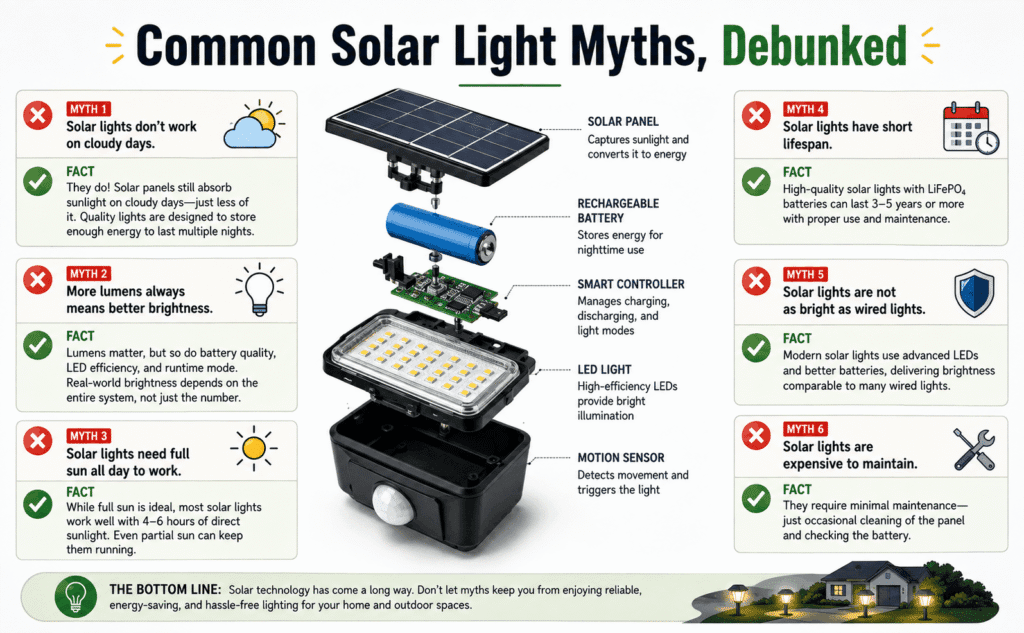
“More lumens always means brighter.” Only up to a point, and only if the battery is fully charged. A well-designed 400-lumen light with good optics and a clean lens can look brighter in practice than a poorly focused 800-lumen light scattering light in every direction except where you need it.
“Solar lights don’t work in winter.” They work less efficiently, not not at all. Shorter days mean less charging time, and cold temperatures do reduce battery efficiency somewhat, but a well-built light with a decent battery will still function through winter, just don’t expect the same runtime you got in July.
“All solar lights need direct sunlight to charge.” Most panels still generate some charge from indirect and diffused daylight, including on cloudy days. It’s slower and less efficient, but “cloudy” doesn’t mean “not charging.”
“A higher price always means better quality.” Not necessarily, sometimes it means better brand marketing, a nicer box, or a retail markup with nothing to do with what’s inside. Price is a weak signal on its own; battery chemistry, IP rating, and verified buyer feedback are much stronger ones.
FAQs
Which solar light brand lasts the longest?
There’s no single answer that holds across every category, a $15 pathway light and a $200 security light aren’t playing the same game. Battery chemistry is a far better predictor of longevity than brand name alone.
Are expensive solar lights actually worth it?
Usually, yes, but not because of the price tag itself. It’s because higher-priced lights tend to pair better batteries with higher IP ratings. A cheap light with a genuinely good battery can outlast an expensive one with a poorly sealed housing.
Do solar lights work on cloudy days?
Yes, but at reduced capacity. Most modern panels still charge in overcast conditions; they just take longer and store less. If you live somewhere with long cloudy stretches, prioritize battery capacity over panel size.
Is Hampton Bay a good brand?
It depends on the specific product. Since Hampton Bay covers ceiling fans, outdoor furniture, solar lighting, and kitchen cabinets under one private-label umbrella, quality varies noticeably by category, our full Hampton Bay breakdown covers the solar-specific findings.
How do I know if a solar light is genuinely IP65-rated, or just claiming to be?
Check for the rating printed directly on the product itself, not just the packaging, since packaging is easy to swap or counterfeit and molded plastic isn’t. If a listing only says “weatherproof” with no IP number anywhere, treat that as a missing spec, not a selling point.
How long should a solar light actually last before I replace it?
With a LiFePO4 battery and a decent IP rating, two to four years of consistent nightly use is a reasonable expectation before capacity noticeably declines. Cheaper lithium-ion lights often start fading within the first year, especially in hot climates where the battery spends all day at high temperature.
Can I replace the battery in a solar light instead of buying a new one?
On some models, yes, a growing number of mid-range and premium solar lights use standard, replaceable battery cells rather than batteries soldered permanently into the unit. It’s worth checking a product’s manual or spec sheet before buying if longevity and repairability matter to you, since a replaceable battery can double a light’s useful life for a fraction of the cost of a new unit.
Summary
There isn’t one “best” solar light brand, there’s a best brand for what you’re lighting up and where you’re buying it from. Use the sections above to find your situation, and check back as we fill in the retailer and regional guides that are still in the works.