The Author
Table of Contents
Sun King lights power roughly 82 million people across more than 40 countries, according to the company’s 2022 funding announcement, and newer figures from Sun King and MIT Technology Review put that closer to 95 or 100 million now. Most of those users aren’t campers. They’re households in Kenya, Nigeria, and a dozen other countries where a Sun King lantern isn’t a backup, it’s the electricity.
That track record matters, but it doesn’t tell you which model to buy or whether it fits your actual use case. Here’s the short version: the Pro and Boom are solid picks for emergency prep and camping, backed by independent lab testing rather than just marketing copy. The Pico Plus is a fine cheap backup light but skips phone charging entirely. Skip the lineup altogether if you need something rated for full submersion or genuinely bright, 160 lumens is the ceiling here, not flashlight territory.
Quick Verdict, Is Sun King Worth It?
Yes, for most of the reasons people search for it. The lanterns hold up under independent testing, the phone charging actually works as advertised, and Sun King has been building this stuff since 2007, long enough to have real field data instead of just claims.
Best for:
- Power outages and emergency kits, where a charged phone matters as much as light
- Camping trips where you want charging capability, not just brightness
- Buyers who care about independent verification, not just star ratings
Skip it if:
- You want a $10 garden stake light, wrong category entirely
- You need real submersion-proof waterproofing (none of these are rated for that)
- You want music streaming instead of FM radio and offline MP3 files
If you’re short on time: grab a Pro or Boom for anything charging-related, a Pico Plus if you just want a cheap light in a drawer. The next section breaks down exactly why.
Which Sun King Model Should You Buy? (Full Lineup Compared)
Search “sun king lights” and Google hands you five products with overlapping names and no explanation of how they differ. Here’s the plain version.
Sun King Pro, The All-Rounder Lantern + Phone Charger
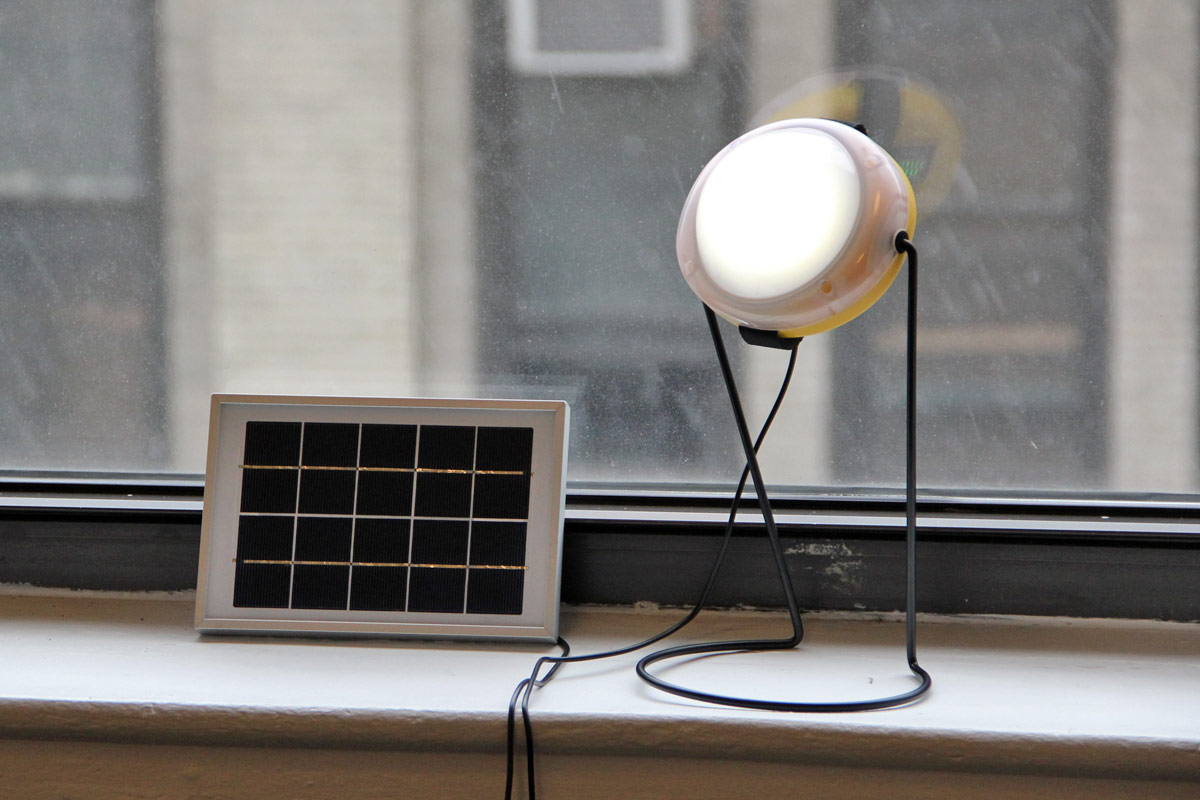
The Pro is the flagship. It runs three brightness modes, roughly 17, 50, and 100 lumens depending on the unit, powered by a 2,800 mAh lithium ferro-phosphate battery. Low mode stretches to about 45 hours of light on a single charge; turbo drops that to roughly 8 hours. It typically costs $45–50.
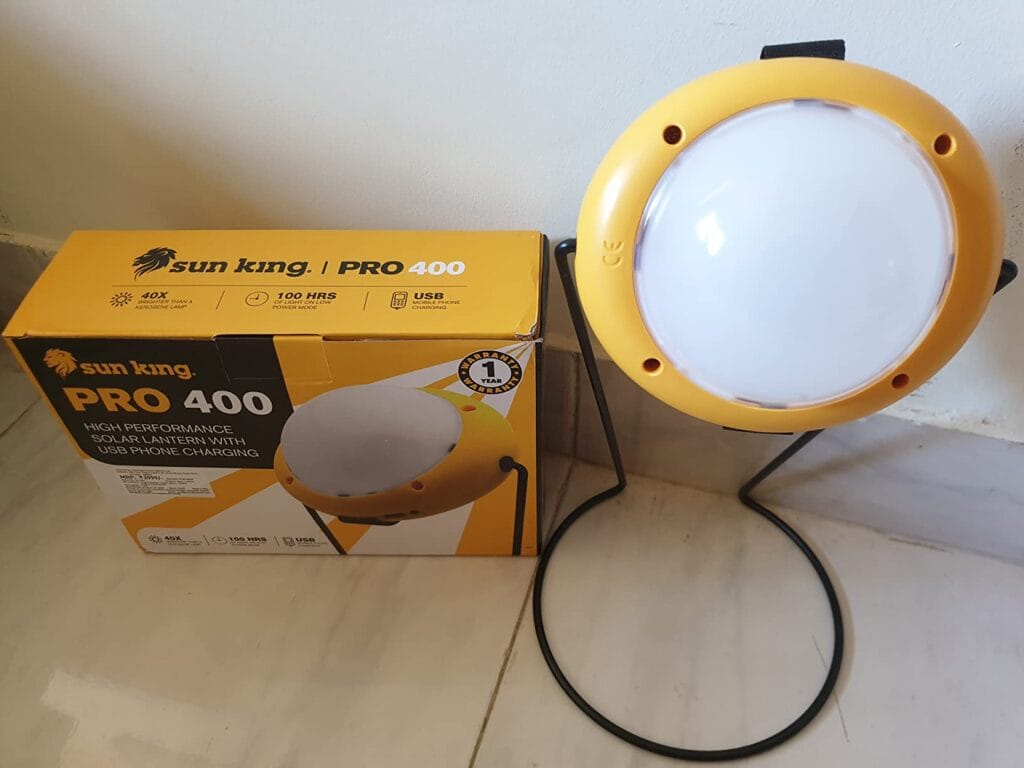
This is also the model with real third-party backing. The Economist once called it “the best solar lamp” on the market, and when MIT’s CITE Lab ran a comparative evaluation of 11 solar lanterns in Uganda, the Sun King Pro scored highest of the group, 88 out of 100. A beefed-up Pro 400 variant pushes output to 400 lumens, aimed more at lighting a room during an outage than backpacking.
Sun King Boom, Lantern With Built-In Radio
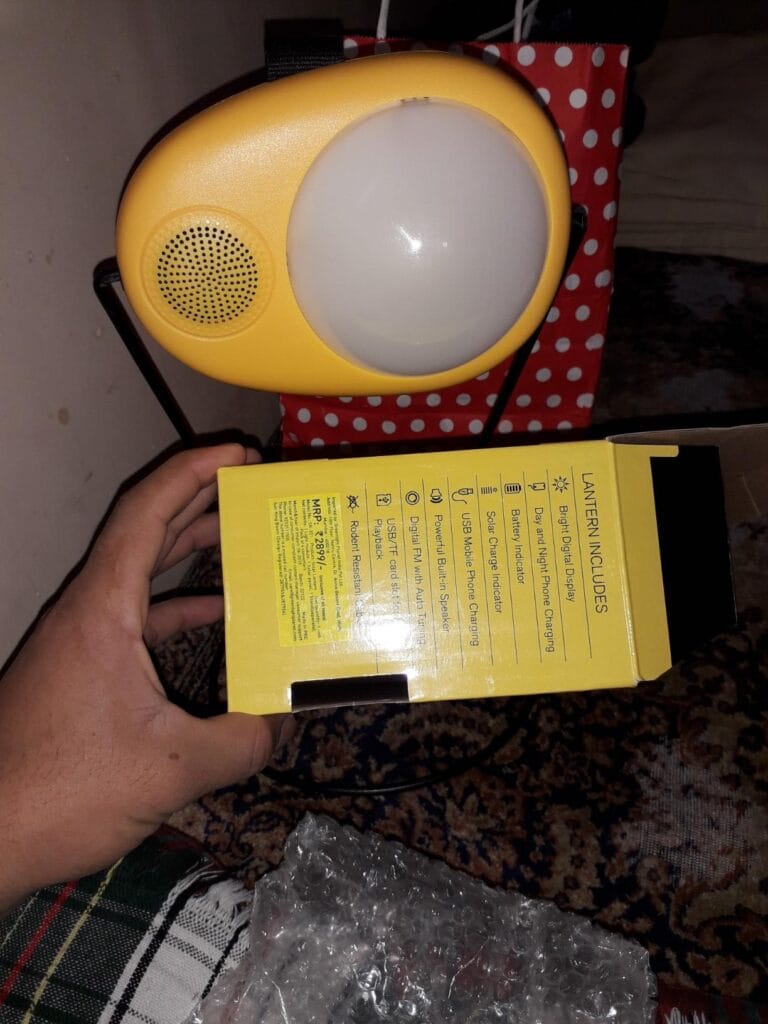
The Boom does what the Pro does, then adds an FM radio and an MP3 player that reads off a USB drive or SD card up to 32GB. Brightness tops out at 160 lumens, with 75 and 25-lumen modes below it, and battery life scales accordingly: 6 hours on turbo, 12 on normal, 36 on low. It’s IP65-rated for dust and light rain, ships with a 2-year warranty, and runs $40–55.
Sun King Home / Home 200X, Multi-Room Home Lighting System
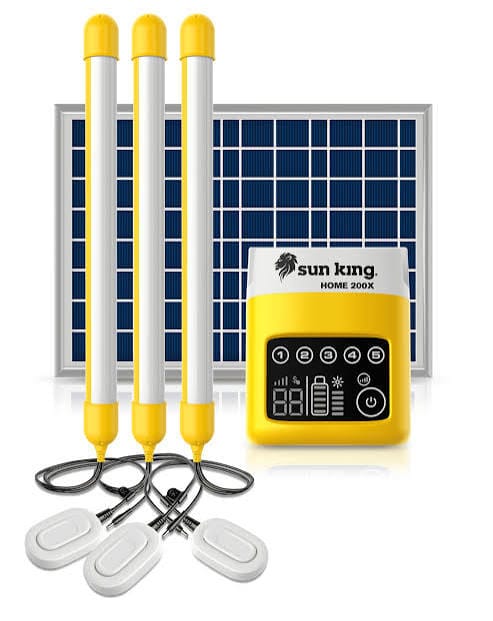
This one isn’t a lantern. It’s a small solar home system with three individually-switched tube lights, an 11-watt solar panel, and a 28.3 Wh battery pack that also charges phones over USB. Think “light two rooms during an outage,” not “clip to a backpack.”
Sun King Pico / Mobile, Compact, Travel-Sized Option
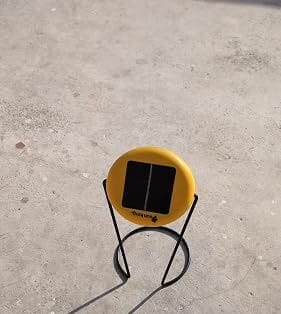
The Pico Plus strips everything down: a single 50-lumen LED, a 425 mAh battery, no phone charging, no radio. It runs up to 72 hours on its lowest setting, or about 4 hours at full brightness, weighs around 150 grams, and typically costs $10–20. It’s the light you keep in a glovebox and mostly forget about until you need it.
Comparison Table
| Model | Max Lumens | Battery Life (low → high) | Phone Charging | Best For | Typical Price |
|---|---|---|---|---|---|
| Sun King Pro | ~100–120 | 45 hrs → 8 hrs | Yes | Emergency kits, camping | $45–$50 |
| Sun King Boom | 160 | 36 hrs → 6 hrs | Yes | Extended outages, entertainment | $40–$55 |
| Sun King Home 200X | 3 tube lights | Varies by usage | Yes | Multi-room power outages | Varies by retailer |
| Sun King Pico Plus | 50 | 72 hrs → 4 hrs | No | Budget backup, glovebox light | $10–$20 |
Sun King Performance: The Specs That Actually Matter
Numbers on a box only mean something once you know what they translate to in actual use.
Brightness in Real-World Use
Fifty lumens, the Pico’s output, is enough to read by or navigate a dark hallway without stubbing a toe. The 100–160 lumen range from the Pro and Boom lights up a whole tent or a kitchen counter during an outage. None of this competes with a real flashlight, and it’s not supposed to; these lanterns trade brightness for runtime, not the other way around.
Battery Life and Charge Time by Model
Every model follows the same tradeoff: dim it down and it runs most of a week, crank it up and you’re measuring hours. The Pico stretches to 72 hours on low. The Boom drops to 6 hours at full turbo. Full solar charging takes a whole sunny day across the lineup, which matters if you’re stocking one for an actual emergency and not just topping it off the night before a trip.
Durability and Weatherproofing
This is where Sun King’s paperwork earns its keep. The Pro’s SK-301 model passed Lighting Global’s full durability suite — drop testing, switch cycling, ingress protection, rain exposure, independently verified, not self-reported. The Boom and Pico carry IP65 and IP64 ratings respectively: solid against dust and splashing, but not built for submersion.
USB Charging and Power-Bank Capability
The Pro and Boom both work as basic power banks, which is the feature that matters most in a real outage, light is nice, a charged phone is the thing you actually need. The Pico skips this entirely to stay small and cheap, a fair tradeoff if charging isn’t why you’re buying it.
Real Sun King Reviews, What Users Actually Say
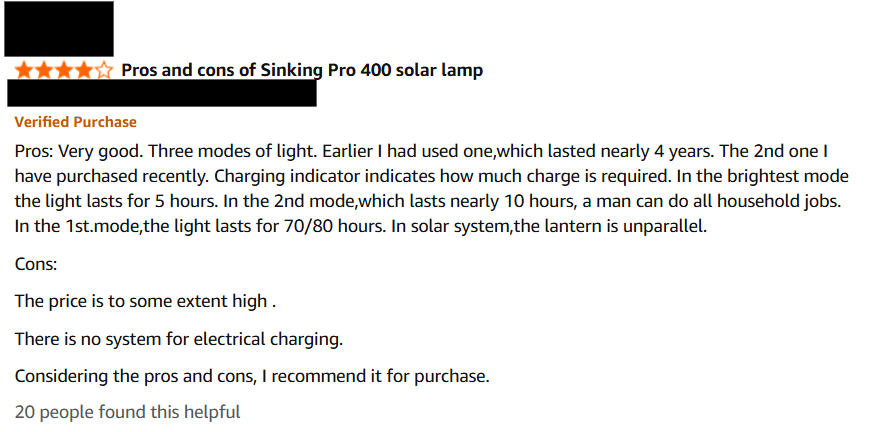
This is the section most competing content skips, and it’s exactly what people searching “sun king reviews” and “sunking solar reviews” are actually looking for.
What Users Consistently Praise
Owners of the Pro 400 on Amazon.in keep mentioning the same two things: fast charging (a full 7–8 hours of direct sun gets it to 100%) and a “step-down” feature that dims gradually as the battery runs low instead of cutting off without warning. That second one sounds minor until it’s the thing saving you from total darkness at 11 p.m. Several reviewers also point out that the low-brightness mode stretches a single charge across multiple nights.
What Users Consistently Complain About
Price comes up the most. Sun King costs more than the no-name lanterns flooding Amazon, and more than one reviewer mentioned waiting for a sale before buying in. There’s also a real limitation worth knowing upfront: on some models, USB charging only works while the panel sits in direct sunlight. It’s not a stored power bank you tap at 2 a.m. you charge devices earlier in the day and plan around it.
What Independent Testing Found
The MIT CITE Lab study is the strongest third-party data point on this brand, and almost nobody covering Sun King mentions it. Researchers evaluated 11 personal-use solar lanterns sold in Uganda using a Consumer-Reports-style framework covering suitability, scalability, and sustainability. The Sun King Pro topped that field at 88 out of 100, a harder number to fake than a five-star rating.
Sun King vs. Other Solar Lanterns
Sun King barely shows up in general “best solar lantern” roundups right now, which is strange given the testing data behind it. Here’s how it actually stacks up.
Sun King vs. MPOWERED Luci
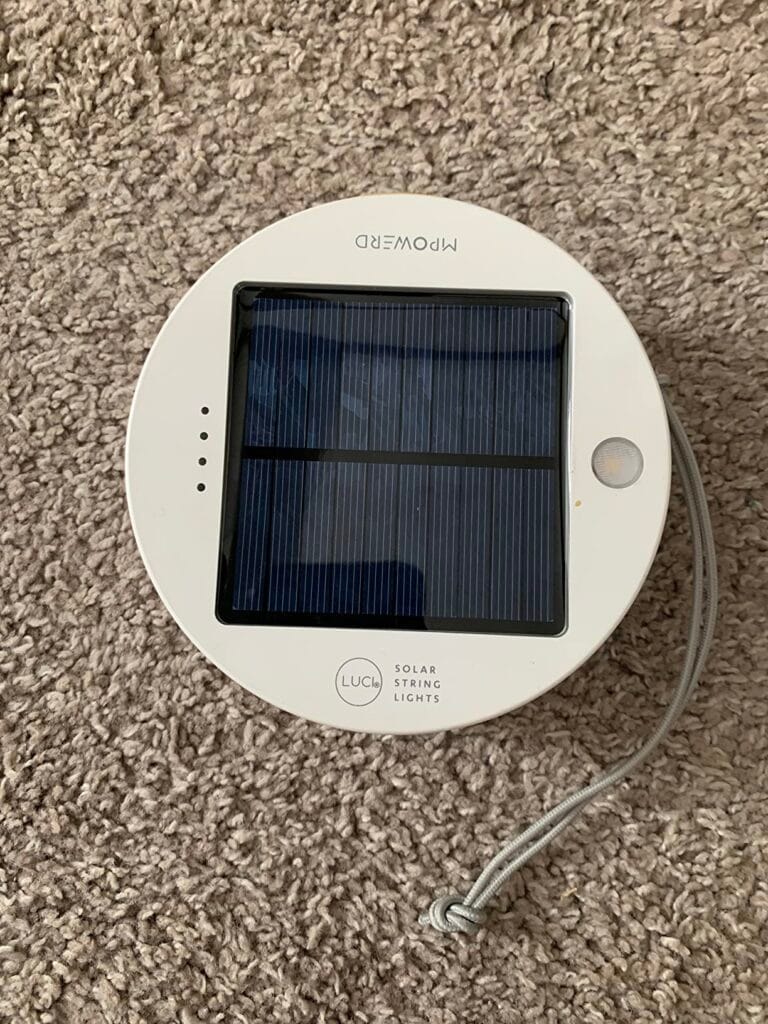
The Luci Outdoor 2.0 is the closest real competitor, an inflatable, collapsible lantern that’s genuinely clever for anyone counting grams. It puts out 75 lumens, runs about 24 hours per charge, recharges in 7 hours, and costs $30–45 depending on the version. It beats Sun King outright on waterproofing: IP67 versus a housing that handles rain but not submersion.
So the choice comes down to what you’re optimizing for. Pack weight and water resistance? Luci wins. A lantern that doubles as a real phone charger with independent lab data behind it? Sun King Pro or Boom.
Sun King vs. Generic Amazon Solar Lanterns
Generic lanterns are usually cheaper and often claim higher lumen counts. The catch: no Lighting Global certification, no MIT data, no established company behind the warranty claim. You’re trusting a product listing instead of a track record, fine for a backyard string light, riskier for something you’re stocking for an actual outage.
When Sun King Is NOT the Right Pick
If you want one light that does everything, full submersion rating, ultralight, collapsible, and cheap, nothing in this lineup checks every box at once. Pick your priority first (charging power, portability, or price), then choose the model built for it.
Who Sun King Is Actually For
Emergency Prep and Power Outages
This is the strongest use case by a wide margin. A Pro or Boom gives you light and a phone charger in one device, and when the power’s actually out, the charger matters as much as the light.
Camping and Off-Grid Outdoor Use
Camping is the second obvious fit, and it’s a growing market, one estimate puts the camping lantern industry at $1.82 billion in 2025, headed toward $3.14 billion by 2034, with solar models growing the fastest. Sun King rides that same shift away from gear that eats disposable batteries.
The “82 Million Users” Story, What It Actually Means
Sun King started in 2007, originally as Greenlight Planet, founded by Patrick Walsh and Anish Thakkar, to serve the roughly 1.8 billion people worldwide who still don’t have reliable grid electricity. In Kenya, about one in five people use a Sun King product, not as a backup, as their actual power source. Buying a Sun King Pro for a weekend camping trip means buying hardware engineered for people whose lives genuinely depend on it working every single night. That’s a higher design bar than most camping gear ever has to clear.
How to Buy the Right Sun King Light
Where to Buy (Official vs. Third-Party Sellers)
Amazon carries the core lineup, Pro, Boom, Pico Plus, with the standard manufacturer warranty intact. Third-party sellers sometimes list them cheaper, which is worth checking, but confirm seller ratings first; off-grid solar gear attracts its share of counterfeits globally. Sun King also sells direct through its regional storefronts if you’d rather skip the marketplace entirely.
Pricing by Model
Budget roughly $10–20 for the Pico Plus, $40–55 for the Pro or Boom, and expect the Home 200X to vary more by retailer and region.
Warranty and Support
Most of the lineup carries a 2-year manufacturer warranty against defects. Hold onto your receipt, this gear tends to get used hard, and warranty claims go smoother with proof of purchase in hand.
FAQs
Is the Sun King solar light worth buying in 2026?
For emergency prep or camping, yes, the Pro and Boom back up their durability claims with independent lab data, not just marketing.
How long does the Sun King solar light stay charged?
It depends on the model and mode. The Pico Plus runs up to 72 hours on its lowest setting; the Pro and Boom range from roughly 6 to 45 hours depending on brightness mode.
What do verified Sun King reviews say about battery life?
Owners generally confirm the manufacturer’s runtime claims on low-power settings, and the most common praise point is the gradual “step-down” dimming warning before a full shutoff.
Is Sun King a reliable, trustworthy brand?
The company has powered over 82 million people since 2007, and it backs that up with independent validation — an 88/100 score from MIT’s CITE Lab and Lighting Global durability certification, both harder to fake than an online star rating.
How does the Sun King solar light compare to other solar lanterns?
Against MPOWERED’s Luci Outdoor 2.0, Sun King trades some waterproofing and portability for stronger phone-charging capacity and more independent lab data.
What’s the difference between Sun King Pro, Boom, and Pico?
Pro is the all-around lantern-plus-charger. Boom adds an FM radio and MP3 player on top of that. Pico Plus strips it down to a small, cheap light with no phone charging.
Where can I buy a genuine Sun King solar light?
Amazon carries the core lineup directly, and Sun King’s own regional sites sell direct as well.
Does the Sun King solar light come with a warranty?
Most models carry a 2-year manufacturer warranty against defects.
How bright is the Sun King solar light in lumens?
It ranges by model: 50 lumens on the Pico Plus, up to 120 on the Pro, up to 160 on the Boom, and up to 400 on the higher-output Pro 400 variant.
What are the most common complaints about Sun King lights?
Price relative to generic alternatives, and the fact that USB charging on some models only works while the solar panel sits in direct sunlight rather than functioning as an always-available power bank.