Table of Contents
A five-star review from Phoenix doesn’t mean much in Minneapolis. Somewhere right now, a homeowner in a snowy climate is staring at the same “amazing, bright, lasted all night!” pathway lights a reviewer in Arizona raved about, except theirs go dark by 6 p.m. every February evening. The reviewer wasn’t lying. The product just never met winter.
That gap explains most of the frustration people feel with solar lighting. The lights aren’t broken. They’re mismatched to the place they’re installed. Three components decide that match every time: the battery chemistry inside the fixture, its IP rating, and the type of solar panel on top. Everything else, lumens, LED count, the shape of the housing, is decoration by comparison.
It’s worth saying plainly: solar lighting itself isn’t the weak link. Solar panels don’t care about cold, they respond to light, not temperature, and electrons actually move a little more efficiently in cooler air. The battery sitting underneath the panel is the part that struggles, and that’s a chemistry problem, not a “solar doesn’t work here” problem. Once that distinction clicks, choosing lights for any climate gets a lot simpler.
The Battery Nobody Checks Before Buying
Most people compare solar lights by brightness. That’s the wrong first question. The right one is: what happens to this battery on the coldest night of the year?
Standard lithium-ion cells, the kind found in most mid-range solar lights, perform well between roughly -10°C and 45°C. Step outside that range and output drops fast. Lithium iron phosphate (LiFePO4) batteries hold their charge far better in the cold, which is why cold-climate manufacturers have quietly shifted toward that chemistry over the past few years, Gama Sonic among them, along with several other outdoor lighting brands that build specifically for northern winters.
NiMH batteries sit at the bottom of the pile. They’re cheap to manufacture, common in budget multipacks, and usually the first thing to give out once temperatures drop. A fixture can have excellent LEDs and still die early purely because of what’s powering them.
None of this shows up on the front of the packaging. It’s usually buried in a spec sheet or a single line in the product description, worth the thirty seconds it takes to find.
IP Ratings Are Not Marketing Fluff
The two digits after “IP” aren’t there to sound technical. The first number rates dust protection, the second rates water. IP65 blocks low-pressure water jets from any angle and covers most backyards without complaint.
Where it gets interesting is placement. A light tucked under an eave rarely takes a direct hit from rain, so IP65 does the job comfortably. A pathway light staked into open lawn, fully exposed to storms and sprinkler overspray, benefits from the jump to IP67, not because the marketing team said so, but because that rating reflects genuinely tighter seals around the battery compartment, which is where cheap fixtures usually fail first.
One thing an IP rating won’t do: protect against cold. A perfectly sealed IP67 light can still die in a hard freeze if the battery inside is the wrong chemistry. Waterproofing and cold tolerance are separate problems with separate solutions.
Panel Type Matters Most When the Sun Isn’t Cooperating
Monocrystalline panels convert somewhere around 17–22% of sunlight into usable energy. Polycrystalline panels typically land closer to 13–16%. In full, unobstructed sun, that gap barely matters, both eventually top off the battery.
The difference shows up on the bad days: overcast afternoons, short winter daylight, a patio half-shaded by next door’s fence. That’s when a monocrystalline panel earns its slightly higher price tag, simply because it needs less usable light to do the same job.
Two Myths Worth Retiring
The first myth: solar lights are only for sunny places. They’re not. Solar panels harvest light, not heat, and plenty of well-engineered fixtures perform fine through cold, cloudy winters, the battery inside, not the panel on top, is what usually gives out first in those conditions.
The second myth: a higher price always means better cold or heat performance. It doesn’t, not automatically. Plenty of expensive solar lights use the same NiMH battery as a $15 multipack, just wrapped in nicer housing. The only reliable way to know is checking the actual spec, battery chemistry, IP rating, panel type, rather than trusting the price tag to do that work.
Both myths point to the same lesson: climate performance is a components question, not a budget question or a geography stereotype.
Cold Climates: Where Batteries Actually Get Tested
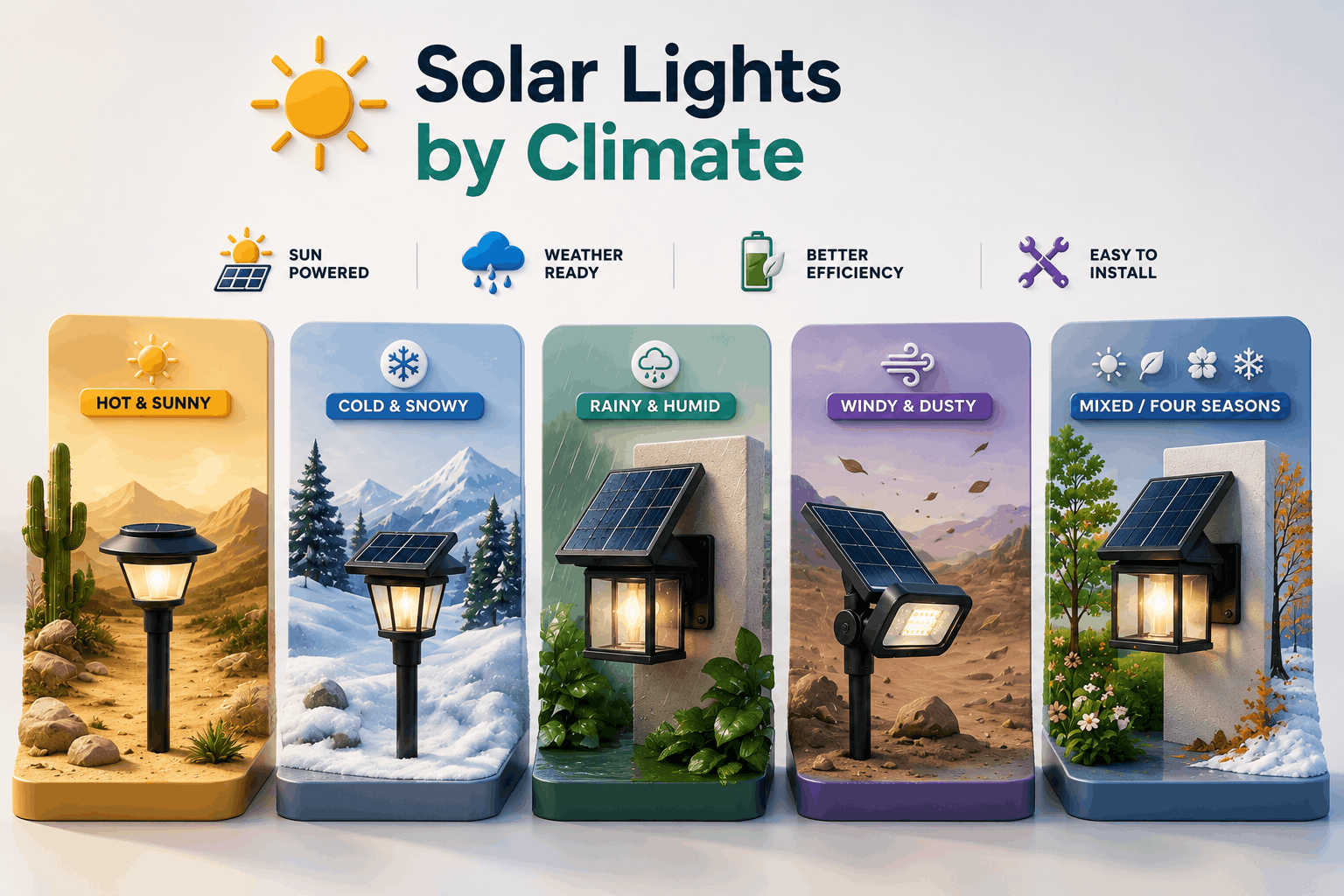
Winter attacks solar lights from three directions at once, shorter days, colder batteries, and snow sitting flat on the panel, blocking light before it ever reaches the cells. Fixing all three doesn’t mean buying a bigger light. It means buying the right components.
Below -10°C, standard lithium-ion batteries can lose well over a third of their usable capacity, based on cold-weather testing widely cited across the industry. LiFePO4 batteries hold onto a much larger share of that capacity across the same range, which is the entire reason they’ve become the default in serious winter-rated fixtures.
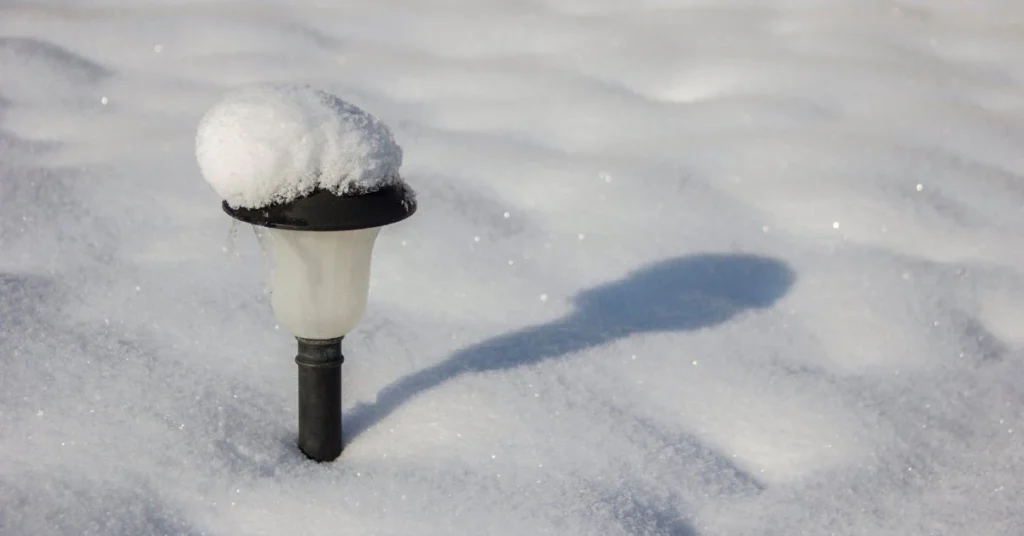
Snow doesn’t need to melt to cause problems, a thin, undisturbed layer is enough to stop charging almost entirely. A steeper panel angle helps it slide off on its own. So does positioning the fixture to face south (in the northern hemisphere), which catches more of winter’s lower sun path than an east- or west-facing spot ever will. And when none of that is enough, wiping the panel with a dry cloth after a storm remains the fastest, cheapest fix available, under a minute of effort for a full charge restored.
| Priority | Cold-Climate Target |
|---|---|
| Battery | LiFePO4 |
| IP Rating | IP65 minimum, IP67 for heavy snow zones |
| Panel Angle | Steep enough to shed snow |
| Battery Size | Oversized for the shorter winter charging window |
A UK winter and a Canadian winter don’t demand the same fixture, even though both fall under “cold.” The UK rarely holds far below freezing for long, grey skies do more damage there than the thermometer does. Canada is a different fight entirely, with weeks of sustained sub-zero temperatures that push battery chemistry to its limit rather than testing panel efficiency alone. A guide built specifically for UK winter conditions is in the works and will link here once published, for now, the battery and IP guidance above applies directly.
For the harsher end of the spectrum, Solar Lights in Canada: Do They Survive the Winter and Are They Worth It? goes deep on realistic runtime through a genuine Canadian February, and the broader Best Solar Lights for Cold Climates: Winter Guide 2026 rounds up battery types, IP ratings, and installation tips across multiple cold regions.
One more thing worth knowing before winter hits: even a well-matched cold-climate fixture will show reduced runtime compared to summer. That’s normal and expected, shorter days mean less total charging time, not a defect. The real difference between a good winter setup and a bad one isn’t zero drop-off; it’s getting three or four solid hours of light instead of ten, versus getting nothing at all by 9 p.m.
Holiday lighting deserves its own mention here, mostly as a warning. Decorative strands are often built with the cheapest battery a manufacturer can get away with, since shoppers rarely check chemistry before buying string lights for a tree. A dedicated cold-climate Christmas lighting guide is coming soon and will be linked here, until then, the same rule applies: check the battery before checking the price tag.
Rain and All-Weather: The Real Enemy Is Water, Not Clouds
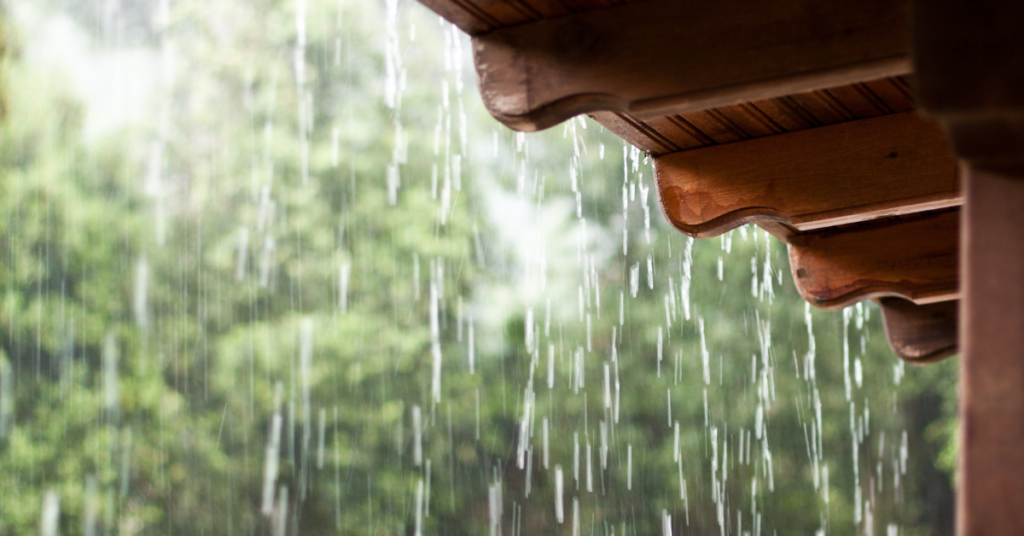
Cloud cover slows charging but rarely stops it, ultraviolet light passes through clouds well enough to keep a battery topping up, just more slowly. The actual threat during a rainy season isn’t a lack of sunlight. It’s water finding a way into the fixture that wasn’t supposed to let it in.
IP65 handles ordinary rain fine. Sustained downpours, flooding, or anything close to a monsoon justify stepping up to IP67, which meaningfully tightens the seals around the battery compartment. Wind matters too, especially for taller stakes or string lights, a fixture that survives the rain itself can still fail from months of repeated wind stress loosening its mount.
Placement solves more waterproofing complaints than any hardware upgrade does. Lights mounted near a gutter or downspout often take on far more water than their IP rating was ever designed to handle, simply because runoff volume dwarfs normal rainfall. Moving a fixture a foot or two out of that path fixes what looks, at first glance, like a defective product.
Battery capacity also carries more weight here than most buyers expect. One overcast afternoon barely dents a full charge. A full week of rain is a different story, capacity decides whether the lights are still working on day five or dark by day three.
Coastal and tropical climates add humidity into the mix, which is a slower but equally real threat. Moisture doesn’t need a downpour to cause corrosion; it seeps in gradually through weak seams over months, which is exactly why the seal quality behind an IP rating matters as much as the number itself. Two products can both claim IP65 while using very different quality gaskets underneath.
Best Lights for Rainy Weather: Which Models Actually Work When It Pours breaks this down for a genuinely wet season rather than the occasional drizzle. Panel and sealing technology in this category keeps improving, 2026 New Models: Better Technology, Smarter Choices covers what’s actually changed this year rather than just what’s marketed as new.
Strobe-style fixtures, often used for storm visibility or extra security in wet climates, need their own weatherproofing standard — Solar Strobe Lights Outdoor: Complete Buying Guide 2026 covers what to look for. And for anyone who’d rather buy one setup that survives every season instead of swapping fixtures twice a year, Solar Lights for All Weather: What Works Year-Round in 2026 focuses on hardware built to handle rain, heat, and cold without complaint.
Rain isn’t limited to storm season, either. Halloween displays sit outside for weeks through unpredictable autumn weather, and Halloween Solar Lights: The Complete Buying Guide covers fixtures built to survive that stretch without needing daily babysitting.
Hot and Shaded Climates: Two Different Problems Wearing the Same Label
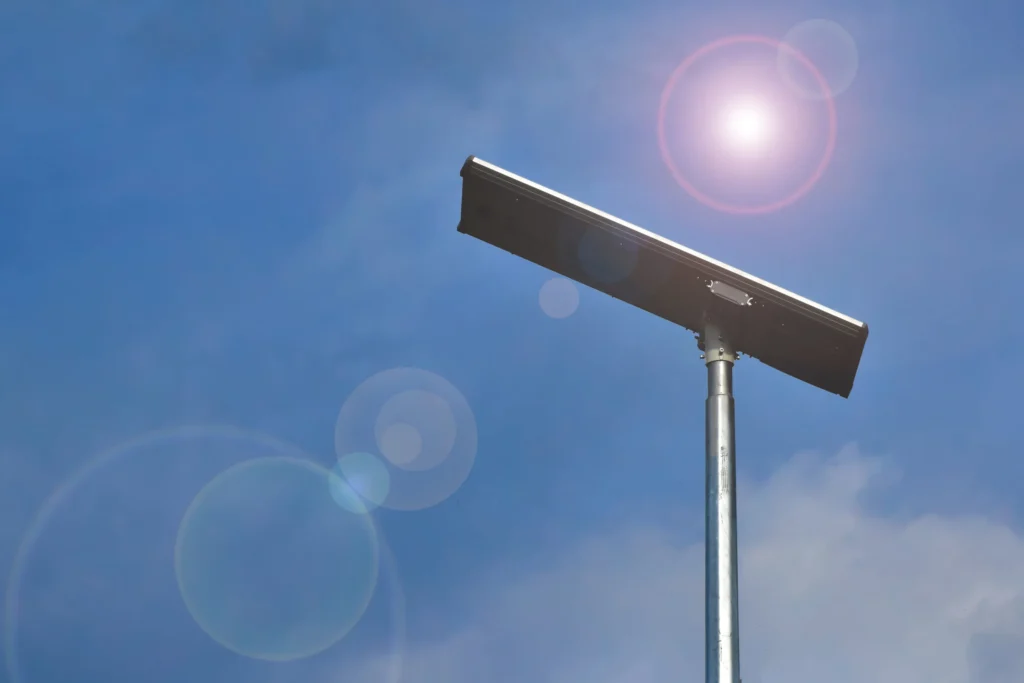
Heat and shade get lumped together as “difficult climates,” but they’re not the same fight. Heat shortens battery lifespan over years of use. Shade cuts the amount of energy reaching the battery on any given day. Solving one does nothing for the other.
Solar panels actually lose a small amount of efficiency as they heat up, the same way most electronics run slightly worse when hot. The bigger issue is long-term battery wear. Sustained high heat speeds up the chemical degradation inside a battery, which shortens its useful life even if daily performance still looks normal from the outside.
Shade is a lighting problem, not a heat problem. A monocrystalline panel earns its keep here, since it needs less direct light than a polycrystalline one to reach a full charge, genuinely useful under tree cover or a partially blocked patio.
Desert climates add a variable most buyers never think about: housing material. Cheap plastic casings turn brittle and discolored after enough seasons of intense UV exposure, often well before the battery or panel actually fails. A fixture rated for heat but built with low-grade plastic can look worn out within a year even while technically still working. Dust piles onto this problem in arid regions, cutting into panel efficiency the same way shade does, a quick wipe every few weeks keeps output closer to what the panel is actually rated for.
There’s an odd upside worth mentioning: the strongest, most direct sun of the day is also when a battery has the least trouble reaching full charge, even in a shortened window. Fixtures in genuinely sunny hot climates rarely struggle with charging itself, the issue is almost always long-term durability rather than daily performance. That’s a useful distinction when deciding where to spend extra money: a slightly better battery chemistry and housing material matter more here than chasing a bigger panel.
Solar Lights for Extreme Heat, a dedicated guide on desert and high-UV battery degradation, is coming soon and will link here. In the meantime, Can Solar Lights Get Too Hot? What Most People Get Wrong About Heat and Solar clears up a surprisingly common misconception about heat and solar output.
Shade brings its own trade-offs, and Solar Lights for Forest Areas: What Actually Works Under Tree Cover covers panel sizing and placement for genuinely low-light installations. Australia is a useful real-world case of heat and UV exposure hitting at the same time, and Best Solar Lights for Australian Climate covers what’s built to withstand both.
Matching a Fixture to a Climate, in Practice
Skip the marketing copy and check three things before buying anything: the battery chemistry, matched to the coldest night the fixture will realistically face. The IP rating, treated as a floor rather than a ceiling — IP65 for sheltered spots, IP67 for anything exposed to real storms or snowmelt. And the panel type, with monocrystalline earning its cost anywhere shade or short winter days are part of the picture.
Climates that don’t fit neatly into one bucket, much of the American Midwest, large parts of Europe, anywhere with genuine seasonal swings, do best with LiFePO4 batteries as a default. That chemistry holds up reasonably well across a wide temperature range, which matters more than optimizing hard for one extreme and hoping the other season doesn’t cause trouble.
Warranty length is a quieter signal worth checking too. Manufacturers confident in their cold or heat tolerance tend to back that confidence with longer coverage, since a battery that dies in one bad winter becomes an expensive return to process. A one-year warranty on a fixture marketed for “all climates” is worth a second look before buying.
None of this requires becoming an electrical engineer before ordering pathway lights. It requires reading past the headline photo and brightness number to the three lines of spec sheet that actually predict how the fixture behaves once winter, a monsoon, or a heatwave shows up.
What Happens When the Battery Eventually Wears Out
Even a well-matched battery doesn’t last forever, LiFePO4 and lithium-ion cells both degrade gradually with every charge cycle, climate stress just speeds that timeline up or slows it down. Most solar light batteries are rated for somewhere between 300 and 1,000 full charge cycles before capacity noticeably drops, which in practice works out to roughly two to four years of daily use, faster in harsh climates and slower in mild ones.
The good news: many mid-range and premium fixtures use replaceable battery packs rather than sealed, disposable units. Checking for this before buying saves money down the line, since a $10 replacement battery is a far better outcome than throwing out an entire $60 fixture because one component wore out. Budget lights, especially the sealed multipacks common at big-box retailers, rarely offer this option, another quiet argument for spending slightly more upfront in a genuinely harsh climate.
FAQs
Do solar lights actually work in winter?
Yes, provided the battery chemistry can handle the cold and the panel gets enough daylight to charge. LiFePO4 makes the difference here far more than brand or price does.
Will heavy rain or a monsoon season ruin solar lights?
Not if the IP rating matches the exposure. IP65 covers ordinary rain; sustained storms call for IP67 and, ideally, a spot away from gutter runoff.
Do solar lights work under trees or in shade?
They work, just with less output. A monocrystalline panel and a slightly larger panel size close most of that gap.
How does someone find out what battery chemistry their lights use?
It’s usually printed on the product listing or manual. If it isn’t mentioned anywhere, it’s very likely NiMH, brands tend to advertise the better chemistries prominently when they use them.
Is a more expensive monocrystalline panel worth it in full sun?
Not really. In consistent, unobstructed sunlight, polycrystalline panels catch up easily. The extra cost pays off specifically in shade, cloud cover, or short winter days.
How long should a solar light battery realistically last?
Most rated cells manage 300 to 1,000 full charge cycles, which typically translates to two to four years of daily use. Harsh climates tend to shorten that window; mild ones stretch it out.
Summary
A solar light that fails in the wrong climate isn’t defective, it’s doing exactly what its battery chemistry and IP rating predicted, just not what the buyer expected going in. Matching those three specs to the actual weather outside costs nothing extra and saves a fixture from becoming a one-season disappointment.
Back to that reviewer in Phoenix: nothing about their glowing review was wrong. Their light genuinely lasted all night, every night, because it never had to fight a battery through a freeze or push light through six inches of snow. The lesson isn’t to distrust reviews, it’s to check where the reviewer lives before assuming their results will repeat somewhere colder, wetter, or hotter.
The linked guides above go deeper into whichever climate applies; starting with the one closest to home is usually the fastest way to a setup that actually lasts through the season it needs to survive.