Table of Contents
Buying a solar street light sounds simple until you open a supplier catalog and see fifteen wattages, three battery chemistries, and a pole height chart that reads like a tax form. Take a breath. This guide walks you through the whole decision, from “what even is this thing” to “here’s exactly what to order,” using real specs, real pricing, and real city case studies instead of marketing fluff.
Quick Answer, How to Choose the Right Solar Street Light
If you only have two minutes, here’s the short version. Match your wattage to your setting, not to the biggest number on the box.
| Setting | Typical Wattage | Approx. Price Range (USD, fixture only) |
|---|---|---|
| Driveways, footpaths, backyards | 30W–45W | $85–$700 |
| Residential streets, rural roads | 45W–60W | $120–$1,350 |
| Parking lots, commercial lots | 60W–150W | $150–$2,300 |
| Highways, large intersections | 150W–300W+ | $300–$5,000+ |
Prices swing that widely because two “60W” lights can hide completely different batteries and panels inside identical-looking housings. We’ll explain exactly why later in this guide. For now: pick your setting, check the wattage guides linked below, and never buy on price alone.
What Is a Solar Street Light & How Does It Work?
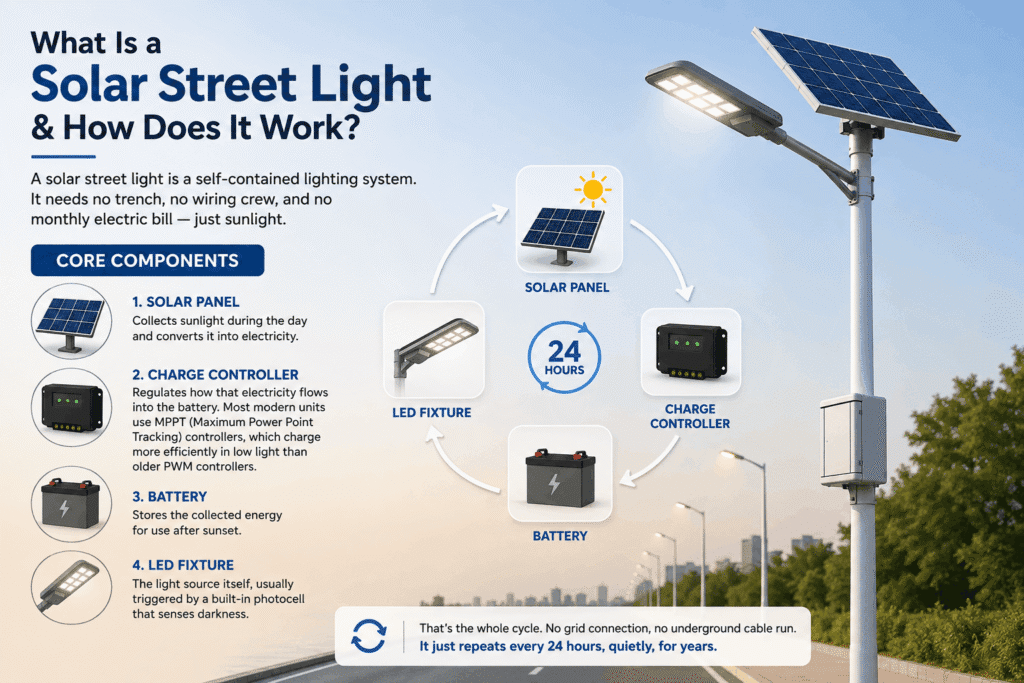
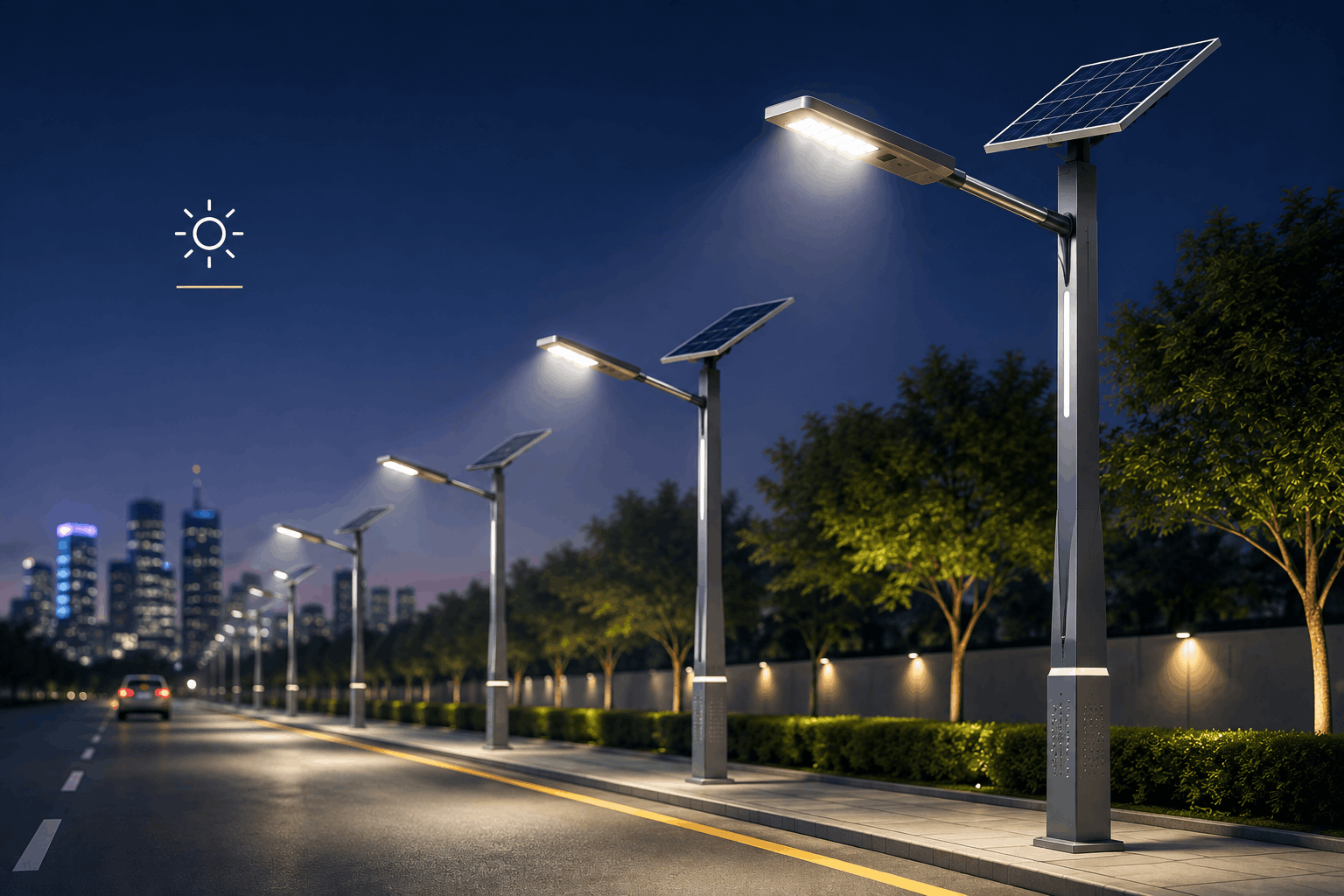
A solar street light is a self-contained lighting system. It needs no trench, no wiring crew, and no monthly electric bill — just sunlight.
Core Components, Panel, Battery, LED, Controller
Every solar street light runs on the same four-part loop, regardless of how fancy the marketing gets.
- Solar panel: collects sunlight during the day and converts it into electricity.
- Charge controller: regulates how that electricity flows into the battery. Most modern units use MPPT (Maximum Power Point Tracking) controllers, which charge more efficiently in low light than older PWM controllers.
- Battery: stores the collected energy for use after sunset.
- LED fixture: the light source itself, usually triggered by a built-in photocell that senses darkness.
That’s the whole cycle. No grid connection, no underground cable run. It just repeats every 24 hours, quietly, for years.
Solar vs Traditional (Grid-Tied) Street Lights, Why Switch?
Traditional street lights need trenching, conduit, wiring, and a permanent grid connection. That installation alone can run into the thousands of dollars per pole before the light even turns on.
Solar lights skip nearly all of it. A recent Fonroche Lighting America analysis of California municipal projects found cities can cut installation and maintenance costs by up to 75% by going solar, since there’s no trenching, cabling, or monthly utility bill involved. A mid-sized Texas municipality that replaced hundreds of grid-connected streetlights with solar units reported a 40% drop in energy costs within the first year alone.
There’s also a public-safety angle rarely mentioned in spec sheets: research cited by municipal lighting providers shows that improved nighttime illumination can reduce crime by as much as 36%, and solar’s independence from the grid means lights stay on during power outages and storms when they matter most.
None of this makes solar the automatic winner for every project. Grid power still suits extremely high-demand fixtures better, and it doesn’t depend on weather. But for most residential, rural, and mid-size commercial projects, solar wins on total cost within a few years — more on that in the ROI section below.
Types of Solar Street Lights
All-in-One (Integrated) vs Split-Type Systems
All-in-one (integrated) lights pack the panel, battery, controller, and LED into a single unit on top of the pole. They’re compact, quick to install, and the go-to choice for residential and small commercial projects.
Split-type systems mount the panel, battery, and light head separately along the pole. This allows a bigger battery and panel, which matters for high-power applications like highways or regions with long stretches of cloudy weather. The tradeoff is a more complex install and a higher price tag.
Neither type wins outright. All-in-one wins on simplicity and cost. Split-type wins on raw power and battery capacity for demanding sites.
Which Solar Street Light Fits Your Use Case?
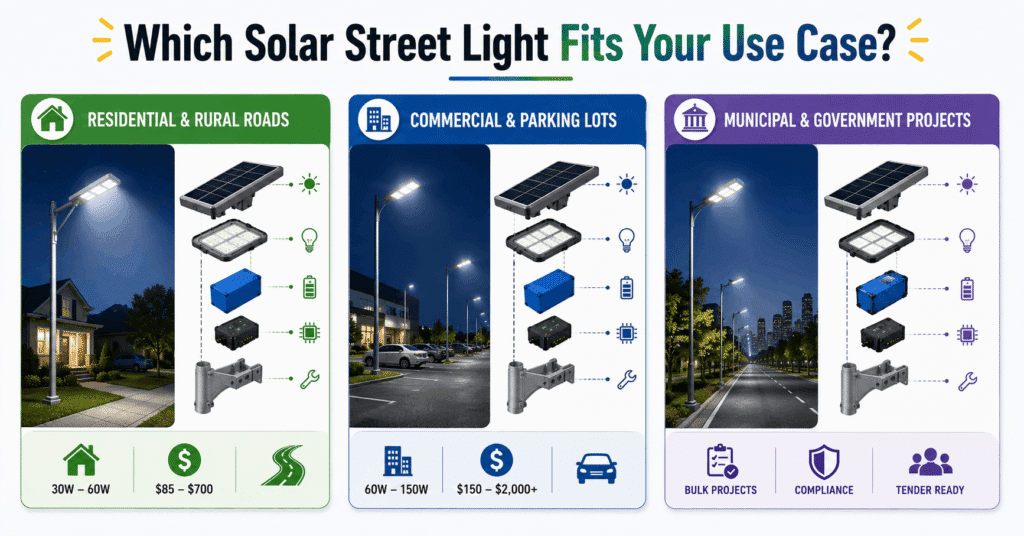
Residential & Rural Roads
For driveways, backyards, and quiet residential streets, 30W–60W all-in-one lights cover most needs. Budget units start around $85–$150, while better-built residential lights with a genuine LiFePO4 battery run $150–$700.
Commercial & Parking Lots
Parking lots and commercial access roads need wider coverage and steadier brightness, typically 60W–150W. Pricing ranges from roughly $150 to over $2,000, with commercial-grade, DLC/UL-certified fixtures sitting at the higher end.
Municipal & Government Projects
Municipal lighting involves bulk procurement, tender documents, and compliance requirements that go well beyond picking a wattage. If you’re speccing lights for a city or public agency, our dedicated guide walks through the procurement and installation process step by step.
[Solar Street Light Installation for Municipalities]
Key Buying Criteria, What to Check Before You Buy
Wattage & Lumens (Brightness)
Here’s the part almost every buyer gets wrong: wattage tells you power draw, not brightness. Lumens tell you brightness. Real-world LED chips deliver roughly 100–150 lumens per watt in commercial-grade fixtures, so a genuine 45W light typically produces somewhere around 4,500–6,000 lumens.
Watch out here: marketplace listings for backyard “solar street lights” frequently advertise numbers like “4200W” or “450,000 lumens” for products selling under $50. That output is physically impossible for a compact solar fixture, no consumer-grade panel or battery that size can support it. Treat wildly inflated wattage/lumen claims as a red flag, not a bargain.
Solar Panel Type (Mono vs Poly)
Monocrystalline panels convert sunlight at roughly 18–22% efficiency. Polycrystalline panels typically run 15–17%. Monocrystalline costs a bit more but performs better in cloudy regions and in the compact, integrated designs used by most solar street lights.
Battery Type & Capacity (LiFePO4 vs Lead-Acid)
This is where cheap lights fall apart, sometimes literally. LiFePO4 (lithium iron phosphate) batteries handle roughly 2,000–4,000+ charge cycles and tolerate heat far better than older chemistries, translating to 5–10+ years of usable life. Lead-acid batteries typically manage only a few hundred to about 1,000 cycles and degrade fast in hot climates. If a listing doesn’t specify LiFePO4, assume it isn’t, and budget for an earlier battery replacement.
IP Rating & Weatherproofing
IP ratings follow the IEC 60529 international standard. The first digit measures dust protection (0–6), the second measures water resistance (0–8). IP65, dust-tight, protected against low-pressure water jets from any direction, is the accepted minimum for outdoor street lighting. In regions with heavy storms or direct power-washing risk, step up to IP66 or IP67.
Pole Height & Coverage Area
Pole height should match the road or area you’re lighting, not personal preference. As a rough guide: 6–8 meters suits driveways and footpaths, 8–12 meters covers general streets and parking lots, and 12+ meters is reserved for highways and large open areas needing wider light distribution.
Lightning/Surge Protection
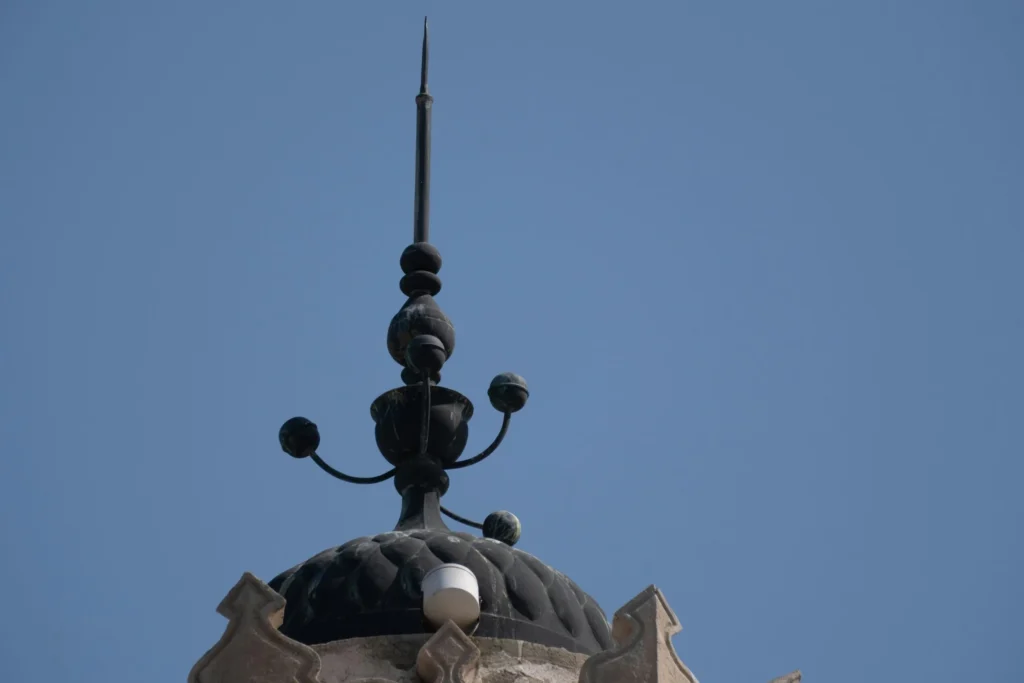
Solar street lights sit exposed on tall poles, which makes them natural lightning-strike targets. A surge protector, often called a lightning arrester, absorbs that spike before it fries the controller and battery, a detail that matters far more than most first-time buyers realize, especially in storm-prone regions.
Solar Lightning Arrester – Range & Complete Guide
Solar Street Light Wattage Guide, Compare by Power
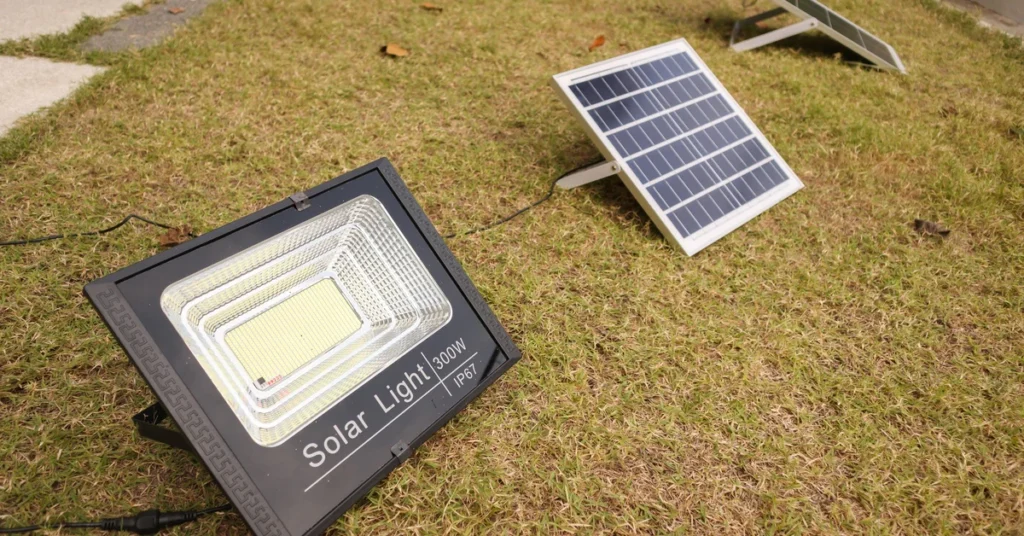
Once you know your use case, the next step is picking the exact wattage. We’ve broken each one down separately with real pricing, specs, and top brand picks.
Installation Process
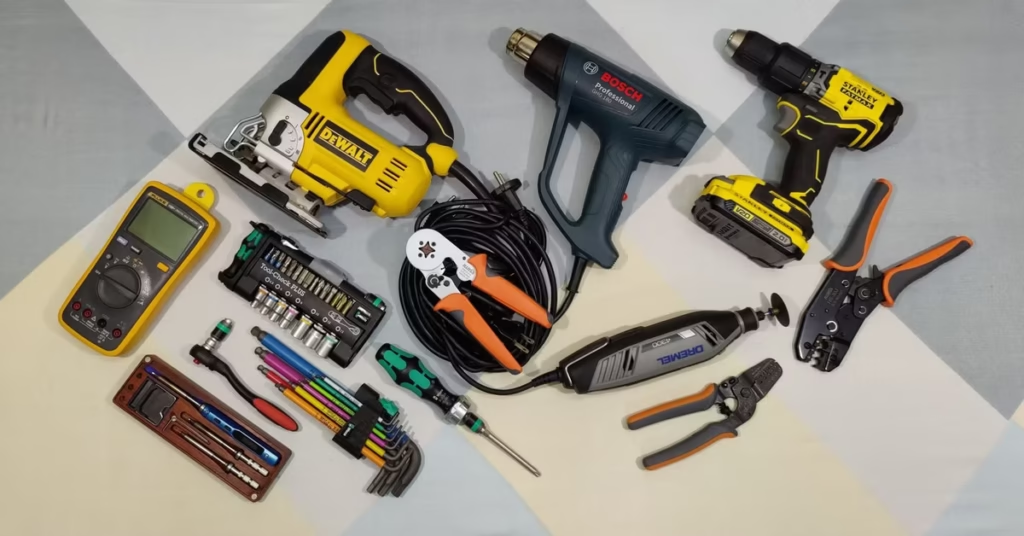
Solar street lights are designed to be installer-friendly, no trenching, no grid tie-in, but you still need the right tools and a clear process.
Tools Needed
Tools Needed to Install Solar Street Lamps
Step-by-Step Installation Overview
- Confirm the site. Check for shading from trees or buildings that could block the panel during the day.
- Prepare the foundation. Most poles need a concrete base, follow the manufacturer’s foundation spec exactly.
- Mount the pole. Secure it plumb (perfectly vertical); an angled pole throws off both light distribution and panel sun exposure.
- Attach the fixture and panel. Orient the panel toward true south (Northern Hemisphere) for maximum sun exposure.
- Test the photocell and battery connection. Cover the sensor to confirm the light triggers correctly before you pack up.
Cost, Pricing & ROI
Solar Street Light Cost Comparison Chart
[Solar Street Light Cost Comparison Chart]
Factors That Affect Price
The battery is usually the single biggest cost driver, often accounting for 40–50% of a light’s total price. That’s exactly why two lights at the same wattage can be priced $100 apart, one has a genuine LiFePO4 pack, the other has a cheaper cell that won’t survive year two. Panel size, pole material, certifications (DLC, UL), and warranty length all factor in too.
Payback Period & Long-Term Savings
Commercial-grade solar street lights typically pay for themselves in 3–5 years through eliminated electricity and installation costs. Fonroche’s California municipal data puts full ROI at under four years once trenching and utility-bill savings are factored in. After that point, a city or property owner is essentially running free lighting until the battery needs replacing.
A simplified 10-light residential example, based on published cost breakdowns: roughly $6,500 upfront (fixtures, poles, installation) versus roughly $8,500 over 10 years including battery replacements, with zero electricity cost throughout. Compare that to a wired alternative, where installation alone can exceed $4,000 per pole before a single kilowatt-hour is used.
There’s an environmental line item too: per U.S. Energy Information Administration figures, every kilowatt-hour of grid electricity avoided prevents roughly 0.81 pounds of CO₂ emissions, which adds up fast across a street full of poles running every night for a decade.
Maintenance & Lifespan
Solar street lights are low-maintenance, not zero-maintenance. Here’s what actually needs attention:
- LED fixture: Quality LED chips are rated for 50,000–100,000 hours, translating to roughly 10–20+ years of nightly use.
- Battery: The first component that will need replacing. LiFePO4 batteries typically last 5–10 years; lower-grade batteries may need swapping within 1–3 years.
- Panel: Wipe off dust, bird droppings, and debris every few months, a dirty panel charges slower and shortens battery life indirectly by forcing deeper discharge cycles.
- Pole and hardware: Check for rust, loose bolts, and worn mounting brackets during routine inspections, especially after storms.
Common Buying Mistakes to Avoid
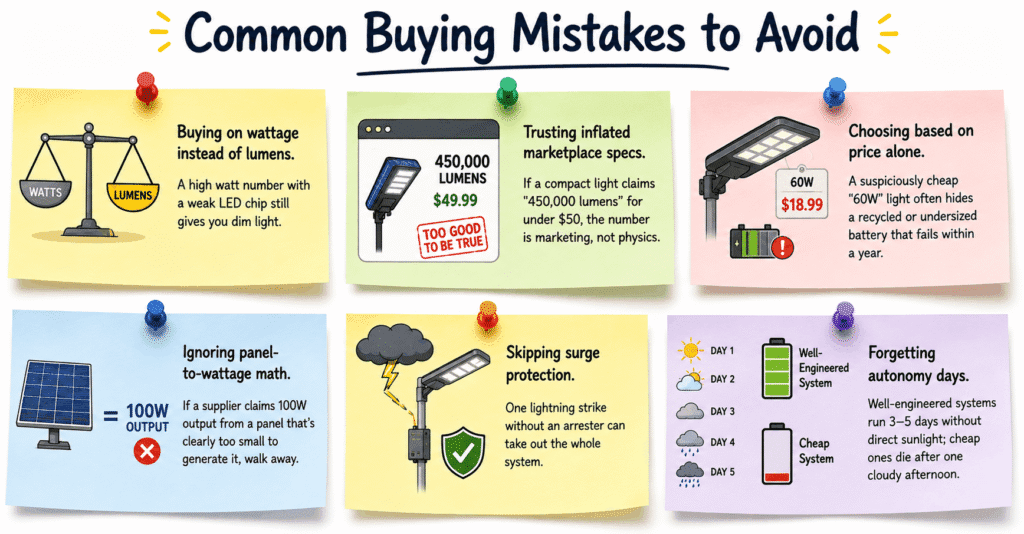
- Buying on wattage instead of lumens. A high watt number with a weak LED chip still gives you dim light.
- Trusting inflated marketplace specs. If a compact light claims “450,000 lumens” for under $50, the number is marketing, not physics.
- Choosing based on price alone. A suspiciously cheap “60W” light often hides a recycled or undersized battery that fails within a year.
- Ignoring panel-to-wattage math. If a supplier claims 100W output from a panel that’s clearly too small to generate it, walk away.
- Skipping surge protection. One lightning strike without an arrester can take out the whole system.
- Forgetting autonomy days. Well-engineered systems run 3–5 days without direct sunlight; cheap ones die after one cloudy afternoon.
FAQs
How long do solar street lights last?
The LED itself can last 10–20+ years, but the battery is the limiting factor. A LiFePO4-based system realistically lasts 5–10 years before the battery needs replacing; the pole and housing can outlast that with basic maintenance.
Do solar street lights work in cloudy or winter weather?
Yes, within limits. Well-engineered systems are built with “autonomy days”, an oversized battery that can power the light for 3–5 consecutive days without a full recharge. Budget lights with undersized batteries struggle much sooner.
Are solar street lights worth it?
For most residential, rural, and mid-size commercial projects, yes. Real municipal data from California shows up to 75% savings on installation and maintenance, with full ROI typically inside four years.
What wattage do I need for my area?
Match wattage to the space: 30–60W for driveways and residential streets, 60–150W for parking lots and commercial areas, and 150–300W+ for highways and large intersections. Use the wattage guides above for exact specs per size.
Conclusion
Solar street lighting isn’t complicated once you strip away the marketing numbers. Match the wattage to your setting, insist on real lumen figures and a genuine LiFePO4 battery, confirm at least an IP65 rating, and don’t skip surge protection. Do that, and you’ll end up with a system that quietly lights your street for a decade without another electric bill, the way California and Texas municipalities already have.