Table of Contents
Solar panels get all the attention. The inverter sits quietly next to your electrical panel doing the actual work of making that sunlight usable, and most homeowners never think about it until something goes wrong.
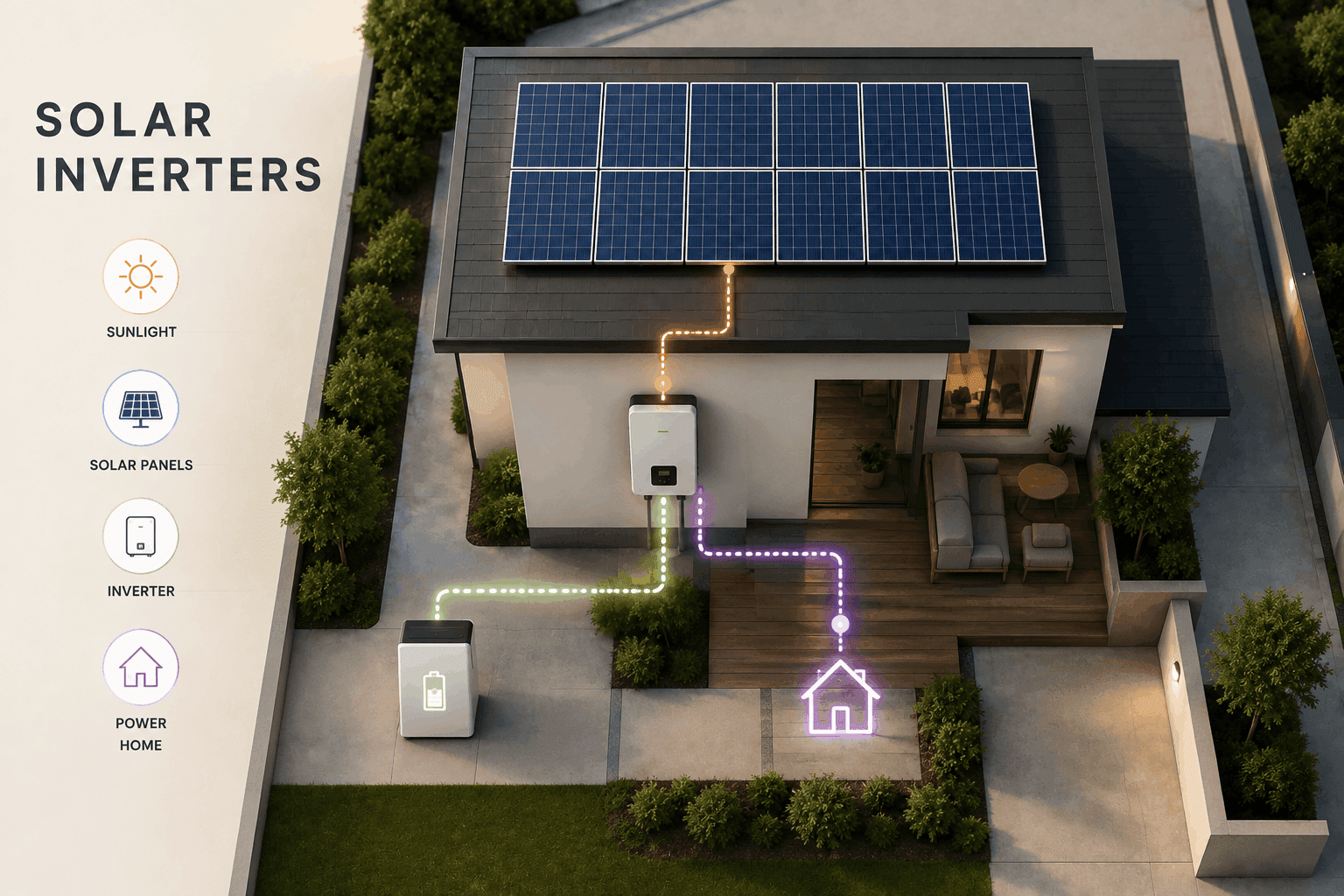
A solar inverter converts the direct current (DC) electricity your panels produce into the alternating current (AC) electricity your home runs on. The U.S. Department of Energy lists it as essential connection equipment for exactly this reason: without it, the power your panels generate has nowhere to go.
Why DC Has to Become AC
Your panels produce DC, current flowing steadily in one direction, the same way a battery works. Your outlets, your fridge, and the grid itself all run on AC, which switches direction dozens of times a second. AC won that battle over a century ago because it travels long distances with far less energy loss than DC.
Nothing about your panels changes that. They’ll keep producing DC no matter what, which is exactly why the inverter exists in the first place.
How the Conversion Actually Happens
Sunlight knocks electrons loose in your panels, producing DC current. That current reaches the inverter, where a set of transistors switches rapidly on and off, thousands of times per second, reshaping the steady DC flow into the back-and-forth wave pattern of AC. From there, it flows straight into your home’s electrical panel.
Most inverters sold today also run Maximum Power Point Tracking (MPPT), which constantly adjusts for shifting sunlight, clouds, shade, time of day. PowerOutage.us puts the efficiency gain from MPPT at up to 30% over older, non-tracking inverter technology.
The Inverter Types Actually Selling in 2026
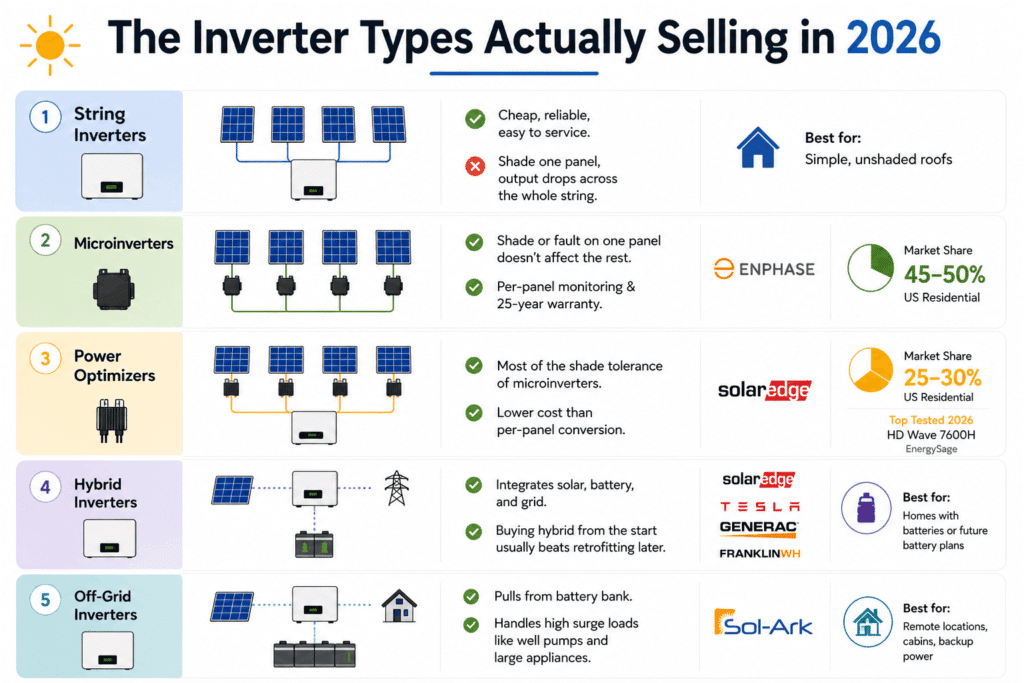
Type matters more than brand, though we’ll get to brands too. Here’s what’s on the market right now.
String inverters remain the default for simple, unshaded roofs, one central box, wired to a “string” of panels, converting everything in one place. Cheap, reliable, easy to service. The downside hasn’t changed in a decade: shade one panel, and output drops across the whole string.
Microinverters flip that setup, every panel gets its own small inverter, so shading or a fault on one panel doesn’t touch the rest. Enphase’s IQ8 series currently holds an estimated 45–50% of the US residential inverter market, largely on the strength of per-panel monitoring and a 25-year warranty that matches most panel warranties.
Power optimizers sit between the two. They “clean up” DC output at each panel, then send it to one central string inverter for conversion, most of the shade tolerance of microinverters, without the per-panel conversion cost. SolarEdge is the name most associated with this category; its DC-optimizer systems hold roughly 25–30% of the US residential market. The SolarEdge HD Wave 7600H currently ranks as EnergySage’s top-tested inverter for 2026, largely on efficiency and voltage performance, though it’s priced accordingly.
Hybrid inverters manage solar, battery, and grid power through one unit. SolarEdge expanded its hybrid and battery-integrated lineup in January 2026, and brands like Tesla, Generac, and Franklin WH now lead the battery-paired segment specifically. If a home battery is anywhere in your plans, buying hybrid from the start usually beats retrofitting one later.
Off-grid inverters work without any grid connection, pulling directly from a battery bank and handling the surge current of appliances like well pumps. Sol-Ark is a name that comes up often here, particularly for storage-heavy off-grid builds.
What Warranty and Lifespan Actually Look Like by Brand
Numbers vary by manufacturer more than by “type” alone:
| Brand / Category | Typical Warranty |
|---|---|
| Enphase microinverters | 25 years |
| SolarEdge (string + optimizer) | 12 years, extendable |
| SMA / Fronius string inverters | 10–12 years |
| Hybrid inverters (general) | 10–12 years |
Panels themselves generally run 25–30 years, so a string or hybrid inverter replacement partway through your system’s life is normal, not a defect.
For a brand-specific look at real-world lifespan by battery type, we broke it down here: How Long Does a Luminous Inverter Last?
What It Actually Costs in 2026
Installed inverter pricing runs roughly $0.22–$0.55 per watt depending on architecture, string coming in cheapest, hybrid and full battery-integrated systems at the top end. On an 8kW residential system, that’s somewhere around $1,800–$4,400 just in inverter equipment, before installation labor.
One thing worth knowing if you’re in the US: the Treasury’s Section 45X manufacturing credit, finalized in late 2024, assigns per-watt credits ranging from 0.25 cents for large central inverters up to 11 cents per watt for microinverters, part of why domestic microinverter manufacturing has expanded over the past year.
A Regulatory Shift Worth Knowing About
If you’re reading this after October 1, 2026, new NERC standards (PRC-028-1, PRC-029-1, PRC-030-1) are now in effect for inverter-based resources connected to the bulk power system, raising requirements around data recording and grid “ride-through” behavior during disturbances. It mostly affects utility-scale installs rather than rooftop systems directly, but it’s a sign of where inverter technology is heading: less passive DC-to-AC box, more active grid participant.
Picking the Right One for Your Roof
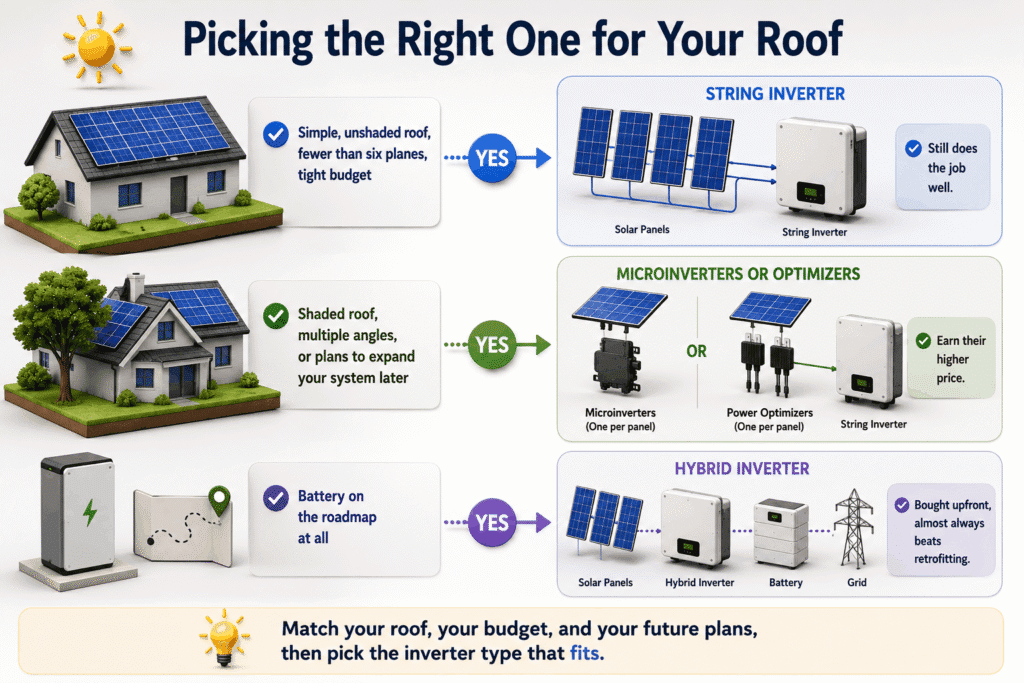
Simple, unshaded roof, fewer than six planes, tight budget, a string inverter still does the job well. Shaded roof, multiple angles, or plans to expand your system later, microinverters or optimizers earn their higher price. Battery on the roadmap at all, hybrid, bought upfront, almost always beats retrofitting.
When Something Actually Goes Wrong
Most inverter problems trace back to one of three things: poor ventilation causing overheating, an aging battery getting mistaken for an inverter fault, or a firmware glitch that clears with a reset. If error codes keep returning after a reset, or you notice an unusual smell, stop troubleshooting and call a technician, that’s not a DIY situation.
FAQs
Can a solar system run without an inverter?
No, the DC power from your panels can’t run household appliances or feed the grid without conversion first.
Which brand actually dominates the market right now?
Enphase leads on microinverter market share; SolarEdge leads the optimizer/string category. Neither is objectively “best”, it depends on your roof and budget.
Is a bigger inverter always better?
No. Oversizing wastes money; undersizing trips your system during surge loads. Size it to your home’s actual continuous and surge wattage.