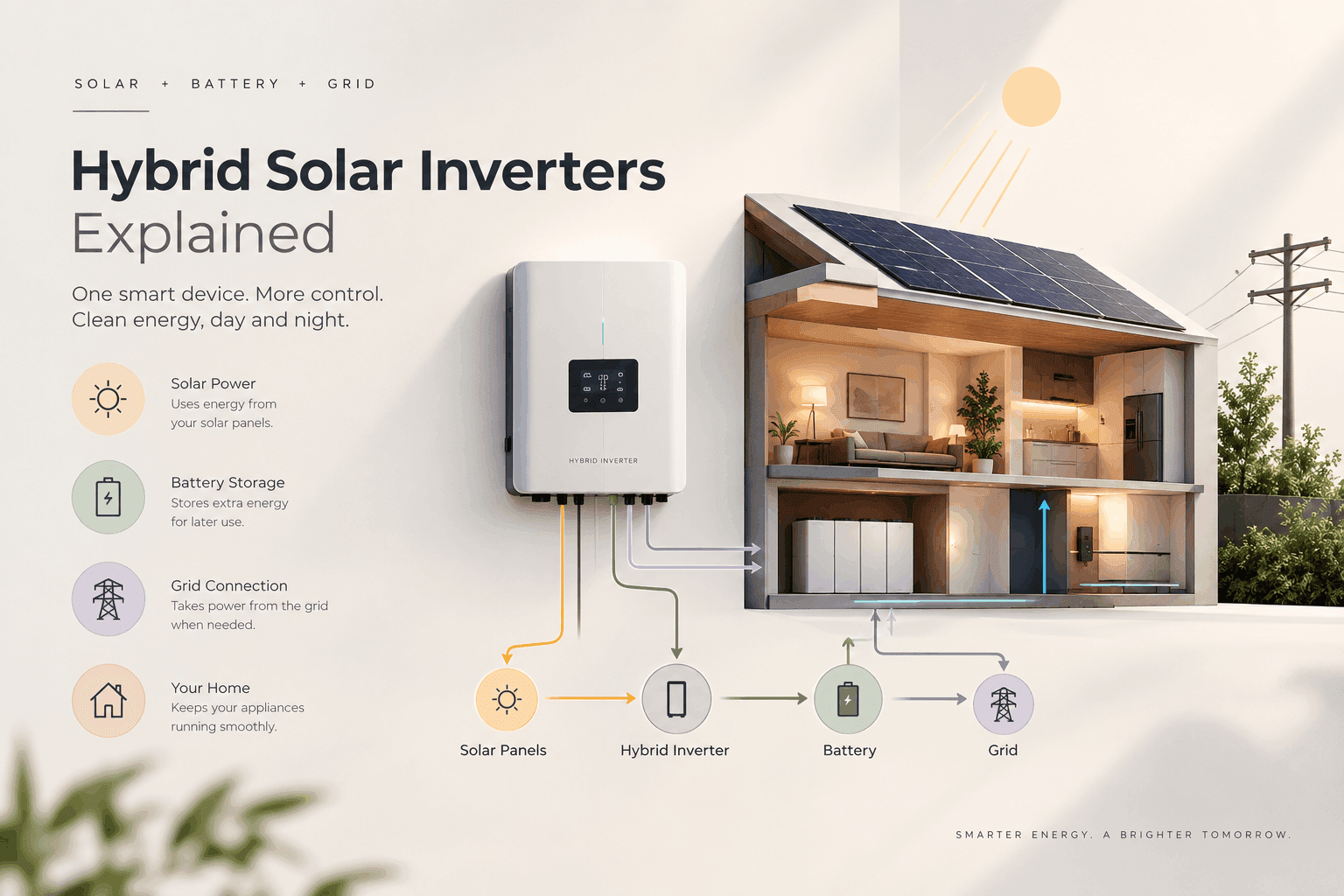
Quick Answer: A hybrid solar inverter is a single device that converts solar power for home use, charges a battery, and manages grid power all in one unit. Unlike a standard solar inverter, it lets you store extra energy and use it during outages or peak-price hours.
Table of Contents
Most people think a hybrid inverter is just a fancier solar inverter with a higher price tag. That’s wrong. A hybrid inverter is a completely different job description, it’s a traffic cop for electricity, not just a converter.
Here’s a number to sit with before we go further: the average household on Earth pays $0.176 per kWh for electricity, as of Q2 2026. That number swings hard by region, $0.088 in Asia, $0.254 in Europe, $0.261 in Oceania. Wherever you live, that price has been climbing. And climbing electricity prices are the entire reason hybrid inverters exist.
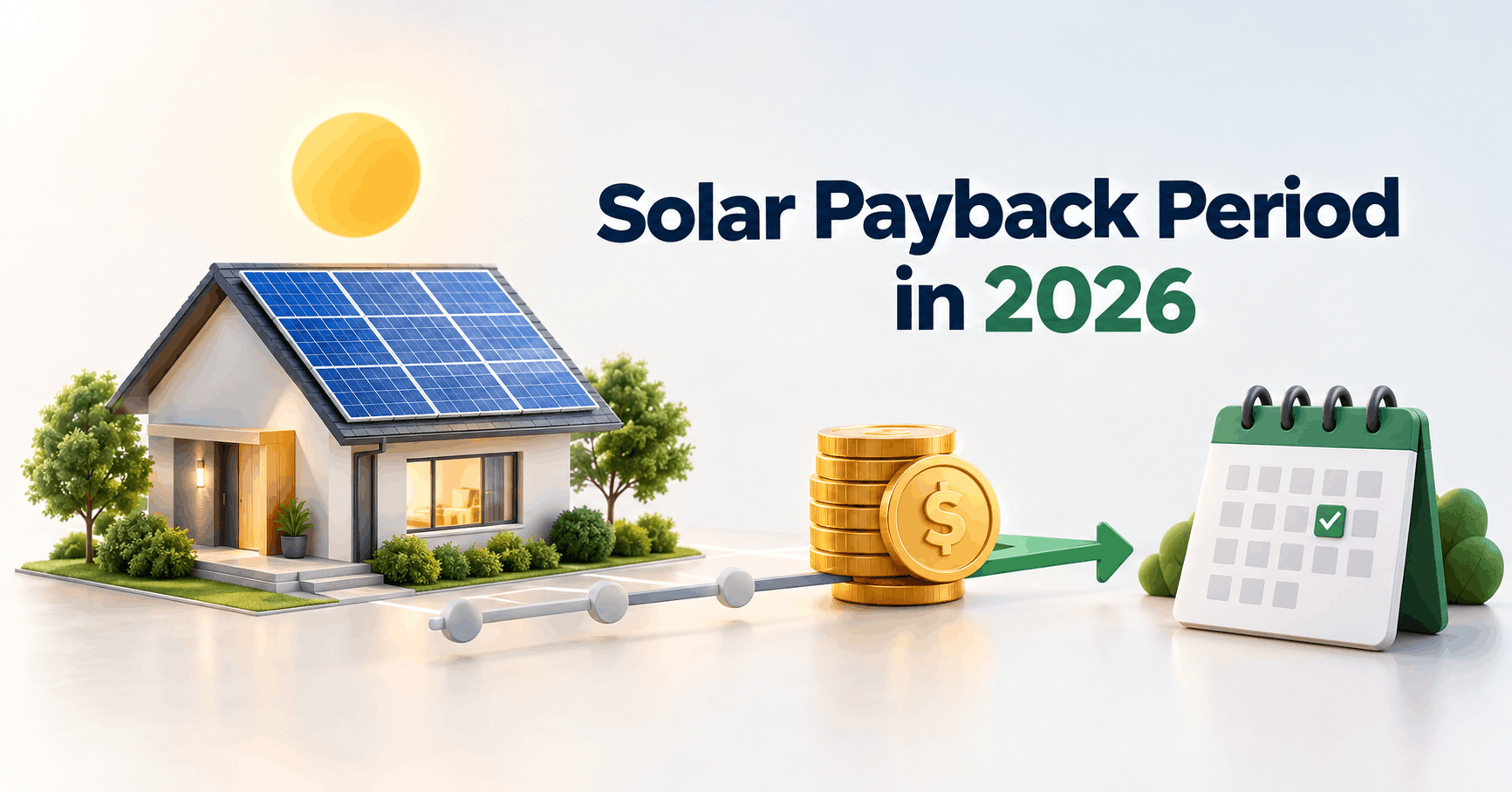
A typical residential solar-plus-battery system pays for itself in 6 to 12 years, depending on your local electricity rate, system size, and available incentives. That’s a wide range. This guide will help you figure out where you’d realistically land in it, and whether a hybrid inverter is even the right tool for your situation.
How I put this guide together: I cross-checked every technical claim against manufacturer datasheets (Sol-Ark, SMA, GoodWe, Growatt, Victron, Sungrow, Huawei), and pulled market and pricing data from Wood Mackenzie, Mordor Intelligence, the Solar Energy Industries Association (SEIA), an independent Australian solar testing publication. Where numbers vary by source, I’ve shown you the range instead of picking the most flattering figure.
- A hybrid inverter combines a solar inverter and a battery inverter into one box.
- It’s not required for solar power to work, but it’s required if you want battery storage to work well.
- Hybrid inverters cost roughly $1,000–$2,500 for a 5kW unit and $1,800–$3,800 for a 10kW unit, before batteries or installation.
- The global hybrid inverter market grew faster than any other inverter category in 2025, driven almost entirely by battery adoption.
- A hybrid inverter is not a substitute for talking to a licensed installer. Nothing in this guide replaces that conversation.
What Is a Hybrid Solar Inverter?
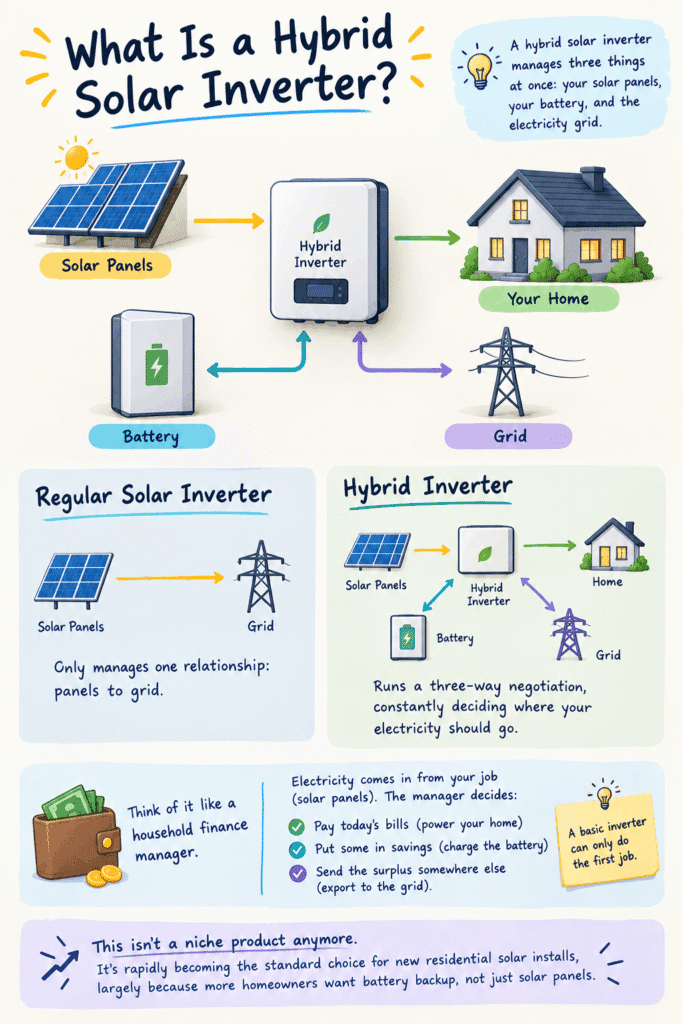
A hybrid solar inverter manages three things at once: your solar panels, your battery, and the electricity grid. A regular solar inverter only manages one relationship, panels to grid. A hybrid inverter runs a three-way negotiation, constantly deciding where your electricity should go.
Think of it like a household finance manager. Money (electricity) comes in from your job (solar panels). The manager decides: pay today’s bills (power your home), put some in savings (charge the battery), or send the surplus somewhere else (export to the grid). A basic inverter can only do the first job.
This isn’t a niche product anymore. It’s rapidly becoming the standard choice for new residential solar installs, largely because more homeowners want battery backup, not just solar panels.
How Does a Hybrid Solar Inverter Work?
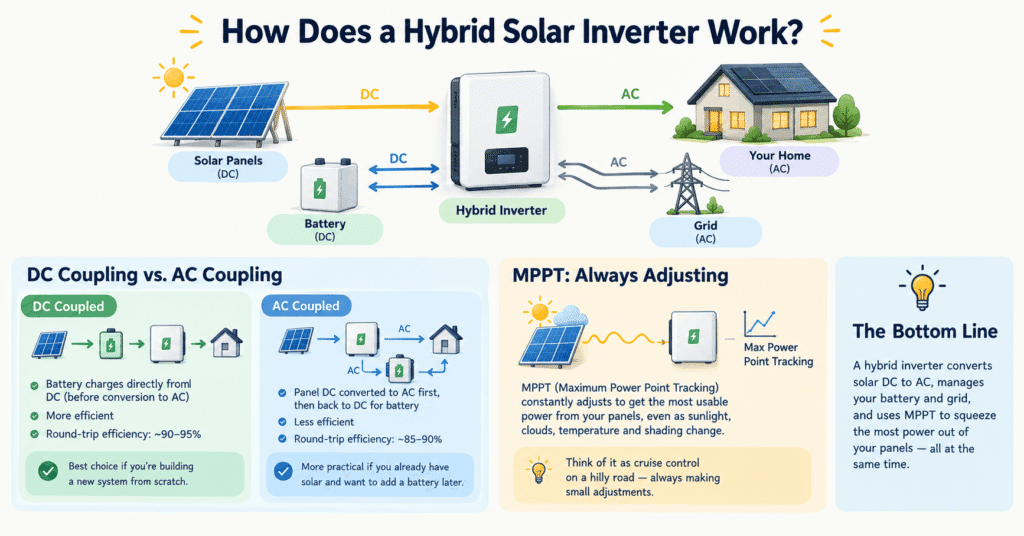
Your solar panels produce direct current (DC) electricity. Your home runs on alternating current (AC). The inverter’s core job, in any inverter, hybrid or not, is converting DC to AC.
A hybrid inverter adds a second conversion path for the battery. Depending on the system design, this happens one of two ways:
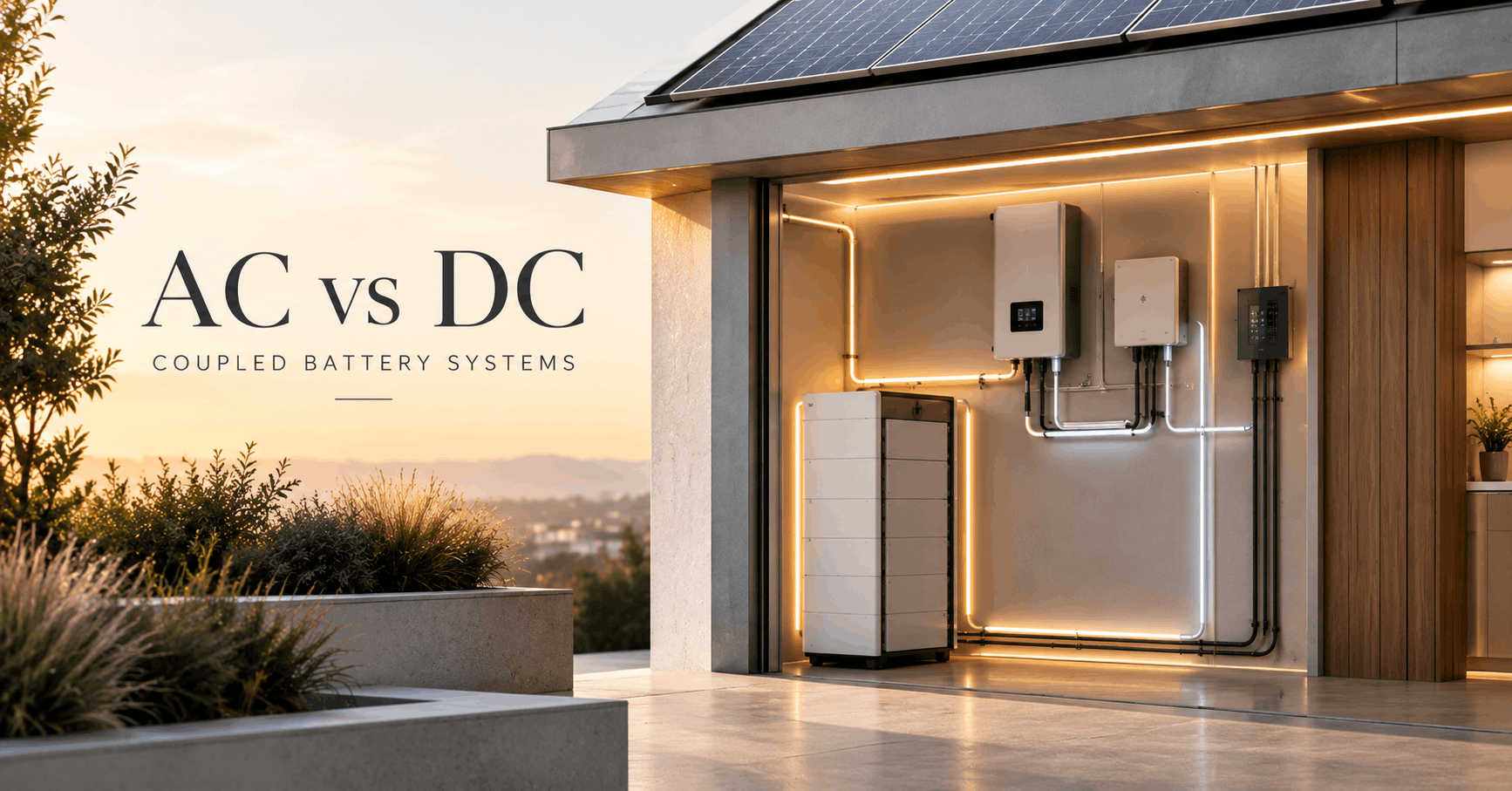
DC Coupling vs. AC Coupling
- DC-coupled systems charge the battery directly from the DC electricity coming off the panels, before it’s converted to AC. This is more efficient, round-trip efficiency typically lands around 90–95%.
- AC-coupled systems convert panel DC to AC first, then convert some of it back to DC to charge the battery. It’s less efficient (roughly 85–90%) but easier to retrofit onto an existing solar system.
If you’re building a new system from scratch, DC coupling usually wins on efficiency. If you already have solar panels and just want to add a battery later, AC coupling is often the practical choice.
MPPT: The Part Nobody Explains Well
MPPT stands for Maximum Power Point Tracking. Sunlight isn’t constant, clouds pass, the sun moves, panels shade each other. MPPT is the inverter’s way of constantly adjusting to squeeze the most usable power out of whatever sunlight is actually hitting the panels at that second. It’s less “set it and forget it” and more “constant small course corrections,” like cruise control on a hilly road.
Hybrid Inverter Operating Modes
A hybrid inverter typically runs in one of three modes, switching automatically based on conditions.
Grid-Tied Mode. Solar power runs your home first. Extra power either charges the battery or exports to the grid, depending on how you’ve configured the system.
Off-Grid / Backup Mode (Islanding). When the grid goes down, the inverter disconnects your home from it and switches to battery and solar power only. This is what people usually mean when they buy a hybrid inverter “for blackouts.”
Self-Consumption / Peak Shaving Mode. The inverter stores solar energy during the day and releases it in the evening, when electricity is usually most expensive. This is the mode that actually saves you the most money over time, especially in regions with time-of-use billing.
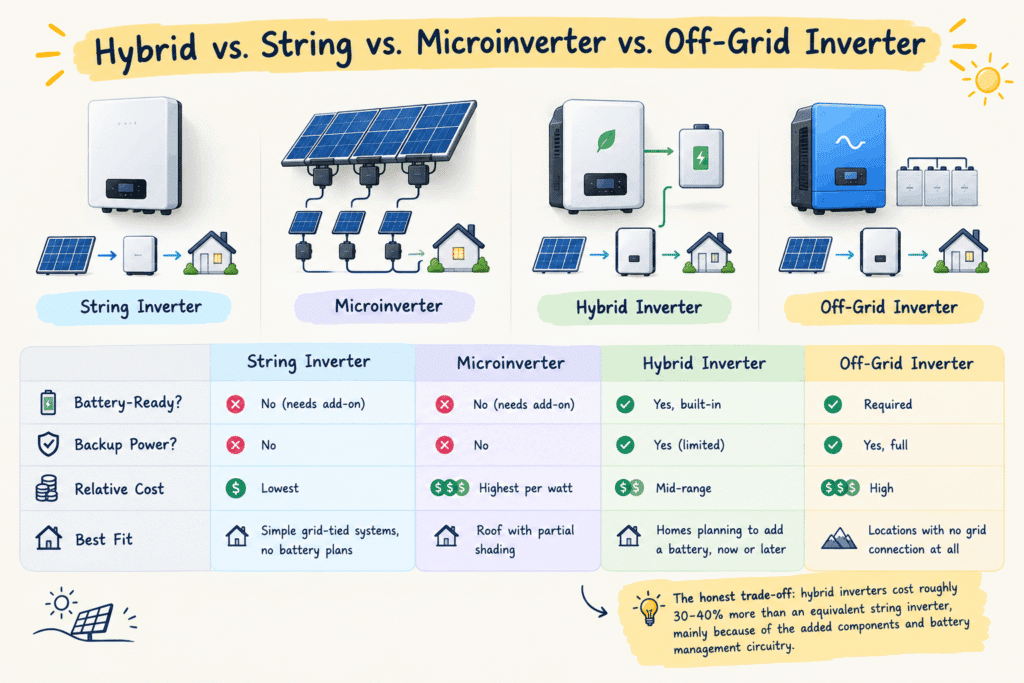
Hybrid vs. String vs. Microinverter vs. Off-Grid Inverter
| Type | Battery-Ready? | Backup Power? | Relative Cost | Best Fit |
|---|---|---|---|---|
| String Inverter | No (needs add-on) | No | Lowest | Simple grid-tied systems, no battery plans |
| Microinverter | No (needs add-on) | No | Highest per watt | Roof with partial shading |
| Hybrid Inverter | Yes, built-in | Yes (limited) | Mid-range | Homes planning to add a battery, now or later |
| Off-Grid Inverter | Required | Yes, full | High | Locations with no grid connection at all |
The honest trade-off: hybrid inverters cost roughly 30–40% more than an equivalent string inverter, mainly because of the added components and battery management circuitry.
Key Takeaways
- DC coupling is more efficient; AC coupling is easier to retrofit.
- MPPT constantly adjusts for changing sunlight, it’s not a one-time setting.
- Hybrid inverters cost more upfront than string inverters, but string inverters can’t natively manage a battery.
Pros and Cons of Hybrid Solar Inverters
Advantages
- One device instead of two (solar inverter + separate battery inverter), which simplifies wiring and installation.
- Enables backup power during outages.
- Lets you shift energy use to avoid peak electricity pricing.
- Can be installed now and paired with a battery later, no need to replace the inverter when you’re ready to add storage.
Disadvantages
- Higher upfront cost than a basic string inverter.
- Backup power capacity during a blackout is usually limited compared to a dedicated off-grid inverter, surge power for things like air conditioners or well pumps can be a weak point.
- More complex system means more things that can technically go wrong, and more programming to get right.
- Most switchboards need modification to support backup circuits, which adds to installation cost.
How Much Does a Hybrid Solar Inverter Cost?
Prices vary by capacity, brand, and region:
| Inverter Size | Unit Price Range (inverter only, no battery/install) |
|---|---|
| 3–5 kW | $1,000 – $2,500 |
| 6–10 kW | $1,800 – $3,800 |
| Commercial (20kW+) | $4,000 – $6,000+ |
None of these figures include the battery itself, installation labor, or switchboard upgrades, all of which can add several thousand dollars depending on your region and installer. This is exactly the kind of number a certified local installer should quote you directly, because permit costs, labor rates, and incentive programs vary enormously by country and even by state or province.
Who Should (and Shouldn’t) Get a Hybrid Inverter
A hybrid inverter is worth it if:
- You already have, or plan to add, a home battery.
- Your area has frequent power outages or an unstable grid.
- You’re on a time-of-use electricity plan and want to shift consumption to off-peak hours.
Skip it if:
- You have zero plans to ever add a battery, a standard string inverter will save you money with no real downside.
- Your grid is highly reliable and your electricity rates are flat, not time-of-use.
- Your budget is tight and solar generation alone (without storage) already meets your goals.
This is genuinely a “your mileage will vary” decision. A qualified energy advisor or installer can run the numbers on your actual electricity bill and local rates, that conversation is worth more than any generic guide, including this one.
Well-Known Hybrid Inverter Brands
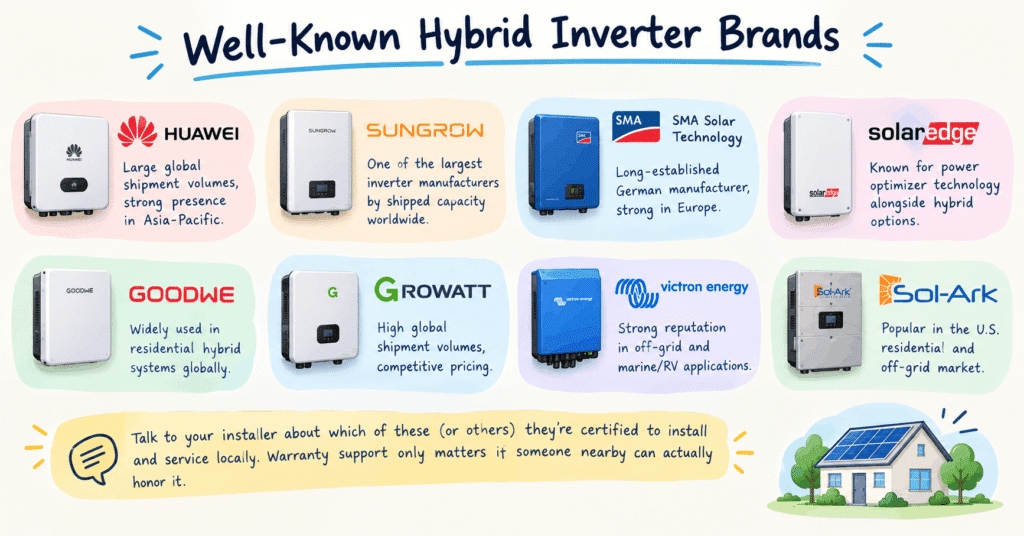
I’m not going to hand you a fake “Best Overall” award, I haven’t lab-tested these units myself, and anyone claiming to have definitively ranked dozens of inverter brands without disclosing a real testing methodology should make you skeptical. What I can tell you, based on Mordor Intelligence’s 2026 competitive landscape data, is which manufacturers are recognized as major players in the global inverter market:
- Huawei: large global shipment volumes, strong presence in Asia-Pacific.
- Sungrow: one of the largest inverter manufacturers by shipped capacity worldwide.
- SMA Solar Technology: long-established German manufacturer, strong in Europe.
- SolarEdge: known for power optimizer technology alongside hybrid options.
- GoodWe: widely used in residential hybrid systems globally.
- Growatt: high global shipment volumes, competitive pricing.
- Victron Energy: strong reputation in off-grid and marine/RV applications.
- Sol-Ark: popular in the U.S. residential and off-grid market.
Talk to your installer about which of these (or others) they’re certified to install and service locally, warranty support only matters if someone nearby can actually honor it.
Why Hybrid Inverter Adoption Is Rising
This isn’t a hunch, it’s a documented trend. Wood Mackenzie’s late-2025 inverter landscape report found that while the overall solar inverter market is contracting (down 2% in 2025, a further 9% forecast for 2026), hybrid solar-plus-storage systems are one of the few segments still driving growth for manufacturers. Analyst Joe Shangraw put it plainly: vendors now need “hybrid solar-plus-storage systems, retrofits and repowering” to stay competitive, because simple shipment growth “is no longer realistic.”
Mordor Intelligence’s separate battery-inverter market analysis backs this up with a concrete number: the U.S. residential solar storage attachment rate hit 45% in Q1 2026, up from 38% in Q1 2025. In plain terms, nearly half of new solar customers are now adding a battery, up sharply from a year earlier. That single stat explains most of the hybrid inverter boom.
Key Takeaways
- Nearly half of new U.S. residential solar installs now include battery storage.
- The broader solar inverter market is shrinking, but hybrid/storage systems are one of the few growth areas within it.
- This isn’t a passing trend, analysts expect the shift toward storage-integrated systems to continue through the decade.
Installation and Battery Compatibility Basics
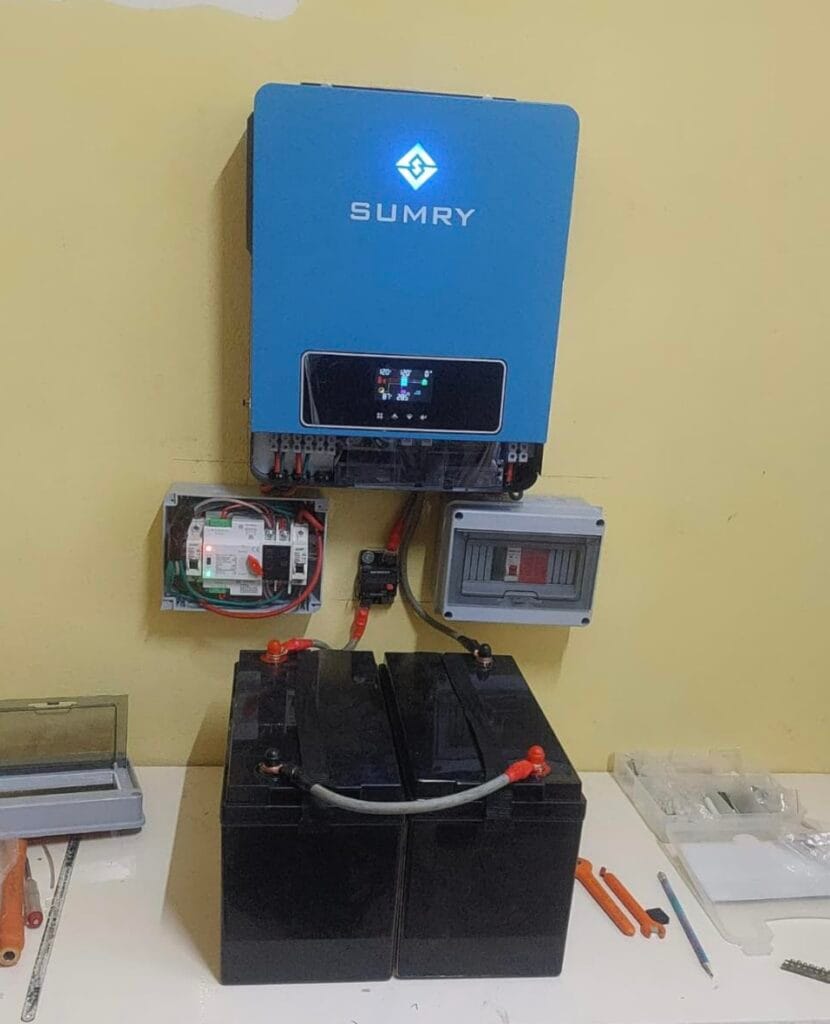
Hybrid inverters need to match your battery’s voltage and chemistry. Most residential systems today use 48V lithium iron phosphate (LiFePO4) batteries, prized for long cycle life and better safety characteristics than older lead-acid batteries. Advanced hybrid inverters communicate directly with the battery’s management system over protocols like CAN or RS485, so charging and discharging stay coordinated automatically.
Grid connection rules differ by country, some require rapid shutdown devices, specific disconnect switches, or utility approval before you can export power. This is not a section where a general guide can safely give you exact rules. Check with a licensed local electrician or your utility provider before finalizing any installation plan.
Common Hybrid Inverter Problems
A few issues come up often enough to be worth knowing in advance:
- Inverter won’t switch to backup mode during an outage. Usually a wiring or configuration issue with the transfer switch, not a hardware failure.
- Battery not charging fully. Often a communication issue between the inverter and the battery’s management system, or an MPPT range mismatch.
- Reduced backup power during heavy loads. Hybrid inverters generally have lower surge capacity than dedicated off-grid inverters, this is a design limitation, not a defect.
- Firmware or app connectivity glitches. Increasingly common as inverters get “smarter”, usually resolved with a firmware update, but worth confirming with your installer before assuming a hardware problem.
If you’re experiencing any of these, contact your installer or the manufacturer’s support line first. Don’t attempt electrical troubleshooting on a live solar-battery system yourself.
FAQs
Is a hybrid inverter worth it without a battery?
Yes, functionally, most hybrid inverters work fine without a battery installed, acting like a standard grid-tied inverter. Many people install one “battery-ready” now to avoid a second installation later. Whether the extra upfront cost is worth it depends on how likely you are to add storage down the road.
Can I add a hybrid inverter to an existing solar system?
Usually yes, through an AC-coupled setup, though it may require additional wiring and switchboard work. An installer can confirm compatibility with your existing panels.
What’s the typical lifespan of a hybrid inverter?
Most come with warranties in the 10–12 year range, though the panels themselves usually carry 25-year warranties. Expect to replace the inverter at least once over the life of your solar system.
Hybrid inverter vs. generator for backup power, which is better?
They solve different problems. A generator provides unlimited backup runtime (as long as you have fuel) but no fuel-free operation and higher noise/maintenance. A hybrid inverter with battery gives quiet, fuel-free backup, but only for as long as the battery lasts, typically hours, not days, unless it’s a large system.
Do hybrid inverters work during a power outage?
Only if paired with a battery and configured for backup mode. Without a battery, a hybrid inverter shuts off during an outage just like a standard grid-tied inverter, this is a safety requirement to protect utility workers.
Glossary
- MPPT (Maximum Power Point Tracking): The inverter’s method for continuously adjusting to extract maximum power from solar panels as sunlight conditions change.
- DC Coupling: A system design where the battery charges directly from DC electricity, before AC conversion.
- AC Coupling: A system design where electricity is converted to AC first, then partially converted back to DC to charge the battery.
- Islanding: The process of disconnecting a home from the grid during an outage so it can run independently on solar and battery power.
- Round-Trip Efficiency: The percentage of energy retained after it’s stored in a battery and then used, some energy is always lost as heat during charging and discharging.
- LiFePO4 (Lithium Iron Phosphate): A lithium battery chemistry known for long cycle life and improved safety over older lithium-ion designs.
- Net Metering: A billing arrangement where excess solar power sent to the grid earns a bill credit.
- Time-of-Use (TOU) Pricing: An electricity rate structure where prices change depending on the time of day, usually higher in early evening.
Summary
A hybrid inverter isn’t magic, and it isn’t required for solar power to work. What it does is give you a foundation for adding a battery, now or later, without ripping out your existing equipment. Whether that’s worth the extra 30–40% upfront cost really comes down to your electricity rates, how often your grid goes down, and how much you value backup power.
Run the numbers with a real conversation, not a spec sheet. A certified local installer or independent energy advisor can plug in your actual electricity bill and give you a payback estimate specific to your home, that number will be far more useful than any global average.
This article is for general informational purposes. Electricity prices, incentives, and regulations vary by country and change over time. Consult a licensed local installer or energy advisor before making a purchasing decision.