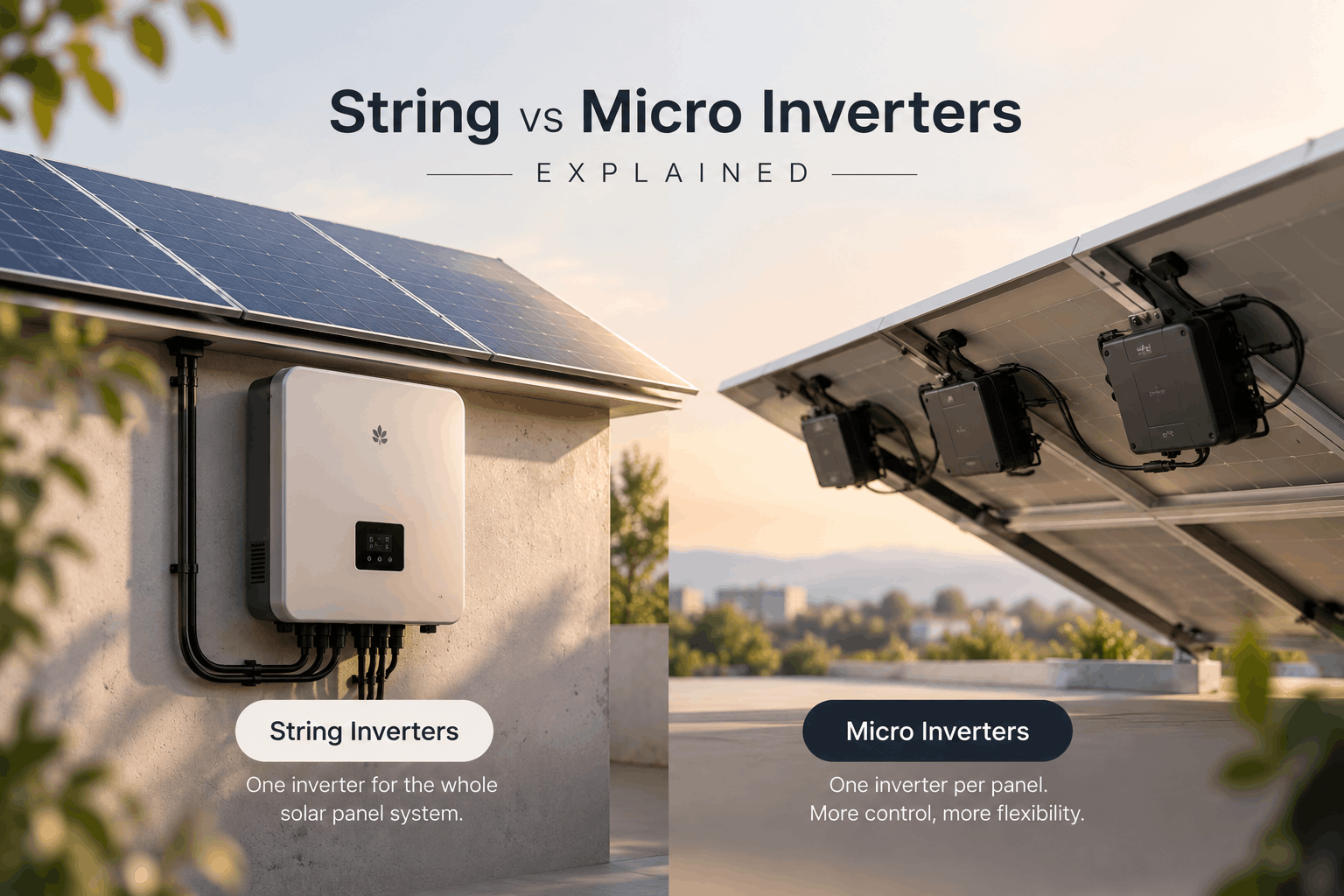
Microinverters convert power at each panel, so shading on one won’t drag down the rest; string inverters convert all panels’ power at one central box and cost less. Unshaded roof → string inverter; shaded or complex roof → microinverter.
Table of Contents
The average U.S. household now pays about 18.34 cents per kilowatt-hour for electricity, and that number keeps climbing.¹ Most homeowners who go solar in 2026 break even somewhere between 8 and 12 years, depending on their state and inverter setup.² That gap between “fast payback” and “slow payback” often comes down to one decision most people skip past: string inverter or microinverter?
Here’s the myth first, so we can kill it early: “Microinverters are always the better choice.” They’re not. They’re the better choice for some roofs and a waste of money on others. This guide explains exactly how each type works, what real data says about cost and reliability, and how to figure out which one fits your roof.
How this guide was put together: I pulled numbers from the U.S. Energy Information Administration (EIA), NREL, national solar marketplace pricing data, manufacturer datasheets, and long-term solar equipment monitoring and claims data. Every figure below is checked against at least one of those sources. Nothing here is a guess.
What Is a Solar Inverter?
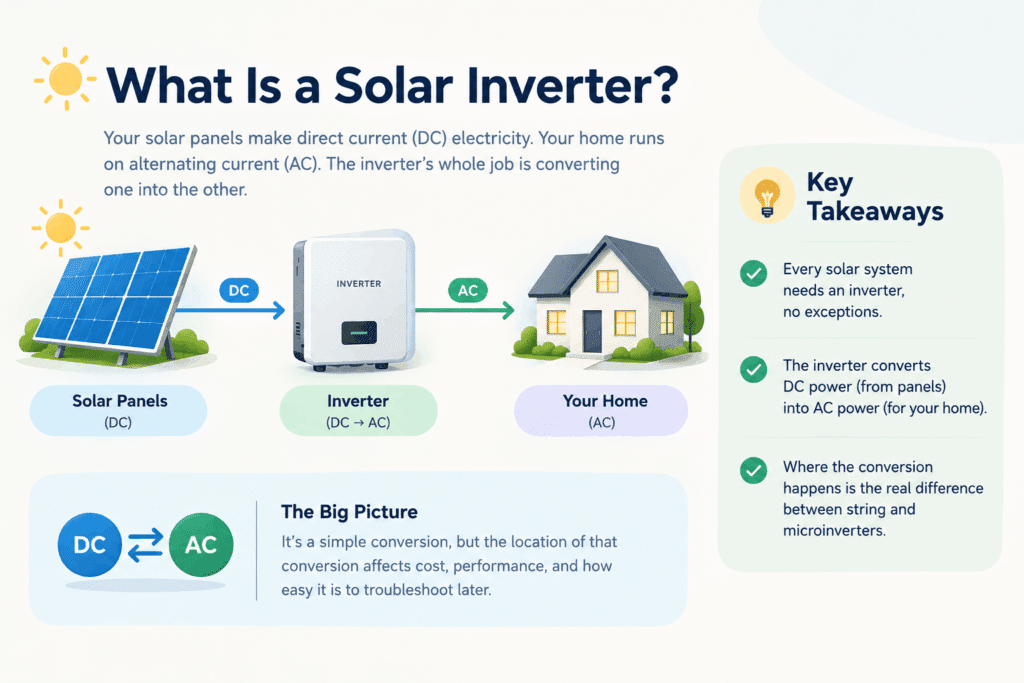
Your solar panels make direct current (DC) electricity. Your home runs on alternating current (AC). The inverter’s whole job is converting one into the other.
That’s it. That’s the job. But where that conversion happens changes everything about cost, performance, and how you troubleshoot a problem later.
Key Takeaways
- Every solar system needs an inverter, no exceptions
- The inverter converts DC power (from panels) into AC power (for your home)
- Where the conversion happens is the real difference between string and microinverters
String Inverters Explained
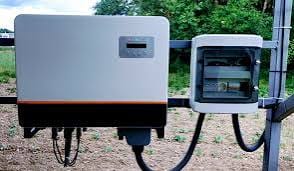
A string inverter sits in one spot, usually a garage wall or an outdoor spot next to your utility meter. Your panels get wired together in a series, called a “string,” and all of them feed into that single box.
Think of it like Christmas lights on one strand. If your panels are all facing the same direction with zero shade, this setup works great. Simple wiring, one point of maintenance, lower cost.
A typical string inverter weighs roughly 50 pounds and is about the size of a guitar case, that’s the one box your whole system depends on.
The catch
String inverters convert power for the whole string at once. If one panel underperforms, a shadow from a chimney, a pile of leaves, bird droppings, the entire string drops to match that weakest panel. With string inverters, the output power is only as strong as the weakest panel in the line.
Key Takeaways
- String inverters are the cheapest, most common option worldwide
- Best for simple, unshaded, single-direction roofs
- One shaded panel can drag down the whole string’s output
Microinverters Explained
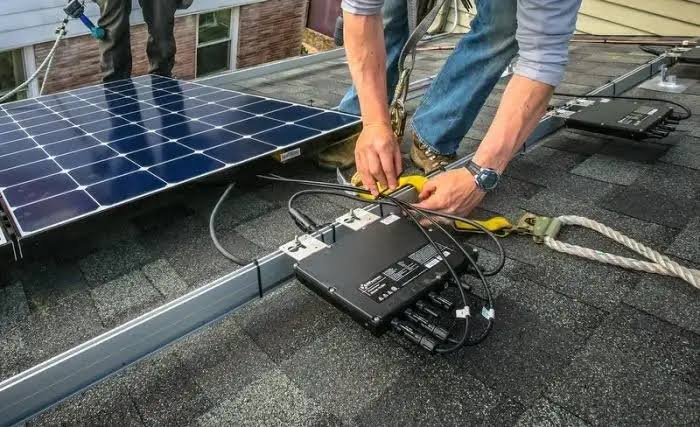
A microinverter is small enough to sit on the back of a single panel. Every panel gets its own microinverter, and every panel converts its own DC power to AC power right there on the roof.
This is the part that actually solves the shading problem. If one panel gets shaded, only that panel’s output drops. Every other panel keeps working at full capacity. Microinverters also allow homeowners to monitor the performance of individual solar panels — something a string inverter can’t do on its own.
The catch
More components mean more upfront cost. You’re paying for 20-plus small inverters instead of one central box.
Key Takeaways
- Microinverters convert power at the panel, not at a central box
- One shaded or faulty panel doesn’t drag down the rest of the system
- Better monitoring, but a higher price tag
The Third Option: DC Optimizers
Most guides skip this one, and that’s a mistake, because it’s genuinely the middle-ground choice a lot of installers actually recommend.
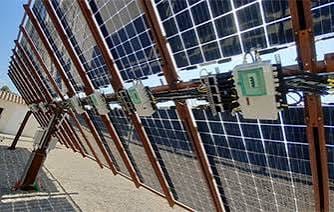
DC optimizers sit on each panel like microinverters do, but they don’t convert DC to AC on the roof. Instead, they “condition” the power, correcting for shading and mismatch, and send it down to one central inverter, which does the AC conversion.
You get panel-level performance monitoring, similar to microinverters, but the actual inverter is still one box you can access at ground level.
Key Takeaways
- Optimizers give panel-level performance without a full microinverter on every panel
- A popular middle ground between cost and shading performance
- Common in systems where installers want central-inverter simplicity plus panel-level data
Comparison Table
| Factor | String Inverter | Microinverter |
|---|---|---|
| Where conversion happens | One central box | At each panel |
| Best for | Simple, unshaded roofs | Complex or shaded roofs |
| Typical warranty | 10–12 years⁴ | Up to 25 years⁴ |
| Shading impact | Drags down the whole string | Isolated to one panel |
| Panel-level monitoring | No (needs added optimizer) | Yes, built in |
| Upfront cost | Lower | Higher |
| Rapid shutdown compliance | Needs added hardware | Built in⁵ |
Shading Performance
This is where the “always buy microinverters” myth actually has some truth to it, but only for the right roof.
Field studies on shading performance show microinverters producing roughly 5% to 25% more energy than string inverters under partial shading, depending on how much shade the roof gets.⁶ On a fully sunny, obstruction-free roof, that gap mostly disappears.
So the real question isn’t “which is more efficient.” It’s “does your roof have shade at any point in the day?” If the answer is no, this entire advantage doesn’t apply to you.
Key Takeaways
- Microinverters outperform string inverters mainly under shading, not in full sun
- The performance gap ranges widely: 5% to 25% depending on shading severity
- An unshaded roof gets little to no benefit from paying extra for microinverters
Cost Comparison
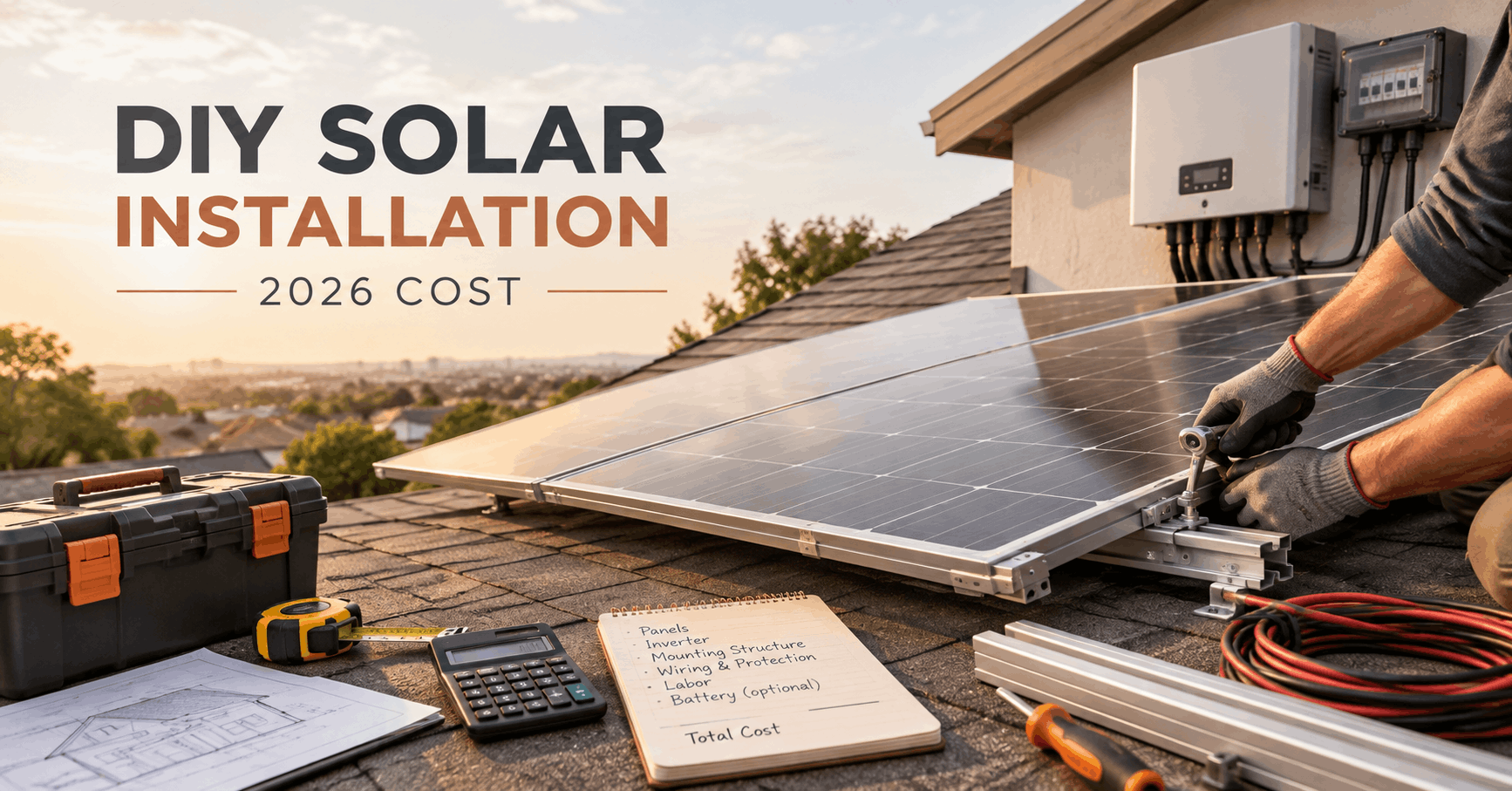
National solar marketplace pricing data for 2026 puts average installed solar costs around $2.55 to $3.15 per watt before incentives.⁷ Microinverter systems typically land at the higher end of that range because you’re paying for more hardware.
Here’s the honest math nobody puts on a brochure: a string inverter needs replacing roughly once during a 25-year panel lifespan, since typical warranties run 10 to 12 years.⁴ Microinverters, with warranties matching the panels at up to 25 years, usually don’t need a mid-life replacement at all.
So the string inverter looks cheaper on day one. Whether it stays cheaper depends on how long you keep the system and how much a future replacement will cost by then.
Talk to a solar advisor before you lock in a quote. A good advisor will run both scenarios, string and microinverter, against your actual roof and usage, not a generic average.
Key Takeaways
- String inverters cost less upfront
- Microinverters often avoid a mid-life inverter replacement thanks to longer warranties
- Get quotes for both setups before deciding, the “cheaper” option depends on your timeline
Reliability and Failure Rates
Nobody wants their inverter to be the thing that breaks. Here’s what the data shows.
Long-term solar equipment monitoring and claims data going back ten years shows string inverters failing at roughly 1 in 350 units, compared to fewer than 1 in 800 for microinverters.⁸ The explanation lines up with basic electronics: microinverters handle lower power levels per unit, which means less heat stress, which means less wear over time.
There’s a trade-off worth naming honestly, though. If a string inverter fails, your whole system goes down until it’s fixed. If one microinverter fails, you lose the output of one panel, the rest keep producing.
Key Takeaways
- Microinverters show a lower failure rate in long-term claims data
- A string inverter failure takes down the entire system
- A microinverter failure only affects the one panel it’s attached to
NEC 2023 Rapid Shutdown Rules
This part matters more than most homeowners realize, and it’s mostly a safety rule for firefighters, not a marketing point.
NEC 690.12 requires solar systems to drop DC conductors to safe voltage levels fast, 80 volts within the array boundary and 30 volts outside it, within 30 seconds of shutdown.⁵ The rule exists so first responders can safely work on or near a roof during a fire.
Microinverters and DC optimizers satisfy this automatically, since they’re already breaking the system into small, independently-controlled units. String inverters need extra rapid-shutdown hardware bolted on to meet the same code. That’s an added cost most quotes bury in the fine print, so ask about it directly.
Key Takeaways
- NEC 690.12 is a firefighter safety code, not optional
- Microinverters and optimizers meet this requirement natively
- String inverters usually need additional rapid-shutdown hardware, which adds cost
Battery Storage Compatibility
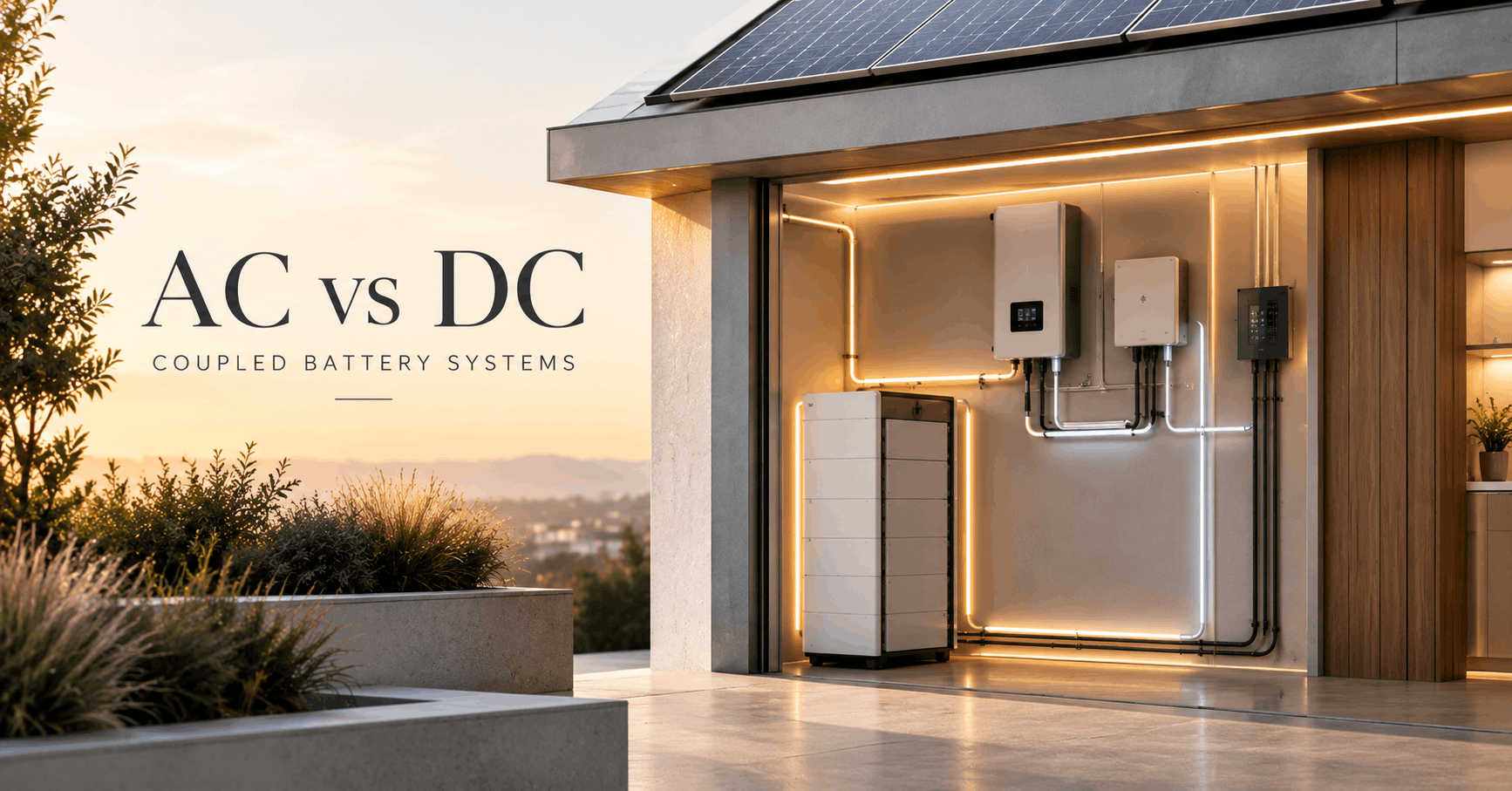
Both setups work with home battery storage, module-level and central-inverter product lines both offer battery-compatible options. The main difference is architecture. Microinverter systems typically pair with AC-coupled batteries, since the power’s already AC by the time it leaves the roof. String-inverter systems more often use DC-coupled batteries tied into the central inverter.
Neither setup blocks you from adding storage later, but it’s worth confirming compatibility with your installer before you sign a contract, especially if a battery is part of your plan.
Which One Should You Choose?
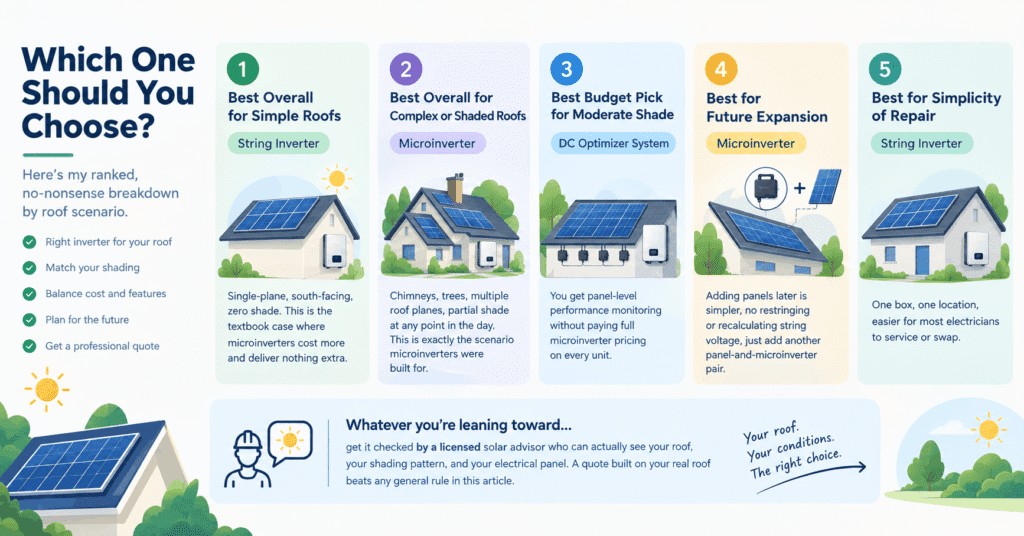
Here’s my ranked, no-nonsense breakdown by roof scenario.
1. Best Overall for Simple Roofs: String Inverter.
Single-plane, south-facing, zero shade. This is the textbook case where microinverters cost more and deliver nothing extra.
2. Best Overall for Complex or Shaded Roofs: Microinverter.
Chimneys, trees, multiple roof planes, partial shade at any point in the day. This is exactly the scenario microinverters were built for.
3. Best Budget Pick for Moderate Shade: DC Optimizer System.
You get panel-level performance monitoring without paying full microinverter pricing on every unit.
4. Best for Future Expansion: Microinverter.
Adding panels later is simpler, no restringing or recalculating string voltage, just add another panel-and-microinverter pair.
5. Best for Simplicity of Repair: String Inverter.
One box, one location, easier for most electricians to service or swap.
Whatever you’re leaning toward, get it checked by a licensed solar advisor who can actually see your roof, your shading pattern, and your electrical panel. A quote built on your real roof beats any general rule in this article.
FAQs
Is a microinverter worth the extra cost?
Only if your roof has shading, multiple planes, or you’re planning to expand the system later. On a clean, unshaded roof, the extra cost buys little.
Do microinverters really produce more energy?
Under shading, yes, field data shows a 5% to 25% gain.⁶ In full sun with no obstructions, the gap is minimal.
Which is safer, string or microinverter?
Both meet NEC safety code when installed correctly. Microinverters meet rapid-shutdown requirements natively; string inverters need added hardware to comply.
Can I mix microinverters and a string inverter in one system?
Not typically as a blended DC system, but some homeowners run separate arrays on separate inverter types (say, a string inverter for the main roof and microinverters for a smaller, shaded section).
How long do these inverters actually last?
String inverters typically carry 10–12 year warranties. Microinverters commonly carry warranties up to 25 years, matching panel lifespan.
Glossary
DC (Direct Current): The type of electricity your solar panels generate.
AC (Alternating Current): The type of electricity your home actually uses.
MPPT (Maximum Power Point Tracking): The method an inverter uses to pull the most possible power out of a panel at any given moment.
MLPE (Module-Level Power Electronics): The umbrella term for microinverters and DC optimizers, anything doing power management at the individual panel level.
Rapid Shutdown: A required safety feature (NEC 690.12) that de-energizes DC conductors quickly during an emergency.
String: A group of solar panels wired together in series, feeding a single inverter.
PERC / TOPCon: Not inverter terms, these describe solar cell technology (how the panel itself is built), not how the inverter works. Worth knowing if you’re also comparing panel brands.