Table of Contents
Ask three solar installers for a quote and at least two of them will mention “Tier 1 panels” before you’ve even asked. It’s become one of those phrases that gets dropped into a sales pitch the way “organic” gets dropped onto a grocery label — it sounds like a guarantee of quality.
It isn’t. Not really.
Tier 1 is a banking term. It was built for lenders deciding who to trust with financing, not for homeowners trying to figure out which panel to put on their roof. That doesn’t make it useless, it just means most people are using it to answer a question it was never designed to answer.
So here’s what it actually means, who made the rule, and whether it should change what you buy.
The short version
Bloomberg New Energy Finance (BNEF) created the Tier 1 classification in 2012 to identify solar manufacturers that banks consider financially safe enough to lend to without extra collateral. It’s a measure of the company’s stability, not the panel’s performance. Tier 2 isn’t an official category at all, it’s just shorthand the industry uses for “everyone who didn’t make the Tier 1 list.”
That’s the whole idea in one paragraph. The rest of this article is really just filling in the parts that make that sentence make sense.
Where the term actually came from
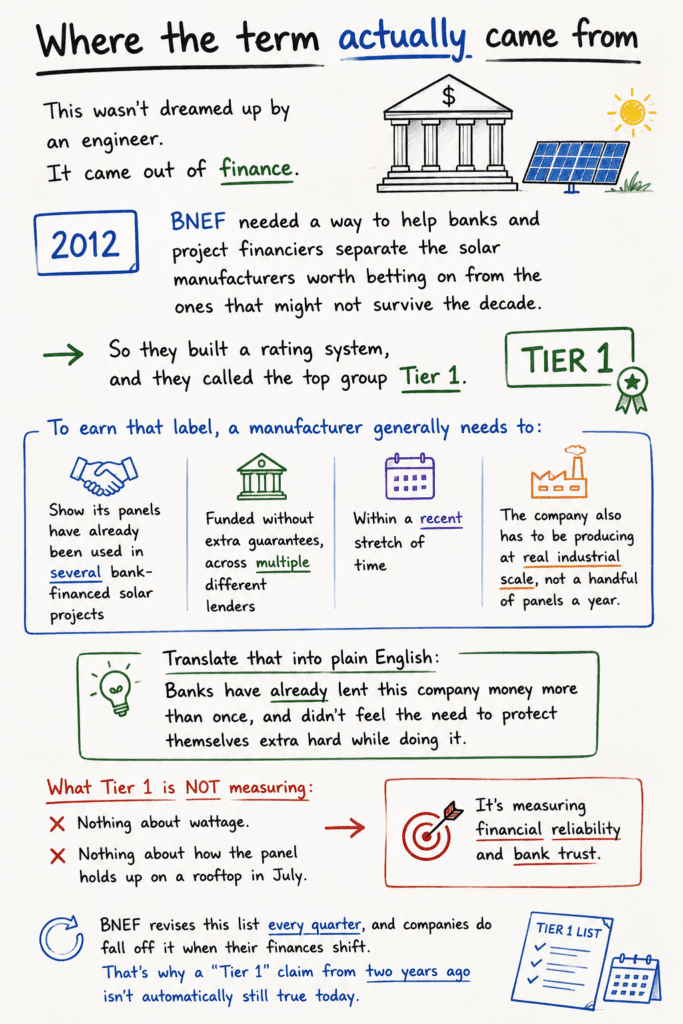
This wasn’t dreamed up by an engineer testing panels in a lab. It came out of finance.
Back in 2012, BNEF needed a way to help banks and project financiers separate the solar manufacturers worth betting on from the ones that might not survive the decade. So they built a rating system, and they called the top group Tier 1.
To earn that label, a manufacturer generally needs to show its panels have already been used in several bank-financed solar projects, funded without extra guarantees, across multiple different lenders, within a recent stretch of time. The company also has to be producing at real industrial scale, not a handful of panels a year.
Translate that into plain English: banks have already lent this company money more than once, and didn’t feel the need to protect themselves extra hard while doing it. That’s what Tier 1 is measuring. Nothing about wattage. Nothing about how the panel holds up on a rooftop in July.
BNEF revises this list every quarter, and companies do fall off it when their finances shift, which is one reason a “Tier 1” claim from two years ago isn’t automatically still true today.
And Tier 2? There’s less to it than you’d think
Here’s the part that surprises most people: there’s no official Tier 2 list. BNEF only ever built criteria for Tier 1.
Everyone else, smaller brands, newer manufacturers, companies that simply haven’t hit the financing thresholds yet, gets informally lumped together as “Tier 2” or “Tier 3” by people in the industry. It’s a convenient label, not a graded certification.
That doesn’t mean Tier 2 automatically means worse. It just means nobody’s formally checked the company’s balance sheet the way they have for the Tier 1 group. Plenty of solid manufacturers simply haven’t applied, or haven’t been in business long enough to qualify.
Tier 1 vs Tier 2, side by side
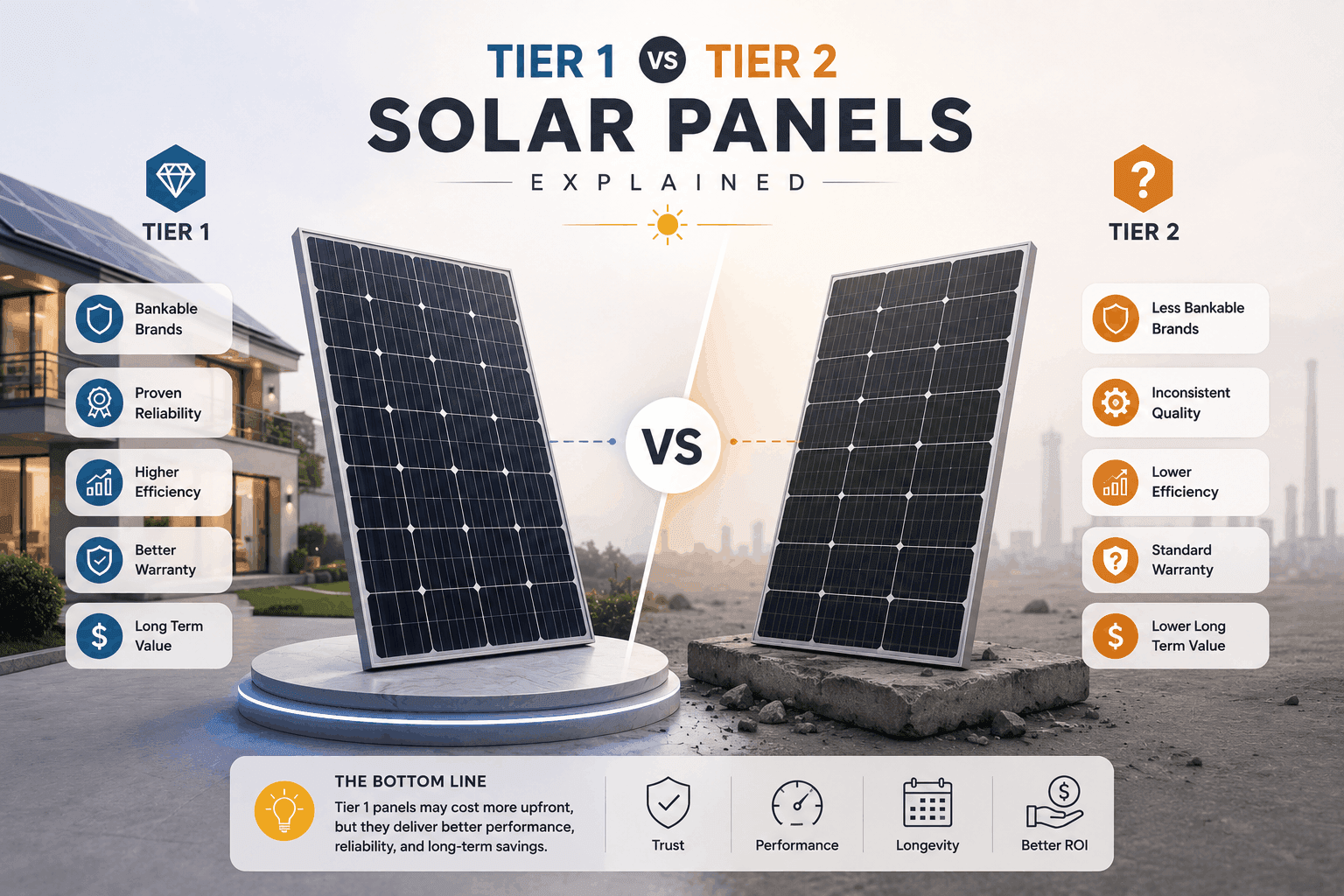
| Tier 1 | Tier 2 | |
|---|---|---|
| Who defines it | BloombergNEF | No official body, informal industry term |
| What it actually measures | Manufacturer’s financial stability | Nothing specific; just “not on the Tier 1 list” |
| Typical company track record | 5+ years producing panels, publicly listed or strong balance sheet | Varies, often newer or smaller companies |
| Production setup | Usually vertically integrated and automated | Often buys in components rather than making everything in-house |
| Warranty reliability | Better odds the 25-year warranty gets honored | Depends heavily on the individual company |
| Price | Usually carries a premium | Usually cheaper upfront |
| Share of the market | Roughly 2% of manufacturers worldwide | The remaining 98% |
Does Tier 1 actually mean higher quality?
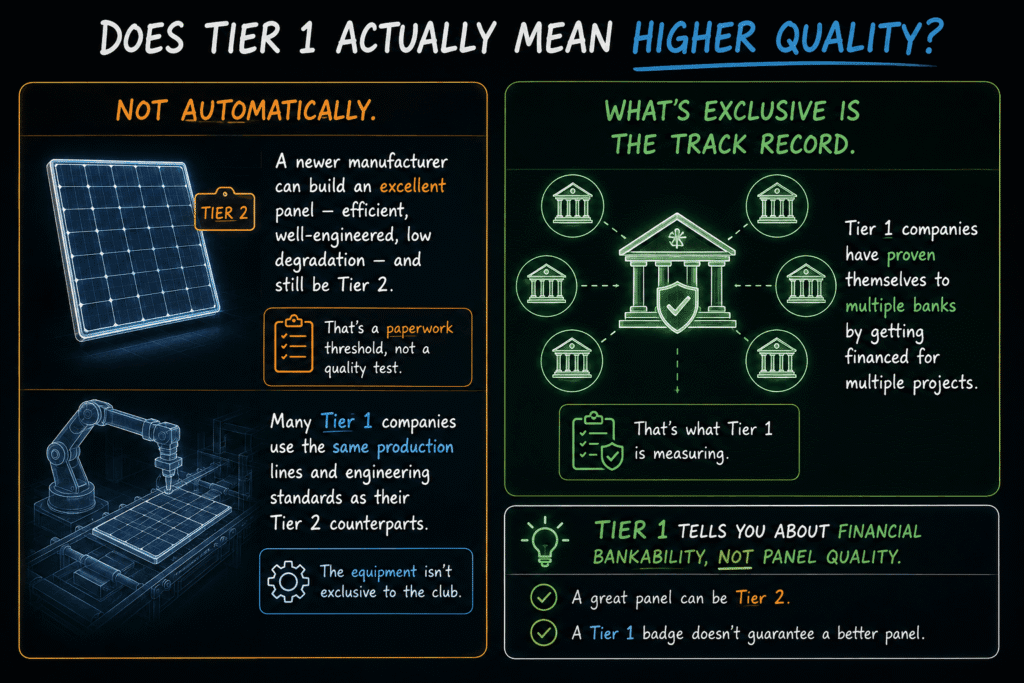
Not automatically, and this is where most sales conversations quietly stretch the truth.
A newer manufacturer can build an excellent panel, genuinely efficient, well-engineered, low degradation, and still get labeled Tier 2 simply because it hasn’t yet financed six projects across six different banks. That’s a paperwork threshold, not a quality test.
At the same time, plenty of Tier 1 companies use the same production lines and engineering standards as their Tier 2 counterparts. The equipment isn’t exclusive to the club. What’s exclusive is the track record.
If there’s one thing worth remembering from this whole article, it’s this: Tier 1 tells you the company will probably still be around to honor your warranty. It doesn’t tell you which specific panel model performs best.
A few Tier 1 brands you’ll actually recognize
Names that have appeared on BNEF’s Tier 1 lists in recent years include Maxeon (formerly SunPower), Qcells, Canadian Solar, REC, Panasonic, Jinko Solar, LONGi, Trina Solar, and JA Solar.
Worth repeating: this list moves every quarter. A brand can drop off or get added depending on its financing activity in that period, so don’t treat any list, including this one, as permanent. If you want current confirmation, check BNEF’s latest published list or just ask your installer to show you the manufacturer’s status directly.
Is the extra cost worth it?
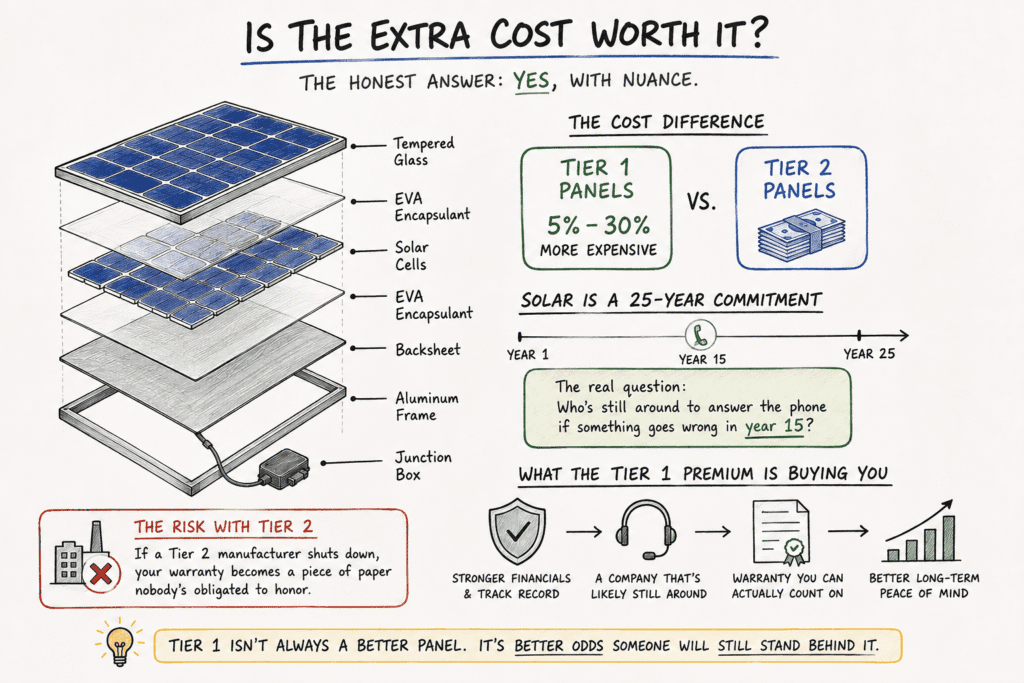
Usually, yes, though the honest answer has some nuance to it.
Tier 1 panels typically cost more, with figures reported across industry sources ranging anywhere from about 5% to 30% higher than Tier 2 alternatives, depending on the brand and market. That’s a real difference on a home system.
But solar isn’t a one-time purchase, it’s a 25-year commitment. The relevant question isn’t which panel is cheaper today. It’s which company is still going to answer the phone in year 15 if something goes wrong. If a Tier 2 manufacturer shuts down, your warranty turns into a piece of paper nobody’s obligated to honor anymore. That risk is largely what the Tier 1 premium is buying you, not necessarily a better panel, but better odds someone’s still around to stand behind it.
Why installers love this phrase so much
“Tier 1 panels” is a genuinely great sales line. It sounds official. It sounds ranked. Compare that to the technically accurate version, “panels from a manufacturer banks are comfortable lending to”, and you can see why nobody says it that way on a sales call.
This isn’t necessarily dishonest. Tier 1 status is a real, useful signal. The problem shows up when it becomes the only justification for a price, and nobody explains what it’s actually measuring.
A couple of things worth noticing if you’re mid-quote: a salesperson who can’t explain what Tier 1 actually means when you ask, or who keeps saying “Tier 1 panels” without ever naming the actual brand and model. Neither one is a dealbreaker on its own. Both are worth a follow-up question.
Checking it yourself takes about ten minutes
Ask for the exact manufacturer and model, not just the phrase “Tier 1.” Look that name up against BNEF’s current list. Compare the panel’s actual written warranty terms too, a company being financially stable doesn’t rewrite a 10-year product warranty into a 25-year one. And if you can find independent test data or reviews on that specific model, that tells you more about real-world performance than the tier label ever will.
None of this requires special expertise. It just requires asking for the specific name instead of accepting the category.
So, worth paying more or not?
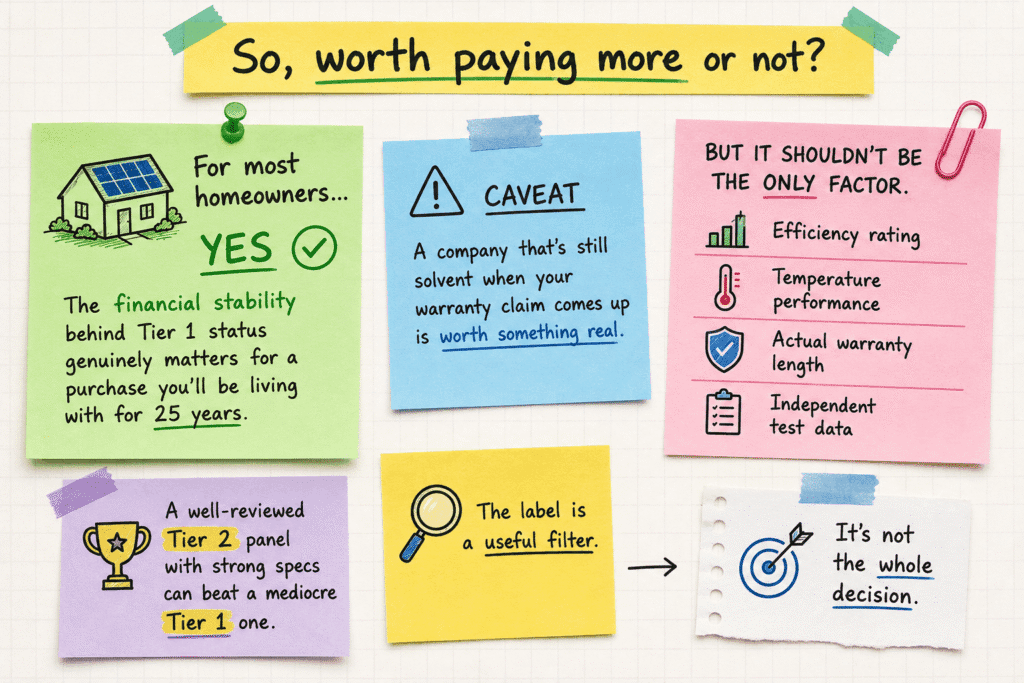
For most homeowners, yes, with a caveat worth holding onto. The financial stability behind Tier 1 status genuinely matters for a purchase you’ll be living with for 25 years. A company that’s still solvent when your warranty claim comes up is worth something real.
But it shouldn’t be the only factor. Efficiency rating, temperature performance, actual warranty length, and independent test data still matter, sometimes more than the tier itself. A well-reviewed Tier 2 panel with strong specs can beat a mediocre Tier 1 one. The label is a useful filter. It’s not the whole decision.
FAQs
Is Tier 1 always better than Tier 2?
Not in terms of raw performance. Tier 1 mainly signals stronger financial backing and better odds of warranty support, not guaranteed higher efficiency.
Are Tier 2 solar panels bad?
No. It just means the manufacturer hasn’t met BNEF’s bankability criteria yet, often because it’s newer or smaller. Plenty of Tier 2 panels perform perfectly well.
How do I check if my panel brand is Tier 1?
Compare the manufacturer’s name against BloombergNEF’s latest published Tier 1 list, updated quarterly.
Does Tier 1 mean higher efficiency?
No. Efficiency comes down to the specific panel model’s engineering, not the company’s financial tier.
How many solar panel tiers are there, officially?
Just one. Tier 1 is the only tier BNEF actually defines. “Tier 2” and “Tier 3” are informal terms the industry made up to describe everyone else.
Where this leaves you
Tier 1 is a real signal, it just measures something narrower than most sales pitches let on. It tells you a manufacturer is financially solid enough for banks to trust, which matters when you’re relying on a 25-year warranty.
It doesn’t tell you the panel is the most efficient one available, or the best fit for your roof. For that, you still need the spec sheet, the actual warranty terms, and some independent data, not just the label.
Treat it as one input, not the whole answer, and you’ll be a lot harder to sell to on buzzwords alone.