Table of Contents
Most people don’t read their solar warranty until something’s already wrong with their system. That’s the wrong order to do things in, but it’s also completely understandable, the document is long, the language is dry, and nobody wants to spend their Saturday parsing degradation clauses.
So here’s the short version, and then the long version, of what you’re actually signing up for.
It’s Not One Warranty. It’s Several.
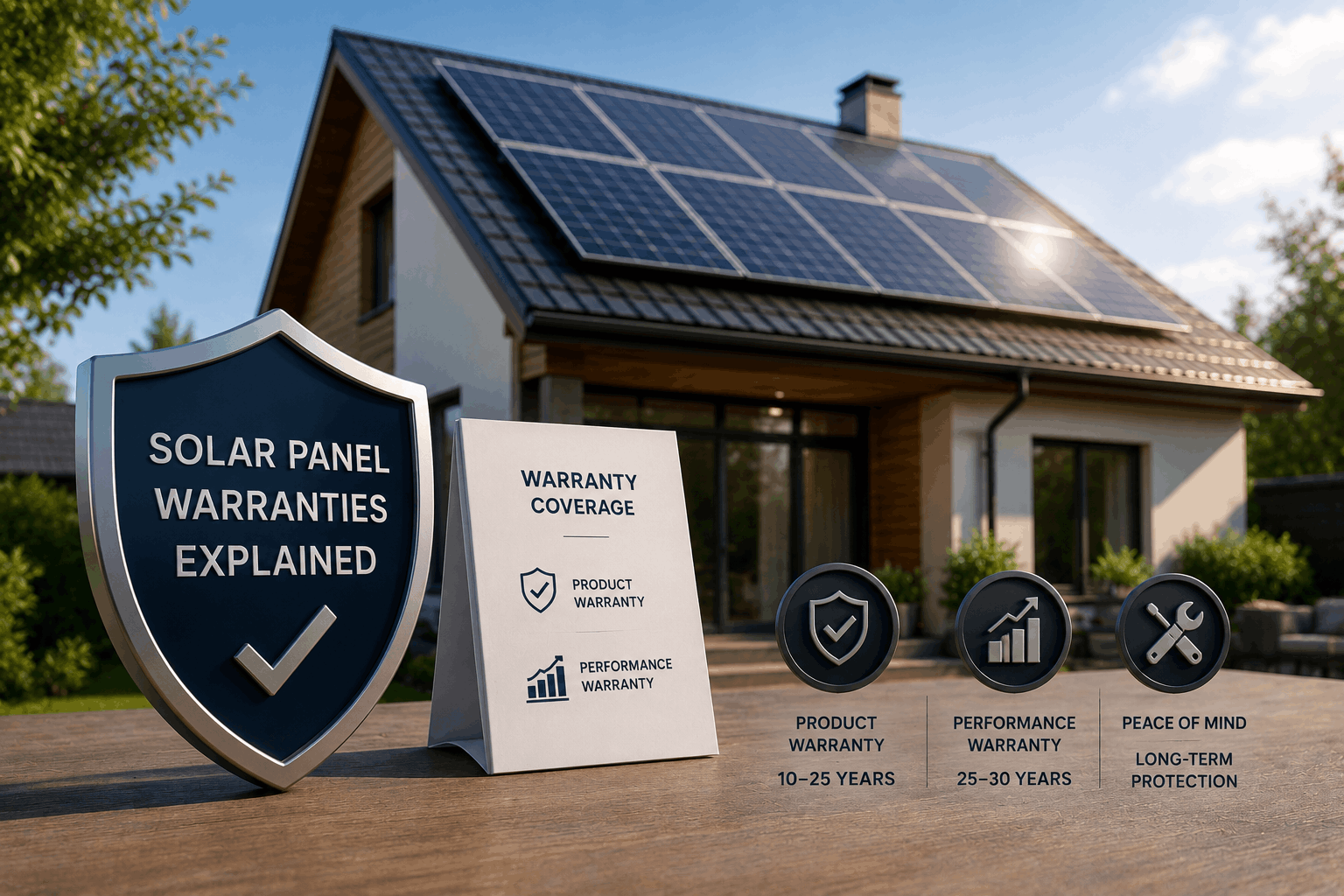
This is the part most people get wrong going in. A solar installation isn’t covered by a single warranty, it’s covered by three or four separate ones, from different companies, on different timelines. Your panels have one. Your inverter has another. Your installer’s actual labor has its own, completely separate from the equipment.
If any one of these expires or gets voided, the others don’t automatically follow along. That’s the trap.
Product Warranty: The One for Manufacturing Defects
This covers the panel itself failing because it was built wrong, cracked glass, bad wiring, corrosion, delamination between layers. Standard coverage sits around 10 to 12 years, though that’s been creeping up. Some premium manufacturers now offer 25 years on the product side, and Maxeon in particular pushes it out to 40.
Worth noting: a defect usually shows up early. If your installer catches a bad panel before it’s even mounted, that’s the product warranty doing its job before you’d ever know there was a problem.
Performance Warranty: The One for Slow Decline
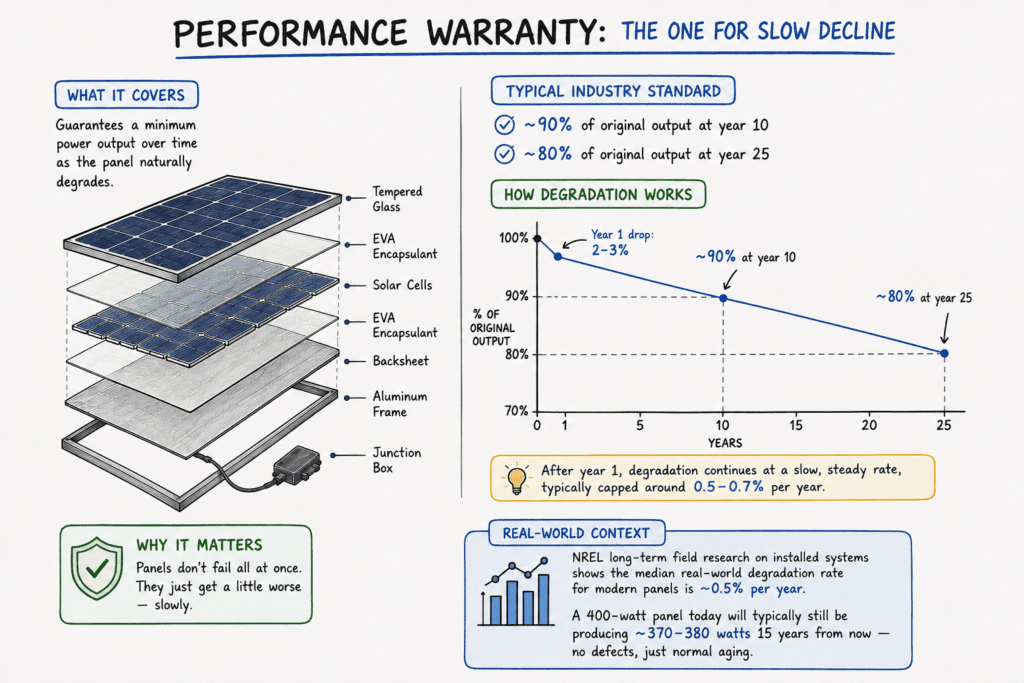
Panels don’t break down cleanly, they just get a little worse every year. That’s degradation, and it happens to every panel on earth regardless of brand or price.
The performance warranty is what guarantees a floor for that decline. The industry standard guarantees roughly 90% of original output at year 10 and 80% at year 25. There’s usually a bigger drop allowed in year one (2–3%, as the panel settles into normal operation), then a slower, steadier loss after that, often capped around 0.5–0.7% per year for the rest of the term.
For context on what that actually means in the real world: NREL’s long-term field research on installed systems puts the median real-world degradation rate for modern panels at around 0.5% annually. So a 400-watt panel today is realistically still producing somewhere in the 370–380 watt range 15 years from now, with zero defects involved, just normal aging.
Inverter Warranty (Usually Shorter, and for Good Reason)
Inverters do more active electrical work than panels do, and they tend to fail first. String inverters typically carry 10 to 12 years of coverage. Microinverters and power optimizers, which spread the workload across smaller units instead of one central box, often get pushed out to 25 years.
If your system underperforms and everything checks out on the panel side, the inverter is usually where to look next.
Workmanship Warranty: The One That Isn’t From the Manufacturer at All
This one comes from your installer, not the panel or inverter company, and it covers their actual labor, mounting, wiring, roof penetrations, general install quality. Terms here are all over the place. Some installers offer one year. Some offer 25. There’s no real industry standard, which is exactly why it’s worth asking about directly instead of assuming it matches the panel warranty.
It’s also the one most likely to disappear if your installer goes out of business, because unlike the manufacturer’s warranty, it isn’t backed by equipment sitting on your roof. It’s backed by a company that may or may not still exist in ten years.
A Quick Reference Table
| Warranty Type | Standard | Premium Range |
|---|---|---|
| Product (Equipment) | 10–12 years | Up to 25–40 years |
| Performance (Power Output) | 25 years | Up to 30 years |
| Inverter (String) | 10–12 years | Up to 25 years |
| Inverter (Micro/Optimizer) | 25 years | — |
| Workmanship (Installer) | 1–10 years | Up to 25 years |
These vary by manufacturer and even by product line, so treat this as a general reference, not a guarantee for the specific panel you’re buying. Check the actual datasheet.
Things That Void a Solar Warranty (and Nobody Warns You About)
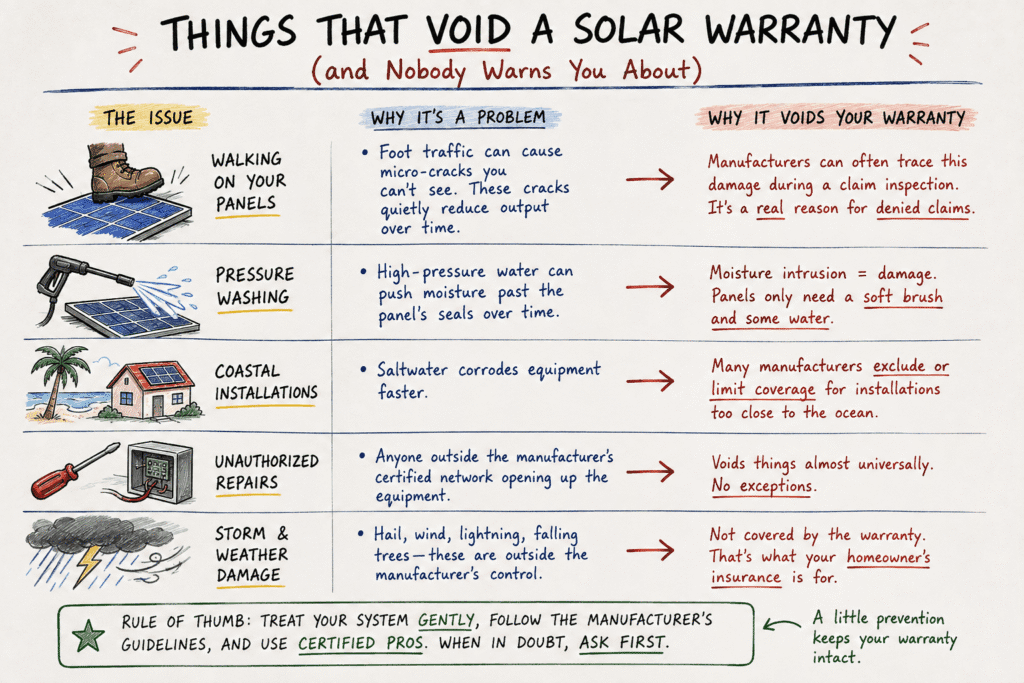
A few of these are genuinely surprising the first time you hear them.
Walking on your panels, for instance, seems harmless, solid glass, right? But foot traffic can cause micro-cracks that don’t show up visually and quietly cut into output over time. Manufacturers can often trace this back during a claims inspection, and it’s a real reason for denied claims.
Pressure washing is another one. High-pressure water can push moisture past the panel’s seals over time. Panels really only need a soft brush and some water, anything more aggressive is doing more harm than the dirt it’s removing.
Coastal homes get their own asterisk too. Saltwater corrodes equipment faster, and some manufacturers exclude or limit coverage for installations too close to the ocean. And unauthorized repairs, anyone outside the manufacturer’s certified network opening up the equipment, void things almost universally, no exceptions.
Storm and weather damage sits outside the warranty entirely, by the way. That’s what your homeowner’s insurance is for, not the panel manufacturer.
Manufacturer vs. Installer: Two Different Promises

The manufacturer backs the equipment. The installer backs their own work. If your roof develops a leak two years after installation, near a mounting bracket, that’s an installer problem, not something the panel manufacturer has any responsibility for.
The uncomfortable part is that your installer’s promise is only as good as your installer’s business staying open.
What If Your Installer Goes Under?
It happens more often than the industry likes to advertise. Solar has gone through real consolidation in recent years, and companies that looked stable one year have shut down or exited panel manufacturing the next.
If your installer disappears, the workmanship warranty usually goes with them. The manufacturer’s product and performance warranties typically survive, since they’re attached to the hardware, not the company that put it up, but you’ll need to find a new authorized servicer, and that search isn’t always quick.
Some installers now sell separate O&M (operations and maintenance) plans specifically to protect against this, coverage for monitoring, cleaning, and inspections that doesn’t depend on the original company staying in business. Worth asking about if long-term reliability matters to you more than saving a few hundred dollars upfront.
Selling Your House Later? Ask About Transferability
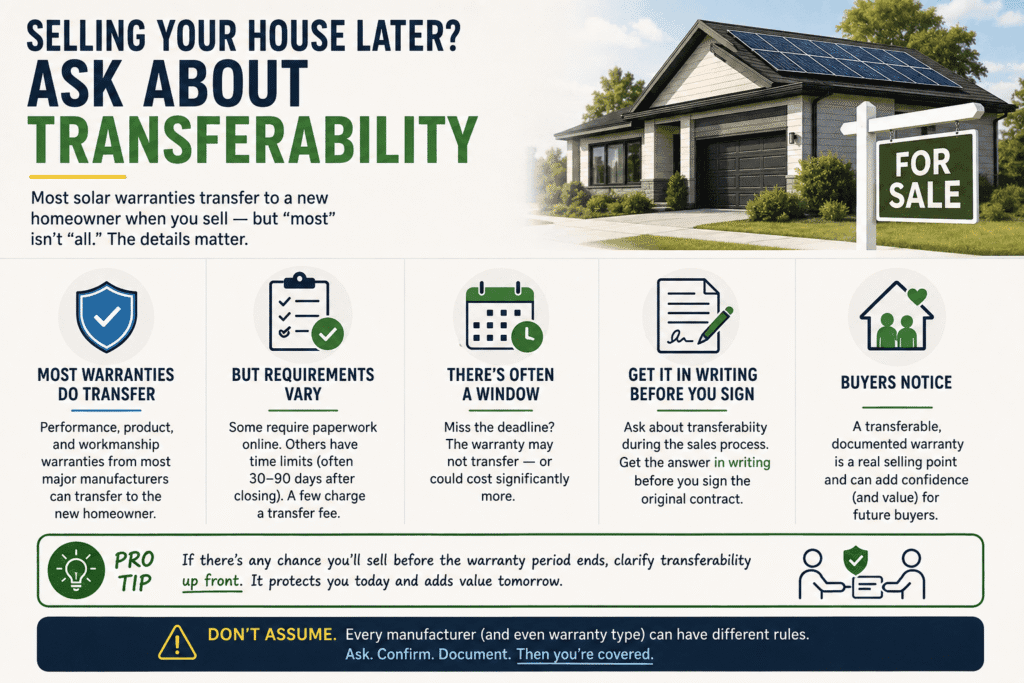
Most warranties transfer to a new homeowner when you sell, but “most” isn’t “all,” and some require paperwork or a fee within a specific window after closing. If there’s any chance you’ll sell before the warranty period ends, get this answer in writing before you sign the original contract, not after your house is already listed. A transferable, documented warranty is genuinely something buyers notice.
Labor and Shipping Usually Aren’t Covered
This is the detail that catches almost everyone off guard. Your warranty might replace a defective part at no cost, but that doesn’t mean it covers the technician’s time to remove the old one and install the new one, or the shipping to get the replacement to your house. Some manufacturers cover this up to a capped dollar amount. A lot of them don’t cover it at all.
This is often where your installer’s own service agreement fills the gap, which is one more reason the workmanship warranty deserves as much attention as the manufacturer paperwork.
Filing a Claim, in Practice
Start with your monitoring app before assuming the worst, a dip in production is usually dirt, shade from a tree that’s grown taller since installation, or a settings glitch, not a defect.
If it looks like a real issue, contact your installer first. They typically handle the claim process on your behalf and already know the paperwork. Have your purchase date, panel serial numbers, and installation records ready, because you’ll be asked for them. An inspection usually follows, partly to confirm the issue isn’t one of the void conditions mentioned earlier. And keep a written record of everything, solar claims can drag on for weeks, and an email trail helps if anything gets disputed later.
Warranty vs. Insurance, Not the Same Thing
Your solar warranty covers defects and underperformance in the equipment. Your homeowner’s insurance covers outside damage, hail, falling branches, fire. If a storm cracks a panel, that’s an insurance claim. If a panel just stops meeting its guaranteed output for no external reason, that’s a warranty claim.
FAQs
How long does a typical solar warranty last?
Product coverage usually runs 10–12 years. Performance coverage usually runs 25. Premium manufacturers are pushing both numbers higher.
What’s actually different between product and performance warranties?
Product covers something breaking. Performance covers something slowly declining. They’re solving two different problems.
Can you extend a solar warranty?
Sometimes, for a fee, and often only if you used a certified installer or specific financing partner.
Does a warranty cover a roof leak?
Only if the leak traces back to installation work, which puts it under the installer’s workmanship warranty, not the manufacturer’s.
What voids a solar warranty most often?
Unauthorized repairs, foot traffic on the panels, and pressure washing top the list.
Twenty-five years is a genuinely long time to trust a piece of paper you skimmed once. Before signing anything, get all four warranties, product, performance, inverter, and workmanship, listed clearly, in writing, from one place. It’s not an exciting exercise. It’s just cheaper than finding out what wasn’t covered after the fact.