Table of Contents
Stubbing your toe at 2 a.m. because the overhead light is too harsh is a problem solar and rechargeable night lights were built to solve. We researched true solar-powered options along with the best cordless, rechargeable alternatives, since most bathrooms don’t get enough direct window sun to run on solar alone. Here’s what actually holds up, what to skip, and how to pick the right one for your space.
A quick honesty note before you scroll: “solar bathroom night light” as a dedicated, well-stocked product category barely exists in 2026. Most bathrooms are small, windowless, or north-facing, which makes true solar charging unreliable indoors. So this guide covers the handful of genuine solar options that exist, plus the rechargeable, no-outlet alternatives that solve the same problem — no wiring, no electric bill, more reliably.
Quick-Pick Comparison
| Product | Best For | Price |
|---|---|---|
| Sunbright Nightlight (Solar) | True solar purists with a sunny window | $14.99 |
| Touch Of ECO Solar Window Night Light, 2-pack (Solar) | Soft ambient glow, decorative + functional | Check listing |
| EZVALO Motion Sensor Closet Light, 100 lm (Rechargeable) | Most reliable everyday pick | Check listing |
| EZVALO 17-inch Closet Light, 150 lm, 2-pack (Rechargeable) | Larger bathrooms, brightest option | Check listing |
| EZVALO 4-Pack Puck Light w/ Charging Station, 50 lm (Rechargeable) | Budget multi-room coverage | Check listing |
| WhitePoplar Rechargeable Motion Sensor Light, 500 lm (Rechargeable) | Explicitly rated for shower/bathroom use, brightest overall | Check listing |
| GE LED Night Light, Plug-in, 30966 (Plug-in) | Skipping charging entirely, most established brand | Check listing |
Our Top Picks
1. Sunbright Nightlight — Best True Solar Pick
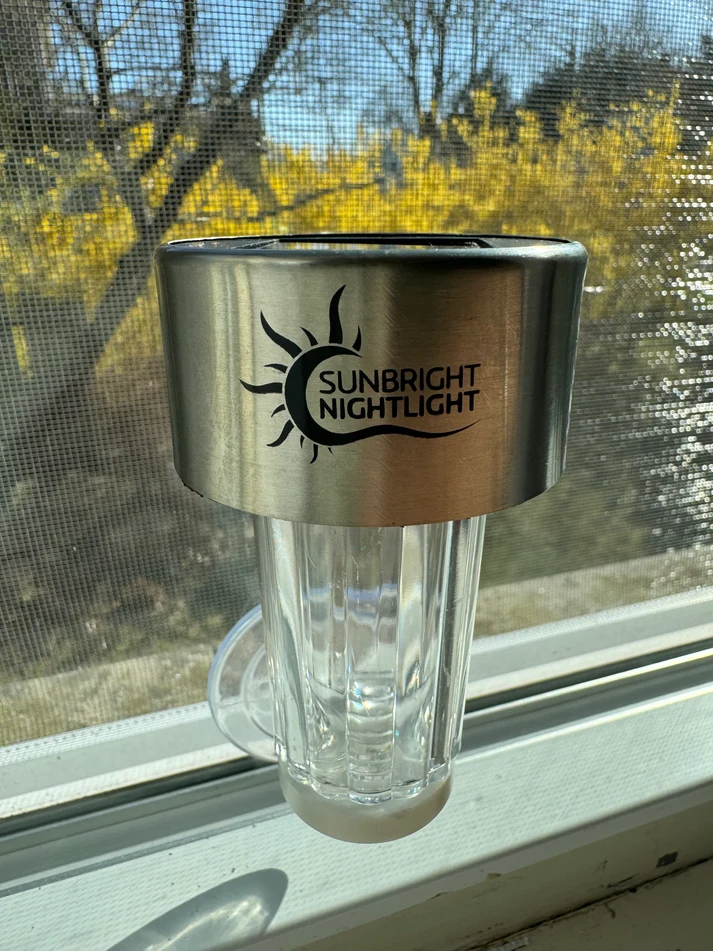
Sunbright Nightlight is a small, woman-owned brand that makes one product: a suction-cup, window-mounted solar night light. It attaches to the inside of a sunny window, charges through the glass during the day, and switches on automatically after dark.
Bathroom-specific performance: This only works if your bathroom has a south-facing window that gets direct sun for most of the day — the maker is explicit that indirect light won’t charge it reliably. In a typical windowless or frosted-glass bathroom, it’s not a realistic option.
Pros:
- Genuinely solar, zero electricity cost
- No wiring or outlet needed
- Simple suction-cup install
Cons:
- Requires a direct-sun, south-facing window — rare in bathrooms
- Very small brand with minimal review history
- No published lumens, IP rating, or charge-time specs
Key specs: Power: solar (suction-cup window mount) · Sensor: dusk-to-dawn · Charge requirement: direct sun, ~8+ hours · IP rating: not published
2. Touch Of ECO Solar Window Night Light (2-Pack) — Best Solar Ambient Pick
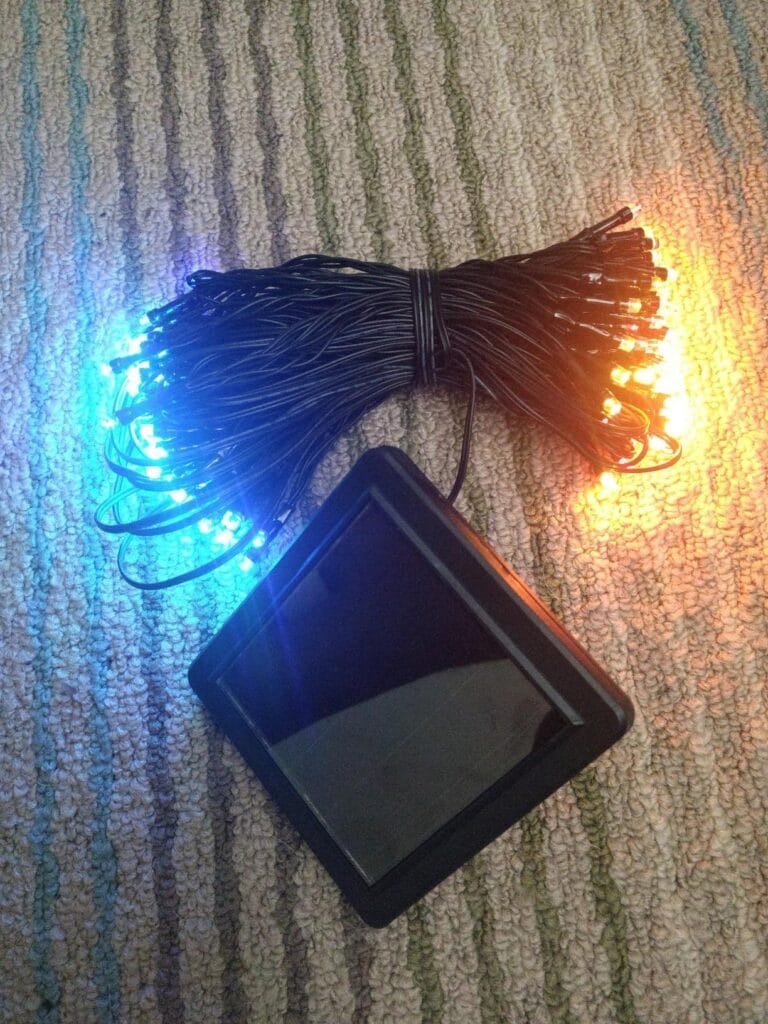
This is a solar-charged LED that mounts on a window with a suction cup and turns on automatically at dusk. It’s sold as a general night light — useful for a bathroom, hallway, or doorway — rather than a bathroom-specific product.
Bathroom-specific performance: Like any window-charged solar light, it needs meaningful daylight exposure to work reliably. It’s better suited to a bathroom with a decent-sized, unobstructed window than an interior or basement bathroom.
Pros:
- Established product with an active Amazon listing
- No plug-in, no batteries to replace
- Doubles as a soft ambient glow, not just a functional light
Cons:
- Same window-dependency limitation as any solar light
- Marketed generally, not engineered specifically for bathroom moisture
- No published IP or waterproof rating
Key specs: Power: solar (suction-cup window mount) · Sensor: dusk-to-dawn photocell · Charge requirement: daytime window sun · IP rating: not published
3. EZVALO Motion Sensor Closet Light — Best Rechargeable Alternative
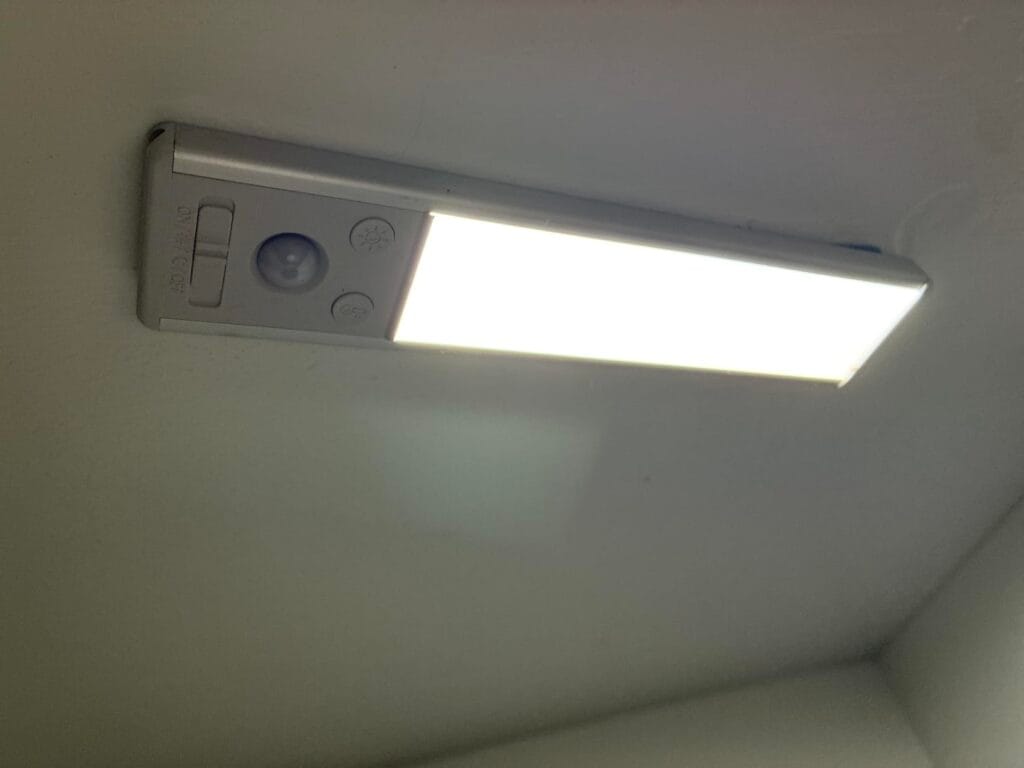
This is the pick we’d actually recommend for most bathrooms. It’s not solar — it charges over USB-C — but it solves the same core problem (no wiring, no ongoing electric cost) far more reliably than a window-dependent solar light, especially in windowless or low-light bathrooms.
Bathroom-specific performance: The rotatable PIR motion sensor triggers on entry and shuts off automatically, which works well for middle-of-the-night bathroom trips. The magnetic, stick-on mount holds to metal surfaces or an included adhesive plate, so it can sit on a mirror frame, cabinet, or wall away from direct water contact.
Pros:
- 100 lumens with 3 selectable color temperatures — enough to actually see by
- 1800mAh battery rated for 30–45 days per charge in motion mode
- Tool-free magnetic/adhesive install
Cons:
- Needs periodic USB-C recharging (roughly monthly)
- Not marketed with a formal waterproof/IP rating — keep it away from direct spray
- Sold as a general closet/cabinet light, not bathroom-specific
Key specs: Power: rechargeable, 1800mAh battery · Sensor: rotatable PIR motion, ~10 ft / 120° range · Lumens: 100 · Charge time: USB-C, runtime ~30–45 days per charge · IP rating: not published
4. EZVALO 17-Inch Motion Sensor Closet Light (2-Pack) — Brightest Option for Larger Bathrooms
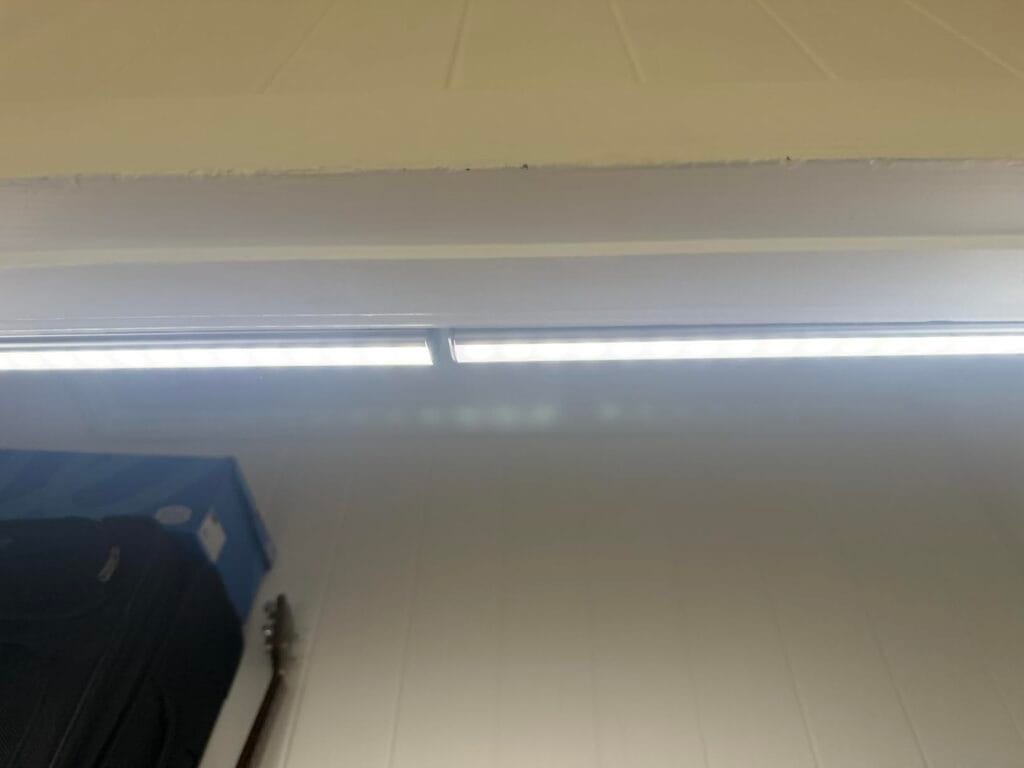
If one small puck isn’t enough to light a larger bathroom, this longer curved bar puts out more usable light while staying glare-free.
Bathroom-specific performance: At 150 lumens, this is bright enough to double as a low-level main light for a middle-of-the-night visit, not just a wayfinding glow. The curved, no-glare design reduces harsh reflections off tile and mirrors, which plain LED strips are prone to.
Pros:
- 150 lumens — the brightest option on this list
- 3600mAh battery rated up to 2,500 uses or ~10.5 hours continuous per charge
- 3 color temperatures and 3 modes (always on, all-day motion, night-only motion)
Cons:
- Larger footprint than a compact puck light
- Still requires manual USB-C recharging on a schedule
- No published IP or waterproof rating
Key specs: Power: rechargeable, 3600mAh battery · Sensor: motion, adjustable, 3 modes · Lumens: 150 · Charge time: USB-C, up to 2,500 uses/charge · IP rating: not published
5. EZVALO 4-Pack Puck Light with Charging Station — Best Budget Multi-Pack
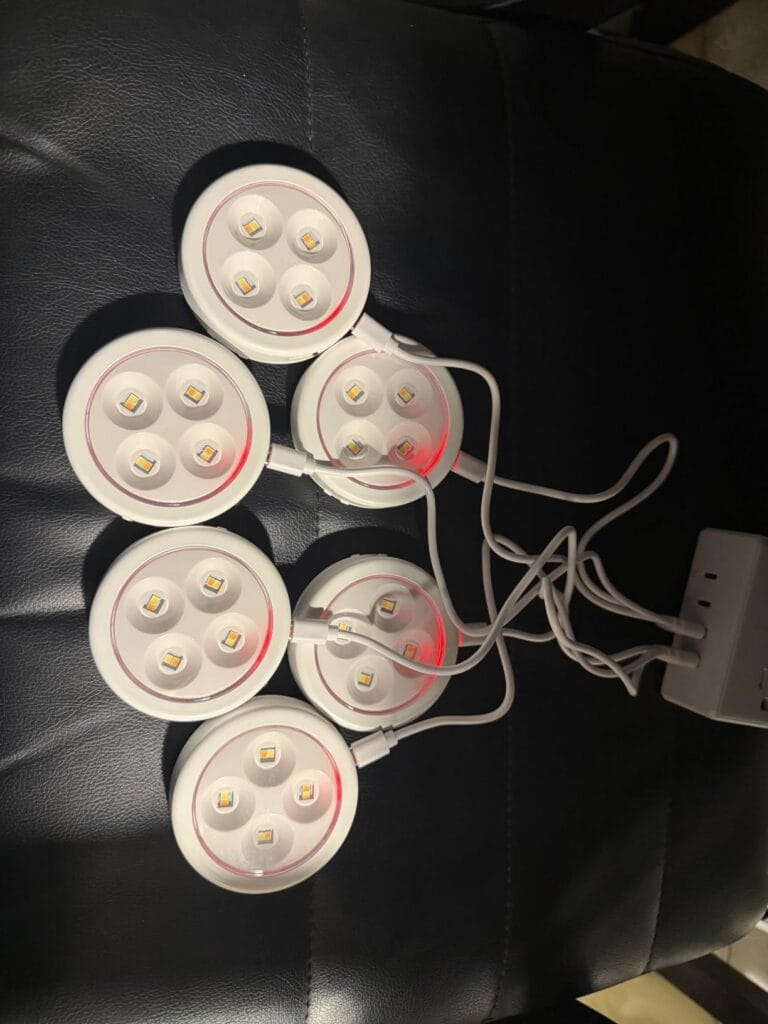
This set is explicitly marketed for bathrooms among other rooms, and the included charging station means you can rotate pucks in and out without hunting for a cable.
Bathroom-specific performance: At 50 lumens, it’s dimmer than the other EZVALO picks — more of a soft wayfinding glow than a functional light, which is actually ideal for a night light that shouldn’t fully wake you up. The compact size (about 3.3 inches) fits discreetly on a mirror edge or cabinet.
Pros:
- Comes with a charging dock, so recharging is simple
- Explicitly listed for bathroom use by the manufacturer
- Magnetic and stick-on mounting options
Cons:
- 50 lumens may be too dim if you need to actually read labels or find something
- Four lights to keep track of and periodically dock
- No published IP or waterproof rating
Key specs: Power: rechargeable, 1200mAh battery · Sensor: motion-activated · Lumens: 50 · Charge time: dock-based USB charging · IP rating: not published
6. WhitePoplar Rechargeable Motion Sensor Light — Best for Shower-Adjacent Brightness
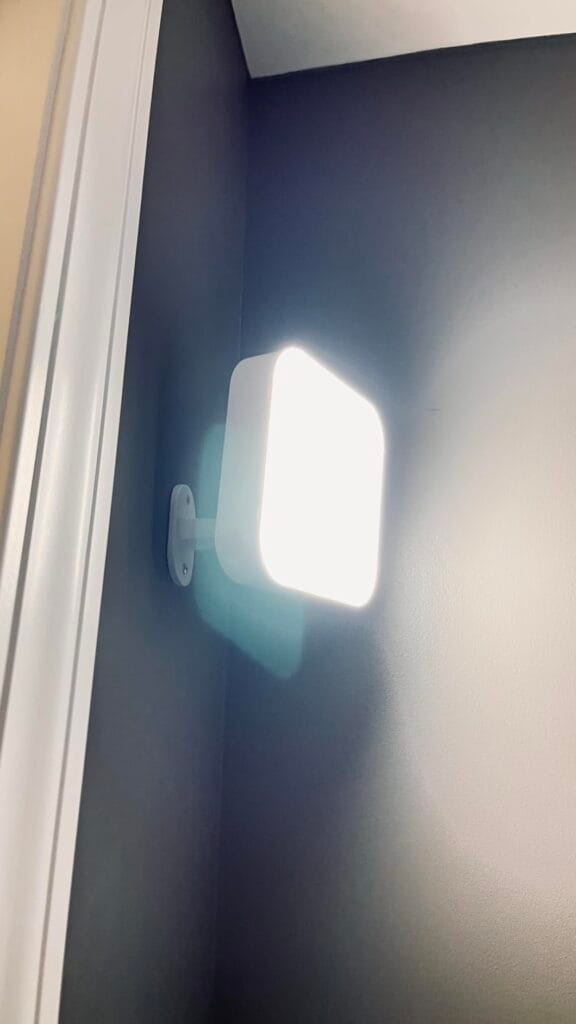
Unlike the other rechargeable picks, WhitePoplar markets this light by name for shower and bathroom use, not just as a general closet light that happens to work in a bathroom.
Bathroom-specific performance: At 500 lumens, it’s dramatically brighter than the other picks here — closer to a functional secondary light than a subtle night light. That makes it a strong fit if your bathroom is dark enough at night that a dim glow isn’t enough to move around safely. It mounts with a bracket and screws rather than a magnet or suction cup, so plan for a few minutes of setup.
Pros:
- 500 lumens, brightest option in this guide
- Explicitly marketed for shower and bathroom placement
- Large battery capacity rated for 60–80 days per charge
Cons:
- Bracket-and-screw mounting takes longer than magnetic or stick-on options
- 12-hour full charge time is longer than most USB-C pucks
- No published IP or waterproof rating despite the shower-adjacent marketing
Key specs: Power: rechargeable battery · Sensor: motion-activated · Lumens: 500 · Charge time: ~12 hours for a full charge, runtime 60–80 days · IP rating: not published
7. GE LED Night Light (Model 30966) — Best If You’d Rather Skip Charging Entirely
This isn’t solar or rechargeable — it’s a plug-in dusk-to-dawn night light. We’re including it because it’s the most established, widely-sold product in this guide, and it’s worth naming as the baseline alternative if the appeal of “no wiring” matters less to you than “it just always works.”
Bathroom-specific performance: No charging schedule to manage, no battery to die at the wrong moment. It plugs into an outlet and turns on automatically at dusk, which is a meaningfully different trade-off than every other pick here: you give up “no electric bill” for “never think about it again.”
Pros:
- UL-certified, from an established, well-reviewed brand
- Automatic dusk-to-dawn sensor, no motion-triggering delay
- Design leaves a second outlet free
Cons:
- Not solar or rechargeable — needs a wall outlet and draws (minimal) electricity
- Stays on all night rather than only activating on motion
- Doesn’t solve the “no wiring” problem the rest of this guide is built around
Key specs: Power: plug-in, 0.5W · Sensor: dusk-to-dawn photocell · Charge time: not applicable · IP rating: indoor use only, not published
A note on LITEOWL: Touch Of ECO’s LITEOWL solar/UV suction-cup night light is explicitly marketed for bathrooms and was a strong candidate for this list — but as of this writing it’s listed as out of stock or currently unavailable on both Amazon and Walmart. Worth checking back on if it restocks, but we won’t recommend buying a product you currently can’t purchase.
Buying Guide
IP rating. Most indoor night lights in this category — solar or rechargeable — don’t carry a formal IP (Ingress Protection) rating, because they’re designed to sit near a mirror or window, not inside a shower. IP ratings are a two-digit scale defined by international electrical standards — the second digit specifically covers moisture resistance, from light splashing up to full submersion. Treat “waterproof” claims on generic listings skeptically if no actual IP number is listed. The safer rule: mount any of these away from direct spray, splash zones near the sink, or condensation-heavy areas like directly above a shower.
Sensor type. You’ll see three types: dusk-to-dawn photocells (turn on automatically when it gets dark and stay on all night), PIR motion sensors (turn on when you walk in, off after a short delay), and manual tap/touch controls. Motion sensors are usually the better fit for a bathroom, since they don’t run all night and they turn on exactly when you need them.
Brightness. For pure wayfinding — enough to avoid stubbing a toe without fully waking you up — 5 to 50 lumens is plenty. If you want to actually read a label or find something in a drawer, look toward 100–150 lumens.
Charging. Solar window-mounted lights need real, mostly-unobstructed direct sun for several hours a day — a requirement most bathrooms simply can’t meet. USB-C rechargeable lights trade the “never plug it in” promise of solar for something far more reliable: a battery that lasts weeks per charge and takes a few minutes to top off.
Mounting. Suction cups work on glass and tile but can lose grip over time in humid environments. Magnetic mounts with an adhesive backing plate tend to hold better long-term and let you remove the light itself for charging without peeling anything off the wall.
Will a Solar Light Actually Work in Your Bathroom?
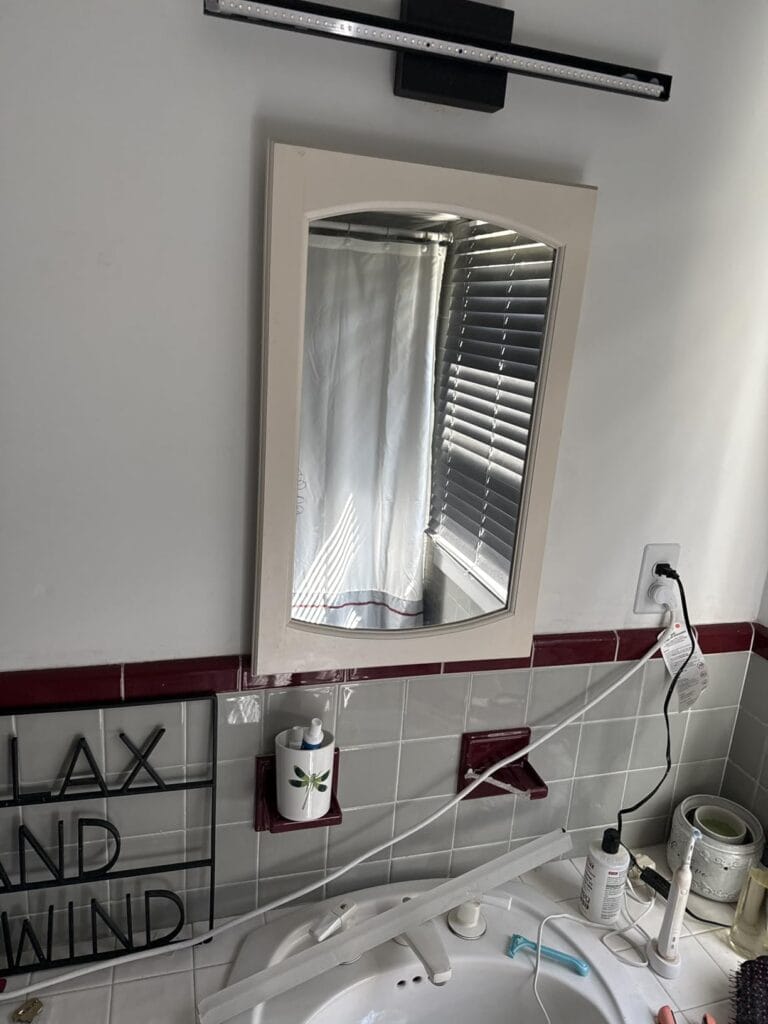
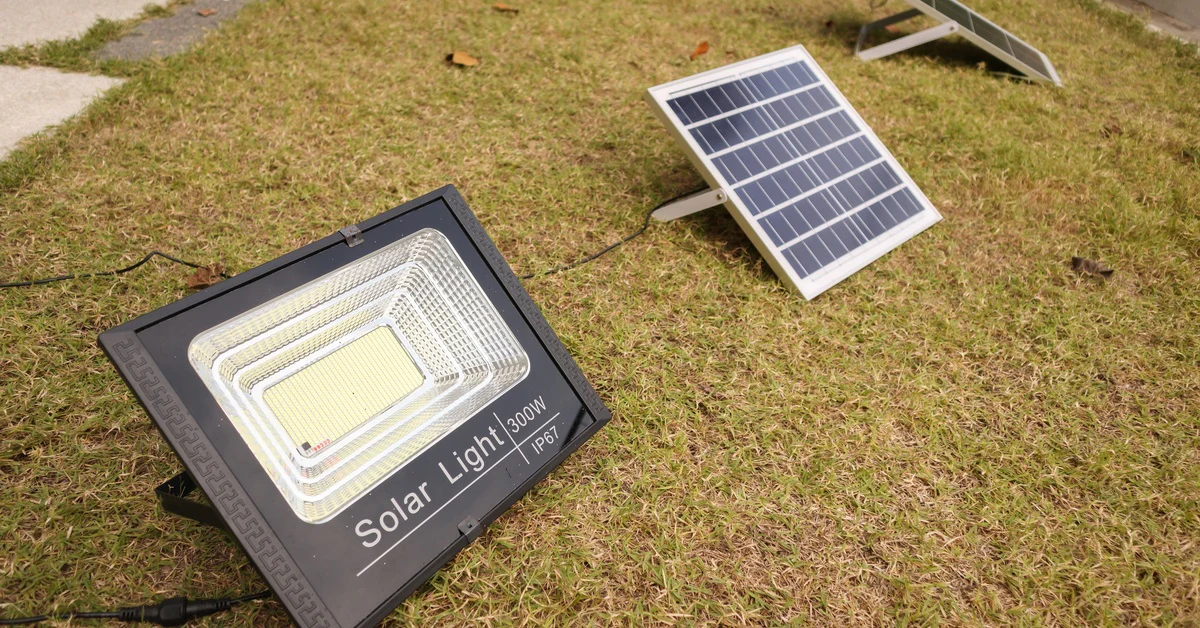
This comes down entirely to what kind of light your bathroom gets, and solar panels are surprisingly forgiving about the answer. They run on the photovoltaic effect, which means they convert light particles into electricity rather than heat. So technically, almost any light helps a little. The real question is whether it helps enough.
If you have a window
Good news, this part’s easy. A real window with a few hours of sun a day charges most solar night lights just fine, whether you sit the light right on the sill or mount it nearby.
If you have frosted or privacy glass
Frosted glass scatters light instead of blocking it outright, so charging still happens, just at a reduced rate. Diffused light through frosted glass behaves a lot like an overcast day for a solar panel. You’ll get a real charge, but expect it to build slower, and expect winter to make it worse.
Solar Light vs. Plug-In Rechargeable Night Light
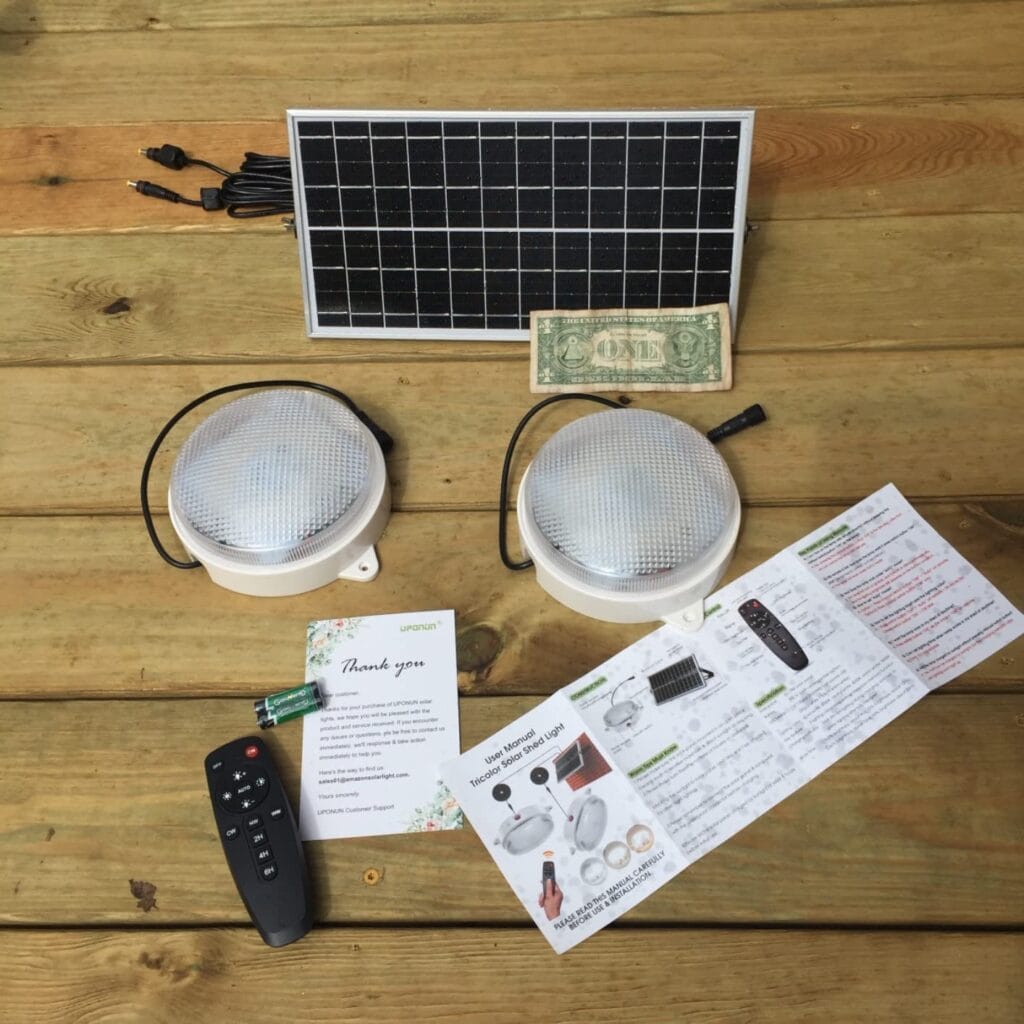
Here’s the objection nobody addresses, and it’s a fair one: if your bathroom barely gets any light in the first place, why bother with solar at all? Just plug something in.
Solar still wins on a couple of fronts. There’s no cord to hunt for, which matters more than it sounds like in a bathroom outlet that’s already juggling a hair dryer and an electric razor. A charged solar battery also keeps working through a power outage, which a plug-in light obviously can’t claim. And a cord running near a sink or shower is never the safest look, solar or not.
That said, let’s not pretend solar wins every fight. A plug-in light will always out-charge a badly placed solar one, full stop. If your bathroom genuinely gets zero light and you don’t want to bother with a remote panel or swapping batteries, a plug-in rechargeable model is the honest answer, and there’s nothing wrong with picking it. This guide isn’t trying to sell you on solar for its own sake. It’s trying to help you pick whatever actually works in your specific room.
Battery Life and Charging, Honestly
Let’s skip the vague marketing language and talk about what actually happens.
Indoor and indirect light charges a lot slower than direct sun, no way around it. On a cloudy day, a solar panel typically produces something like 10 to 25 percent of its full-sun output. Frosted glass and bright shade land in a similar range. Practically, that means a light living behind frosted glass might need several days of accumulated light just to bank one solid night’s charge, instead of topping off daily like you’d hope.
That’s exactly why battery reserve matters more than the “shines all night” claim printed on the box. A well-built solar night light is designed to run for several nights on a full charge, precisely because manufacturers know charging isn’t going to be consistent day to day. If a product listing brags about long runtime but says nothing about reserve capacity across cloudy stretches, that’s worth a second look before you buy.
If you’ve landed on a hybrid or battery-swap model, treat the solar panel as a nice bonus rather than the whole plan. Charge the removable battery under a lamp or in a sunny window every week or two, and let whatever solar exposure exists do its small part on top of that.
How We Chose These
We prioritized products with verifiable specs and active, purchasable listings over anything with vague marketing claims. For solar picks, we checked whether the charging method (window/suction cup) was realistic for a typical bathroom, and flagged products where sun exposure requirements make them a poor fit for most homes. For rechargeable and plug-in alternatives, we weighed battery capacity or wattage, sensor type and range, brightness in lumens, and how tool-free the mounting was. We included one plug-in pick as a deliberate baseline comparison, not because it fits the “no wiring” theme. We excluded products we couldn’t currently buy, and skipped IP ratings or prices manufacturers haven’t published rather than estimate them.
What About Other Rooms?
Bathrooms aren’t the only spot where a small solar night light earns its place. Hallways, closets, and bedrooms all benefit from the same low-glow, motion-triggered approach, often with a bit more flexibility since those rooms usually have better window access to work with. If you’re actually shopping for a bedroom solar night light, the charging logic stays the same, but where you place it and how bright it needs to be will shift a bit. Worth its own look if that’s the room you’re really solving for.
FAQs
Do solar lights work in a bathroom with no window?
Only with a battery-swap model, a remote panel on a cable, or a solar-plus-USB hybrid. A built-in-panel light sitting somewhere with zero light exposure just won’t charge, no matter how good it looks online.
What’s the difference between a solar bathroom light and a regular solar night light?
A bathroom-ready version carries a moisture rating, IP44 or IP65, while a generic garden-style solar night light often carries no rating for humidity or splashes at all. Check the IP number before you assume anything is bathroom-safe.
Are solar bathroom lights waterproof?
Not automatically, and “waterproof” printed on a box doesn’t mean much on its own. It comes down to the IP rating. IP44 handles splashes, IP65 handles direct jets. Read the number, not the marketing word.
Do they need direct sunlight, or does indirect and frosted-glass light work?
Indirect and frosted-glass light will charge a solar panel, just much more slowly. Expect roughly 10 to 25 percent of full-sun charging power on a cloudy day or through diffused glass, and plan for that with a light that has decent reserve capacity.
Are they safe near a shower or sink?
Yes, as long as the IP rating matches the spot. IP65 anywhere water could hit it directly, IP44 for splash-only zones like near a sink.
What happens in winter or during a stretch of cloudy days?
Charging slows down noticeably, since both winter sun angles and cloud cover cut into how much light actually reaches the panel. That’s exactly why battery reserve, and a backup charging option for windowless rooms, matters more than whatever brightness number is on the packaging.