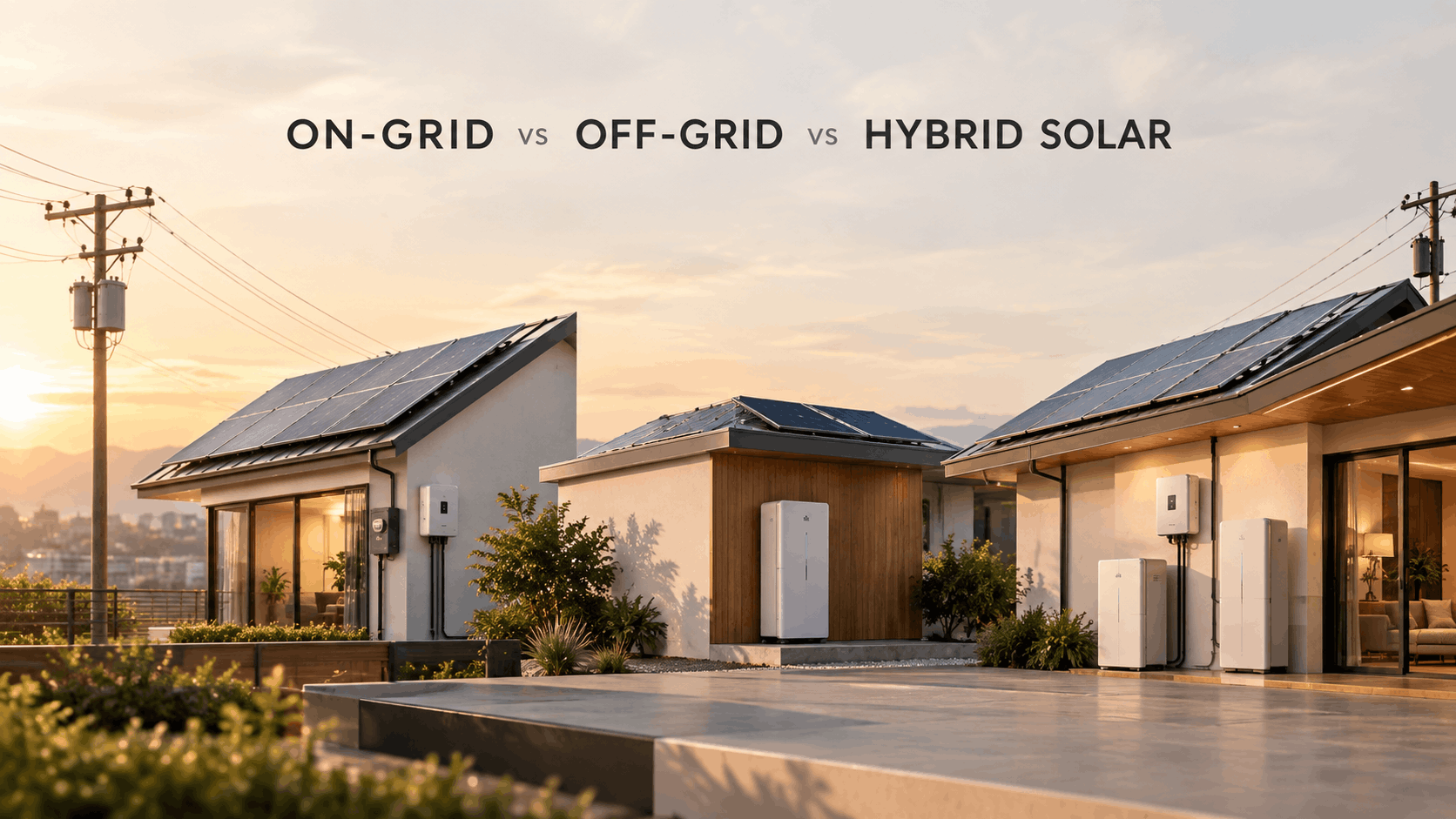
Quick answer: On-grid solar is the cheapest and fastest-paying-back option for most homeowners with reliable utility service. Off-grid solar is the right choice for remote properties with no grid access, and hybrid solar is worth the extra cost mainly if you face frequent power outages or weak net metering in your area.
Table of Contents
Everyone tells you off-grid solar means true energy freedom. That’s only half true, and the other half can cost you $50,000 or more that most people never budget for.
Here’s the number that matters first. The average US electricity rate is about 18 cents per kWh in 2026, according to the US Energy Information Administration (EIA), and the federal 30% solar tax credit expired on December 31, 2025. That change alone stretched grid-tied payback periods out to roughly 8 to 14 years nationally. Whether on-grid, off-grid, or hybrid solar makes sense for you depends entirely on which of these three systems you’re actually comparing, and most guides blur that distinction badly.
I built this guide using US Department of Energy technical documentation, EIA electricity pricing data, and the Solar Energy Industries Association’s (SEIA) state-by-state net metering database. Not marketing copy from a single installer. Here’s exactly how the three systems differ, what each one actually costs in 2026, and which one fits your situation.
Key Takeaways
- On-grid (grid-tied) solar is the cheapest option and pays back fastest, but it shuts off during outages unless you add a battery.
- Off-grid solar means true independence, but a full system can run $30,000 to over $100,000 depending on how much backup you need.
- Hybrid solar sits in between: grid-connected with battery backup, typically an on-grid system plus $9,000 to $18,000 for storage.
- 34 states plus Washington D.C. and Puerto Rico require utilities to offer net metering as of 2026, and that policy changes which system makes the most financial sense where you live.
The 3 Types of Solar Systems at a Glance
| Type | How It Works | Avg. Cost (2026) | Backup Power | Best For |
|---|---|---|---|---|
| On-Grid (Grid-Tied) | Connects to the utility grid, no battery | $2.50–$3.50/watt (~$20,000–$28,000 for 8 kW) | No, shuts off automatically during an outage | Most homeowners with reliable grid service |
| Off-Grid | Fully independent, large battery bank | $30,000–$70,000 typical; can exceed $100,000+ for full multi-day backup | Yes, always, by design | Remote homes with no practical grid access |
| Hybrid | Grid-connected with battery backup | On-grid cost plus $9,000–$18,000 for storage | Yes, during blackouts | Homes with frequent outages or weak net metering |
Not sure which row fits your roof and your area’s grid reliability? That’s exactly the kind of question a local solar advisor can answer in fifteen minutes, using your real electricity rate instead of a national average.
Quick Glossary
A handful of terms come up repeatedly in this guide. Here’s what they actually mean.
- Net metering: A billing arrangement where your utility credits you for solar power you send back to the grid.
- Grid-tied: A solar system connected to the utility grid, with no battery backup by default.
- Hybrid inverter: A device that manages power flow between your panels, battery, and the grid at the same time.
- Charge controller: A component that regulates how much power flows into a battery bank, preventing overcharging.
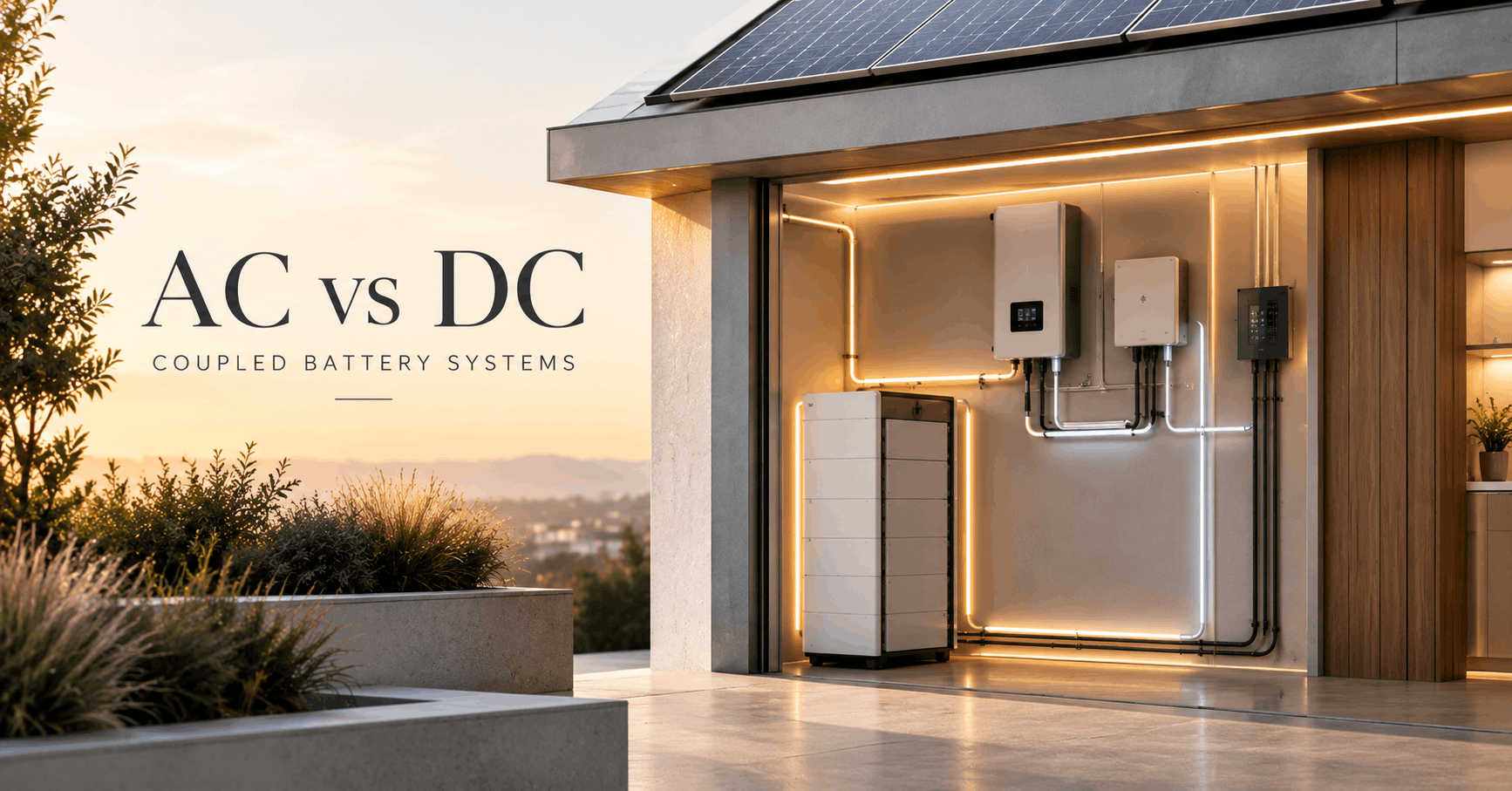
- AC-coupled vs DC-coupled: Two ways of wiring a battery into a solar system. AC-coupled is easier to retrofit onto an existing system; DC-coupled is usually more efficient but harder to add later.
- Battery bank: A group of batteries wired together to store solar energy for use at night or during an outage.
What Is an On-Grid (Grid-Tied) Solar System?
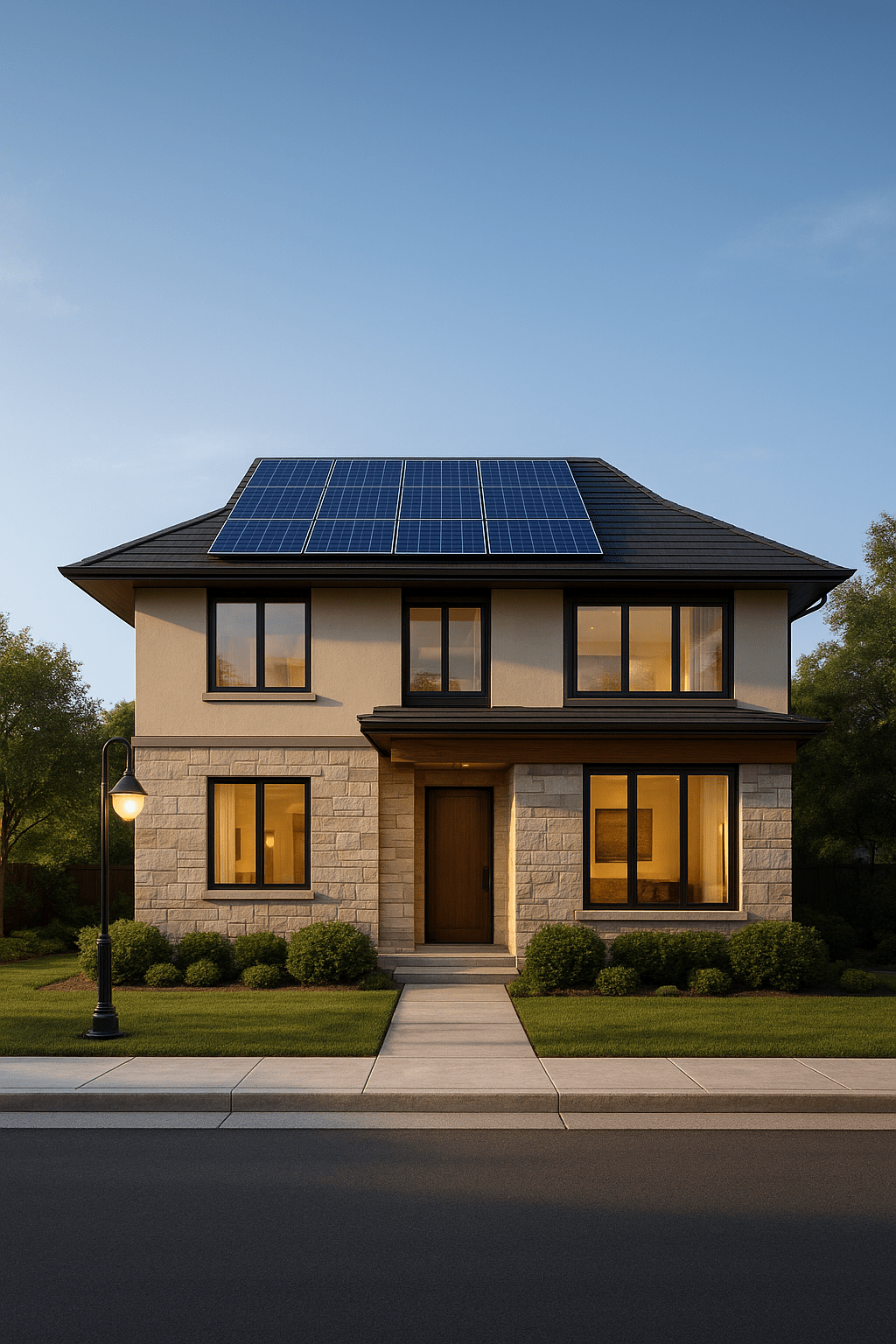
Think of an on-grid system as a roommate, not a replacement, for your utility. Your panels generate power during the day. Your home uses it. Anything extra flows back into the grid.
How On-Grid Solar Works
Your panels produce DC electricity. The inverter converts it into AC power your home can use. Whatever you don’t use gets exported to the grid. At night, when your panels are asleep, you pull power back from the grid like normal.
Net Metering Explained
Net metering is the billing arrangement that makes on-grid solar financially attractive. Your utility credits you for the electricity you send back, and you use those credits to offset what you draw at night. As of 2026, 34 states plus Washington D.C. and Puerto Rico require utilities to offer mandatory net metering, according to SEIA. Credit rates vary a lot by state, though. Some states still pay close to full retail rate, while others, California’s NEM 3.0 being the most-discussed example, pay closer to wholesale rates, which stretches out your payback period.
Pros of On-Grid Solar
- Lowest upfront cost of the three system types
- Fastest payback period, typically 8 to 14 years given current electricity rates and the expired federal tax credit
- No battery maintenance or replacement costs
- Simplest installation and permitting process
Cons of On-Grid Solar
- Shuts off automatically during a power outage, a safety requirement so utility workers aren’t fixing lines while your panels are secretly feeding power back into them
- Offers zero backup power unless you add a battery
- Net metering value depends entirely on your state’s policy, and some states are actively reducing it
Who Should Choose On-Grid Solar?
If your grid is reliable and you mainly want to cut your electricity bill, this is almost always the right call. It’s the system most homeowners end up with, and for good financial reason.
What Is an Off-Grid Solar System?
Off-grid means exactly what it sounds like: no utility connection at all. Your home runs entirely on what your panels produce and what your batteries store.
How Off-Grid Solar Works
Panels charge a battery bank through a charge controller. An off-grid inverter converts the stored DC power into usable AC power for your home. There’s no fallback option here. If your batteries run low during a cloudy week, you’re either rationing power or starting a backup generator.
Battery Bank & Sizing Requirements
This is where off-grid gets expensive. You need enough panels and battery storage to cover your home’s energy needs through nighttime, cloudy stretches, and winter, with zero grid support. A typical off-grid setup runs $30,000 to $70,000, and a full whole-home system designed for multiple cloudy days in a row can exceed $100,000. Battery storage alone typically costs $700 to $1,000 per kWh installed, which is why sizing decisions matter so much here.
Pros of Off-Grid Solar
- Complete energy independence, no utility bill, ever
- Works in locations with no grid access at all
- Immune to utility rate hikes and grid policy changes
Cons of Off-Grid Solar
- Highest upfront cost by a wide margin
- Requires careful energy budgeting, there’s no unlimited backup supply
- Battery replacement adds long-term maintenance cost
- Overkill for most homes that already have grid access
Who Should Choose Off-Grid Solar?
Off-grid makes sense mainly for remote properties where running grid infrastructure would cost more than the solar system itself. If you already have a grid connection nearby, off-grid is rarely the economical choice. A solar advisor can actually run the math on grid-extension cost versus off-grid system cost for your specific property, which is worth doing before you commit either way.
What Is a Hybrid Solar System?
Hybrid solar takes the “best of both” approach. You stay connected to the grid for backup and net metering credits, but you also have a battery for outages and peak-rate savings.
How Hybrid Solar Works
Panels generate power during the day. Your home uses what it needs, extra power charges the battery, and any remaining surplus can still be exported to the grid, depending on your setup and local rules. When the grid goes down, your hybrid inverter automatically isolates your home from the grid and switches to battery power, keeping your lights on.
Hybrid Inverters Explained (AC-Coupled vs DC-Coupled)
Hybrid systems use one of two setups. AC-coupled systems convert DC power to AC first, then route it to the battery, which is easier to retrofit onto an existing grid-tied system. DC-coupled systems send power straight to the battery before conversion, which is generally more efficient but usually needs to be planned into a new install rather than added later. Popular hybrid inverter brands include Sol-Ark, Fronius GEN24, SolarEdge StorEdge, and Goodwe, each with different voltage compatibility and surge power capabilities.
Pros of Hybrid Solar
- Backup power during outages, unlike a standard grid-tied system
- Still eligible for net metering credits in most states
- Useful for time-of-use rate arbitrage, storing cheap power and using it during expensive peak hours
Cons of Hybrid Solar (Honest Downsides Most Guides Skip)
Most articles paint hybrid as the obvious upgrade. It isn’t always. Here’s what tends to get left out:
- Batteries add $9,000 to $18,000 to your total cost, and that’s before installation complexity
- Standard hybrid inverters often have limited surge power compared to dedicated off-grid inverters, meaning they may struggle to run high-draw appliances like AC units during an outage
- Batteries degrade over time and typically need replacement or capacity-loss management within 10 to 15 years
- The payback period stretches out significantly compared to a plain grid-tied system
Who Should Choose Hybrid Solar?
Hybrid solar earns its cost if you live somewhere with frequent outages, weak net metering policy, or high time-of-use rate differences. If your grid rarely goes down and your state has strong net metering, a battery may take years longer to pay for itself than the marketing suggests.
On-Grid vs Off-Grid vs Hybrid: Full Comparison Table
| Factor | On-Grid | Off-Grid | Hybrid |
|---|---|---|---|
| Grid connection | Yes | No | Yes |
| Battery required | No | Yes, large bank | Yes, moderate |
| Backup during outage | No | Yes | Yes |
| Upfront cost | Lowest | Highest | Medium-High |
| Maintenance | Low | High, battery upkeep | Medium |
| Net metering eligible | Yes | N/A | Usually yes |
| Ideal setting | Suburban/urban homes | Remote, no grid access | Outage-prone areas |
Cost Comparison (Upfront & Long-Term)
On-grid systems win on both upfront and long-term cost for most homeowners, since there’s no battery to buy or replace. Off-grid systems cost the most upfront and carry ongoing battery replacement costs every 10 to 15 years. Hybrid sits in between, and its long-term value depends heavily on how often you’d actually use that backup power.
Reliability During Power Outages / Load-Shedding
This is the one area where on-grid solar loses outright. Off-grid and hybrid systems both keep your home powered during a blackout or scheduled load-shedding, since they’re built around battery storage rather than depending on the grid staying up.
Maintenance & Lifespan Comparison
On-grid systems are the simplest to maintain, since panels and inverters need little more than occasional cleaning and inspection. Off-grid systems demand the most attention, mainly because battery banks need monitoring and eventual replacement. Hybrid falls in the middle, with maintenance scaling to the size of the battery you’ve added.
Equipment Differences (Inverters, Batteries, Charge Controllers)
On-grid systems need only a standard grid-tie inverter. Off-grid systems need a charge controller, a large battery bank, and an off-grid-rated inverter capable of running your whole home independently. Hybrid systems need a hybrid inverter that can manage grid power, battery power, and solar input simultaneously.
Which Solar System Is Best for You? [Decision Framework]
There’s no universal “best” system. It depends on your grid reliability, budget, and how much backup power actually matters to you.
If You Live in an Area With Reliable Grid Power
Grid-tied solar is almost always the smarter financial choice. Lower cost, faster payback, no battery headaches.
If You Live in a Remote Area With No Grid Access
Off-grid is your only real option, and the cost is simply the price of independence.
If Your Area Has Frequent Outages or Load-Shedding
Hybrid solar earns its keep here. A short blackout might just be inconvenient, but a multi-day outage during a heatwave or winter storm is a different story.
If You Want Maximum Savings (Best ROI)
Stick with on-grid. Batteries are a comfort and resilience upgrade, not a savings shortcut, in most states.
If you’re still torn between two of these, that’s genuinely common, and it’s exactly what a solar advisor is for. They can run your actual electricity rate, roof orientation, and outage history through the math instead of you guessing.
Common Misconceptions About Grid-Tied, Off-Grid & Hybrid Solar
“Solar panels alone give you backup power” — False. A standard grid-tied system shuts off automatically during an outage. Without a battery, your panels go quiet right when you need power most.
“Hybrid is always the best option” — Not always true. Hybrid systems cost more and take longer to pay back. If outages are rare where you live, you may be paying a premium for a safety net you rarely use.
“Off-grid means no electricity bill ever” — Partially true. You stop paying a monthly utility bill, but you take on battery replacement costs and the responsibility of managing your own power supply carefully.
Regional Considerations
Key Takeaways
- Net metering policy varies enormously by state and directly changes which system makes financial sense.
- States with strong retail-rate net metering favor simple grid-tied systems.
- States with weak export credits, like California under NEM 3.0, push more homeowners toward hybrid systems.
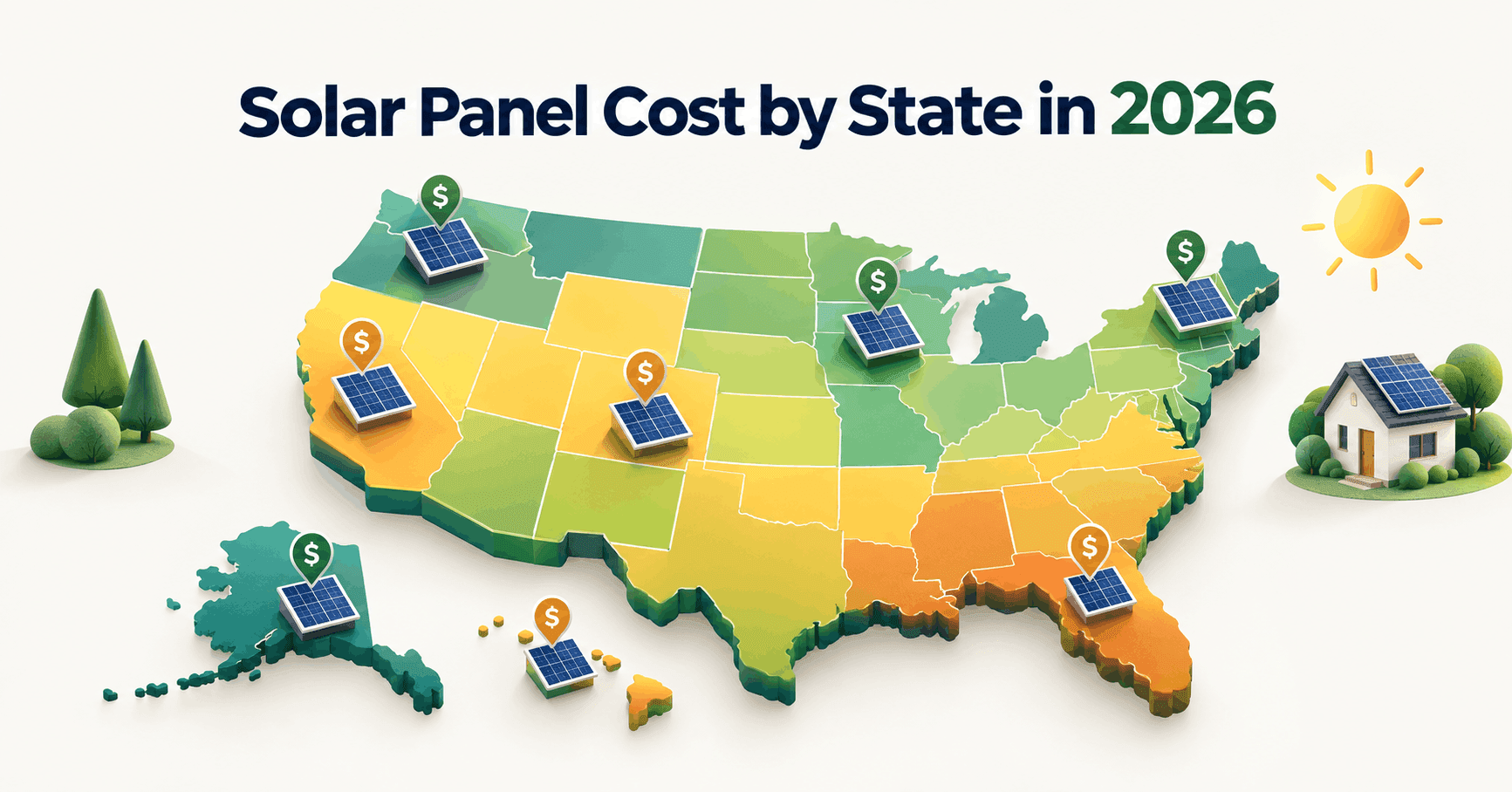
Net metering policy varies enormously by state, and it directly affects which system makes financial sense. States like New Jersey and Massachusetts still offer strong retail-rate credits, which favors simple grid-tied systems. California’s shift to NEM 3.0, which pays significantly less for exported power, has pushed more Californian homeowners toward hybrid systems just to capture value from their own solar production through batteries instead of low-value grid exports.
If you live somewhere with frequent grid instability, whether from storms, aging infrastructure, or scheduled outages, the backup power argument for hybrid or off-grid solar becomes much stronger regardless of net metering policy. Check your state’s current rules through DSIRE (the Database of State Incentives for Renewables and Efficiency) before deciding, since policies shift yearly, and a solar advisor familiar with your state can confirm what actually applies to you.
FAQs
Can I switch from grid-tied to hybrid later?
Yes. Most grid-tied systems can be retrofitted with an AC-coupled battery later, though it’s usually cheaper to plan for a hybrid setup from the start if you already know you’ll want backup power.
Do off-grid systems work without a battery?
No. Without storage, an off-grid system only produces power while the sun is out and has no way to supply electricity at night or during cloudy weather.
Is hybrid solar worth the extra cost?
It depends on your outage frequency and net metering rate. In areas with frequent blackouts or weak export credits, yes. In areas with reliable grid power and strong net metering, the payback period can stretch well beyond a decade.
How many batteries do I need to go off-grid?
It depends entirely on your daily energy usage, local sunlight hours, and how many cloudy days you need to plan for. Most off-grid installers size battery banks using a load calculation based on your specific appliances, not a one-size-fits-all number.
What happens to on-grid solar during a power outage?
The system shuts off automatically for safety, a requirement so utility workers aren’t at risk from power flowing back through supposedly dead lines. You lose solar power along with grid power until service is restored, unless you have a battery with an automatic transfer switch.
Summary
Grid-tied solar wins on cost and simplicity for most homeowners with reliable utility service. Off-grid solar is the right, and often only, choice for remote properties with no practical grid access. Hybrid solar sits in between, and it’s worth the extra investment specifically for buyers who value outage protection or live somewhere net metering doesn’t pay well.
The right system isn’t the one with the most features. It’s the one that matches how your grid actually behaves where you live, and if you’re still unsure after reading this, a fifteen-minute conversation with a solar advisor is a lot cheaper than guessing wrong on a $20,000 to $100,000 decision.