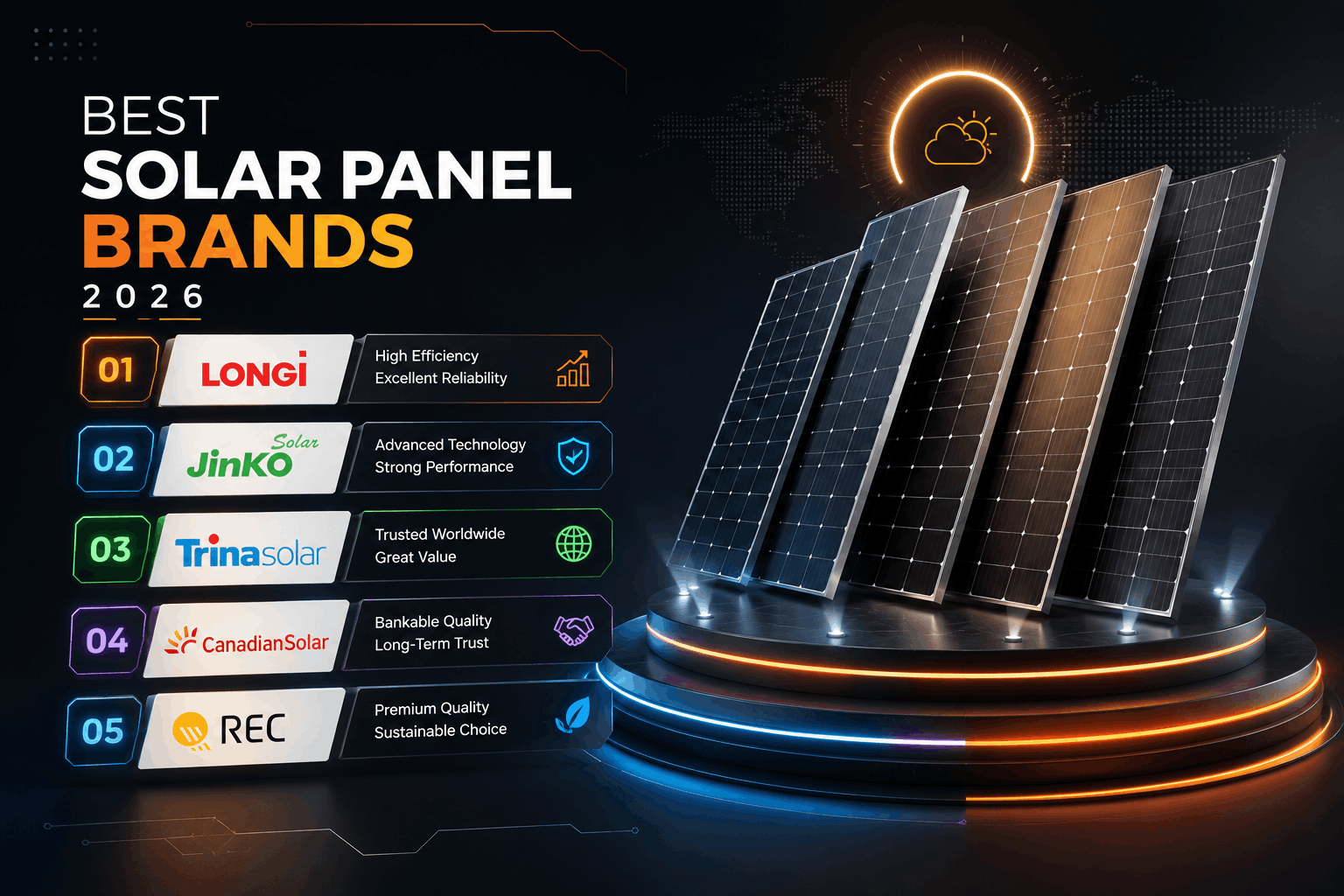
REC Group is the best overall solar panel brand for 2026, thanks to its heat-resistant HJT cell technology and strong 25-year warranty. Qcells ranks as the most trusted US brand, and SunPower/Maxeon leads on raw efficiency at 24%+.
Table of Contents
Everyone tells you to buy the panel with the highest efficiency number on the spec sheet. That advice is wrong for most homeowners, and I’ll explain exactly why in a second.
Here’s the number that actually matters first. The average US electricity rate is sitting around 18 cents per kWh in 2026, according to the US Energy Information Administration (EIA), and it’s still climbing. The federal 30% solar tax credit expired on December 31, 2025. Without it, most homeowners are now looking at a payback period somewhere between 8 and 14 years, depending on their state’s electricity rate and net metering policy. Your brand choice can shift that number by years in either direction. That’s exactly why “just buy the most efficient panel” is bad advice for most roofs.
I ranked the 10 best solar panel brands for 2026 using six criteria, which I’ll walk you through below. No brand paid to be on this list, and no brand paid to be left off it.
Key Takeaways
- REC ranks #1 overall for hot-climate performance and lab-tested reliability. Qcells is the most trusted US brand. SunPower/Maxeon has the highest efficiency.
- Average US electricity rate: about 18¢/kWh in 2026 (EIA). Average payback period: 8 to 14 years, now that the federal tax credit has expired.
- The factor that matters most, and gets ignored most, is manufacturer financial stability. A 25-year warranty means nothing if the company isn’t around in year 10.
- Talk to a solar advisor before you sign anything. These rankings only mean something once they’re matched to your actual roof, climate, and electricity rate.
How I Ranked These Brands

I didn’t just copy spec sheets and call it a ranking. I scored each brand across six factors that actually affect what you experience over 25 years of ownership, not just what looks good in a sales pitch.
Efficiency and temperature coefficient. How much power the panel makes per square foot, and how much of that output survives a hot roof in July.
Warranty terms. A product warranty covers manufacturing defects. A performance warranty guarantees minimum output over time. These are different things, and some brands are strong on one and weak on the other.
Degradation rate. Every panel loses a small percentage of output each year. Lower is better, and the gap between brands compounds hard over 25 years.
Price per watt. What homeowners actually pay installed, not the wholesale price manufacturers quote to installers.
Manufacturer financial stability. Almost nobody checks this, and it’s the one factor that can quietly wreck your warranty. A 25-year promise is worthless if the company backing it folds in year 10.
Independent lab testing. I weighted brands higher when they showed up consistently in PVEL’s Module Reliability Scorecard, a third-party testing program the solar industry treats as a credibility benchmark.
Quick Glossary
A few terms come up constantly in this guide. Here’s what they actually mean.
- PERC: An older, widely-used solar cell technology. Reliable, but a step behind newer tech on efficiency.
- TOPCon: A newer cell design that’s more efficient and degrades slower than PERC. Most Tier 1 brands have shifted to it.
- HJT (heterojunction): A premium cell technology that performs especially well in heat. REC’s top panels use this.
- Degradation rate: How much power a panel loses each year as it ages, usually shown as a percentage.
- Temperature coefficient: How much power a panel loses for every degree above 25°C. A number closer to zero is better.
- Tier 1: A financial classification for manufacturers with strong balance sheets and bank financing history. Not a quality rating.
- Bankability: Whether a manufacturer is financially stable enough to still exist, and still honor its warranty, in 20 years.
Best Solar Panel Brands 2026 — Full Comparison Table
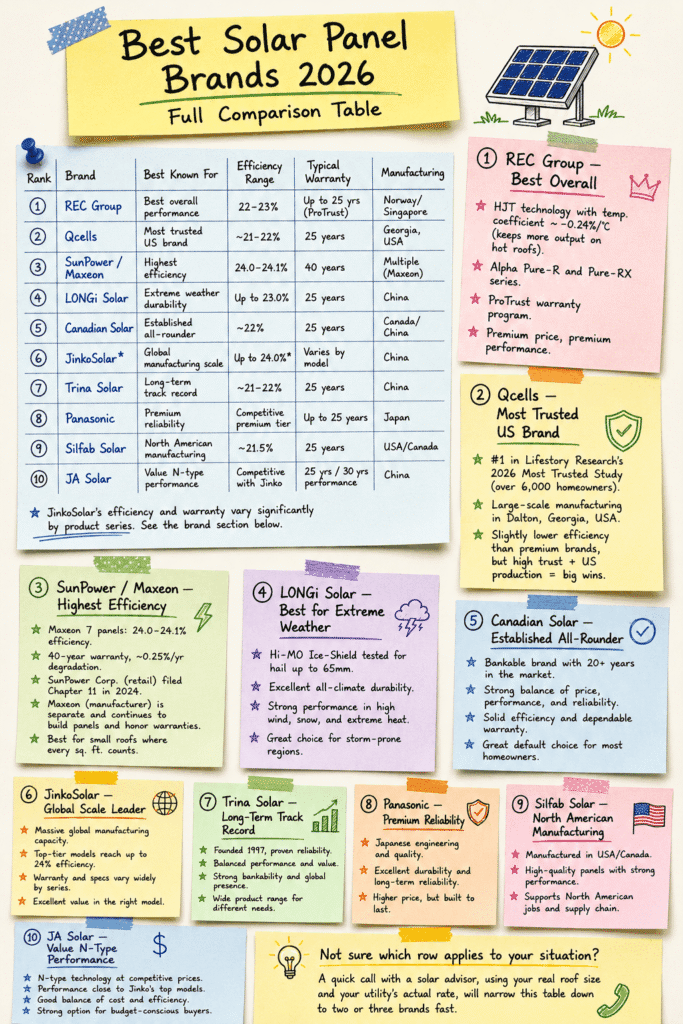
| Rank | Brand | Best Known For | Efficiency Range | Typical Warranty | Manufacturing |
|---|---|---|---|---|---|
| 1 | REC Group | Best overall performance | 22–23% | Up to 25 yrs (ProTrust) | Norway/Singapore |
| 2 | Qcells | Most trusted US brand | ~21–22% | 25 years | Georgia, USA |
| 3 | SunPower / Maxeon | Highest efficiency | 24.0–24.1% | 40 years | Multiple (Maxeon) |
| 4 | LONGi Solar | Extreme weather durability | Up to 23.0% | 25 years | China |
| 5 | Canadian Solar | Established all-rounder | ~22% | 25 years | Canada/China |
| 6 | JinkoSolar | Global manufacturing scale | Up to 24.0%* | Varies by model | China |
| 7 | Trina Solar | Long-term track record | ~21–22% | 25 years | China |
| 8 | Panasonic | Premium reliability | Competitive premium tier | Up to 25 years | Japan |
| 9 | Silfab Solar | North American manufacturing | ~21.5% | 25 years | USA/Canada |
| 10 | JA Solar | Value N-type performance | Competitive with Jinko | 25 yrs / 30 yrs performance | China |
*JinkoSolar’s efficiency and warranty vary significantly by product series. See the brand section below.
Not sure which row applies to your situation? A quick call with a solar advisor, using your real roof size and your utility’s actual rate, will narrow this table down to two or three brands fast.
1. REC Group — Best Overall
Hot roofs are where most panels quietly lose their edge, and it’s exactly where REC pulls ahead. The Alpha Pure-R and Pure-RX lines use heterojunction (HJT) cell technology, which posts a temperature coefficient of roughly -0.24%/°C, one of the best figures in the industry. In plain terms, if your roof hits 140°F in July, REC’s panels hold onto more of their output than most TOPCon competitors.
That performance comes at a price, literally. HJT technology carries a premium, so budget-first buyers may find better value a few spots down this list. But REC backs its panels with the ProTrust warranty program, and it consistently posts strong scores in independent lab testing. That’s a big part of why it earns the top spot here. If you’re in a hot climate, or you simply want to squeeze the most lifetime output out of your panels, start your comparison with this brand.
2. Qcells — Most Trusted US Brand
Spec sheets can tell you a lot, but they can’t tell you how a company treats you after the sale. That’s where consumer trust data fills the gap, and it’s where Qcells wins decisively. In Lifestory Research’s 2026 America’s Most Trusted Solar Panels Study, built on responses from over 6,000 homeowners, Qcells ranked first overall.
There’s also a manufacturing story worth mentioning. Qcells produces panels at real volume in Dalton, Georgia, making it one of the few Tier 1 brands with substantial domestic manufacturing. Given the tariff pressure on imported panels in 2026, that’s not a small detail. Efficiency runs a step behind premium brands like REC, sure. But for buyers who want a widely-installed, dependable name backed by strong trust data and US-based production, Qcells is hard to beat.
3. SunPower / Maxeon — Highest Efficiency
If raw output per square foot is what you’re after, this is your brand. Maxeon 7 panels hit 24.0–24.1% efficiency, the highest figure on this entire list, backed by a 40-year warranty and a degradation rate of roughly 0.25% per year. PVEL’s independent accelerated-aging tests have repeatedly ranked Maxeon among the top performers in the industry.
Now, the part every buyer needs to hear before this brand shows up on a quote. SunPower Corporation, the US retail brand, filed for Chapter 11 bankruptcy in 2024. That’s public record, and it understandably makes people nervous. Here’s the nuance most listings leave out: Maxeon Solar Technologies is a separate, publicly traded manufacturer that continues to build panels using SunPower’s original technology, and it continues to support existing warranties. The two names get tangled together constantly, so it’s worth untangling before you sign anything. If your roof is small and you want maximum watts per panel, the performance justifies the premium price. Just know which company you’re actually buying from.
4. LONGi Solar — Best for Extreme Weather
Hail is where cheap panels fail first, and LONGi built its reputation around not failing. Its Hi-MO Ice-Shield line is tested to withstand hail up to 65mm in diameter, more than double the industry-standard rating. It’s one of the highest-rated brands for all-climate durability, thanks largely to gallium-doped cells that slow long-term power loss.
Efficiency climbs as high as 23% on the Hi-MO 6 Explorer, which is competitive with brands charging considerably more. One caveat: LONGi is a China-based manufacturer, so it carries the same tariff and import considerations affecting most Tier 1 Chinese brands right now. For homeowners in hail-prone, high-wind, or storm-heavy regions, the durability testing alone makes LONGi worth a serious look.
5. Canadian Solar — Established All-Rounder
Not every brand needs a flashy headline number to earn a spot on this list, and Canadian Solar is proof of that. It’s been in the residential market longer than most competitors. The general consensus among installers is simple: a solid panel from a financially successful company with a good warranty. Dependable, not flashy, is basically the brand identity here.
Cold-weather performance is a genuine strength, and pricing stays competitive relative to the reliability on offer. Efficiency sits around 22%, respectable but not chart-topping next to REC or Maxeon. For buyers who want a proven, mainstream option without stretching into premium-brand pricing, Canadian Solar is a safe, sensible pick.
6. JinkoSolar — Global Manufacturing Scale
Scale is Jinko’s whole story. It’s the world’s largest solar module manufacturer by shipment volume, and its Tiger Neo series pushes efficiency as high as 24% on the newest models. Financial institutions treat it as a Tier 1 bankable manufacturer, a meaningful stability signal when you’re trusting a company with a decades-long warranty.
There’s a catch, and it’s the one thing on this entire list worth double-checking before you sign anything. Jinko’s warranty terms swing wildly by model. Some Tiger Neo panels carry a full 25-year product warranty. Others in the same lineup offer as little as 12 years, even while the performance warranty stretches to 30. Same brand, wildly different fine print. If a Jinko panel shows up on your quote, ask your installer to confirm the exact warranty tied to that specific model number, not just the brand name.
7. Trina Solar — Long-Term Track Record
Consistency is underrated in an industry that loves to chase the newest efficiency record. Trina Solar is one of only two manufacturers, alongside Jinko, to hold a top industry manufacturer ranking every single year from 2014 through 2020. A decade of staying at the top says something a spec sheet can’t.
The panels themselves are solidly competitive rather than category-leading: TOPCon efficiency in the low-to-mid 22% range, plus a 25-year product and performance warranty through its TrinaProtect program. There’s no single standout feature that separates Trina from Canadian Solar or JA Solar in the same price bracket. But if manufacturer longevity is the kind of thing that helps you sleep at night, Trina’s track record earns it a spot on any shortlist.
8. Panasonic — Premium Reliability
Not every premium brand needs to shout about a record-breaking efficiency number, and Panasonic is a good example of that. It consistently scores among the highest-rated brands for module quality, right alongside Maxeon and REC. It has built its reputation on consistency rather than headline specs.
That’s really the tradeoff here. You won’t see Panasonic topping efficiency charts, and its marketing stays fairly quiet compared to newer premium entrants. What you get instead is a long-standing manufacturing reputation and dependable warranty support, which matters more than a flashy number if you value a brand’s track record over its press releases.
9. Silfab Solar — North American Manufacturing
Ask any installer worried about tariffs where they’d rather source panels from, and Silfab comes up fast. It manufactures in Washington State and Ontario, Canada, one of the only Tier 1 brands with genuine North American production. That matters for two practical reasons: it can qualify for domestic-content incentives on certain projects, and it sidesteps the supply-chain exposure tied to Chinese-manufactured panels.
Efficiency lands in the mid-range, around 21.5%, so it’s not chasing the top of the performance chart. But between the domestic manufacturing angle and the extended labor coverage offered through its certified installer program, Silfab earns its spot for anyone who specifically wants North American-made panels or needs to meet domestic-content requirements.
10. JA Solar — Value N-Type Performance
JA Solar rarely gets the brand recognition its specs deserve. It’s one of the four largest module manufacturers on the planet, and its DeepBlue series goes head-to-head with JinkoSolar’s Tiger Neo on both efficiency and price. Where it actually pulls ahead of Jinko is consistency: the residential DeepBlue series carries a standard 25-year product and 30-year performance warranty across the board, without the model-by-model guesswork that complicates Jinko’s lineup.
If Jinko’s specs appealed to you but the warranty variability gave you pause, put JA Solar on your quote-comparison list. Same performance class, more predictable fine print, less brand name to lean on.
How to Choose the Right Solar Panel Brand for Your Home
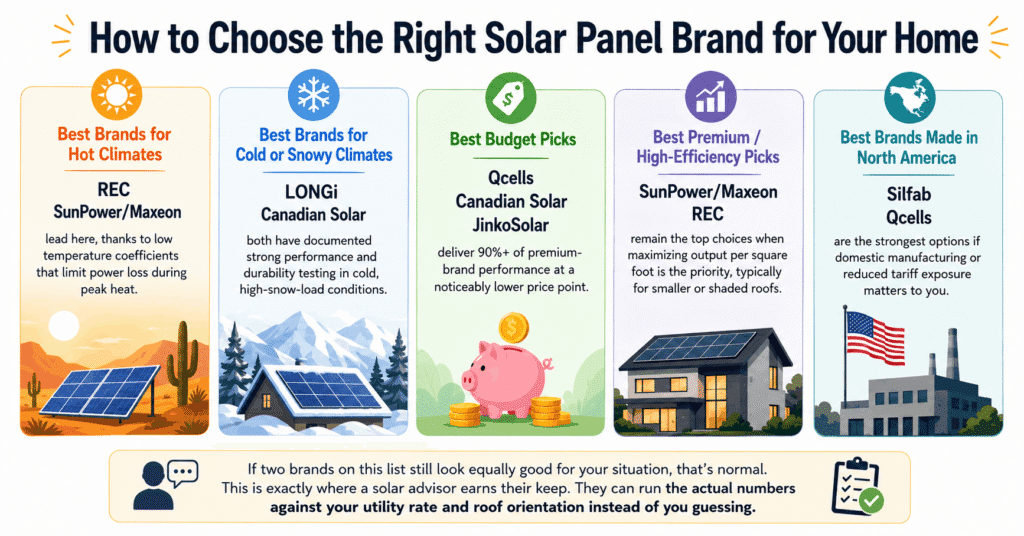
Best Brands for Hot Climates
REC and SunPower/Maxeon lead here, thanks to low temperature coefficients that limit power loss during peak heat.
Best Brands for Cold or Snowy Climates
LONGi and Canadian Solar both have documented strong performance and durability testing in cold, high-snow-load conditions.
Best Budget Picks
Qcells, Canadian Solar, and JinkoSolar deliver 90%+ of premium-brand performance at a noticeably lower price point.
Best Premium/High-Efficiency Picks
SunPower/Maxeon and REC remain the top choices when maximizing output per square foot is the priority, typically for smaller or shaded roofs.
Best Brands Made in North America
Silfab and Qcells are the strongest options if domestic manufacturing or reduced tariff exposure matters to you.
If two brands on this list still look equally good for your situation, that’s normal. This is exactly where a solar advisor earns their keep. They can run the actual numbers against your utility rate and roof orientation instead of you guessing.
What Happens If Your Solar Panel Manufacturer Goes Out of Business?
This is the question almost every roundup skips, and it deserves a straight answer. A solar panel warranty is only as strong as the company standing behind it 20 years from now.
Key Takeaways
- SunPower Corporation filed for bankruptcy in 2024. Maxeon, the actual panel manufacturer, kept operating and kept honoring warranties.
- A big brand name is not the same thing as a financially stable brand.
- Check if the manufacturer is publicly traded, since public companies have to disclose their finances.
Real Example: SunPower’s Bankruptcy
When SunPower Corporation filed for Chapter 11 bankruptcy in 2024, it created real confusion for homeowners with SunPower-branded systems. The manufacturing side of the business, now operating as Maxeon Solar Technologies, kept producing panels and kept honoring existing warranties. But the event is a useful case study. Even a well-known, long-established brand can face financial trouble, and the corporate structure behind your panel brand matters more than most buyers realize.
How to Check a Manufacturer’s Financial Stability
Look for whether the company is publicly traded. Public companies must disclose financial statements, which adds real transparency. Check if the brand appears on independent bankability trackers, which weigh factors like operating revenue and financial disclosures. A long operating history, like Trina’s or Canadian Solar’s decade-plus track record, is also a reasonable, if imperfect, signal of staying power. If you’re not sure how to read any of this, ask your solar advisor to walk you through it before you commit.
Common Misconceptions About Solar Panel Brands

“The most efficient panel is always the best choice.” Not necessarily. A highly efficient panel on a large, unshaded roof may be unnecessary spending. Efficiency matters most when roof space is limited.
“Tier 1 means top quality.” Tier 1 is a financial classification, referring to manufacturers with strong balance sheets and bank financing history. It isn’t a technical quality rating, and it doesn’t automatically mean the best-performing panel.
“A bigger brand name guarantees better warranty support.” Brand size doesn’t equal warranty reliability. As the SunPower example shows, even large, recognizable companies can restructure. Financial stability and warranty structure matter more than name recognition alone.
FAQs
Which solar panel brand has the best warranty?
SunPower/Maxeon offers the longest warranty on this list at 40 years. REC and JA Solar both offer strong, consistent 25-year product and performance coverage.
Are expensive solar panel brands worth the extra cost?
It depends on your roof. If you have ample unshaded space, a mid-range brand like Qcells or Canadian Solar often delivers excellent value. If your roof is small or partially shaded, paying more for higher efficiency from REC or Maxeon can make more financial sense.
What does “Tier 1 solar panel” actually mean?
It refers to a manufacturer’s financial standing and bank-financing track record, not the technical performance of the panel itself. It’s a reasonable bankability signal, but it isn’t a substitute for checking actual efficiency and warranty specs.
Which solar panel brands are made in the USA?
Qcells manufactures at scale in Georgia. Silfab manufactures in Washington State, with additional production in Ontario, Canada.
How much does brand actually affect long-term savings?
Significantly, but not in the way most people expect. The bigger factors are degradation rate and warranty enforcement over 25 years, not the sticker efficiency number. A slightly less efficient panel with a lower degradation rate can outproduce a “better” panel by year 20.
Summary
For most homeowners with a reliable grid connection and average roof space, Qcells or Canadian Solar deliver the best balance of price, warranty, and manufacturing reliability. If your roof is small or shaded, REC or SunPower/Maxeon justify their premium through higher output per panel. If you live somewhere hail, heat, or severe weather is a real concern, LONGi’s durability testing makes a strong case for itself.
There’s no single “best” brand for every roof. There’s only the best brand for your specific roof, climate, and budget. Now you have the real data to make that call, and if you still want a second opinion, a solar advisor can double-check the math for free before you sign anything.