
Last updated on October 27th, 2026 at 09:23 am
Quick answer: On current datasheets, LONGi and Jinko flagship panels are almost tied. Both list a −0.26%/°C temperature coefficient, 0.35% yearly degradation after year one, and a 30-year linear power warranty. LONGi’s back-contact design targets shaded roofs and a clean look (a manufacturer claim). Jinko’s TOPCon panels often win on bifacial ground mounts and, depending on the model, on product warranty length. For most US homeowners, the better written quote, warranty paper, and installer decide this, not the brand.
Table of Contents
If you came here hoping for a knockout, sorry. These two are like twins who went to different colleges. Same family, slightly different personalities.
The honest answer is this: pick LONGi if shade or a clean all-black look is your main worry. Pick Jinko if the quote is lower or you want a bifacial ground mount. Everything else comes down to paperwork. The rest of this guide shows you where each claim comes from, so you can check it yourself.
| Best for | Pick | Why (short version) |
|---|---|---|
| Partly shaded roof | LONGi | Back-contact design built around shade tolerance (manufacturer claim) |
| Hot climate | Tie | Both newest datasheets list −0.26%/°C |
| Bifacial ground mount | Jinko | Tiger Neo 3.0 bifaciality is 85 ± 5% vs 75 ± 5% on Hi-MO 9 Prime |
| Lowest total cost | Whichever quote is lower | Compare the same wattage, warranty, and installer scope |
| Longest product warranty | Check the model | Both vary by model (12 to 25 years) |
| US-assembled option | Both | Jinko in Florida, LONGi through a joint venture in Ohio |
LONGi vs Jinko at a Glance
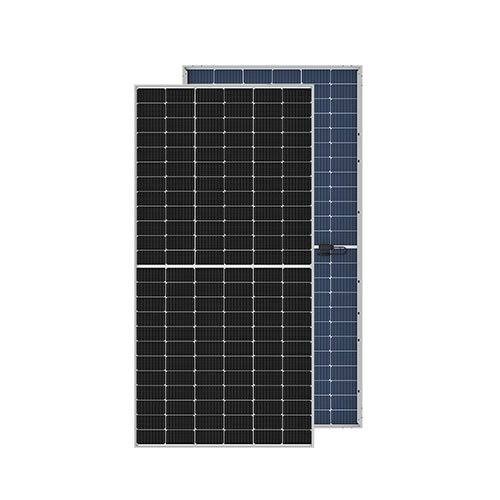
Here are the newest datasheet numbers I could verify. Treat them as the “paper” comparison. Your quote’s exact model may differ.
| Feature | LONGi (Hi-MO 9, Hi-MO X10) | Jinko (Tiger Neo 3.0) |
|---|---|---|
| Cell technology | HPBC 2.0 back-contact | N-type TOPCon |
| Peak efficiency | Up to 24.8% (large-format), 25.2% on utility-scale Hi-MO 9 Prime | Up to 24.8% (large-format), about 24.3% on residential-size 48QL6 |
| Temperature coefficient | −0.26%/°C (X10, 9 Prime); older Hi-MO 9 lists −0.28%/°C | −0.26%/°C |
| Degradation | ≤1% year one, ≤0.35%/yr after | ~1% year one, 0.35%/yr after |
| Product warranty | 12 years (Hi-MO 9), 15 years (X10) | 12 to 25 years, depends on model |
| Power warranty | 30-year linear | 30-year linear |
| Bifaciality | 75 ± 5% (Hi-MO 9 Prime) | 85 ± 5% (bifacial Tiger Neo 3.0) |
| US assembly | Ohio, via Illuminate USA | Jacksonville, Florida |
| Price per watt | No reliable brand-specific US figure | No reliable brand-specific US figure |
Last verified: October 22, 2026. Specs vary by model, wattage, and market. Efficiency is measured at Standard Test Conditions and reported by manufacturers.
Yes, the price row says “no reliable figure.” Many pages online quote brand prices from different years and different models, and they contradict each other. Honest beats tidy here.
Who Are LONGi and Jinko?
Both are Chinese giants, and both sell hard in the US market. Industry reporting on H1 2026 shipments puts them neck and neck near 30 GW each.
Why should you care about size? Because a warranty is only as good as the company behind it. A 25-year promise from a company that vanishes in year six is a very expensive piece of paper. Neither of these two looks likely to disappear.
One caveat. Size does not make claims easy. In the US, you usually deal with your installer or distributor first. Ask who handles a claim before you buy.
TOPCon vs Back-Contact: What’s Actually Different?
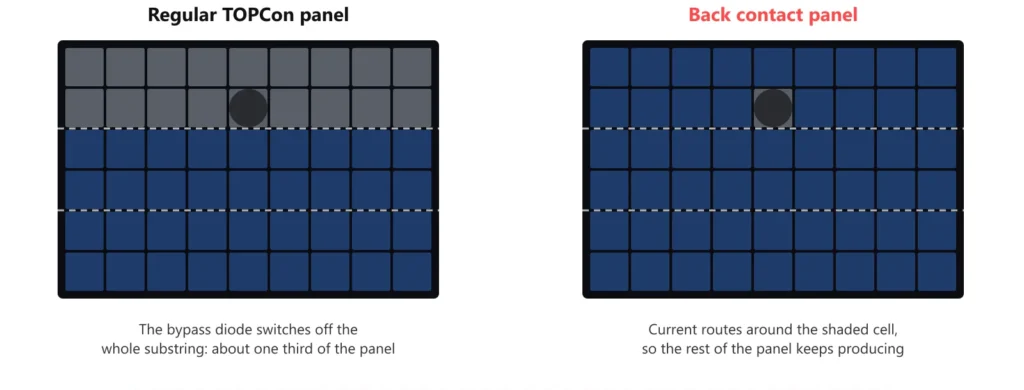
Think of a solar cell like a window. On a TOPCon cell, thin metal lines run across the front to carry the current. On a back-contact cell, all those lines move to the back. The front stays clear.
Jinko’s Tiger Neo uses TOPCon. LONGi’s Hi-MO 9 and X10 use HPBC 2.0, a back-contact design.
So what changes for you?
- Look: Back-contact panels have no visible grid lines. They look more uniform from the street.
- Shade: LONGi says its bypass-diode layout reroutes current around shaded areas, cutting power loss by over 70% versus traditional TOPCon. That is a manufacturer claim.
- Low light: Jinko claims its Tiger Neo 3.0 yields roughly 10% to 20% more than back-contact panels in low light, such as 200 W/m². That is also a manufacturer claim.
Notice the two claims point in opposite directions. Both companies are marking their own homework.
What does not change much? On a clean, unshaded roof, the gap between these technologies is small. Your roof angle, inverter, and installer quality matter more than cell type.
Efficiency and Real-World Output
Efficiency tells you how much sunlight a panel turns into power per square foot. Higher is better when your roof is small.
At the flagship level, they tie. LONGi’s Hi-MO X10 reaches up to 24.8%. Jinko’s Tiger Neo 3.0 also reaches up to 24.8%. The catch: these are large-format panels, about 2.4 meters long, which suit commercial roofs better than homes. Jinko’s residential-size 48QL6 tops out near 24.3%. Match your quote’s exact model to its datasheet.
Why do websites disagree on numbers? Three reasons:
- They compare different models.
- They use old datasheets.
- They mix up lab efficiency with measured output.
Lab efficiency comes from Standard Test Conditions: 1,000 W/m² of sun at 25 °C. Real roofs rarely hit those conditions. Heat, wiring, and inverter losses all take a bite.
Here is what both brands promise over time. This is arithmetic from the shared datasheet figures: about 1% loss in year one, then 0.35% per year.
| Year | Guaranteed minimum output |
|---|---|
| 1 | about 99% |
| 10 | about 95.9% |
| 25 | about 90.6% |
| 30 | about 88.85% |
The year-30 number matches the 88.85% floor in both brands’ published guarantees. These are minimums, not predictions. Panels often beat them.
Heat, Shade and Climate Performance
Heat steals power. The temperature coefficient tells you how much per degree.
Both newest datasheets say −0.26%/°C. Here is a quick example, labeled as arithmetic. If a cell runs 35 °C above the 25 °C test condition, a −0.26%/°C panel loses about 9.1% of its rated power. Same math, same result, either brand.
Watch the model year, though. The earlier Hi-MO 9 launch listed −0.28%/°C. A small gap, but it shows why you check the model on your quote.
For humid, dusty, or coastal areas, web pages contradict each other. Some say LONGi handles heat better, others say Jinko does. Without independent test data, treat those claims as opinion. Look for third-party reliability results instead, like the PV Module Reliability Scorecard, and check the latest edition for the model you are buying.
Shade is the one place the technology gap could matter. If a chimney or tree hits your roof for part of the day, ask your installer for a shade analysis and independent data on the exact panel, not just a brochure.
Price and Payback: LONGi vs Jinko
First, the bad news for anyone shopping soon. New Section 232 measures take effect December 4, 2026, including a 15% duty and a $0.38/watt minimum import price for solar modules. Anza reports the median imported module price moved from $0.27/W to $0.38/W for deliveries after that date, a jump of more than 40%. Those are brand-neutral market figures, not LONGi or Jinko quotes. Cells are covered too, with their own $0.22/W floor.
Want to see how this plays out for one specific model? Our breakdown of the LONGi 585W solar panel price in the USA walks through current per-watt ranges and the tariff timeline.
Now the money logic. When two panels list the same temperature coefficient and the same degradation, the output gap shrinks. Price differences between quotes often matter more.
An example, clearly labeled as one. Say one quote costs $0.05/W more on panels for a 10 kW system. That is a $500 difference on that line item. Now say the pricier panel makes 1% more power on a system producing 12,000 kWh a year. That is 120 kWh, or about $24 a year at an example rate of 20 cents per kWh. Do the math with your own numbers, and ask whether the premium buys something real.
One more thing on incentives. Federal action in 2026 changed the credit picture for businesses. For homeowners buying outright, the 25D residential credit ended for expenditures after December 31, 2025, under the 2025 federal budget law. If you lease or use a power purchase agreement, ask the provider how credits apply to them.
Warranty: What It Really Covers
Two warranties hide in every datasheet, and people mix them up.
- Product warranty: covers defects in materials and workmanship.
- Performance warranty: guarantees minimum output over time.
On performance, they tie at 30 years linear. On product warranty, it depends on the model. LONGi’s X10 lists 15 years. Jinko’s large-format Tiger Neo 3.0 lists 12 years. Its residential all-black version lists 25 years. So “Jinko has the longer warranty” is true for some models and false for others. Check the model.
Then read the fine print on labor. Many manufacturer warranties cover a replacement panel but not the cost of taking one off your roof and installing another. Ask your installer in writing who pays for that, and for how long their own workmanship warranty runs.
Finally, ask who processes the claim. In practice, that is usually your installer or distributor. Pick one you expect to still be in business in 2040.
Reliability, Bankability and Independent Tests
You will see the phrase “Tier 1” a lot. It is a banking label, not a quality guarantee. It means lenders consider the manufacturer financially safe to fund projects with. Both brands are widely treated as Tier 1. It is a good sign. It is not a promise your panel will behave.
For real reliability, look at independent testing, such as the PV Module Reliability Scorecard, and check results for the specific product family you are buying. Results change by model and year, so use the latest edition.
You can also look at installer feedback, with caution. A 2026 Australian installer survey found installers who rated both brands scored LONGi higher. That is one market and one survey. Treat it as a data point, not a verdict for US roofs.
Which One Should You Buy? (By Situation)
- Partly shaded or small roof, or you want a sleek look. Lean LONGi. The back-contact design is built for this, though the shade claim comes from the manufacturer. Ask for independent data and a shade analysis.
- Tight budget. Buy whichever written quote is lower for the same wattage, warranty, and installer scope. Online claims that “Jinko is cheaper” or “LONGi is cheaper” cancel each other out.
- Hot or humid climate. Call it a tie on paper (−0.26%/°C on both). Then choose by installer track record and independent test results.
- Large rooftop or ground mount. Jinko’s higher bifaciality (85 ± 5% vs 75 ± 5% on LONGi’s Hi-MO 9 Prime) can help where light reflects off the ground behind the panel. On a typical home roof, bifaciality matters little.
- After-sales support matters most. Choose the brand your installer has installed many times and will back with its own warranty. A great panel with a bad installer is a bad system.
Where Each Brand Falls Short
LONGi:
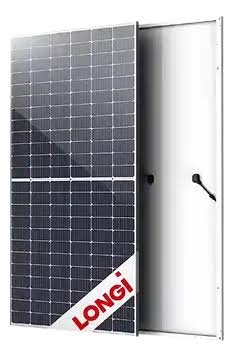
- Datasheet product warranties are shorter on the models I reviewed (12 to 15 years).
- Its biggest shade and performance claims come from the company, not independent testers.
- Not every Hi-MO model is sold in the US. Confirm availability with your distributor.
Jinko:
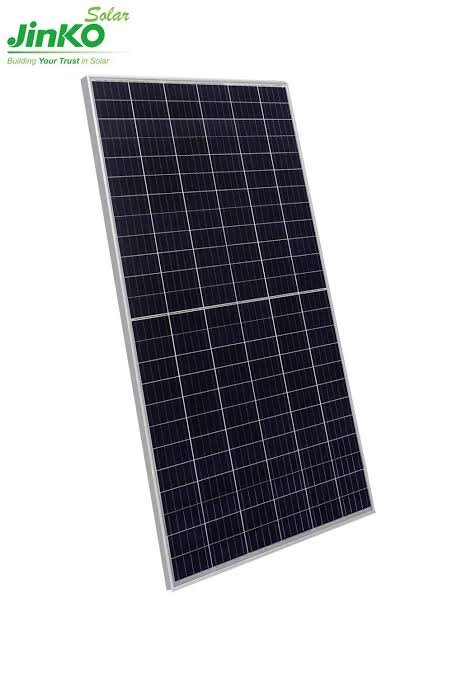
- Product warranty length swings by model (12 to 25 years), so a “25-year warranty” headline needs checking against your exact model.
- Its low-light advantage over back-contact panels is also a company claim.
- Jinko’s first-quarter 2026 module shipments fell about 22% year over year, which the company tied partly to tariffs. That is not a quality problem, but it shows how trade policy shakes supply.
Neither flaw disqualifies either brand. Both flaws mean you should read the datasheet like a contract.
Availability and Support in Your Region
For US buyers, supply comes in two flavors: imported or US-assembled.
- Jinko: Its Jacksonville, Florida plant went through a $52 million expansion last year and now produces about a gigawatt a year.
- LONGi: Illuminate USA, in Pataskala, Ohio, started commercial production in February 2024 and is configured for roughly 5 GW a year. Invenergy is the majority owner and anchor customer.
“US-assembled” is not the same as “no tariff exposure.” The new rules cover cells as well as modules, so ask whether the cells inside a US-assembled panel are imported.
Also, which models land in the US changes over time. Distributors know what is in stock. Ask for the exact model code before you compare anything.
7 Questions to Ask Your Installer Before You Sign
- What is the exact model number and wattage on this quote?
- Is this panel assembled in the US, and where were the cells made?
- What is the product warranty length for this model, in writing?
- Who pays for removal and reinstallation if a panel fails?
- Who handles warranty claims, and how long does a typical claim take?
- How does this panel pair with the inverter you are proposing?
- Is the price locked, and does it change if delivery slips past December 4?
Take this list to every quote. If an installer dodges more than one question, that tells you something too.
FAQs
Which lasts longer?
Neither can prove a longer life yet. Both guarantee at least 88.85% of rated power at year 30. Actual lifespan depends on installation quality, climate, and the specific model, so use independent testing and installer track record to judge.
Are LONGi and Jinko Tier 1?
Both are widely treated as Tier 1, a bankability label used by lenders. It tells you the company is financially strong. It does not guarantee panel quality, so also look at independent reliability tests.
Which has the better warranty?
It depends on the model. Both list 30-year linear power warranties. Product warranties range from 12 to 25 years on Jinko models and 12 to 15 years on the LONGi models reviewed. Read the datasheet for your exact model.
Which is cheaper, LONGi or Jinko?
There is no reliable brand-specific US price figure right now. Market data shows imported modules moving from $0.27/W to $0.38/W after December 4, whatever the brand. Compare written quotes for the same wattage, warranty, and installer scope. That is the only comparison that counts.
Is LONGi better than Jinko?
Not across the board. On current flagship datasheets they tie on temperature coefficient, degradation, and power warranty. LONGi leans toward shade tolerance and looks. Jinko leans toward bifacial gain and, on some models, longer product warranties. Your quote and installer decide the rest.
Summary
Pick LONGi if shade or looks drive your decision. Pick Jinko if a lower quote or a ground-mount setup matters more. If everything else matches, take the better warranty paper and the installer you trust. When two panels tie on paper, the contract is the tiebreaker.
Sources and Last Updated
- Manufacturer datasheets and launch coverage for LONGi Hi-MO 9, Hi-MO 9 Prime, and Hi-MO X10 (as published by LONGi and trade press including pv magazine and TaiyangNews)
- Manufacturer datasheets and launch coverage for Jinko Tiger Neo 3.0 (pv magazine and distributor-published datasheets)
- Anza, market pricing for imported solar modules, September 2026
- Section 232 Proclamation 11052 (August 6, 2026), as summarized in law-firm and customs-advisory trade notices
- Illuminate USA and trade-press reporting on the Ohio plant
- Industry press reporting on JinkoSolar’s Q1 2026 results and Florida plant expansion
- Industry shipment reporting for H1 2026
- Solar Energy Industries Association, summary of the 2025 federal budget law’s clean energy provisions
- 2026 Australian installer survey (one market only)