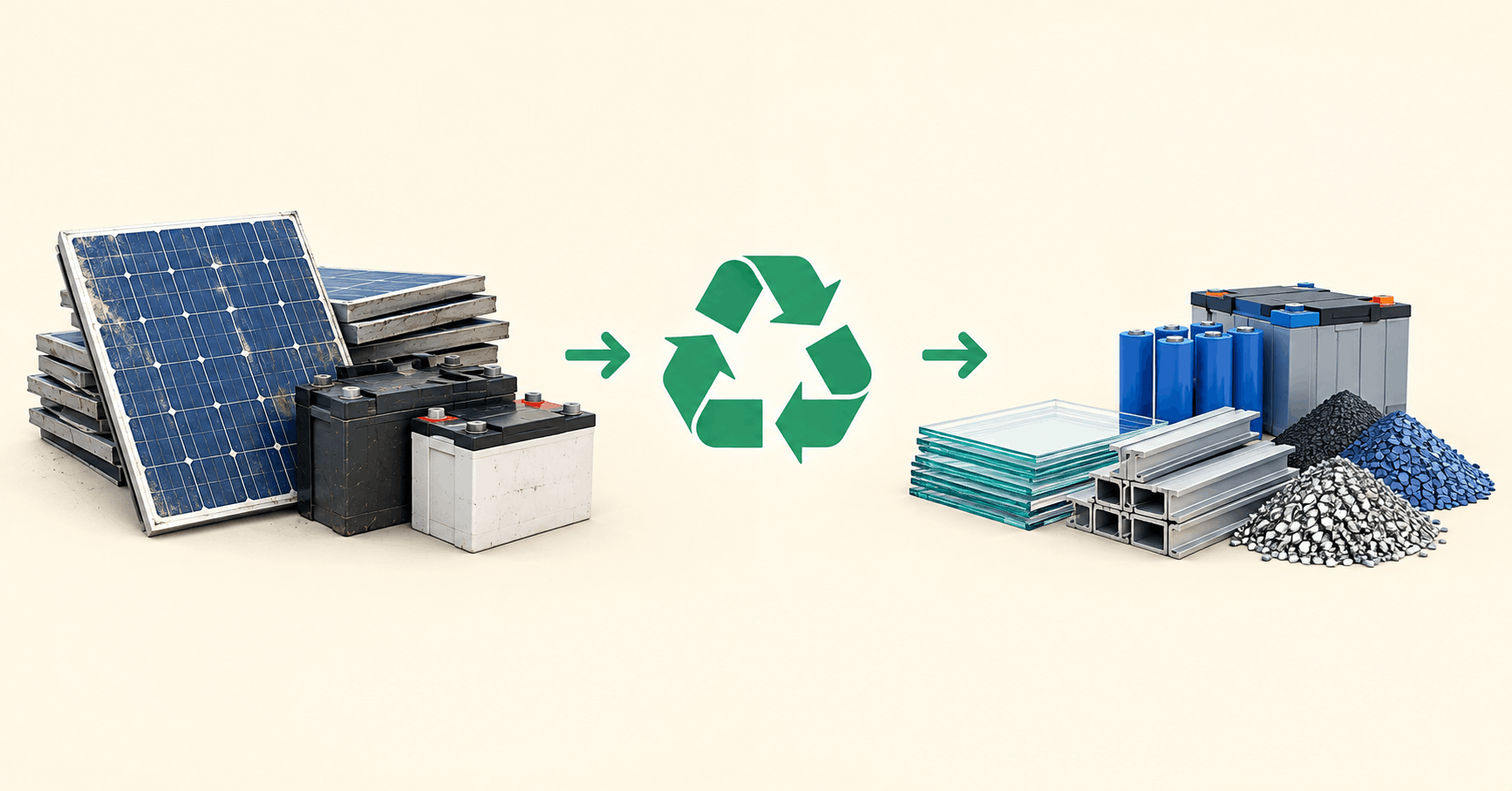
Quick Answer; Solar panels are recycled by separating their glass, aluminum frame, and silicon cells for reuse, usually through a manufacturer take-back program or a certified recycler, while batteries, especially lithium-ion, must be dropped off separately at free retail collection points like The Battery Network (Home Depot, Lowe’s, Best Buy) rather than trashed.
Table of Contents
Myth: Once a solar panel dies, it’s basically e-waste with no future. Straight to the landfill.
Reality: A dead solar panel is closer to 95% recoverable material. Glass, aluminum, copper, silver, even the silicon, almost all of it can come back as something else. The industry just hasn’t built enough recycling infrastructure yet to catch up with demand.
That gap between “recyclable” and “actually recycled” is the whole story here. Let’s walk through it properly.
Key Takeaways
- Solar panels are not garbage, but in most U.S. states they’re also not automatically treated as hazardous waste, the rules depend on where you live.
- Panels and batteries are recycled through completely different processes. Don’t treat them the same.
- California has a specific law (SB 489) that classifies dead panels as “universal waste”, a real legal category, not a marketing term.
- Small consumer solar products (garden lights, solar lanterns, small panel kits) follow different, simpler disposal rules than a rooftop system.
- Free recycling exists for most batteries. Panel recycling usually isn’t free, yet.
Are Solar Panels Actually Hazardous Waste?
It depends on where you live, and this trips up a lot of people.
Under U.S. federal rules, the Environmental Protection Agency notes that solar panels can contain materials such as tin, tellurium, antimony, and gallium or indium in some thin-film modules, some of which can trigger hazardous waste classification depending on test results. But there’s no single nationwide law that treats every panel the same way.
California went further. In 2015, the state passed SB 489, which lets the Department of Toxic Substances Control (DTSC) classify end-of-life panels as “universal waste.” That’s a real legal category, the same one used for things like old fluorescent bulbs and certain batteries. It’s not full trash, and it’s not full hazardous waste. It’s a middle tier with its own rules.
Under California’s finalized regulations (effective January 1, 2021), universal waste panels:
- Can’t be thrown in regular trash or a standard landfill
- Must go to a DTSC-authorized destination facility, not just any recycler
- Come with real penalties for violations, up to $70,000 per day, per the Hazardous Waste Control Law
Most other states don’t have anything this specific yet. That’s actually a big part of why solar recycling infrastructure is still catching up nationally, the rules are inconsistent, so the market hasn’t scaled evenly.
What’s Actually Inside a Solar Panel
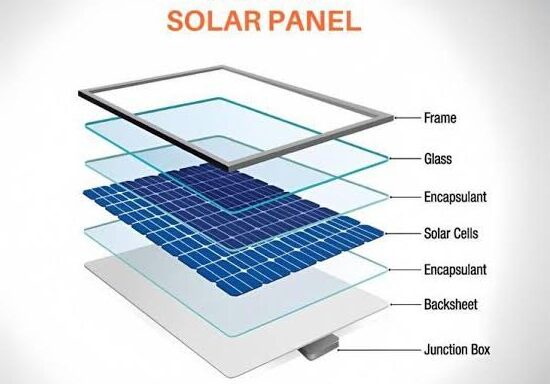
You can’t recycle “a solar panel” as one object. It has to be broken into its materials first. A typical crystalline silicon panel, the most common type on the market, breaks down roughly like this:
| Material | Share of Panel Weight | Recyclable? |
|---|---|---|
| Glass | ~75–76% | Yes, easily |
| Polymer/plastic backsheet | ~10% | Partially |
| Aluminum frame | ~8% | Yes, easily |
| Silicon cells | ~5% | Yes, but harder |
| Copper wiring | ~1% | Yes, easily |
| Silver and other metals | <0.1% | Yes, high value |
(Figures based on component breakdowns from dedicated European solar recycling facility operations and EPA materials data.)
The glass and aluminum are the easy part, recyclers already know how to process those at scale. The silicon cells and trace metals are where it gets technical, because separating them without damaging their value takes more specialized equipment.
How Solar Panel Recycling Actually Works
Here’s the real, physical process, not the marketing version.
- Frame and junction box removal. The aluminum frame is unscrewed or pried off. The junction box (the little plastic housing where wires connect) and cables are detached.
- Glass separation. The panel goes through mechanical or thermal separation to lift the glass layer off the silicon cells underneath.
- Silicon and metal recovery. Remaining materials go through chemical or electrical processes to pull out silver, copper, and purified silicon.
- Sorting and shipment. Each recovered material is baled or crated and shipped to manufacturers who reuse it, glass often goes back into new glass products, metals back into new panels or other electronics.
Some newer facilities can process a panel in under two minutes per unit. Others still do it in slower batches. The technology exists; the scale is what’s still developing.
How Solar Battery Recycling Works (It’s Not the Same Process)
This is where a lot of guides get sloppy, they lump batteries in with panels. Don’t do that. Batteries are a different material problem entirely.
Lithium-ion batteries (the type in most home solar storage systems) go through:
- Discharge (draining remaining power safely, this step matters, because a charged lithium battery is a fire risk if crushed)
- Disassembly into cells
- Shredding
- Chemical or mechanical separation to recover lithium, cobalt, nickel, and copper
Lead-acid batteries (older or backup systems) are recycled through a more mature, decades-old process: the lead is smelted and reused, the plastic casing is melted down, and the acid is neutralized or reprocessed.
Never throw a lithium-ion battery in household trash or a standard curbside recycling bin. Damaged or swollen batteries specifically need specialty handling, dropping one in a regular bin has caused real waste-facility fires.
What About Small Solar Products? (Garden Lights, Lanterns, Small Kits)
This is the part most guides skip completely, and it’s probably closer to your actual situation if you’ve got a dead solar garden light rather than a rooftop system.
Small consumer solar products are usually made of three separable parts:
- A small solar panel (glass/plastic + a tiny silicon cell)
- A small rechargeable battery (almost always lithium-ion or NiMH)
- A plastic or metal housing
The good news: you can usually take these apart yourself with basic tools. Once separated:
- The battery goes to a battery-specific drop-off (see below), never in the trash
- The plastic/metal housing goes in standard recycling if your local program accepts those materials
- The small panel is trickier, most curbside programs don’t take it, so check with a local e-waste or electronics recycler
If you’ve got a handful of these lying around, some local recycling centers offer discounted rates for bulk drop-offs, which is worth asking about before assuming it’s not worth the trip.
California’s Universal Waste Law, in Plain English
Since this is the most developed state-level regulation in the country right now, it’s worth understanding even if you don’t live there, other states often follow California’s lead eventually.
Under SB 489 and the finalized DTSC regulations:
- The handler, meaning the installer, contractor, or system owner who takes the panel out of service — is the responsible party, not the manufacturer
- Anyone generating more than 5,000 kg of panel waste per year has to notify DTSC and get an ID number
- Shipment records must be kept for 3 years
- Panels must go to an authorized destination facility, not just a general scrap yard
This is different from states with “extended producer responsibility” models, where manufacturers fund the takeback instead of the installer or owner.
Where to Actually Recycle Solar Panels and Batteries
| Option | Best For | Cost | Notes |
|---|---|---|---|
| Manufacturer take-back program | Rooftop panels from brands with a program | Varies, sometimes free | Some manufacturers partner directly with recyclers for their own panels |
| DTSC-authorized facility (CA only) | California residents/installers | Paid | Legally required destination for universal waste panels in CA |
| Specialty solar recyclers | Large batches, decommissioned systems | Paid, often quote-based | Handle full material recovery including silicon and metals |
| Retail battery drop-off (Home Depot, Lowe’s, Best Buy via The Battery Network / Call2Recycle) | Rechargeable batteries under 11 lbs | Free | The most accessible option for most households |
| Local e-waste/household hazardous waste event | Small panels, small electronics, damaged batteries | Usually free | Check your city or county’s schedule |
For batteries specifically: The Battery Network (formerly known as Call2Recycle) runs free drop-off collection at major retailers for lithium-ion, nickel-cadmium, nickel-metal hydride, and small sealed lead-acid batteries under 11 pounds. Damaged or swollen batteries need their specialty handling kits instead of a standard drop-off bin.
Is Solar Recycling Free?
Batteries: usually yes, for standard household-sized rechargeable batteries through retail drop-off programs.
Panels: usually no. Full-scale panel recycling involves real processing costs, and unless a manufacturer take-back program covers it, expect to pay a fee — especially for a single panel rather than a bulk shipment. Bulk or community collection drives tend to bring the per-unit cost down significantly.
Step-by-Step Checklist
- Figure out what you actually have, a full rooftop system, a home battery, or a small consumer product like a garden light.
- Check if your state has specific rules (California residents: this is mandatory, not optional).
- For batteries: locate a nearby retail drop-off through The Battery Network’s locator.
- For panels: contact the manufacturer first to check for a take-back program before paying a third party.
- For small products: disassemble what you safely can and route the battery and housing separately.
- Keep any shipment or drop-off receipts if you’re a business or installer, California requires 3-year record retention for universal waste.
Quick Glossary
- Universal waste, A regulatory middle category between regular trash and full hazardous waste, used in states like California for end-of-life solar panels.
- TCLP test, Toxicity Characteristic Leaching Procedure; the lab test used to determine if a panel legally counts as hazardous waste.
- EVA encapsulant, The plastic layer that seals and protects the silicon cells inside a panel.
- Destination facility, A DTSC-authorized site legally allowed to receive universal waste panels in California.
- Extended producer responsibility (EPR), A regulatory model where manufacturers, not owners, are financially responsible for recycling their products.
Sources
- U.S. EPA, Solar Panel Recycling
- California DTSC, Photovoltaic Modules Universal Waste Management Regulations
- California Legislative Information, SB 489 Bill Text
- The Battery Network (formerly Call2Recycle), call2recycle.org
- New York State Department of Health, Lithium-Ion Battery Disposal Guidance


![Best Solar Lights at Walmart & Home Depot [2026]](https://storyofsolar.com/wp-content/uploads/2026/09/Best-Solar-Lights-at-Walmart-Home-Depot-2026.jpg)

![Solar Light Waterproof Rating Chart [IP Guide]](https://storyofsolar.com/wp-content/uploads/2026/09/Solar-Light-Waterproof-Rating-Chart-IP-Guide.jpg)