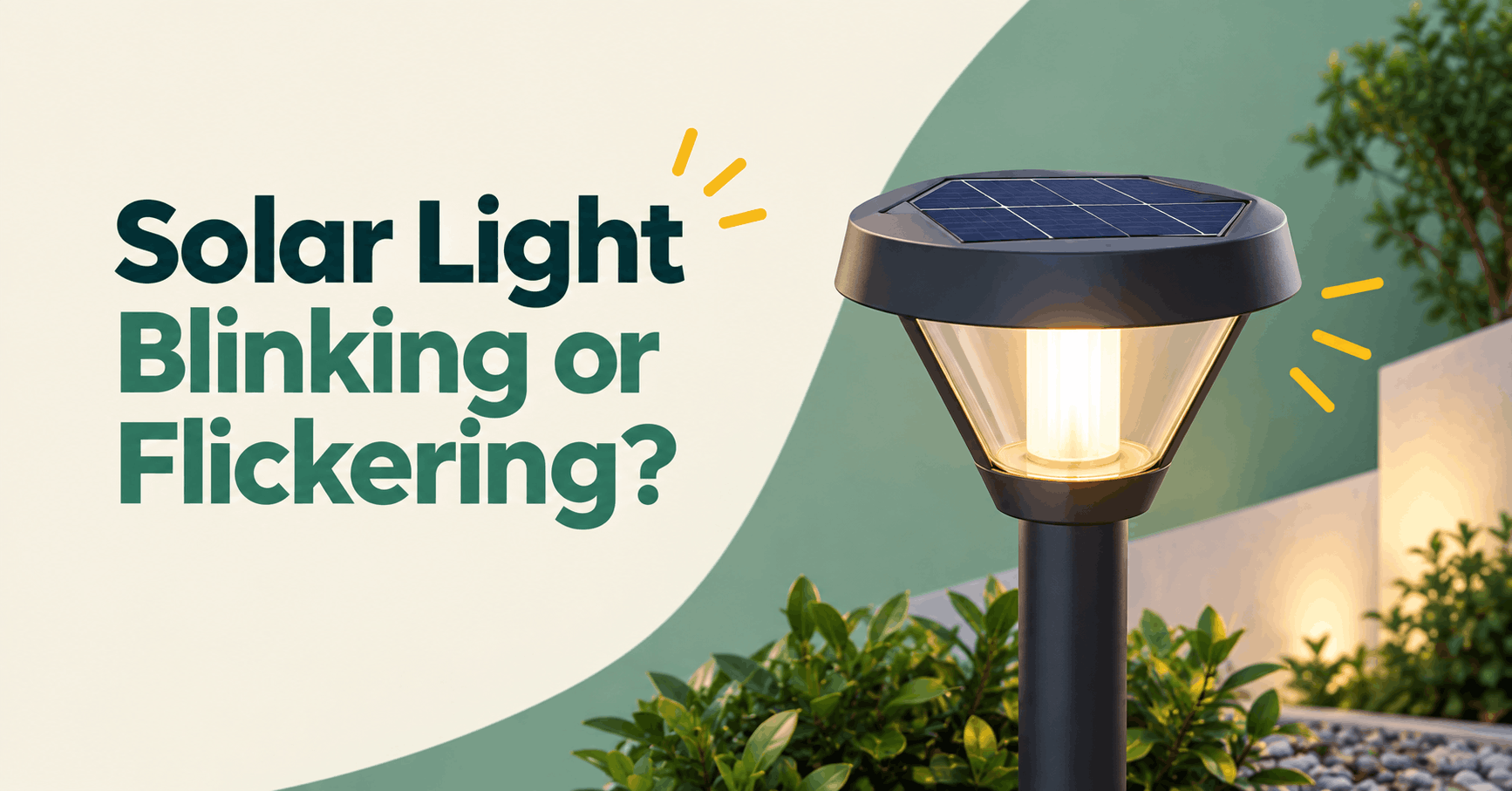
Quick Answer: A solar light blinks or flickers when it isn’t getting steady power, usually from a weak battery, a dirty solar panel, or a confused dusk sensor.
Table of Contents
Most people assume a blinking solar light means it’s dying. Sometimes that’s true. But in a lot of cases, the light isn’t broken at all — it’s just doing exactly what a weak battery tells it to do, or it’s confusing itself with its own glow. Once you know which one you’re dealing with, the fix usually takes five minutes and zero tools.
Here’s the short version: solar lights blink or flicker mainly because of a weak or aging battery, a dirty solar panel, a confused dusk sensor, corroded contacts, or water damage. Below, we break down each cause, how to confirm it, and exactly how to fix it, no guesswork.
Key Takeaways
- Blinking is almost always a power delivery problem, not an LED problem.
- A weak battery is the most common cause, by a wide margin.
- Some flickering is caused by the light’s own sensor reacting to its own glow, a feedback loop, not a defect.
- Basic decorative garden lights don’t have a “healthy blink code”, for these, blinking signals a problem to fix, not a status update.
- Most fixes cost nothing and take under 10 minutes.
Why Is My Solar Light Blinking? (7 Real Causes)

1. Weak or Aging Battery
This is the number one cause, and it’s not close.
Solar garden lights typically run on one of three battery types, NiMH, standard Li-ion, or LiFePO4, and each has a different real-world lifespan. NiMH cells, the most common type in budget garden lights, are usually rated for 500 to 1,000 full charge cycles before their capacity drops below 80%. At one charge cycle a day, that works out to roughly 1.5 to 2.7 years before you’ll notice a real decline in performance.
Lithium-based batteries hold up longer. Higher-quality Li-ion cells can reach 1,500–2,000 cycles, and LiFePO4, increasingly used in better-quality solar lights, can handle 2,000 to 4,000 cycles, translating to roughly 5–10 years of service. Lithium chemistries also tolerate cold far better: they hold usable capacity down to around -20°C, while NiMH batteries lose a significant chunk of their capacity below freezing and can struggle to charge at all in winter.
When a battery weakens, it can’t push enough steady voltage to the LED. The light flickers because it’s running out of “oomph,” not because the LED itself is faulty.
2. Dirty or Obstructed Solar Panel
A solar panel covered in dust, pollen, leaves, or bird droppings collects less sunlight during the day. Less charge in means less charge out at night, and an undercharged battery produces exactly the same flickering symptoms described above. Over time, the plastic cover on cheaper panels can also degrade and cloud from UV exposure, further cutting how much light actually reaches the cell.
This is often mistaken for a “battery problem” when it’s really an input problem, the battery never gets enough charge to run cleanly through the night.
3. Confused Dusk-to-Dawn Sensor (Photocell)
This cause surprises most people, so it’s worth explaining properly.
A solar light’s on/off sensor, called a photocell, works on a simple principle: it reads ambient light through a component that changes electrical resistance based on brightness. That reading feeds into a small circuit, often a voltage divider, and when the voltage crosses a certain threshold, the circuit switches the LED on or off.
Here’s the catch: if the sensor can “see” light coming from the fixture’s own LED, because of reflection, poor housing design, or a scratched lens, it reads that light as “it’s getting bright out” and switches itself off. Then, with the LED off, it senses darkness again and switches back on. This repeats rapidly, which shows up as flickering, sometimes fast enough to look like strobing.
This is a placement and design issue as much as a hardware fault, and it’s one of the most overlooked causes in most troubleshooting guides.
4. Loose or Corroded Wiring/Contacts
Solar lights live outside permanently, which means their internal contacts are constantly exposed to humidity and temperature swings. Battery terminals, sensor wires, and switch contacts can corrode over months or years, creating an intermittent connection. An intermittent connection doesn’t fail completely, it just cuts in and out, which looks exactly like flickering.
5. Water Ingress Beyond the Light’s Rating
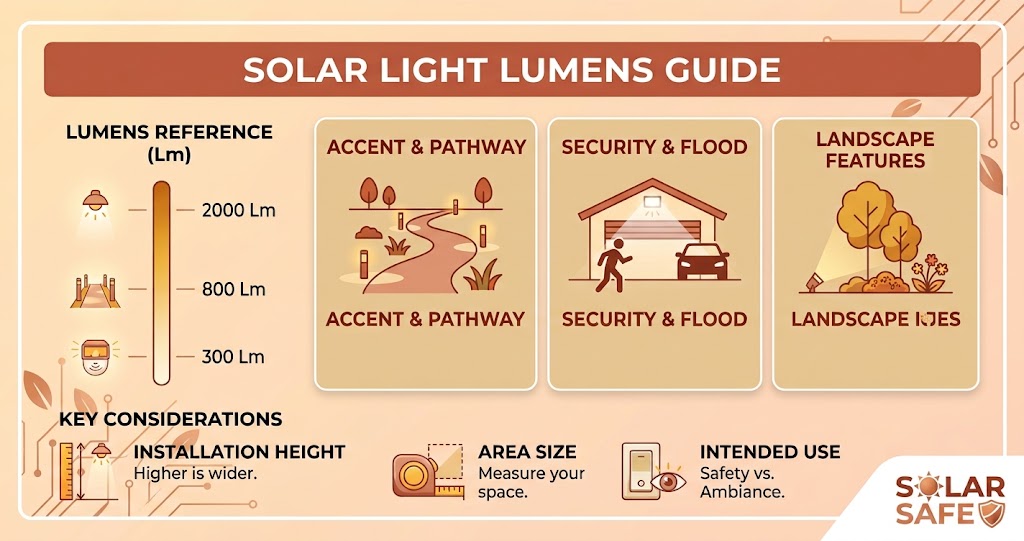
Every outdoor solar light carries an IP (Ingress Protection) rating, and the number matters more than most buyers realize:
- IP44: protected against splashing water only. Fine under a covered porch, not fine in open rain.
- IP65: dust-tight and rated for low-pressure water jets from any direction. This is the realistic minimum for garden or pathway lights left out in rain.
- IP67: rated for temporary immersion (roughly up to 1 meter for about 30 minutes), useful for low-lying areas that pool water after heavy rain.
If a light rated IP44 is installed somewhere it gets rained on directly, or planted in soil where water pools around the base, moisture will eventually reach the circuit board or battery compartment. Once that happens, you’ll usually see flickering before you see total failure — it’s often the first visible symptom of internal corrosion.
6. Faulty or Sticky On/Off Switch
Cheaper solar lights use a basic mechanical switch to enable charging and operation. If that switch is low quality, wired slightly off, or has become “sticky” from dirt or corrosion, it can create the same kind of on-off-on cycling as a loose wire. This is usually fixable in under a minute by popping the switch cover and toggling it a few times, or cleaning the contacts.
7. The Light Has Simply Reached End of Life
Solar garden lights, as a complete product, typically last anywhere from 2 to 15 years depending on battery chemistry, build quality, and climate exposure. The LED itself almost never fails first, LED chips in these lights run at very low power (often 0.5–3 watts) and are rated for tens of thousands of hours, so thermal wear on the LED is minimal. It’s nearly always the battery, panel coating, or seals that degrade first. If a light is several years old and has already had a battery replacement, persistent flickering may simply mean it’s at the end of its practical service life.
How to Fix Each Cause (Step-by-Step)
| Cause | How to Confirm | Fix | Difficulty |
|---|---|---|---|
| Weak battery | Light dims/flickers late in the night, worse in winter | Replace with same voltage/chemistry (NiMH, Li-ion, or LiFePO4) | Easy |
| Dirty panel | Panel looks dusty, hazy, or shaded part of the day | Wipe panel with a damp cloth; relocate if shaded | Easy |
| Confused sensor | Flickering mainly right at dusk, stops once fully dark | Clean sensor lens; reposition light so LED doesn’t reflect onto sensor | Easy–Medium |
| Corroded contacts | Flicker gets worse when nudged or during humid weather | Remove battery, clean terminals with a dry cloth or fine sandpaper | Medium |
| Water ingress | Flickering after rain or watering; visible moisture inside | Dry unit fully, reseal or replace gasket, consider a higher IP-rated replacement | Medium |
| Faulty switch | Flicker changes when you tap or move the housing | Toggle switch several times; clean or replace it | Easy |
| End of lifespan | Multiple fixes tried, light is several years old | Replace the unit | N/A |
Quick fix walkthroughs
Replacing the battery: Match the exact voltage and chemistry printed on the old battery, swapping NiMH for a random lithium cell (or vice versa) can damage the circuit. Most garden lights use standard AA or AAA-sized rechargeable cells, making this a same-day fix.
Cleaning the panel: Use a soft, damp cloth, no soap or abrasive cleaners, which can scratch the protective coating and reduce light absorption over time.
Fixing sensor confusion: Reposition the light so its own LED cannot shine back onto the sensor lens, and make sure nearby reflective surfaces (white walls, glass, mirrors) aren’t bouncing light back at it either.
Cleaning corroded contacts: Remove the battery, and gently clean visible corrosion (often a white or greenish crust) with a dry cloth or fine sandpaper before reinserting a fresh battery.
Do Fairy Lights, Pathway Lights, and Flame-Effect Lights Fail Differently?
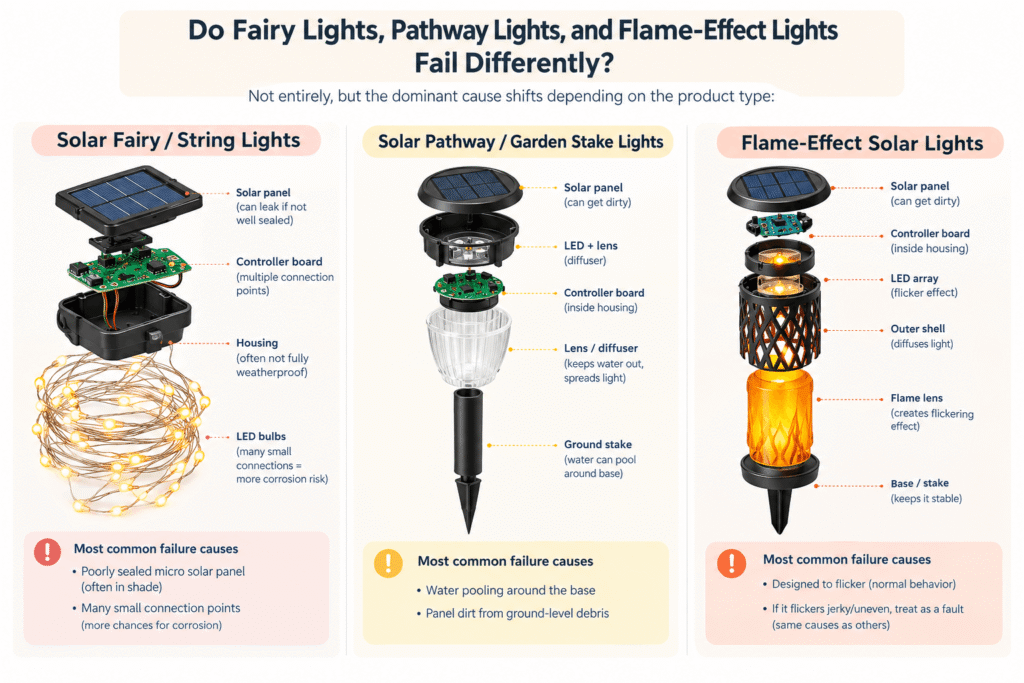
Not entirely, but the dominant cause shifts depending on the product type:
- Solar fairy/string lights, often flicker due to a poorly sealed micro solar panel sitting in shade (they’re frequently strung under trees or eaves), and due to their many small connection points, which multiply the odds of one corroded joint.
- Solar pathway/garden stake lights, most often affected by water pooling around the base if planted in soil that holds moisture, plus panel dirt from ground-level dust and lawn debris.
- Flame-effect solar lights, designed to flicker on purpose to mimic a candle. If yours flickers in a jerky, uneven way that looks like a fault rather than a flame pattern, treat it as a real fault using the causes above — don’t assume it’s “just the effect.”
How to Stop It From Happening Again
- Clean solar panels every 4–6 weeks, more often near trees or in dusty areas.
- Bring lights indoors, or at least the battery, during extended freezing spells if they use NiMH batteries.
- Check IP ratings before buying, IP65 or higher for anything exposed to direct rain.
- Replace batteries proactively every 2–3 years for NiMH-based lights, rather than waiting for full failure.
- Keep the light’s own LED from facing directly into its sensor when installing.
When to Repair vs. Replace
| Situation | Recommendation |
|---|---|
| Light is under 2 years old, one clear cause found | Repair |
| Multiple fixes already tried, no improvement | Replace |
| Visible internal corrosion or cracked housing | Replace |
| Light is a low-cost unit and battery costs nearly as much as a new light | Replace |
FAQs
Why does my solar light only blink at night?
Because that’s when the battery is under the most load and any weakness, low charge, corrosion, a bad connection, becomes visible. During the day, the light isn’t drawing power, so problems stay hidden.
Can I fix a flickering solar light without buying a new battery?
Sometimes. If the cause is a dirty panel, a confused sensor, or a loose connection, cleaning or repositioning can solve it without any parts. If the battery itself has degraded, replacement is usually the only real fix.
Is a blinking solar light dangerous?
For low-voltage garden and pathway lights, no, there’s no meaningful fire or shock risk. The main things to watch for are battery leakage (rare, but avoid touching corrosion with bare hands) and general wear.
How long do solar light batteries actually last?
NiMH batteries typically last 1.5 to 3 years with regular use; better-quality lithium-ion cells often reach 3–5 years; LiFePO4 batteries can last 5–10 years. Cold climates shorten NiMH lifespan noticeably more than lithium.
Why do my solar fairy lights blink even with a brand-new battery?
Check the panel placement first. Fairy lights are frequently installed under trees, eaves, or fences, where they don’t get enough direct sun to charge properly, the symptom looks like a battery problem but is actually a charging problem.
Glossary
- Photocell (dusk sensor): A light-sensitive component that automatically switches the light on at dusk and off at dawn based on ambient brightness.
- NiMH (Nickel-Metal Hydride): A common rechargeable battery chemistry used in budget solar lights; moderate lifespan, weaker in cold weather.
- Li-ion (Lithium-ion): A rechargeable battery chemistry offering longer life and better cold-weather performance than NiMH.
- LiFePO4 (Lithium Iron Phosphate): A more durable lithium battery chemistry, common in higher-end solar lights, known for very long cycle life.
- IP Rating (Ingress Protection): A two-digit code indicating how well a device resists dust and water, e.g., IP65, IP67.
- Charge cycle: One full discharge-and-recharge of a battery; used to measure battery lifespan.
- Voltage divider: A simple circuit used in photocells to convert a light reading into a voltage signal that triggers the on/off switch.
Summary
Blinking or flickering solar lights are almost always a power or sensor issue, not a broken LED. Start with the battery and panel, they cause the vast majority of cases, then check the sensor, wiring, and seals if the problem continues. Most fixes take minutes and cost little to nothing, and knowing which cause you’re dealing with saves you from replacing a light that only needed a $3 battery.
![Best Solar Lights at Walmart & Home Depot [2026]](https://storyofsolar.com/wp-content/uploads/2026/09/Best-Solar-Lights-at-Walmart-Home-Depot-2026.jpg)

![Solar Light Waterproof Rating Chart [IP Guide]](https://storyofsolar.com/wp-content/uploads/2026/09/Solar-Light-Waterproof-Rating-Chart-IP-Guide.jpg)