Table of Contents
Full 2026 review of the Garmin Instinct 2 Solar Tactical, real battery numbers, current pricing, and an honest comparison to the Instinct 3. See if it’s still worth buying.
Here’s the short answer: yes, the Garmin Instinct 2 Solar Tactical is still worth buying in 2026, but only for a specific type of buyer, and only once you know what the newer Instinct 3 Tactical Edition changed.
That newer model matters. Garmin launched the Instinct 3,Tactical Edition in April 2025, and it didn’t just tweak the software. It added a flashlight, a smarter satellite system, and a noticeably brighter solar layer. So before you add the Instinct 2 Solar Tactical to your cart, you deserve a straight comparison, not a spec sheet copy-paste.
This review covers real battery behavior, what the tactical features actually do in the field, current 2026 pricing, and a head-to-head with the Instinct 3. No fluff, no recycled marketing lines.
Garmin Instinct 2 Solar Tactical, Full Review (2026 Update)
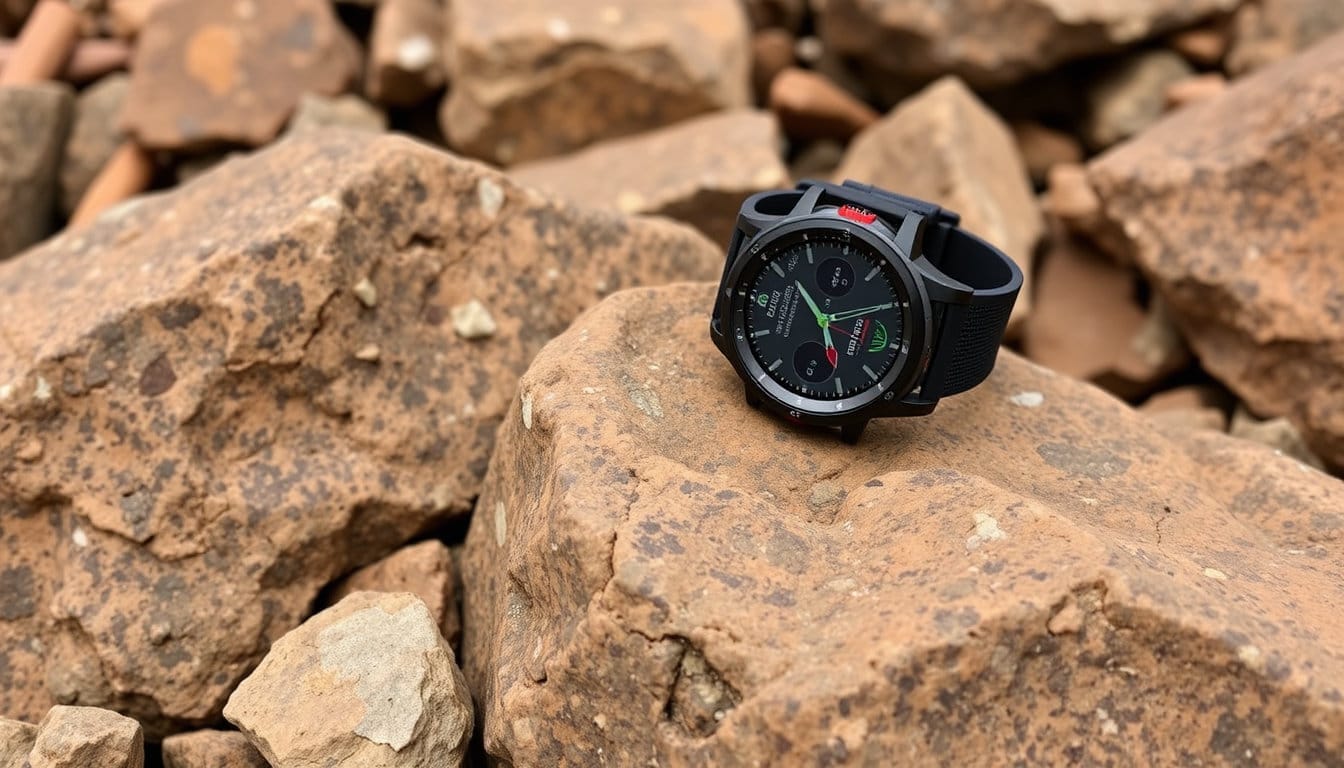
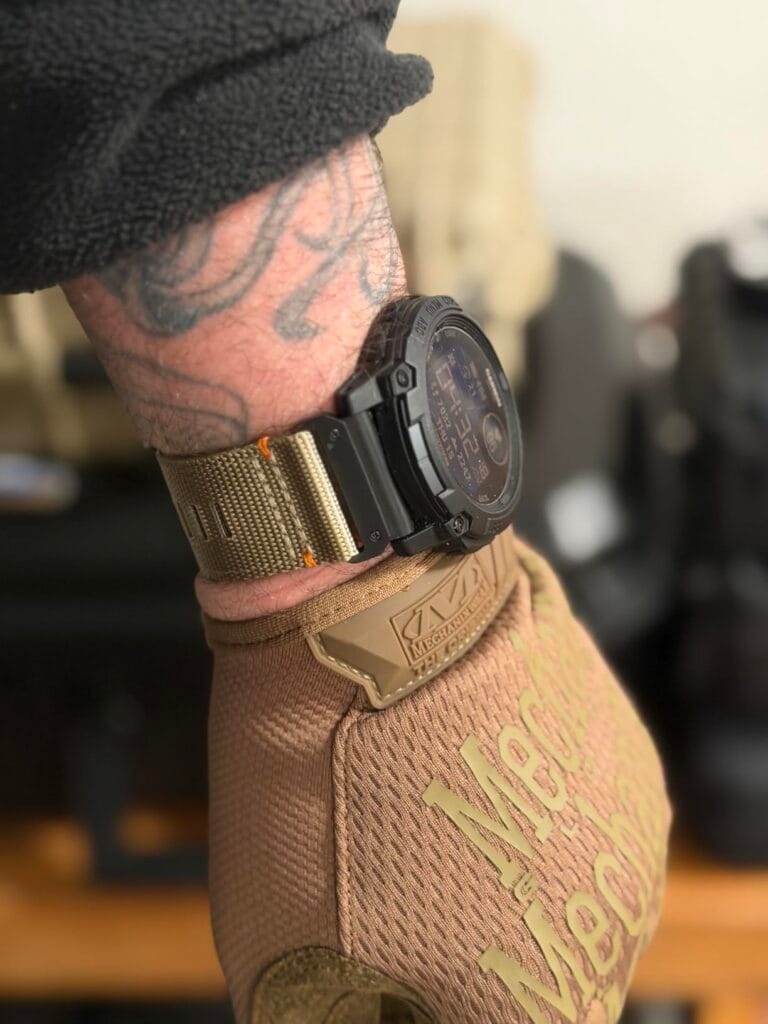
The Instinct 2 Solar Tactical Edition launched in February 2022 as the military-flavored sibling of Garmin’s rugged Instinct 2 line. It’s built for two crowds: people who genuinely need MIL-STD-810 durability and stealth features for work, and outdoor athletes who just want a watch that refuses to die.
It ships in one case size only, 45mm, and weighs 53 grams. If you were expecting a 50mm option here, that’s actually the Instinct 2X Solar Tactical, a separate watch with its own price tag and its own flashlight (more on that mix-up below).
The verdict, in one paragraph: this is still a genuinely tough, genuinely long-lasting GPS watch. It doesn’t do everything the Instinct 3 does, and it’s not dramatically cheaper anymore either. But if you don’t need the newest satellite tech or a built-in flashlight, it holds up well in 2026, especially if you find it discounted. We’ll unpack exactly how much “worth it” depends on price in a moment.
Garmin Instinct 2 Solar Tactical vs. Instinct 3: Should You Still Buy the 2 in 2026?
This is the question most people searching for this watch actually want answered. So let’s not dodge it.
Garmin announced the Instinct 3 lineup at CES in January 2025, and the Instinct 3 Tactical Edition followed on April 24, 2025, bringing military-specific features to the newer generation. It’s a real successor, not a minor refresh, so acknowledging it exists is step one of any honest 2026 review.
What the Instinct 3 actually adds
Garmin didn’t hold back on this update. Compared to the Instinct 2 Solar Tactical, the Instinct 3 Tactical Edition includes:
- SatIQ technology: multi-band GPS with SatIQ delivers more accurate positioning while also optimizing battery use, instead of relying on the older multi-GNSS setup.
- A brighter, more efficient solar layer: the 50mm Instinct 3 Tactical solar model gets more than five times the GPS-mode battery life of the Instinct 2 Solar when solar charging. That’s not a marketing rounding error; it’s a real jump.
- A standard built-in flashlight: a white and red LED flashlight now ships on every Instinct 3 model, a feature previously exclusive to the larger 50mm Instinct 2X Solar. The regular Instinct 2 Solar Tactical never got one.
- A metal-reinforced bezel: and a size option the older Tactical line never had, the 45mm case became the first Instinct Tactical model available in a medium size, since the Instinct 2X Solar Tactical only ever shipped in 50mm.
- A new rucking activity profile: and small software extras like a Kill Switch for wiping user data.
What you don’t actually lose by sticking with the Instinct 2
Here’s the part most comparison pages skip: the older watch isn’t obsolete just because it’s older.
Both watches share the same core durability standard, MIL-STD-810, and roughly the same battery ceiling in everyday smartwatch use. You also keep the entire tactical toolkit that matters most to Tactical-edition buyers — stealth mode, night vision compatibility, dual-position GPS format, jumpmaster mode, and the kill switch. None of that got locked behind the newer model.
The actual verdict
If a flashlight and SatIQ genuinely matter to your use case, pay for the Instinct 3. It’s a meaningfully better watch, not just a cosmetic refresh.
But if you don’t need those two things specifically, the Instinct 2 Solar Tactical is the smarter buy right now — not because it’s dramatically cheaper (it isn’t, and we’ll get to that), but because you’re not paying extra for features you won’t use. Buy the newer watch for the upgrades, or buy the older one because you’ve decided you don’t need them. “It depends” is a cop-out; that’s the actual decision tree.
| Instinct 2 Solar Tactical | Instinct 3 Solar Tactical | |
|---|---|---|
| Launch price (45mm) | $449.99 | $499.99 |
| Satellite tech | Multi-GNSS (GPS, GLONASS, Galileo) | Multi-band GNSS + SatIQ |
| Flashlight | None (2X model only) | Standard, white/red LED, all models |
| Solar efficiency | Baseline | Up to 5x GPS-mode battery gain |
| Case sizes | 45mm only | 45mm and 50mm |
| Core tactical toolkit | Stealth mode, NVG compatibility, jumpmaster, kill switch, dual-position GPS | Same toolkit, plus rucking activity |
| Durability | MIL-STD-810, 10 ATM | MIL-STD-810, 10 ATM |
| Best for | Buyers who don’t need the newest satellite/flashlight tech and want a lower entry cost | Buyers who want the latest satellite accuracy and a built-in flashlight |
Garmin Instinct 2 Solar Tactical Pricing in 2026: What It Actually Costs Now
The Instinct 2 Solar Tactical launched with a suggested retail price of $449.99 for the 45mm model. That’s not a typo, and it’s also not far off from what you’ll pay today, which might surprise people expecting a steep 2026 discount.
Recent listings from major retailers put it anywhere from roughly $340 to $460, depending on the seller and the week. Amazon has periodically dropped it into the $340–$370 range, while Best Buy, Target, and specialty retailers like GPS Nation and PlayBetter often still list it at the original $449.99.
Why hasn’t it collapsed in price the way older tech usually does? A few reasons. Garmin didn’t discontinue it after the Instinct 3 launched, it still sells through official channels, and demand from military and outdoor buyers hasn’t dried up. You’ll see the better discounts around major retail sale events (holiday sales, Prime-style events) rather than as a permanent markdown.
Does that change the “worth it” verdict? Slightly. At full MSRP, the Instinct 2 Solar Tactical and the Instinct 3 Tactical sit only about $50 apart, which makes the Instinct 3’s extra features look like good value. But when you catch the Instinct 2 on sale in the $340–$370 range, the gap widens enough to make the older watch the clearly cheaper, still-capable option.
Key Features of the Instinct 2 Solar Tactical
Solar Charging & Battery Life
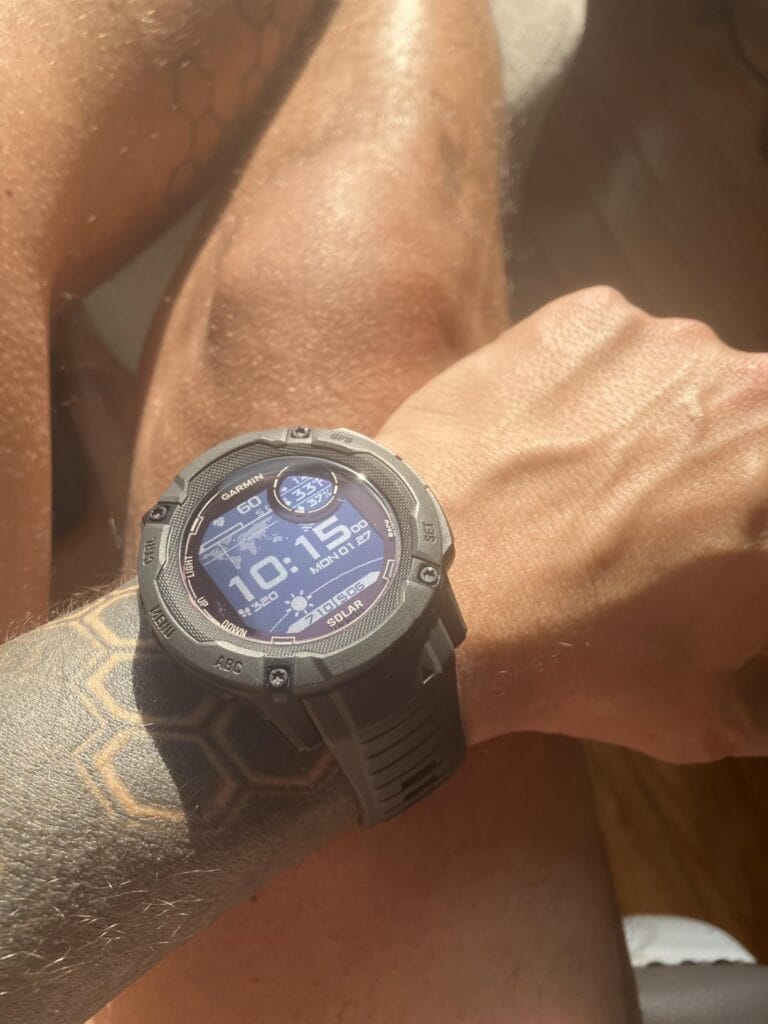
The solar panel sits inside the watch’s display ring and tops up the battery any time the watch is outside in daylight — no cables required for casual use. Garmin doesn’t publish a simple “minutes of sun equals hours of battery” conversion; instead, it rates battery life across several use modes assuming a set amount of daily sun exposure.
Here’s what Garmin’s own battery-life chart shows for this watch:
| Mode | Without solar | With solar |
|---|---|---|
| Smartwatch mode | Up to 28 days | Unlimited* |
| Battery Saver watch mode | Up to 65 days | Unlimited* |
| GPS mode | Up to 30 hours | Up to 48 hours** |
| Max Battery GPS mode | Up to 70 hours | Up to 370 hours** |
| Expedition GPS activity | Up to 32 days | Unlimited* |
- Solar figures assume all-day wear with three hours per day outside in 50,000 lux conditions.
- Solar figures for GPS modes assume continuous use in 50,000 lux conditions. Fifty-thousand lux is bright daylight, think a clear day outdoors, not a cloudy afternoon or an indoor office.
Solar Charging,The Honest Limits
Let’s be direct about where “unlimited battery” actually holds up, because Garmin’s own fine print already hints at the catch.
Garmin’s unlimited battery claim in smartwatch mode assumes all-day wear with roughly three hours of bright, 50,000-lux sunlight per day, that’s the standard, and it’s a genuinely achievable one if you’re outside regularly.
Where it gets more honest: independent testers consistently note that the solar boost is real for light, everyday use, but heavy GPS tracking, a bright screen, and constant heart-rate sensing can outpace what the panel generates, even on a sunny day. Garmin itself frames the solar gain as most meaningful in specific watch modes rather than as a blanket “never charge again” promise across every activity. In practice, that means:
- Solar keeps up well: light smartwatch use, daily step tracking, occasional short GPS activities.
- Solar can’t fully keep up: all-day GPS tracking, continuous heart-rate monitoring during long expeditions, or heavy backlight use at night.
If you’re planning multi-day GPS-heavy trips, treat solar as a meaningful range-extender, not a replacement for occasionally plugging in.
Tactical-Specific Features
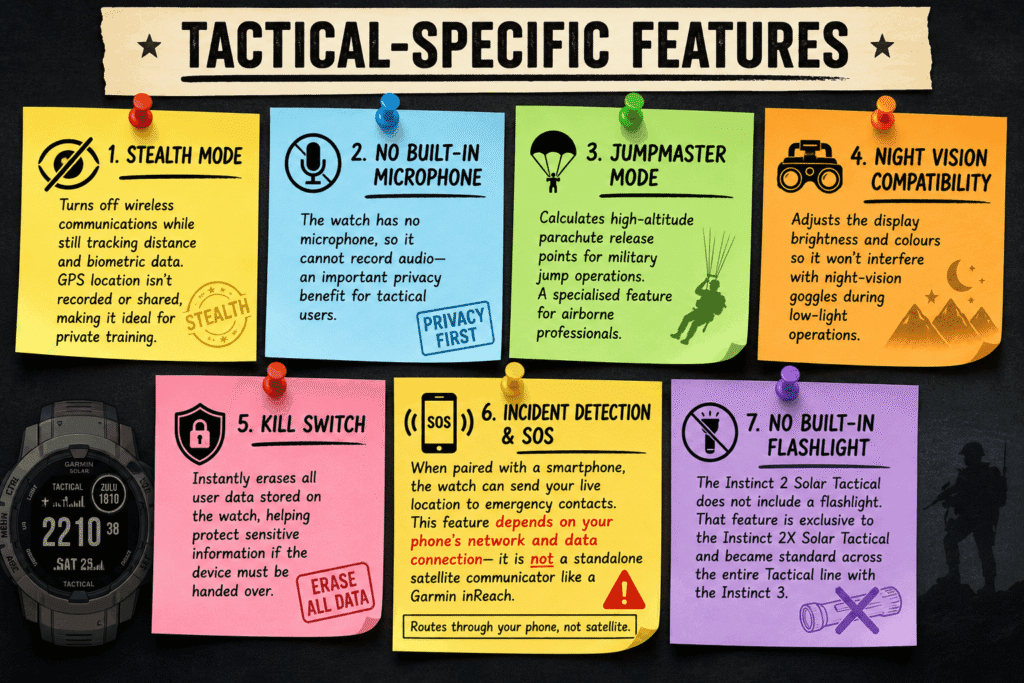
- Stealth mode: turns off wireless communications while the watch still collects distance and biometric data, without recording or sharing GPS location. It’s built for people who need to keep training data without broadcasting where they are.
- No built-in microphone: a genuinely relevant privacy point for tactical buyers, since the watch simply has no way to record audio.
- Jumpmaster mode: calculates high-altitude release points for military parachute operations, a niche feature but a meaningful one for the buyers who actually need it.
- Night vision compatibility: dims and shifts the display so it won’t wash out night-vision goggles, a small detail that matters a lot in the field.
- Kill switch: wipes user memory from the device on demand, useful if the watch needs to change hands quickly or securely.
- Incident detection / SOS: worth clarifying: this feature calls or sends a message with your live location to emergency contacts when the watch is paired with your smartphone, and it requires your phone to have network coverage and data connectivity. It routes through your phone, not a standalone satellite communicator,an important distinction if you’re comparing it to something like a Garmin inReach.
- No built-in flashlight: worth repeating clearly, since it’s a common point of confusion: the regular Instinct 2 Solar Tactical doesn’t include one. That feature is exclusive to the larger 2X Solar Tactical, and it only became standard across the whole Tactical line with the Instinct 3.
Durability & Military-Grade Build
MIL-STD-810 is a U.S. military testing standard covering things like shock, vibration, extreme temperatures, and humidity — it’s not a single “toughness score,” but a battery of environmental tests the watch has to survive. Garmin builds the case from fiber-reinforced polymer with a scratch-resistant, chemically strengthened Corning Gorilla Glass lens, and rates the whole thing to 10 ATM (100 meters) of water resistance.
In plain terms: this is a watch designed to shrug off drops, dust, temperature swings, and submersion, not just look rugged. Owner reviews across major retailers consistently praise its durability, with the Instinct 2 Solar Tactical carrying a strong average rating from verified buyers on sites like Best Buy.
Instinct 2 Solar Tactical Specifications
| Spec | 45mm |
|---|---|
| Case size | 45 x 45 x 14.6 mm |
| Weight | 53 g |
| Display | 0.9″ x 0.9″ monochrome, transflective MIP, 176 x 176 px |
| Battery (smartwatch, solar) | Unlimited* |
| Battery (GPS mode, solar) | Up to 48 hours** |
| Water rating | 10 ATM (100 m) |
| Satellite systems | GPS, GLONASS, Galileo (multi-GNSS) |
| Case material | Fiber-reinforced polymer, Gorilla Glass lens |
| Launch price | $449.99 |
- Assumes 3 hrs/day at 50,000 lux.
- Assumes continuous use at 50,000 lux. Note: there’s no 50mm version of this specific model, the 50mm Tactical option is the separate Instinct 2X Solar Tactical.
Is the Garmin Instinct 2 Solar Tactical Worth It in 2026?

Yes, with a condition: it’s worth it if you value proven MIL-STD-810 durability and near-unlimited battery life over having the absolute newest satellite tech and a flashlight.
Nothing about the watch has meaningfully “held up worse” since launch, Garmin still supports it with regular firmware updates through Garmin Connect, and the core hardware (GPS accuracy, water resistance, battery chemistry) doesn’t degrade with software age the way a phone’s app ecosystem might. Compared to 2026 alternatives at a similar price, its main disadvantage is simply that Garmin’s own newer watch outclasses it in a few specific areas, competitors from other brands rarely match its battery life at all.
Instinct 2 Solar Tactical vs. Instinct 2X Solar Tactical Don’t confuse these two. The 2X is the larger, 50mm-only sibling with a built-in flashlight and a bigger solar lens that generates roughly 50% more power than the standard model’s panel. If maximum battery life and a flashlight matter more to you than the smaller case size, the 2X is worth comparing directly before you buy either watch.
Real-World Use Case
Picture a multi-day backcountry trip: daytime hiking with GPS tracking on, evenings spent mostly in smartwatch mode. Based on Garmin’s published battery figures and consistent findings across independent outdoor-gear reviewers, that mixed use pattern is exactly where this watch performs best, GPS mode draws down the battery steadily during the day, then the smartwatch-mode “unlimited” ceiling effectively resets the clock overnight and on lower-activity days.
The honest limitation shows up on GPS-heavy, low-sun days: overcast skies or dense tree cover cut into the solar gain, and the watch behaves closer to its non-solar battery numbers. The other real-world limitation worth flagging: no onboard maps or topographic display, since this is a breadcrumb-navigation watch, not a mapping one. If turn-by-turn topo maps matter to you, that’s a bigger factor than anything covered above.
Pros and Cons
Pros:
- Genuinely long battery life, even without perfect sun exposure
- MIL-STD-810 durability that holds up to real abuse
- Full tactical toolkit: stealth mode, jumpmaster, NVG compatibility, kill switch
- Multi-GNSS satellite support for reliable tracking in tough terrain
- No microphone, a real plus for privacy-focused buyers
- Comfortable 45mm size compared to the bulkier 2X and Instinct 3 50mm
Cons:
- No built-in flashlight, unlike the 2X and every Instinct 3 model
- Missing SatIQ, so it can’t optimize satellite/battery balance as intelligently
- No onboard topographic maps
- Price hasn’t dropped as dramatically as buyers might expect
- Monochrome display only, no AMOLED option like the newer Instinct 3
Who Should Buy It (and Who Shouldn’t)
Buy it if:
- You need MIL-STD-810 durability and tactical-specific tools for work or serious training
- You’re a solar-dependent hiker or backpacker who prioritizes multi-day battery life
- You want a smaller 45mm case rather than the bulkier 50mm alternatives
- You don’t need a flashlight or the newest satellite tech
Skip it if:
- You specifically want a built-in flashlight, go straight to the 2X or Instinct 3
- You’re not tactical/military-focused and don’t need stealth mode or jumpmaster tools
- You’d rather have the 2X’s bigger battery gains and don’t mind the larger case
- You want AMOLED color display or the very latest satellite accuracy
FAQs
Is the Garmin Instinct 2 Solar Tactical still worth buying in 2026?
Yes, if you value its durability and battery life over having the newest features. It doesn’t have a flashlight or SatIQ like the Instinct 3, but it still delivers strong real-world performance for the price.
Should I buy the Instinct 2 Solar Tactical or the Instinct 3 Solar Tactical?
Buy the Instinct 3 if you want a flashlight, SatIQ satellite tech, or up to five times the GPS-mode solar battery gain. Buy the Instinct 2 if none of those specifically matter to you and you can find it below its $449.99 launch price.
What’s the difference between the Instinct 2 Solar and the Instinct 2 Solar Tactical?
The Tactical Edition adds military-specific features on top of the standard Instinct 2 Solar, including stealth mode, jumpmaster activity, dual-position GPS format, night vision compatibility, and a kill switch.
Is the Garmin Instinct 2 Solar Tactical waterproof?
It’s water-rated to 10 ATM, meaning 100 meters, and built to MIL-STD-810 for additional thermal and shock resistance. That covers swimming and most water sports, though it’s not designed for scuba diving depths.
Does the Garmin Instinct 2 have a flashlight?
The standard 45mm Instinct 2 Solar Tactical does not. A built-in flashlight was exclusive to the 50mm Instinct 2X Solar Tactical, and only became a standard feature across the whole Tactical lineup with the Instinct 3.
How long does the battery actually last with solar charging?
Garmin rates it as unlimited in smartwatch mode and up to 48 hours in GPS mode, but both figures assume roughly three hours of bright, 50,000-lux sunlight daily. Heavy GPS use, low sun, or constant heart-rate tracking will pull those numbers down.
What size does the Instinct 2 Solar Tactical come in?
Just one: 45mm. There’s no 50mm version of this specific model, the 50mm Tactical option is the separate Instinct 2X Solar Tactical.
When was the Garmin Instinct 2 Solar Tactical released, and is it discontinued?
It launched in February 2022. It’s not officially discontinued; Garmin still sells it through its own site and major retailers, though the Instinct 3 is now the current flagship in the Tactical lineup.
How much does the Garmin Instinct 2 Solar Tactical cost in 2026?
Expect to pay between roughly $340 and $460 depending on the retailer and any active sales, with $449.99 remaining the standard listed price at many stores.
Is the Instinct 2 Solar Tactical better than the Instinct 2X Solar Tactical?
Not better, just different. The 2X is larger, has a flashlight, and gets more solar-charging power, while the standard Instinct 2 Solar Tactical is smaller and slightly more affordable.
What tactical-specific features does the watch include?
Stealth mode, jumpmaster activity, dual-position GPS format, night vision goggle compatibility, a kill switch, and phone-routed incident detection/SOS messaging.
Summary
The Garmin Instinct 2 Solar Tactical earns its “still worth it” label in 2026, but it’s not the obvious no-brainer it was at launch. The Instinct 3 Tactical Edition genuinely improved on satellite tech, solar efficiency, and added a flashlight — real upgrades, not marketing filler. If those three things matter to you, spend the extra money.
If they don’t, the older watch still delivers rock-solid durability, excellent battery life, and the full tactical feature set that made it popular in the first place — for roughly $50 less at MSRP, and considerably less when you catch a sale. That’s a fair trade for plenty of buyers, and it’s why this watch hasn’t disappeared from shelves.