
Last updated on October 27th, 2026 at 10:10 am
Quick answer: The best solar garden and pathway lights for most homeowners use warm white light (3000K or lower), a replaceable rechargeable battery, and an IP65 or higher waterproof rating. Aim for roughly 10 to 80 lumens per path light, space them 6 to 10 feet apart in a spot with direct sun, and plan to swap small-set batteries every one to three years.
Table of Contents
Solar lights have a reputation. You push a cheap stake into the lawn, it glows like a tired firefly for a week, and then it retires.
Good news: the gap between a dud and a keeper comes down to a few specs you can check before you buy. This guide covers those specs, plus the picks we found worth your money.
We compared manufacturer data, independent reviews, and advice from professional lighting designers. We also flag where product listings disagree with each other, because they do.
Our Top Picks at a Glance
| Best for | Product | Lumens | Battery | Weather rating | Light mode |
|---|---|---|---|---|---|
| Classic curb appeal, multipack | Gigalumi 8-Pack Stainless Steel and Glass Path Lights | 10 (listed) | NiMH rechargeable | IP65 on most listings (some say IP44) | Dusk to dawn |
| Brightness and smart control | Ring Solar Pathlight | Up to 80 (adjustable) | 18650 lithium-ion | IP66 | Motion-activated |
| Stairs and decks | Ring Solar Steplight | 50 | Check listing | Check listing | Motion-activated |
Specs come from manufacturer listings. Confirm them on the product page before you order.
How We Chose These Solar Lights
We looked at six things:
- Color temperature. Warm light looks better in a garden and bothers neighbors less.
- Lumens. More isn’t always better on a path.
- Battery type. A replaceable battery can extend a light’s life.
- Waterproof rating. We checked the IP code, not just the word “waterproof.”
- Light mode. Dusk-to-dawn and motion-activated lights suit different jobs.
- Materials. Metal and glass age differently than thin plastic.
Spec sheets can’t show how a light behaves after 18 months in your yard. Treat every pick as a strong starting point, not a guarantee.
Best Solar Pathway Lights
Pathway lights have one job: show you where the edge is. They don’t need to blind the mailman.
Lighting a long alley or a shared walkway? Our guide to the best solar pathway lights for alleys and walkways goes deeper on that setup.
Best for Classic Curb Appeal: Gigalumi 8-Pack Stainless Steel and Glass Path Lights

Specs (manufacturer-reported): 8 lights, stainless steel and glass, about 10 lumens, 3500K warm white, NiMH rechargeable battery, 6 to 8 hours of direct sun to charge, up to 8 hours of light.
These lights give you a traditional lantern look, and the glass shade throws a decorative pattern on the ground. One independent reviewer confirmed the battery is a replaceable 1.2V AA cell, which matters because batteries age out before the fixture does.
Pros
- Metal and glass look more expensive than plastic
- Replaceable battery
- Sold in packs, so you can line a whole walkway
Cons
- 10 lumens is soft, so space them closer together
- 3500K runs warmer than daylight but above the 3000K that designers prefer
- Listings disagree on the waterproof rating (IP65 on some, IP44 on others), so check the box
Best for Brightness and Smart Control: Ring Solar Pathlight
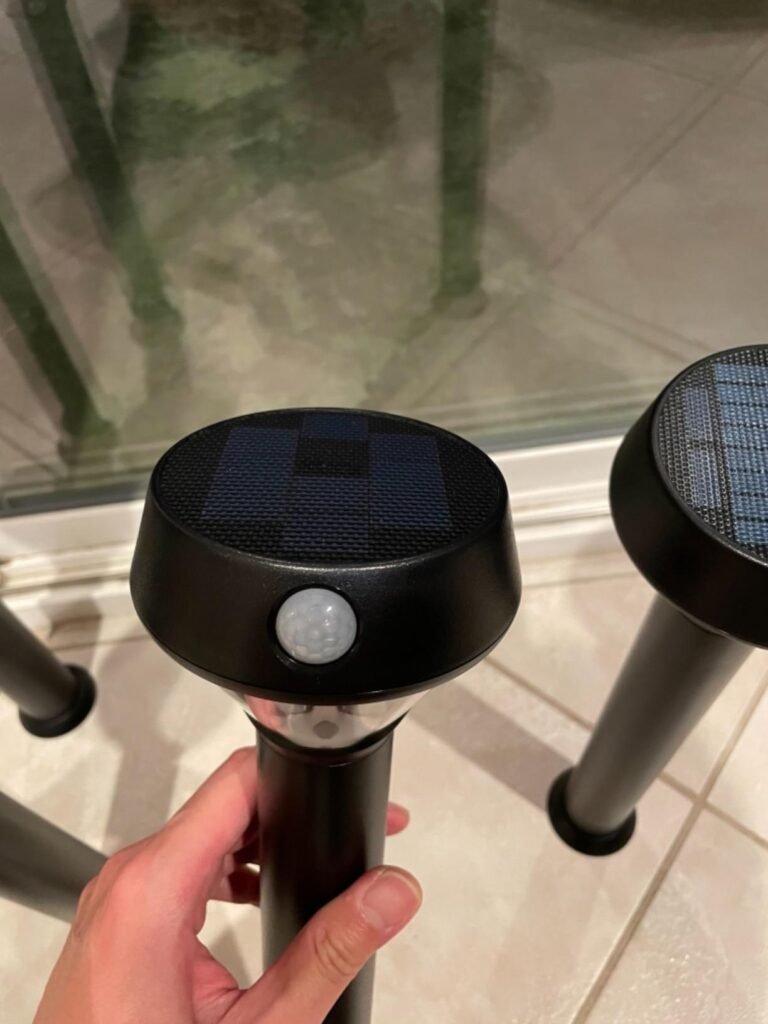
Specs (manufacturer-reported): Up to 80 lumens (adjustable), 3500K, 18650 lithium-ion battery, IP66, operating range of -4°F to 122°F.
This is the brightest light on our list. It switches on when it detects motion, so it works as both a path light and a security nudge.
Smart controls need a Ring Bridge or a compatible Echo device. Without one, you lose the app features.
Pros
- Much brighter than typical solar stake lights
- IP66 rating and a wide temperature range
- Lithium-ion battery
Cons
- Costs noticeably more per light than multipacks
- Motion-triggered, so it doesn’t glow all night
- Full features need other Ring hardware
Best for Stairs and Decks: Ring Solar Steplight

Ring lists this light at 50 lumens when it detects motion, designed for stairs, decks and paths. Stairs are where a dim light causes real injuries, so a brighter, motion-activated light makes sense here. Check the product page for battery and weather-rating details before you buy.
Best Solar Garden Lights: What to Buy for Beds, Trees and Decor
We didn’t name garden picks here, because we could only verify a few products and we won’t guess. Use these targets instead.
Flower beds and borders. Choose low-lumen stake lights with short stakes. Plants grow, so keep the solar panel clear of leaves. A panel in shade is just a decoration.
Trees and plants. Landscape designers like downlighting from above, which they call moonlighting: aim a light down through branches and it casts soft shadows on the ground. A solar spotlight on a stake can fake the effect, but the panel still needs sun.
Decorative and ambient. Lanterns, orbs and string lights add atmosphere, not safety. Pick warm white, check the waterproof rating, and don’t expect them to light a path.
Garden Lights vs. Pathway Lights: What’s the Difference?
| Pathway lights | Garden lights | |
|---|---|---|
| Job | Safety and navigation | Accent and atmosphere |
| Brightness | Bright enough to see the surface | Soft and low |
| Placement | Along the edge, evenly spaced | Near plants, trees, features |
| Spacing | Regular rhythm | Clusters and gaps are fine |
Pathway lights serve you. Garden lights serve the view.
How to Choose Solar Lights for Your Home

Lumens: How Much Brightness Is Enough?
Lumens measure how much light a fixture puts out. Designers say path lights work fine at 200 lumens or lower, and most solar stake lights fall far below that.
The verified lights in this guide range from about 10 to 80 lumens. Lower-lumen lights need tighter spacing, while brighter ones can sit farther apart. Many manufacturers don’t list lumens at all, which is a yellow flag.
Battery Type and Capacity
Most small solar lights use NiMH batteries (often 1.2V, 600 to 1000mAh AA or AAA). Higher-end lights, like the Ring Pathlight, use lithium-ion.
Typical replacement windows run about one to three years for NiMH and two to five years for lithium-ion. Check whether the battery is replaceable. A light you can’t re-battery becomes trash the day the battery fades.
Solar Panel Size and Placement
Manufacturers typically say 6 to 8 hours of direct sunlight gives a full charge. A big panel in the shade loses to a small panel in the sun, so placement matters more than panel size.
Waterproof Rating (IP65 and Others)
IP codes come from the international standard IEC 60529. The first digit covers dust and the second covers water.
- IP44: Protected against splashes. Fine for sheltered spots.
- IP65: Dust-tight and protected against low-pressure water jets from any direction.
- IP66: Protected against stronger water jets.
For fully exposed spots, choose IP65 or higher.
Warm White vs. Cool White
Color temperature runs on the Kelvin scale. Lower numbers look warmer. Lighting designers recommend 2700K to 3000K, and DarkSky International guidance for outdoor lighting also favors warm light at 3000K or below.
Designers also note that many solar path lights come in above 3000K, so check the spec.
Material and Durability
Metal and glass usually outlast thin plastic. Over years of UV exposure, plastic can fade, yellow or turn brittle. A stainless steel stake also survives hard soil better than a plastic one.
How Many Solar Lights Do You Need? (Spacing Guide)
Designers commonly place path lights about 8 to 10 feet apart, and a range of 5 to 12 feet covers most situations. Dim solar lights need tighter spacing, so start closer, around 6 to 8 feet.
Too many lights too close together create what designers call the runway look. Think airport, not garden.
Here’s the quick math: divide your path length by your spacing and round up.
| Path length | At 6 ft spacing | At 8 ft spacing | At 10 ft spacing |
|---|---|---|---|
| 20 ft | 4 lights | 3 lights | 2 lights |
| 40 ft | 7 lights | 5 lights | 4 lights |
| 60 ft | 10 lights | 8 lights | 6 lights |
Two placement tips from lighting designers:
- Set each light back from the edge by roughly its own height.
- Alternate lights on opposite sides of the path for a softer, more balanced look.
Then walk the path at night and adjust. Your eyes beat any formula.
Do Solar Lights Work in Shade, Cloudy Weather and Winter?
Shade: Poorly. The panel needs direct sun to charge, so a shaded spot often means a short glow or none.
Cloudy days: They still charge, but more slowly. Some manufacturers note that bad weather increases charging time.
Winter: Fewer sun hours means less charge. Nights are longer, so a battery rated for about 8 hours can run out before dawn. Snow on the panel blocks charging, so brush it off. Cold also affects batteries, and Ring rates its pathlight down to -4°F.
For tricky spots, move the light, not your expectations.
How to Install Solar Garden and Pathway Lights
- Map the path. Measure it and pick your spacing.
- Check the sun. Choose spots with direct sunlight for most of the day.
- Prep the light. Pull any battery tab and flip the switch to on. Check your manual for first-charge instructions.
- Stake it in. Water hard soil first and push by hand, not with a hammer.
- Set the distance. Place each light back from the edge by about its height.
- Test at dusk. Walk the path at night and move any light that looks off.
Maintenance: Cleaning, Battery Replacement and Lifespan
Wipe the panel with a damp cloth when it gets dusty or pollen-coated. Trim plants that grow over it.
When lights dim or shut off early, the battery is the usual suspect. Replace it with the same chemistry and voltage. For NiMH lights, that’s typically a rechargeable 1.2V cell. Never use a standard alkaline battery. Our guide on [Can You Use Regular AA Batteries in Solar Lights?] covers why.
Lighting designers say small solar path lights seldom last more than one or two seasons, while sturdier fixtures can last years. Recycle old rechargeable batteries according to your local rules.
When Solar Lights Are Not the Right Choice
Solar works well for ambiance, borders and low-traffic paths. It’s a weaker choice when you need certainty.
Professional designers generally prefer wired low-voltage systems for main walkways, because they deliver steadier output and more years of reliable service. Consider wiring when:
- Your main entry path gets daily use after dark
- The area sits in heavy shade
- You light stairs where a dead light means a real fall risk
You can mix both. Use wired lights where you need reliability and solar where you want flexibility.
FAQs
Can solar lights stay outside all year?
Many can, if the rating matches your weather. Look for IP65 or higher, and check the temperature range. Ring, for example, lists -4°F to 122°F.
Can I replace the batteries?
Often yes, but check first. Many small lights use rechargeable AA or AAA NiMH cells, and the Gigalumi lights use a replaceable AA cell. Match the voltage and chemistry.
Do cheap solar lights work?
They work, but for less time. Designers say small solar path lights seldom last more than one or two seasons. Budget for replacements.
How long do solar lights run at night?
Manufacturers commonly advertise up to about 8 hours on a full charge. Motion-activated lights use less, because they only switch on when needed.
Summary
For a classic look and a whole walkway, the Gigalumi 8-pack is a sensible start. Space the lights closer together to make up for their soft output.
For the brightest option and smart features, the Ring Solar Pathlight earns its higher price. For stairs, the Ring Solar Steplight fits the job.
Whatever you buy, remember the rules: warm light, IP65 or higher, a replaceable battery, direct sun, and sensible spacing.