Quick Answer: Most U.S. homes need a 10–13.5 kWh solar battery for essential backup power. The exact size depends on your daily electricity usage, how many backup days you want, and your battery’s Depth of Discharge, calculated as: Battery size (kWh) = Daily usage × Backup days ÷ Depth of Discharge ÷ Efficiency. Whole-home backup typically requires 25–40+ kWh instead.
Table of Contents
The average U.S. home pays 18.34 cents per kilowatt-hour for grid electricity as of September 2026, and that rate is up 5% from last year.¹ A correctly sized solar battery usually pays for itself in 7 to 12 years, according to current industry analyst estimates.² Get the size wrong, and that payback window stretches out, or the battery runs dry the first night the power goes out.
Here’s the myth I want to kill first: bigger is not better.
Most people assume the safest move is to buy the biggest battery they can afford. It isn’t. Oversized batteries cost more upfront, take longer to pay back, and often sit half-empty because they were never sized to your actual usage. Undersized batteries leave you in the dark during an outage. The right number sits in between, and it’s a number you can calculate, not guess.
Key Takeaways
- Most U.S. homes need a 10–13.5 kWh battery for essential backup.
- The formula: Battery size = Daily usage × Backup days ÷ Depth of Discharge ÷ Efficiency
- Whole-home backup for multiple days can require 25–40+ kWh.
- Battery payback typically runs 7–12 years, depending on your electricity rate.
- This number is a starting point, a licensed energy advisor should confirm it before you buy.
How I Checked This
I’m not going to pretend I ran a national survey, I didn’t. What I did do: I cross-checked the formula and reference numbers below against multiple published solar battery calculators and sizing guides, including tools, NREL-backed guidance, and manufacturer sizing pages, then verified the underlying electricity and cost figures against the U.S. Energy Information Administration (EIA) directly.³ Where sources disagreed, I used the more conservative number and said so. If you want to sanity-check your own result, a licensed solar installer or energy advisor is still the right call before you buy, this calculator gets you close, not final.
The Formula (Quick Answer First)
Here’s the one line that answers the question:
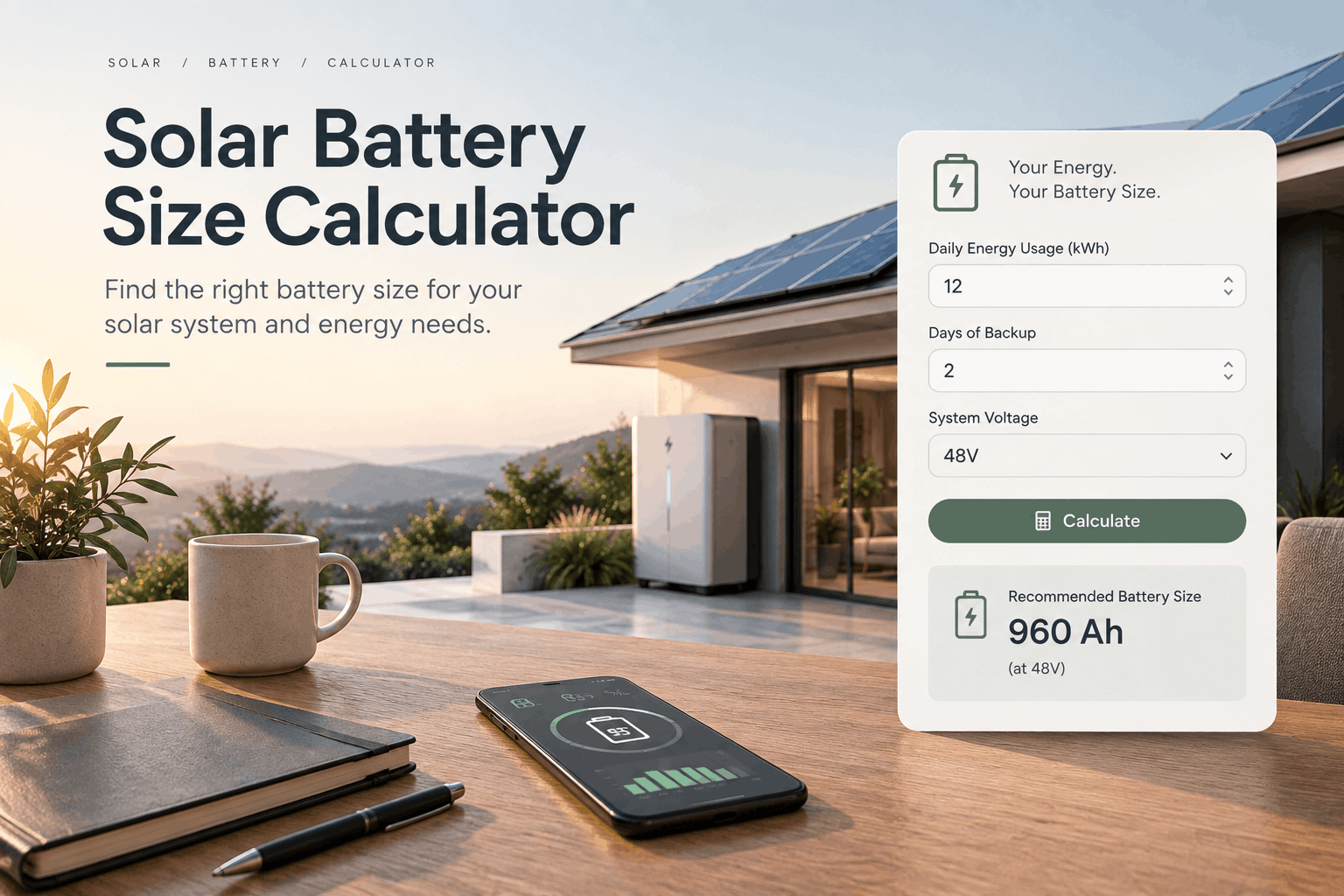
Battery capacity (kWh) = Daily energy use (kWh) × Backup days ÷ Depth of Discharge ÷ Round-trip efficiency
That’s it. Everything else on this page just helps you fill in the blanks accurately.
Quick example: a home using 10 kWh a day, wanting 1 day of backup, with a battery rated for 90% Depth of Discharge and 90% round-trip efficiency, needs:
10 × 1 ÷ 0.9 ÷ 0.9 = 12.3 kWh
Not bad for one line of math.
Step 1: Find Your Daily kWh Usage
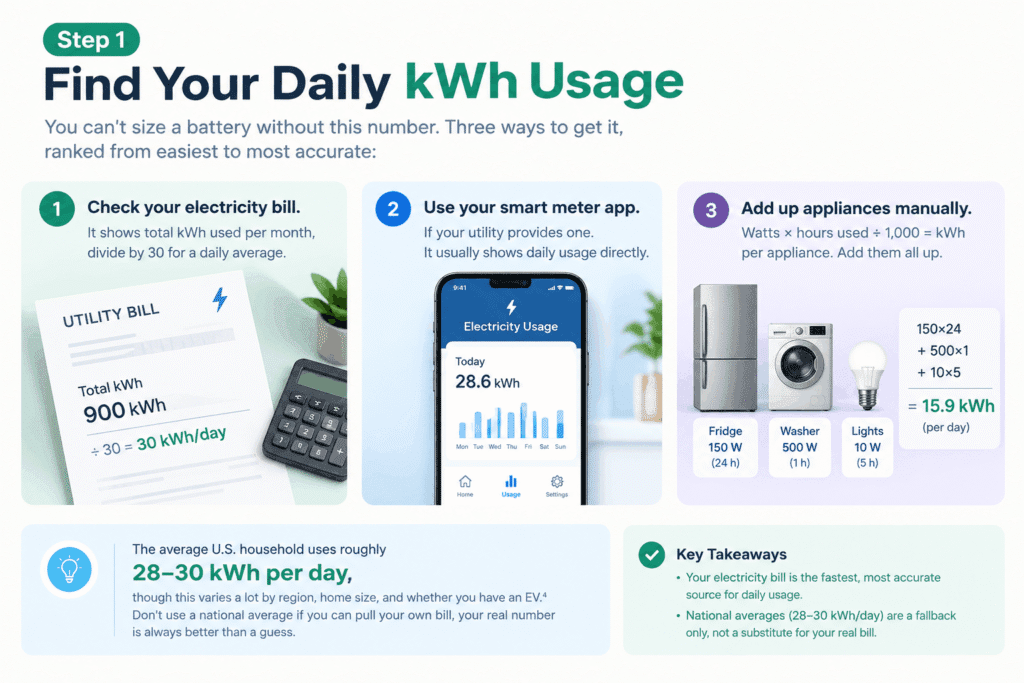
You can’t size a battery without this number. Three ways to get it, ranked from easiest to most accurate:
- Check your electricity bill. It shows total kWh used per month, divide by 30 for a daily average.
- Use your smart meter app, if your utility provides one. It usually shows daily usage directly.
- Add up appliances manually. Watts × hours used ÷ 1,000 = kWh per appliance. Add them all up.
The average U.S. household uses roughly 28–30 kWh per day, though this varies a lot by region, home size, and whether you have an EV.⁴ Don’t use a national average if you can pull your own bill, your real number is always better than a guess.
Key Takeaways
- Your electricity bill is the fastest, most accurate source for daily usage.
- National averages (28–30 kWh/day) are a fallback only, not a substitute for your real bill.
Step 2: What Actually Changes the Battery Size
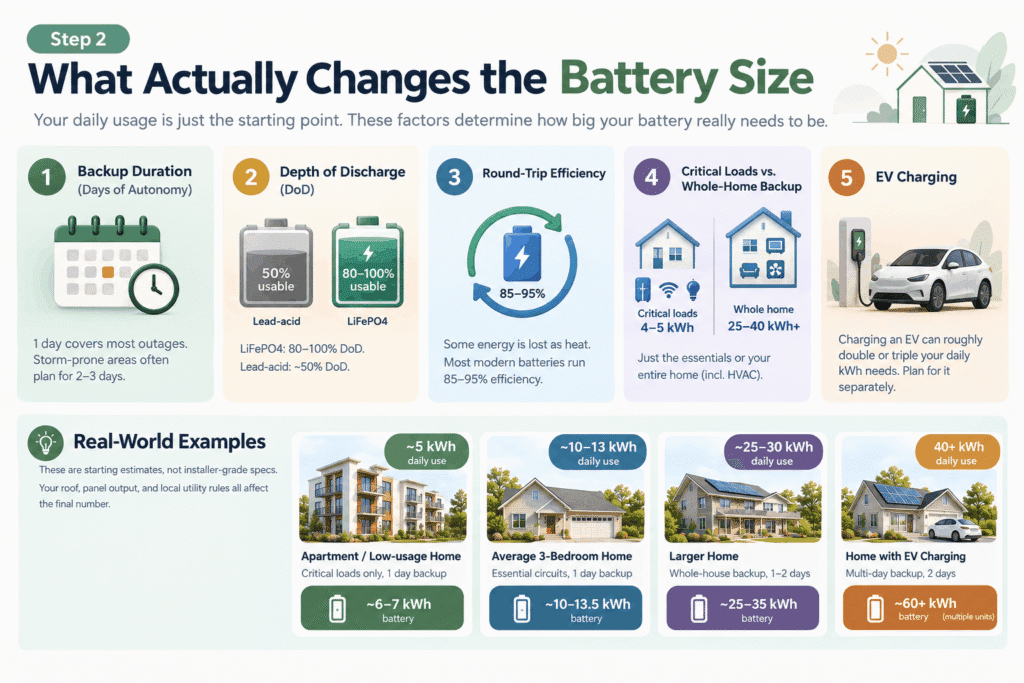
Backup Duration (Days of Autonomy)
How many days do you want the battery to run without sun or grid power? One day covers most short outages. Storm-prone regions often plan for 2–3 days.
Depth of Discharge (DoD)
This is the part most calculators gloss over, and it’s the one that causes the most confusion. A battery’s listed capacity and its usable capacity are not the same number.
Modern lithium (LiFePO4) batteries allow 80–100% DoD, meaning you can safely use almost all of the rated capacity. Older lead-acid batteries max out around 50% DoD, so a “10 kWh” lead-acid battery only gives you 5 kWh of real, usable power.⁵ That single fact explains most of the “my battery ran out faster than expected” complaints you’ll find in solar forums.
Round-Trip Efficiency
Every time electricity goes into a battery and back out, some is lost as heat. Most modern batteries run 85–95% round-trip efficiency. Lower efficiency means you need a slightly bigger battery to deliver the same usable power.
Critical Loads vs. Whole-Home Backup
This is the single biggest lever. Backing up just your fridge, WiFi, and a few outlets can need as little as 4–5 kWh. Backing up your entire home, HVAC included, can need 25–40 kWh or more.
EV Charging
Charging an electric vehicle at home can roughly double or triple your daily kWh needs. If you plan to charge an EV from the same battery system, size for it separately, don’t bolt it on as an afterthought.
Key Takeaways
- DoD is the most-missed variable, it separates rated capacity from what you can actually use.
- Critical-loads-only backup and whole-home backup are two very different battery sizes.
- EV charging changes the math significantly. Size for it on purpose.
Worked Examples
Ranked from smallest real-world need to largest:
- Apartment / low-usage home, ~5 kWh daily use, critical loads only, 1 day backup → ~6–7 kWh battery
- Average 3-bedroom home, ~10–13 kWh daily use, 1 day backup, essential circuits → ~10–13.5 kWh battery
- Larger home, whole-house backup, ~25–30 kWh daily use, 1–2 days backup → ~25–35 kWh battery
- Home with EV charging, multi-day backup, 40+ kWh daily use, 2 days backup → ~60+ kWh battery, usually built from multiple stacked units
These are starting estimates, not installer-grade specs. Your roof, panel output, and local utility rules all affect the final number.
How Many Batteries Will You Actually Need?
Most residential batteries on the market sit in the 10–13.5 kWh range per unit. If your calculation lands above that, you’re not shopping for a bigger single battery, you’re shopping for two or more units stacked together. This is completely normal. Whole-home backup systems routinely use 2–4 battery units wired together.
This is exactly the kind of decision where a licensed energy advisor earns their fee, stacking configuration, wiring, and inverter capacity all have to match, and getting it wrong is expensive to fix after installation.
Cost & Payback: What the Size Actually Costs You
Bigger batteries cost more, obviously, but the relationship isn’t purely linear, and payback depends heavily on your local electricity rate.
| Battery Size | Typical Use Case | Rough Installed Cost Range |
|---|---|---|
| 5–7 kWh | Critical loads, apartment/small home | Lower end of the market |
| 10–13.5 kWh | Average home, 1-day backup | Mid-range, most common residential size |
| 25–40+ kWh | Whole-home backup, multi-day | Highest cost, usually multiple units |
At the national average electricity rate of 18.34¢/kWh, and with current analyst estimates putting battery payback at 7–12 years, the math favors sizing accurately rather than sizing big “just in case.” A battery that’s too large simply extends your own payback period for storage capacity you rarely use.
If your state has higher electricity rates or strong net metering incentives, your payback will likely land at the faster end of that range. A licensed energy advisor or installer can run this specific to your utility rate and usage, national averages only get you so far.
Common Mistakes to Avoid

- Ignoring Depth of Discharge. Buying based on rated capacity instead of usable capacity is the single most common sizing error.
- Sizing for the worst outage you can imagine. Most outages are short. Size for realistic backup needs, not worst-case paranoia, unless you live somewhere outages are genuinely frequent and long.
- Forgetting future EV charging. If an EV is even a possibility in the next few years, factor it in now. Retrofitting later costs more.
- Skipping a professional review. A calculator gets you a solid estimate. A licensed installer confirms it against your actual panel, inverter, and roof.
Battery Size vs. Solar Panel Size, Are They Linked?
Related, but not the same calculation. Your solar panel array needs to produce enough daily kWh to refill your battery, not just match its capacity. Panel sizing formula:
Panel output (kW) = Daily kWh needed ÷ Peak sun hours × 1.2 (buffer for cloudy days and degradation)
If your panels can’t recharge the battery in a day of sunlight, you’ll be topping up from the grid, which defeats part of the purpose. This is another spot where a solar advisor’s input matters more than a standalone calculator.
FAQs
How many kWh does a house use per day?
The U.S. average sits around 28–30 kWh per day, but your actual bill is a far better source than any national figure.
What size battery do I need for a 2,000 sq ft house?
There’s no direct size-to-square-footage formula, usage depends on occupants, appliances, and climate control, not square footage alone. Use your actual daily kWh instead.
How long will a 10 kWh battery last?
At 80–90% usable DoD, that’s roughly 8–9 kWh of real power. For essential loads only (fridge, WiFi, some lighting), that can cover a full day. For whole-home use, it may last just a few hours.
Can I oversize my battery “just in case”?
You can, but it extends your payback period and adds cost for capacity you may rarely use. A licensed advisor can help you find the balance between safety margin and cost.
Glossary
- kWh (kilowatt-hour): A unit of energy, how much power used over time. This is what battery capacity is measured in.
- kW (kilowatt): A unit of power, the rate at which energy is delivered at any given moment.
- Depth of Discharge (DoD): The percentage of a battery’s total capacity that can safely be used without shortening its lifespan.
- Round-trip efficiency: The percentage of energy you get back out of a battery, compared to what you put in.
- Days of autonomy: How many days you want your system to run without sun or grid power.
- Critical loads: The specific circuits (fridge, WiFi, some lighting) you choose to keep powered during an outage, rather than backing up the whole home.
- Usable capacity: What a battery can actually deliver, after accounting for DoD, different from its rated (nameplate) capacity.
The Bottom Line
Sizing a solar battery is one formula and four inputs: your daily usage, how many backup days you want, your battery’s Depth of Discharge, and its round-trip efficiency. Most homes land in the 10–13.5 kWh range for essential backup, and significantly higher for whole-home coverage.
Run the numbers here to get a solid starting estimate, then take that number to a licensed energy advisor before you commit to a purchase. This page gets you 90% of the way there. A professional site assessment closes the last 10%, and that’s the part that actually matters when the power goes out.
This article is for general informational purposes and does not replace a professional site assessment. Battery sizing involves your specific home, panel output, inverter capacity, and local electrical code, consult a licensed solar installer or energy advisor before purchasing.