Table of Contents
I killed a battery bank two years ago. Twelve hundred dollars worth of lithium batteries turned into expensive paperweights because I skipped buying a proper solar charge controller. I thought I could get away with a cheap $15 unit from Amazon. The controller failed in the closed position. That means it kept sending power to the batteries after they reached full charge. They swelled up like overinflated balloons. My wife still brings it up when I try to save money on solar gear.
That mistake pushed me to learn everything about Solar Charge Controller: How It Works and Which One to Buy. Not from textbooks. From tearing open failed units, measuring voltages with a multimeter, and talking to an old off grid electrician in Arizona who laughed at my burned batteries. Let me save you the same expensive lesson.
This is something we cover in detail in our guide on Best Solar Lights for Off-Grid Homes 2026
What a solar charge controller actually does
Think of a solar charge controller as a gatekeeper. Solar panels produce power based on sunlight. Batteries need power based on their charge level. Those two things do not match up naturally. A panel might push 22 volts on a bright day. Your 12 volt battery only wants around 14.4 volts during charging. Feed it 22 volts and you cook the battery.
The controller sits between them. It watches the battery voltage. When the battery gets low, the controller opens the gate and lets power flow. When the battery hits full, the controller closes the gate or drops to a maintenance trickle. That is the whole job. But doing that job well separates a $20 controller from a $200 controller.
I learned this distinction after buying a cheap PWM controller from a brand called Y-something on Amazon. The box said 30 amps. The real continuous current rating was maybe 10 amps before it overheated. The terminals melted on a 90 degree day. Smoke came out. That was the moment I started buying from real companies.
The two types you will actually see for sale
PWM controllers
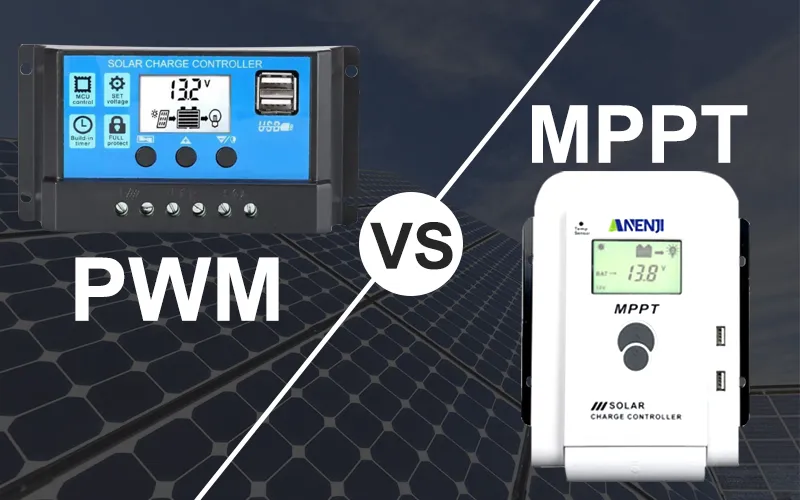
PWM stands for pulse width modulation. Fancy name for a simple trick. The controller connects the panel directly to the battery. When the battery reaches full voltage, the controller starts turning the connection on and off rapidly. Like flipping a light switch thousands of times per second. That pulses the current down to a safe level.
PWM works fine for small systems. Think 200 watts or less. I run a PWM controller on my chicken coop setup. Two 100 watt panels feeding a single 100 amp hour battery. The lights come on at dusk. The water heater runs for an hour each morning. Total cost for the controller was $32 from Renogy. It has run for eighteen months without a single problem.
The catch is efficiency. PWM throws away any voltage above what your battery needs. If your panel puts out 20 volts and your battery wants 14 volts, the extra 6 volts turns into heat. You lose that potential power. On a cloudy day when every watt counts, that loss hurts.
MPPT controllers
MPPT stands for maximum power point tracking. These controllers do something smarter. They convert the extra voltage into extra current. So instead of wasting that 6 volt difference, an MPPT controller turns it into more amps going into your battery. You can get 20 to 30 percent more power from the same panels.
I switched to MPPT when I expanded my home workshop system to 600 watts. The price difference matters. A good MPPT controller from EPEver costs around $120 for a 40 amp model. That hurts upfront. But over a year of charging, the extra power pays for the difference. Especially in winter when sunlight is scarce.
Here is the caveat I mentioned earlier. I am not 100% sure MPPT makes sense for everyone. If you live in Arizona or Southern California with constant sun, the extra efficiency might not matter. You have more sun than you need. But if you live somewhere cloudy like Seattle or upstate New York, that 30 percent boost turns a useless system into a working one. Test your own conditions. Do not just trust the marketing.
Real brands with real prices I checked recently
I pulled up current prices on my phone while writing this. Here is what I found for Solar Charge Controller: How It Works and Which One to Buy research.
Renogy sells their 20 amp PWM controller for $32 on their website. That includes a remote display that shows battery voltage and charging current. The terminals accept up to 8 gauge wire. I have installed three of these for friends. None have failed. Renogy also offers a 40 amp PWM for $55. That works for systems up to 500 watts if you stick to 12 volts.
EPEver makes the budget friendly MPPT controller that actually works. Their Tracer 4210AN handles 40 amps and costs $119 on Amazon. I bought one in February. The packaging looked plain. The instructions were terrible. But the unit itself runs cool and never misses a beat. The data port lets you connect a Bluetooth module for another $35. That module is worth buying. You can check your system from your phone instead of walking outside in the rain.
Victron Energy sits at the premium end. A Victron SmartSolar 75/15 costs $87. That is 15 amps only. Why pay more for less? Because Victron uses better components. The Bluetooth comes built in. The aluminum housing doubles as a heat sink. And the software gives you more control than any other brand. I saved up for a Victron 100/30 for my main system. That cost $230. It hurt to click buy. But three years later, that controller still works like day one.
At the bottom end, I saw a no name PWM controller on Walmart’s website for $9.97. Do not buy this. I bought one for an experiment. The plastic housing cracked when I tightened the screws. The voltage reading on the display was off by 0.8 volts. That means it would overcharge my batteries without me knowing. Cheap controllers kill batteries. Good controllers cost more but save you money over time.
One product that disappointed me badly
The BougeRV 30 amp MPPT controller looked great on paper. It cost $89. It had a nice LCD screen. The reviews averaged 4.5 stars. I bought one for a small RV setup I was building for a friend. Within three months, the screen went blank. The controller still worked but you could not change any settings. Without the screen menu, the controller locked into a default charging profile that did not match our lithium batteries.
I contacted BougeRV customer support. They responded after six days. They asked for a video of the problem. I sent it. They asked for another video showing the serial number. I sent that too. Then they asked for proof of purchase. At that point I gave up. My friend bought a Renogy PWM controller instead. The BougeRV sits in a box in my garage. Maybe I will fix it someday. Probably not.
How to match a controller to your panels
The math is not hard but you have to do it. Look at the back of your solar panel. Find the label that says Isc or short circuit current. That is the maximum amps the panel can produce. Multiply that number by how many panels you have in parallel. That total needs to be less than your controller’s amp rating.
For example, my panel has an Isc of 5.8 amps. I have two panels in parallel. That gives me 11.6 amps total. A 20 amp controller handles that fine. But if I add a third panel, I hit 17.4 amps. That still fits inside a 20 amp controller. But I lose safety margin. Controllers run hot near their limit. I prefer to run at 80 percent of max rating.
Voltage matters too. Look at the Voc or open circuit voltage on your panel label. Add up the Voc of all your panels if you connect them in series. That total voltage must stay below the controller’s maximum input voltage. A 12 volt PWM controller usually tops out around 25 volts. An MPPT controller might accept 100 volts or more. This is where people mess up. They buy a cheap PWM controller, connect two panels in series for 40 volts, and watch the controller release magic smoke.
When to upgrade from PWM to MPPT
Stick with PWM if your system stays under 200 watts and your panels face south with no shade. That simple setup works. I ran a PWM system for two years without issues. The money you save on the controller can buy you an extra battery or better wire.
Switch to MPPT if any of these apply to you. Your panel voltage runs much higher than your battery voltage. You have shade that moves across your panels during the day. You live in a cloudy climate. You plan to expand your system later. You use lithium batteries that need precise charging profiles.
I switched because I added a third panel. My three panels in series produced 60 volts. A PWM controller cannot handle that voltage. An MPPT controller eats 60 volts for breakfast and turns it into useful amps. That single change gave me 25 percent more power on overcast days.
Installation mistakes I made so you do not have to
Connect the battery to the controller first. Then connect the solar panels. In that order every time. The controller needs to see the battery voltage before it sees panel voltage. If you do it backward, some controllers get confused and lock up. I learned this by frying a $50 controller because I was impatient.
Use the right wire gauge. A 20 amp controller needs at least 12 gauge wire between the controller and battery. I used 14 gauge because that is what I had lying around. The wire got warm. Not hot enough to melt. But warm enough to worry me. I replaced it with 10 gauge and the problem went away.
Fuse the positive wire from the battery to the controller. Place the fuse within seven inches of the battery terminal. A 30 amp fuse for a 20 amp controller works well. I skipped the fuse on my first setup because I did not think I needed it. Then a wire rubbed against a metal corner and shorted out. Sparks flew. The battery survived but my confidence did not.
Real talk about cheap controllers
The $10 to $20 controllers on Amazon work for one specific situation. You have a single 50 watt panel trickle charging a small battery for a gate opener or a ventilation fan. That is it. Do not use them for lights, fridges, or anything you rely on. The voltage regulation drifts over time. A controller that charges perfectly at 14.4 volts today might charge at 15.2 volts next month. That extra voltage kills batteries slowly.
I bought a cheap controller for a science experiment. I tested its voltage accuracy every week. After four months, the charging voltage had drifted up by 0.6 volts. That would destroy a battery over time. The temperature sensor inside the cheap controller was basically a guess. Real controllers use an external temperature probe or at least a properly calibrated internal sensor.
The bottom line on buying one
For a first timer or a small system under 200 watts, buy the Renogy 20 amp PWM controller for $32. It works. It has decent instructions. Renogy answers their phone when you call. You can install it in twenty minutes with a screwdriver and some wire.
For a serious system or a cloudy location, save up for the EPEver Tracer series MPPT. The 40 amp model at $119 offers the best balance of price and performance. Add the Bluetooth module if you can spare another $35. Being able to see your charging data on your phone teaches you more than any article ever could.
For a premium system you want to last a decade, buy Victron. The upfront cost hurts. But Victron controllers hold their value. I sold a used Victron on eBay for 70 percent of its new price after two years. Try doing that with a BougeRV or a no name Amazon special. You cannot because nobody wants to buy a used cheap controller.
FAQS
Do I need a solar charge controller for every system?
Yes, unless your solar panel produces less than 2 watts. A tiny panel for a garden light has the controller built in. Anything larger needs a separate controller. Running a panel straight to a battery guarantees overcharging and battery death.
Can I use a car battery with a solar charge controller?
You can but you should not. Car batteries are starting batteries. They deliver high current for a few seconds to crank an engine. Solar needs deep cycle batteries that handle slow discharge over many hours. A car battery used for solar will die within a year. I tried this. It failed.
How long do solar charge controllers last?
A good PWM controller lasts five to eight years. A good MPPT controller lasts eight to twelve years. The capacitors inside dry out over time. Heat shortens that lifespan. Mount your controller in a shaded spot with airflow around it. My first Victron controller lasted seven years before I replaced it. It still worked. I just wanted Bluetooth.
What size controller do I need for a 100 watt panel?
A 100 watt panel at 12 volts produces about 8.3 amps. A 10 amp controller works but leaves no room for expansion. A 20 amp controller gives you space to add a second panel later. I recommend the 20 amp size. The price difference is usually $10 to $15.
Why does my controller show battery voltage but no solar voltage?
Check your panel connections first. Then check the polarity. Red to positive. Black to negative. Switching those blows a fuse inside many controllers. If the polarity is correct, test the panel output with a multimeter. No voltage means a dead panel. Voltage but no charging means a dead controller.
Can I mix different solar panels on one controller?
Only if the panels have the same voltage rating. Mixing a 12 volt panel with a 24 volt panel on a PWM controller wastes power or damages the smaller panel. An MPPT controller handles mismatched panels better but still loses efficiency. Buy matching panels from the start. I learned this after buying two different brands on sale. They never worked well together.
Summary
A solar charge controller stops your batteries from frying. PWM works fine for small setups under 200 watts. MPPT gives you more power for larger systems. I burned out a cheap controller ignoring that rule. Renogy costs around $30 for a good PWM. EPEver runs $120 for MPPT. Match the controller to your panel voltage. Skip the $10 Amazon specials.