
Last updated on October 27th, 2026 at 08:57 am
Quick Answer: The best flat solar lights for most US homes are low-profile step and deck lights rated near 50 lumens, such as the Ring Solar Steplight. For driveways, choose a cast-aluminum dock-style light rated IP67 or higher. Cheap 5-lumen disc lights only mark edges, and their batteries usually need replacing every 1–3 years.
Table of Contents
Flat solar lights are slim fixtures with the panel, battery and LED built into one low housing. They sit flush on a deck, step, driveway edge or garden path. Nobody trips over them, and nobody has to bury a wire.
They are not solar tube skylights or solar flood lights. Those are different products for different jobs.
The quick verdict: the Ring Solar Steplight is the best all-rounder for steps and decks. A VEVOR-style aluminum dock light suits driveways. A SOLPEX disc multipack covers cheap path markers.
Quick Answer: Best Flat Solar Lights at a Glance
| Best For | Pick | Lumens | Battery | IP Rating | Run Time | Price Range |
|---|---|---|---|---|---|---|
| Best Overall (steps, decks) | Ring Solar Steplight | Up to 50 | Rechargeable 18650 Li-ion | IP66 | Varies with motion use | Around $30 per light |
| Best Budget (paths, patios) | SOLPEX ground disc lights, 10-pack | 5 | NiMH, 400–600 mAh (varies by listing) | IP65–IP68 (varies by pack) | 8–10 hours (listed) | About $24 per 10-pack list price |
| Best for Driveways | VEVOR solar driveway lights, 4-pack | Not published (maker cites 400–500 lux) | 600 mAh NiMH | IP68 (listed) | Up to 80 hours per full charge (maker claim) | About $31 per 4-pack |
| Best for Docks and Decks (light traffic) | Dock Edge Dock and Deck Solar Lights, 2-pack | 5 | Not listed | Not listed | Up to 8 hours | About $29–$33 per 2-pack |
| Brightest | Ring Solar Steplight | Up to 50 | Li-ion | IP66 | Varies | Around $30 per light |
| Best for Shade | Separate-panel kits (category pick) | Varies by kit | Varies | Often IP65–IP67 | Varies | Varies |
All figures are manufacturer or retailer listings, not our measurements. Prices move often, so check the current price before you buy.
A note on “Brightest”: 50 lumens was the highest stated output I could verify for any flat-style light.
What Are Flat Solar Lights?

Flat solar lights are low-profile, self-contained outdoor lights. You screw, stick or press them into a surface. The category covers disc lights, deck lights, step lights and dock-style driveway markers.
How Flat Solar Lights Work
Four parts do the job:
- Solar panel: collects sunlight during the day.
- Rechargeable battery: stores the energy. Most small lights use NiMH cells. Some, like the Ring Solar Steplight, use a lithium-ion cell.
- LED: gives off the light.
- Light sensor: switches the light on at dusk and off at dawn. Some models add a motion sensor.
The Ring Solar Steplight lists a motion range of 15 feet and a field of view up to 120 degrees.
Flat vs. Stake vs. Spike vs. Bollard Solar Lights
| Type | Best For | Strength | Weakness |
|---|---|---|---|
| Flat (disc, step, dock) | Decks, steps, driveway edges | Low profile, no tripping, some take light traffic | Usually lower output; panel is small |
| Stake | Garden beds, lawn edges | Easy to move | Sticks up, easy to knock over |
| Spike (spotlight) | Trees, signs, features | Directional, brighter beam | Needs aiming, more visible |
| Bollard | Long paths, entrances | Taller, wider spread | Bulkier, costs more |
If you like a different look, our guide to square solar lights for modern outdoor spaces covers more design-forward options.
Where Flat Solar Lights Work Best
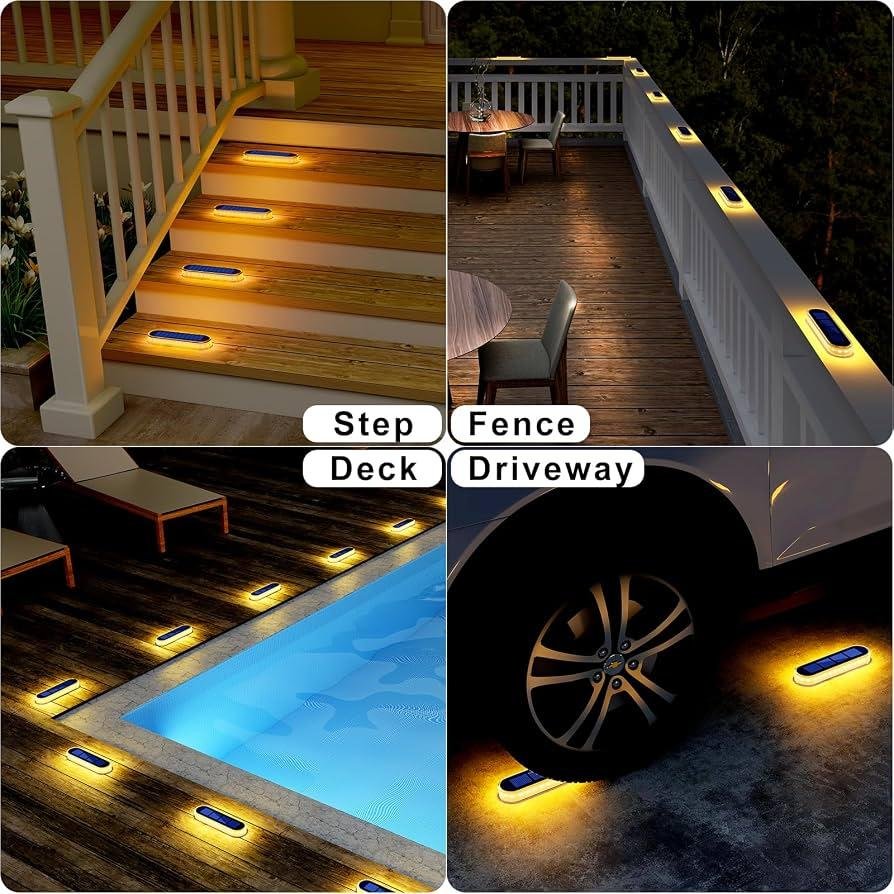
- Decks and steps: safe footing without wiring.
- Driveway edges: markers that show where the pavement ends.
- Garden paths: soft guide lighting.
- Patios and docks: low glow that doesn’t wreck your night vision.
If you want pure decoration, star solar lights add a playful touch to the same spaces.
How We Picked These Lights
Here is what this guide is, and what it isn’t. We did not lab-test these lights. We compared published specs, product manuals, retailer listings and one independent hands-on review.
What we checked:
- Stated lumens. Brightness numbers show who is being honest.
- IP rating. The standard behind it is IEC 60529.
- Battery type. A swappable battery means a longer useful life.
- Warranty. A longer warranty signals more confidence.
- Spec consistency. Similar-looking lights with wildly different claims get a skeptical look.
What we didn’t do: measure lux, time battery runtime or run over anything with a car. When you see a lumen figure here, it is the maker’s number.
Best Flat Solar Lights in 2026: Our Top Picks
Ring Solar Steplight: Best Overall for Steps and Decks

Who it’s for: Homeowners who want safety lighting on stairs and decks, especially anyone already in the Ring ecosystem.
Rated lumens: Up to 50 (manufacturer). Not measured by us.
Specs: IP66 weather resistance. Operating range of -4°F to 122°F. Rechargeable 18650 lithium-ion battery that can also charge by micro-USB. Motion detection with adjustable settings.
Pros:
- Strong rated output for this category
- Wide temperature range suits cold winters
- Replaceable, rechargeable battery
- Motion detection saves battery
Cons:
- The smart features need a Ring Bridge or compatible device, sold separately
- One published hands-on review called setup a hassle, mostly because of the Bridge
- That same review found the light tone cool white, not warm
- Costs more than basic solar step lights
Price and where to buy: Around $30 per light, sold through Ring and major US retailers. Prices change, so check before you buy.
SOLPEX Ground Disc Lights: Best Budget for Paths and Patios
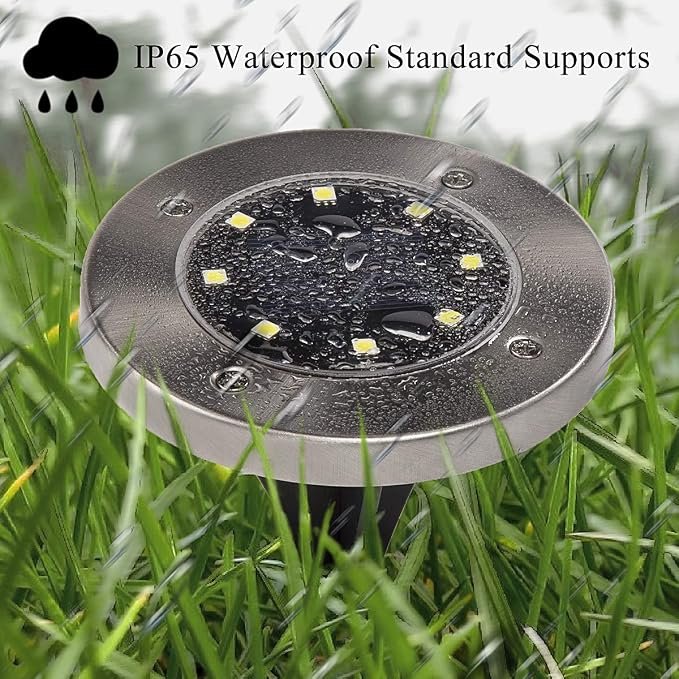
Who it’s for: Anyone who wants cheap markers along a path, patio edge or garden border.
Rated lumens: 5 (retailer listing). That is a glow, not a beam.
Specs (as listed): 8 LEDs per light. Automatic dusk-to-dawn sensor. About 4–6 hours to charge and 8–10 hours of light.
Pros:
- Very low cost per light
- Small and easy to place
- Simple, no-wiring install
Cons:
- 5 lumens marks a path but doesn’t light it
- Listings for similar-looking discs disagree on battery size (400 to 600 mAh) and IP rating (IP65 to IP68)
- Plastic discs aren’t the best choice for tire traffic
Price and where to buy: The 10-pack listed at about $24, often discounted, through online marketplaces.
VEVOR Solar Driveway Lights: Best for Driveways
Who it’s for: People who want markers along a driveway or dock edge that can handle some pressure.
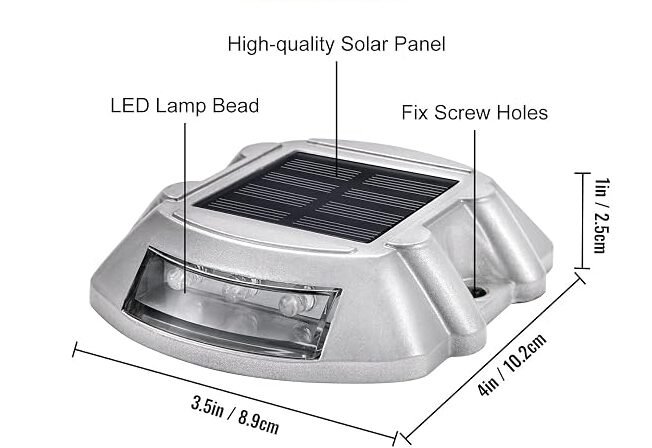
Specs (as listed by the maker): Die-cast aluminum shell. 6 LEDs. 600 mAh NiMH battery. IP68. Working temperature of -4°F to 158°F. Size of about 3.5 x 4 x 1 inch. Has an on/off switch.
Rated output: The maker cites 400–500 lux and doesn’t publish lumens.
Pros:
- Metal body suits tough spots
- On/off switch for storage and setup
- Wide temperature range
Cons:
- Load claims are huge (45 tons) and unverified. Treat them as marketing, not a parking permit.
- Battery is small
- The “80 hours” runtime claim doesn’t say under which settings
- At about 1 inch tall, the light sits proud of the surface. A snowplow blade may find it.
Price and where to buy: About $31 for a 4-pack on the maker’s store, with listings at large US retailers.
Dock Edge Dock and Deck Solar Lights: Best for Docks and Light-Traffic Decks

Who it’s for: Boat docks, deck edges and walkways with foot traffic only.
Rated lumens: 5 (retailer listing).
Specs (as listed): Low-profile, weatherproof, comes on automatically at dusk. Up to 8 hours of light. Described as withstanding moderate traffic.
Pros:
- Simple and slim
- No wiring
- Built with docks and decks in mind
Cons:
- 5 lumens is marker-level light
- No published IP rating or battery details
- Not for driving over
Price and where to buy: About $29–$33 for a 2-pack at boating retailers.
Separate-Panel Deck Light Kits: Best for Shade
Who it’s for: Decks and steps that get little direct sun.
In a separate-panel kit, small flush lights run on a cable from one panel you mount in a sunny spot. That fixes the biggest flat-light problem: a shaded panel.
What to look for: A panel on a cable, replaceable batteries, an IP65–IP67 rating and a clear warranty. Some kits list around 16 feet (5 m) of cable from the panel to the first light.
Why there’s no brand pick: I couldn’t verify specs for a US-available option, so I won’t name one. Check the US warranty and shipping before you buy.
What to Avoid: Claims That Should Make You Squint
Some solar light listings read like fiction. Watch for these:
- “Super bright” with no lumens. If the maker won’t give a number, expect a low one.
- Mismatched IP ratings. Two near-identical discs can claim IP65 and IP68. Ask which is real.
- Absurd load ratings. Listings claim 10, 20 or even 45 tons. One listing for a 20-ton light still warns against repeated vehicle runovers.
- Vague runtimes. “Up to 80 hours” can hide a dim or flashing mode.
- Short warranties. One disc-light listing I saw gave a one-month warranty.
- No battery spec. If you can’t tell what battery is inside, you can’t replace it.
How to Choose the Best Flat Solar Lights
Brightness (Lumens Explained)
Lumens measure total light output. For context, ENERGY STAR equates about 450 lumens to a 40-watt traditional bulb. A 5-lumen disc is a marker. A 50-lumen step light is useful for stairs.
Battery Type and Run Time
Most small flat lights use NiMH batteries. Manufacturers and lighting guides put replacement at roughly every 1–3 years. One major retailer’s manual recommends swapping a 600 mAh NiMH cell every 3 years or when performance drops.
Lithium-ion cells, like the one in the Ring, hold more energy in a smaller space and often cost more.
Solar Panel Size and Charging Time
Manuals generally call for 6–8 hours of direct sun a day. One retailer’s manual asks for at least 8. Some ask for a 10–12 hour first charge. A bigger or remote panel helps in partial shade.
Waterproof Rating (IP65 vs. IP67 vs. IP68)
IP ratings follow the IEC 60529 standard. The first digit covers dust, and the second covers water:
- IP65/IP66: protected against water jets. Fine for rain.
- IP67: survives temporary immersion up to 1 meter for 30 minutes. Good for puddles and snowmelt.
- IP68: deeper or longer immersion, but the exact conditions come from the manufacturer.
Drive-Over Weight Rating
No single standard governs the load claims on consumer lights. Choose metal bodies for any vehicle contact. Don’t trust a huge number with no test info. When in doubt, mark the edge instead of driving over the light.
Warm White vs. Cool White Light
Warm white (around 3000K) looks cozy on decks. Cool white (4000K and up) reads brighter but harsher. Some lights let you switch between the two.
Sensors and Modes (Auto Dusk-to-Dawn, Motion)
Dusk-to-dawn lights stay on all night. Motion lights save battery and boost brightness when triggered. Pick motion for steps and security. Pick dusk-to-dawn for markers.
Do Flat Solar Lights Work in Shade, Winter or Cloudy Weather?
Yes, but at a reduced level. Solar lights still charge in cloud, just more slowly.
Shade: A panel in shade gives you a short, dim night. Fix it with a remote-panel kit or move the light.
Winter: Shorter days mean less charge. Manuals also say to keep snow and debris off the panel. If snow covers a light for a long time, give it 10–12 hours of direct sun to recover.
Cold: Check the operating range. The Ring Solar Steplight lists -4°F to 122°F.
Placement tips:
- Trim back plants that block the sun
- Wipe the panel clean
- Face the panel toward the open sky
- Test after setup by covering the panel with your hand to trigger the sensor
How to Install Flat Solar Lights
On Decks and Steps
- Pull the battery tab or flip the switch on.
- Hold the light in place and mark the screw holes.
- Screw it down. Use adhesive only on smooth, clean surfaces.
- Cover the panel to test the sensor.
On Driveways and Paving
- Plan spacing along the edge before you drill.
- Use screws or masonry anchors rated for the surface.
- Keep lights out of the snowplow’s path where you can.
- Give them a full sunny day to charge before judging the night result.
On Grass or Gravel
Many disc lights come with a short stake or plug. Push them into the ground flush with the surface. Keep grass trimmed so it doesn’t shade the panel.
Why Do Solar Lights Stop Working? (Troubleshooting)
Solar lights work great in the store and then take a vacation in January. Run this checklist before you throw them out:
- Switch or tab: Is the light switched on? Did you pull the plastic battery tab?
- Dirty or shaded panel: Wipe it. Move it or trim the plants.
- Dead battery: Replace it with the same type and voltage. Don’t use non-rechargeable alkaline cells, which fail within months in solar lights.
- Moisture inside: Water ingress usually means a failed seal. Replace the light.
- Fooled sensor: A nearby lamp can keep the light sensor from switching on at dusk.
- Not enough charge: After new batteries, give it a full sunny day before testing.
How Long Do Flat Solar Lights Last? (Maintenance and Battery Replacement)
The housing can outlast the battery. NiMH batteries typically need replacing every 1–3 years. Some makers claim 3–5 years of working life, which is a claim, not a test result.
Care routine:
- Clean the panel every few weeks
- Brush off snow and leaves
- Check the seal and screws each season
- Swap the battery when run time drops
If the battery isn’t replaceable, the light is disposable. Check before you buy.
Are Flat Solar Lights Worth It? (Cost vs. Wired Lighting)
| Solar | Low-Voltage Wired | Mains Wired | |
|---|---|---|---|
| Upfront cost | Low | Medium | Highest |
| Installation | Screw or press in | Needs transformer and wire | Electrician and permits |
| Brightness | Low to moderate | Moderate | Highest |
| Running cost | None, but battery swaps | Small electricity cost | Electricity cost |
| Best for | Easy markers and safety | Larger lit projects | Permanent security lighting |
Prices in the listings above run from about $1–$2 for a basic disc to about $30 for a smart step light. Solar wins when wiring would be a headache. It loses when you need real brightness.
FAQs
What is the difference between flat and stake lights?
Flat lights sit on or in a surface and keep a low profile. Stake lights push into soil and stick up. Flat suits steps, decks and drives. Stake suits garden beds.
Can I replace the battery?
Most can, but check first. Use the same type and voltage. Some sealed lights have no replaceable battery.
How long do the batteries last?
Plan on 1–3 years for typical NiMH batteries. Lithium-ion cells can run longer. Runtime per night is often 8–10 hours on a full charge.
How bright are flat solar lights?
Listings show about 5 lumens for basic discs and up to 50 lumens for step lights. A 40-watt-equivalent bulb is about 450 lumens, so flat solar lights give accent light, not floodlight.
Do flat solar lights work without direct sun?
They charge more slowly in cloud or shade, so run time drops. A remote-panel kit lets you put the panel in a sunny spot.
Can you drive over flat solar lights?
Only if the maker designs them for it. Metal dock-style lights are made for this, but load claims vary wildly and rarely come with test proof. Plastic discs are for foot traffic.
Are flat solar lights waterproof?
Most carry an IP rating between IP65 and IP68. IP65 and IP66 handle rain. IP67 handles temporary immersion in about 1 meter of water for 30 minutes. IP68 allows deeper immersion, with the details set by the maker.
Summary
For steps and decks, the Ring Solar Steplight is the best all-rounder, thanks to its 50-lumen rating, IP66 protection and wide temperature range. For driveways, a metal dock-style light like the VEVOR set makes sense, but ignore the tonnage claims. For cheap path markers, a SOLPEX disc pack does the job, just don’t expect it to light anything.
Buy for your real problem: markers, safety light or driveway edge. Then plan for a battery swap in a year or three.
Sources and method: IEC 60529 (ingress protection standard); ENERGY STAR lumen equivalence guidance; manufacturer spec pages for Ring; manufacturer and retailer listings for SOLPEX, VEVOR and Dock Edge; product manuals from major US home-improvement retailers; one published independent hands-on review of the Ring Solar Steplight. Specs are as listed by manufacturers or retailers and were not independently measured.