Table of Contents
A 12W bulb should beat a 9W bulb that’s the assumption almost everyone carries into this question, and for decades of incandescent lighting it was a safe one. Solar lighting breaks that assumption, and the 9W vs 12W solar light comparison has more to do with how LEDs work than anything specific to solar power itself.
Wattage vs. Lumens: Why Watts Don’t Tell You Brightness
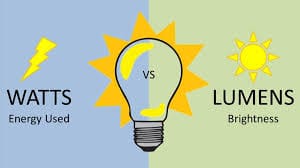
Watts measure energy draw. Lumens measure visible light output. With incandescent bulbs, these two numbers tracked each other closely, because filament bulbs convert energy to light at a fairly fixed, low rate — more watts in meant more light out, reliably.
LEDs broke that relationship. They produce light through a semiconductor process where the conversion rate isn’t fixed — it varies by chip quality and design, sometimes by 30-50% between a cheap chip and a well-engineered one at the same wattage. That variability is the entire reason a 9W and 12W solar light can land at similar, or even reversed, brightness levels.
What Actually Determines a Solar Light’s Brightness
Four things shape the brightness you actually see at night, and wattage isn’t directly one of them.
LED Efficiency
Efficiency is measured in lumens per watt — a number that tells you far more than wattage alone. A decent chip lands around 80-130 lm/W; cheaper chips fall well under that. A 9W fixture with a 130 lm/W chip can outproduce a 12W fixture stuck near 80 lm/W, which is the core mechanic behind this entire comparison.
Solar Panel Power and Battery Capacity
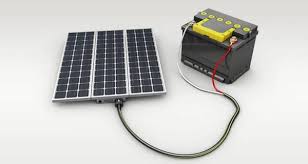
The LED’s ceiling only gets reached if the battery stays charged. A panel too small for its battery never fully tops up, and a fixture running on partial charge dims regardless of how good its LED chip is. Many underperforming solar lights aren’t failing because of the LED — they’re failing because the energy storage behind it never gets properly filled.
Driver/Controller Quality
The controller regulates current flow from battery to LED. A weak controller lets voltage sag as the battery depletes, causing visible dimming over the course of the night even though the LED itself hasn’t changed. A better controller holds a flatter brightness curve from dusk to dawn.
9W vs 12W Solar Lights: Lumen Output Compared
As a general market pattern, not a fixed rule, 9W fixtures often fall around 700–1,200 lumens, and 12W fixtures often fall around 900–1,600 lumens. These ranges overlap by a wide margin, and where a specific product lands within its range depends on the three factors above not on the wattage printed on the box.
That overlap is the real answer to “which is brighter”: a well-built 9W light at the top of its range will outperform a poorly-built 12W light at the bottom of its range.
Lumens vs Lux: Brightness vs Ground Illumination
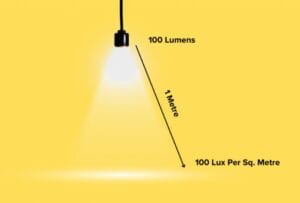
Lumens measure total light leaving the fixture in every direction. Lux measures how much of that light actually lands on a given surface.
A fixture spreading its lumens across a wide arc puts less light on any single patch of ground than one focusing the same lumens into a tight beam. That’s why a lower-lumen light with a narrow beam can light up a doorstep more intensely than a higher-lumen light with a wide, scattered beam — total output and what you actually see on the ground are not the same thing.
When a 9W Light Can Outshine a 12W Light
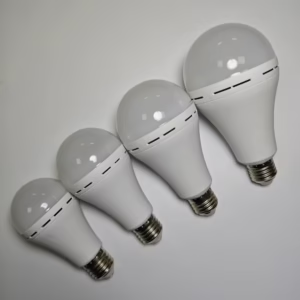
This shows up consistently in independent product comparisons, usually from some combination of these factors:
The 9W unit’s LED chip is meaningfully more efficient — a 20-30% efficiency gap between a good and mediocre chip at the same price point isn’t unusual. Its battery is properly sized for its draw, so output holds for six or eight hours instead of fading after two. Its beam is focused rather than scattered, putting more lux where it’s actually needed.
Meanwhile, the 12W competitor’s lumen claim sometimes comes from a measurement taken in the first few minutes of operation rather than sustained output through the night — a detail that rarely shows up on the packaging.
How to Choose Between 9W and 12W for Your Space

Assess Your Lighting Needs
Start with the space, not the spec sheet. A narrow garden path or fence line generally needs only enough light to mark the route — even, low-level illumination works better here than a bright hot spot. A driveway entrance or a wider gate area usually needs more reach and a steadier output through the full night, since the area being lit is larger and the consequences of dim coverage are more noticeable.
Match Wattage and Lumens to Application
Once the space is defined, match the fixture to the job rather than to the bigger number. Pathway and garden lighting tend to work well with a focused 9W unit if its battery and chip are solid. Driveways, gates, and security corners tend to benefit from a 12W unit, but only if its battery is sized to match the LED’s draw — a 12W light with an undersized battery offers no real advantage over a well-built 9W one.
Industry Standards and Benchmarks for Lumen Performance

Lumens-per-watt is the most useful single benchmark for comparing solar lights, since it accounts for efficiency rather than raw power draw. A figure in the 80-130 lm/W range is typical for a reasonably built fixture; figures well outside that range, especially unusually high ones paired with a low price, are worth treating with some skepticism unless backed by independent testing.
Battery chemistry is a secondary but meaningful benchmark. LiFePO4 batteries generally hold capacity longer over repeated charge cycles than standard lithium-ion batteries used in cheaper outdoor fixtures, which affects how consistent brightness stays over the life of the product, not just on day one.
FAQs
Is 12W solar light always brighter than 9W?
No. A 12W light has a higher output ceiling on paper, but actual brightness depends on LED efficiency, battery sizing, beam angle, and controller quality. A well-built 9W fixture regularly matches or exceeds a poorly-built 12W one.
How many lumens do I need for pathway or security lighting?
Pathway lighting generally works well in the 100-300 lumen range per fixture, spread evenly along the route. Security lighting usually needs more, often starting around 700 lumens, concentrated on a specific area rather than spread wide.
How can I verify a solar light’s actual lumen output?
Look for lumens-per-watt figures and independent test results rather than relying on the manufacturer’s peak claim alone. Reviews that describe brightness several hours into the night, not just at switch-on, are a more reliable signal than the number on the box.
Conclusion
Wattage tells you how much energy a solar light pulls in — not how much usable light it puts out at 9pm on a cloudy night. That conversion depends on LED efficiency, battery sizing, controller behavior, and beam optics, none of which the watt figure captures. A 12W light carries a higher ceiling, but a well-engineered 9W light routinely reaches or beats it in practice. Check lumens, lux, battery type, and beam angle before wattage, and the right choice gets a lot clearer.