
The Author
Table of Contents
Solar panels get all the attention. The organization fighting for your right to install them, cheaply and without a mountain of red tape, gets almost none.
That organization is SEIA, the Solar Energy Industries Association. If you’ve ever benefited from a solar tax credit, or watched your state expand its net metering rules, there’s a good chance SEIA had a hand in it.
This guide covers what SEIA actually does, who runs it, and why its work matters right now, including the parts of 2026 that haven’t been easy.
Quick Facts
- Founded: 1974, Washington, D.C.
- Members: 1,200+ companies
- Current President & CEO: Tim Pawlenty (since June 15, 2026)
- U.S. solar capacity added in 2025: 43 GW
- Cumulative U.S. solar installations: over 6 million
- Manufacturing target: 100 GW of renewable manufacturing capacity, including 50 GW of solar, by 2030
What Is SEIA? (History, Mission & Leadership)
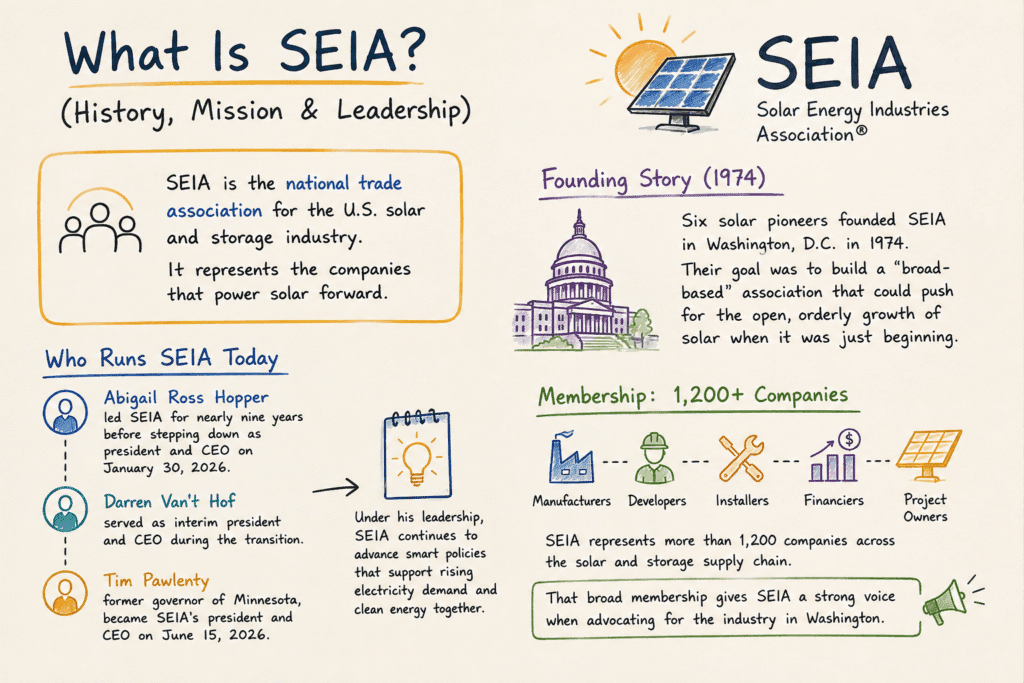
SEIA is the national trade association for the U.S. solar and storage industry. It doesn’t sell panels or install anything. It represents the companies that do.
Founding Story (1974)
Six solar pioneers founded SEIA in Washington, D.C. in 1974. Their goal was to build a “broad-based” association that could push for the open, orderly growth of solar at a time when the technology barely registered nationally.
Fifty years later, solar generates more U.S. electricity than coal did for the first time in the country’s history, as of May 2026. The industry SEIA’s founders imagined actually happened.
Who Runs SEIA Today
Leadership has changed hands twice in 2026. Abigail Ross Hopper led SEIA for nearly nine years before stepping down as president and CEO on January 30, 2026. Darren Van’t Hof then served as interim president and CEO, keeping the organization steady during the transition.
Tim Pawlenty, a former Minnesota governor, took over as SEIA’s president and CEO on June 15, 2026. Under his leadership, SEIA has continued pushing for policy that treats rising electricity demand and clean energy as the same problem, not competing ones.
Membership: 1,200+ Companies
SEIA’s members span the entire solar and storage supply chain, manufacturers, developers, installers, financiers, and utility-scale project owners. Balancing that many interests under one roof isn’t simple, but it’s also exactly why SEIA carries weight in Washington. A group representing every link in the chain is harder to ignore than one representing just installers.
What Does SEIA Actually Do? (Its Four Core Pillars)
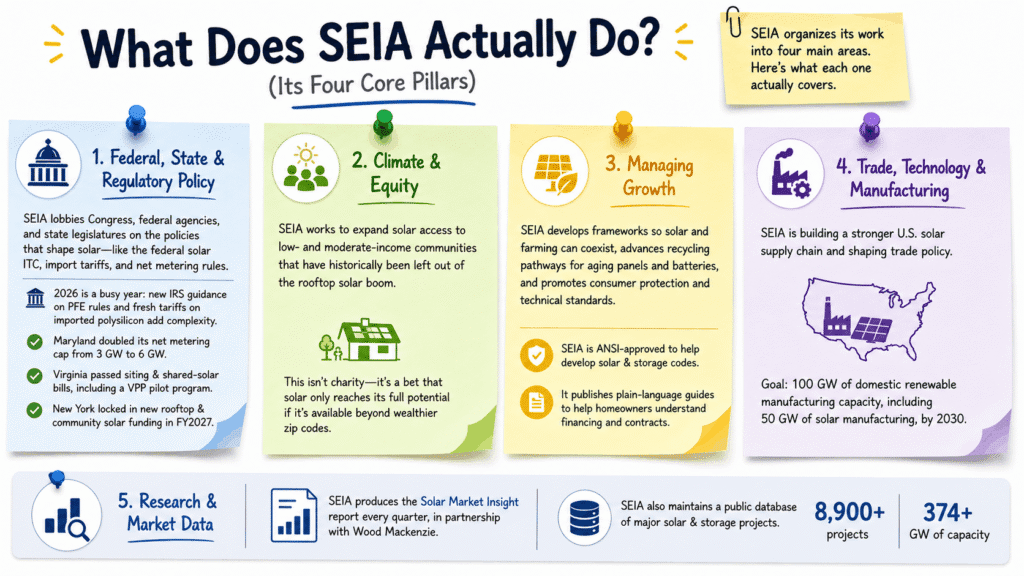
SEIA organizes its work into four main areas. Here’s what each one actually covers.
Federal, State & Regulatory Policy
This is SEIA’s largest and most visible function. SEIA lobbies Congress, federal agencies, and state legislatures on issues like the federal solar Investment Tax Credit (ITC), import tariffs, and net metering rules.
2026 has kept this team busy. New Treasury and IRS guidance on Prohibited Foreign Entity (PFE) provisions under the 2025 tax law, along with fresh tariffs on imported polysilicon, have added real complexity for solar companies to navigate.
At the state level, SEIA has notched concrete wins this year. Maryland’s Utility RELIEF Act doubled the state’s net metering cap from 3 GW to 6 GW. Virginia passed a package of siting and shared-solar bills, including a virtual power plant pilot program. New York locked in fresh commitments to rooftop and community solar in its FY2027 state budget.
Climate & Equity
SEIA works to expand solar access to low- and moderate-income communities that have historically been left out of the rooftop solar boom. This isn’t charity, it’s a bet that solar only reaches its full potential if it’s available beyond wealthier zip codes.
Managing Growth
Utility-scale solar needs land, and land use creates friction with agriculture, conservation, and local communities. SEIA works on frameworks meant to let solar and farming coexist rather than compete, plus recycling pathways for aging panels and batteries.
This pillar also covers consumer protection and technical standards. SEIA has been approved by the American National Standards Institute (ANSI) to help develop solar and storage codes, and it publishes plain-language guides that walk homeowners through financing and contracts before they sign anything.
Trade, Technology & Manufacturing
SEIA has set a target of 100 GW of domestic renewable manufacturing capacity, including 50 GW of solar manufacturing, by 2030. This pillar covers trade policy, tariff response, and building out a U.S.-based supply chain instead of relying entirely on imports.
Research & Market Data
longside its four pillars, SEIA produces the Solar Market Insight report every quarter, in partnership with Wood Mackenzie. It’s treated across the industry as the definitive source for U.S. solar installation data. SEIA also maintains a public database of major solar and storage projects, currently tracking more than 8,900 projects and over 374 GW of capacity.
Why SEIA Matters in 2026
The honest answer requires looking at both the record growth and the real friction the industry is hitting.
The Growth Numbers
In the first quarter of 2026, solar and storage combined made up 91% of all new U.S. electricity-generating capacity. In May 2026, solar generated more electricity than coal in the United States for the first time ever. The U.S. passed 6 million cumulative solar installations in 2026, just two years after hitting 5 million.
None of that happens by accident. It happens because organizations like SEIA keep pushing policy in solar’s favor, year after year.
The Headwinds Making Advocacy More Important
2026 hasn’t been a straight line up. SEIA’s own Q2 2026 market report projects a roughly 21% contraction in residential solar this year, driven by the bankruptcy of one of the industry’s largest national installers, tighter tax-equity financing, and new federal tax-credit compliance requirements.
This is exactly the environment where a trade association earns its keep. When financing gets harder and rules get more complex, SEIA’s job is to fight for the policy conditions that let the industry recover and keep growing through 2027 and beyond.
How to Join or Work With SEIA
SEIA membership isn’t limited to giant manufacturers. Installers, developers, and smaller solar businesses join too, often alongside their state-level solar association for more local relevance.
Membership Levels and Benefits
Membership dues fund SEIA’s lobbying, research, and standards work. In return, members get access to detailed market data, industry events like RE+, and a voice in setting SEIA’s policy priorities.
Consumer Resources (No Membership Needed)
You don’t need to be a SEIA member to benefit from its work. Homeowners can use SEIA’s free consumer guides to understand solar financing and contract terms before signing anything.
FAQs
More Solar Guides Worth Reading
Environmental Impact
- Why Farmers Oppose Solar Panels, 7 real reasons behind the pushback
- How Much CO2 Is Saved by Solar?, the real numbers explained
- Are Solar Lights Environmentally Friendly?, the full truth
- How to Recycle Old Solar Panels & Batteries
Global & Industry
- Sinn Power’s Floating Solar (SKIPP), how the technology works
- How Plug-In Solar Works, a 2026 guide
- Federal Solar Tax Credit (ITC) 2026 Explained
US State Incentives
- Solar Incentives by State (50-State Guide)
- Maryland Solar Incentives 2026, grants, tax credits, and rebates
Summary
SEIA won’t install your panels, and it won’t send a technician to your roof. What it does is quieter but arguably more important: it fights for the policies that decide whether solar stays affordable, whether your state expands incentives, and whether the industry can push through a rough patch like 2026 and keep growing.
The next time a tax credit or a state incentive saves you money on solar, there’s a decent chance a group you’d never heard of, until now, helped make that happen.