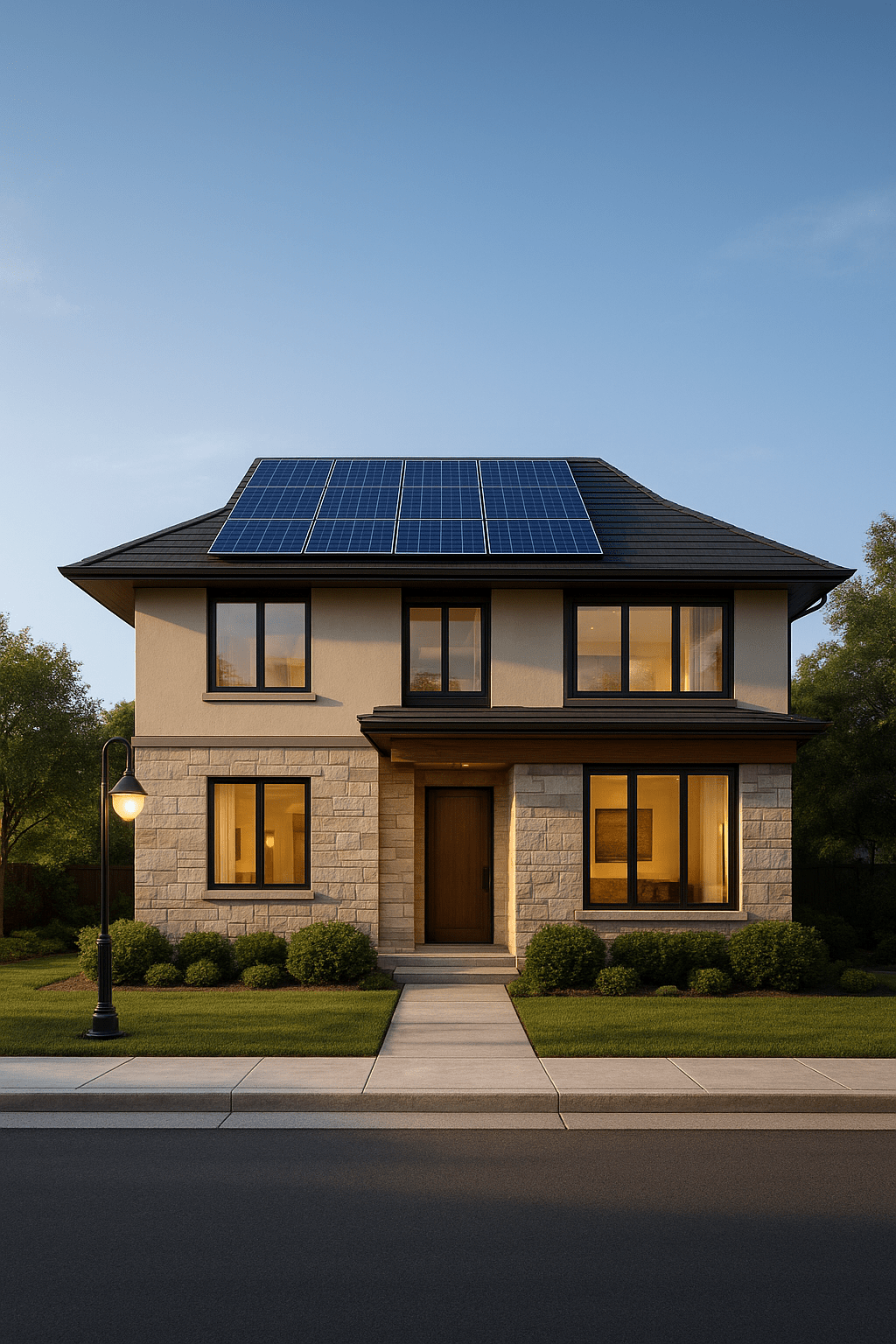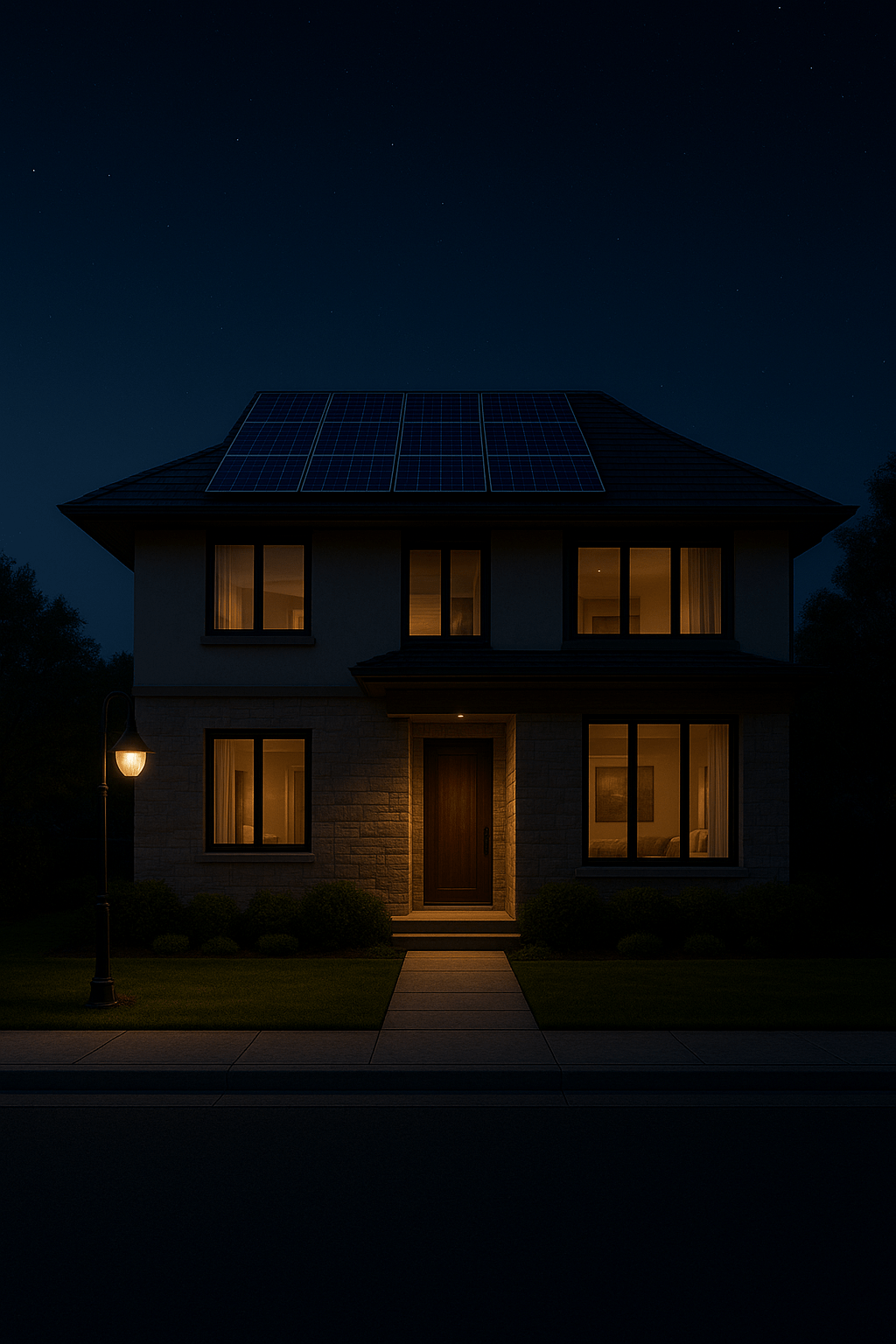
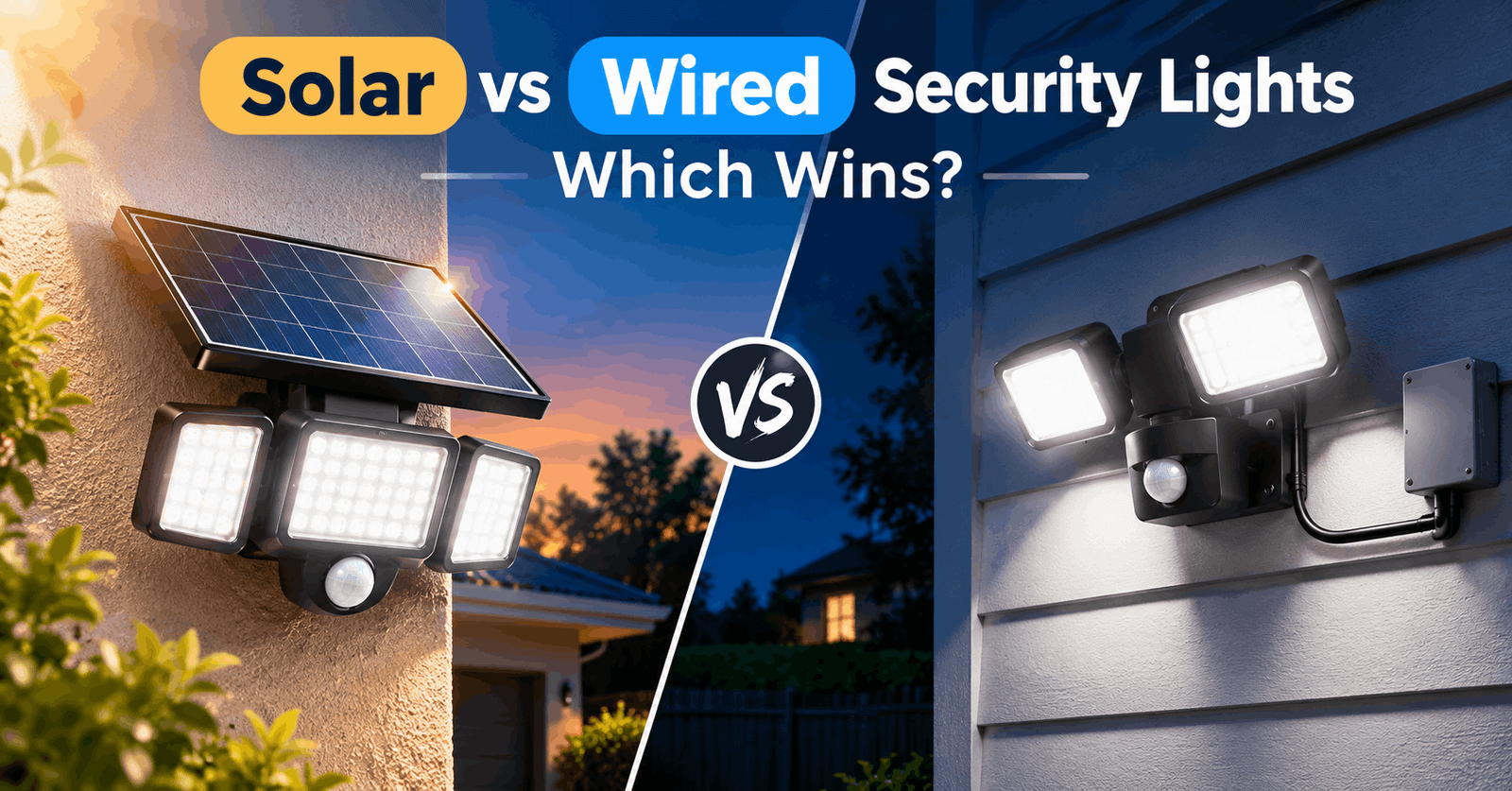
Quick Answer: Solar security lights win on easy installation, zero power bills, and flexible placement. Wired lights win on steady brightness, bad weather, and main entrances, so most homes do best with wired at the doors and solar at the edges.
Myth: One type of security light beats the other everywhere.
Reality: It depends on your sun, your wiring, and the spot you’re guarding.
Here’s the short version of solar vs wired security lights. Solar wins on easy installation, no power bill, and placement far from the house. Wired wins on steady brightness, bad weather, and the doors you can’t leave dark. Most homes do best with both.
Key Takeaways
- Wired suits main entrances, driveways, and shaded homes.
- Solar suits sheds, gates, fence lines, and renters.
- A pro install of a motion sensor light averages about $425. Running it costs far less per year (math below).
- Lights deter some burglars, not all. Where you point the light matters as much as how it gets power.
Quick Answer: Which Should You Choose?
| Best for | Pick |
|---|---|
| Front door, garage, and driveway you use every night | Wired |
| Shaded house or cloudy winters | Wired |
| Shed, gate, or fence line far from power | Solar |
| Renters and quick fixes with no electrician | Solar |
| Full coverage on a budget | Both (hybrid) |
Solar vs Wired Security Lights at a Glance
| Solar | Wired |
|---|---|
| Install: stick it on a wall or pole, no wiring | Install: needs a circuit, often an electrician |
| Running cost: none | Running cost: small power bill |
| Brightness: depends on the battery’s charge | Brightness: steady every night |
| Weather: weaker in winter and under clouds | Weather: unaffected |
| Power cuts: keeps working, since it skips the grid | Power cuts: goes dark without a backup |
| Upkeep: battery swaps, occasional panel wiping | Upkeep: very little |
How Each Type Works
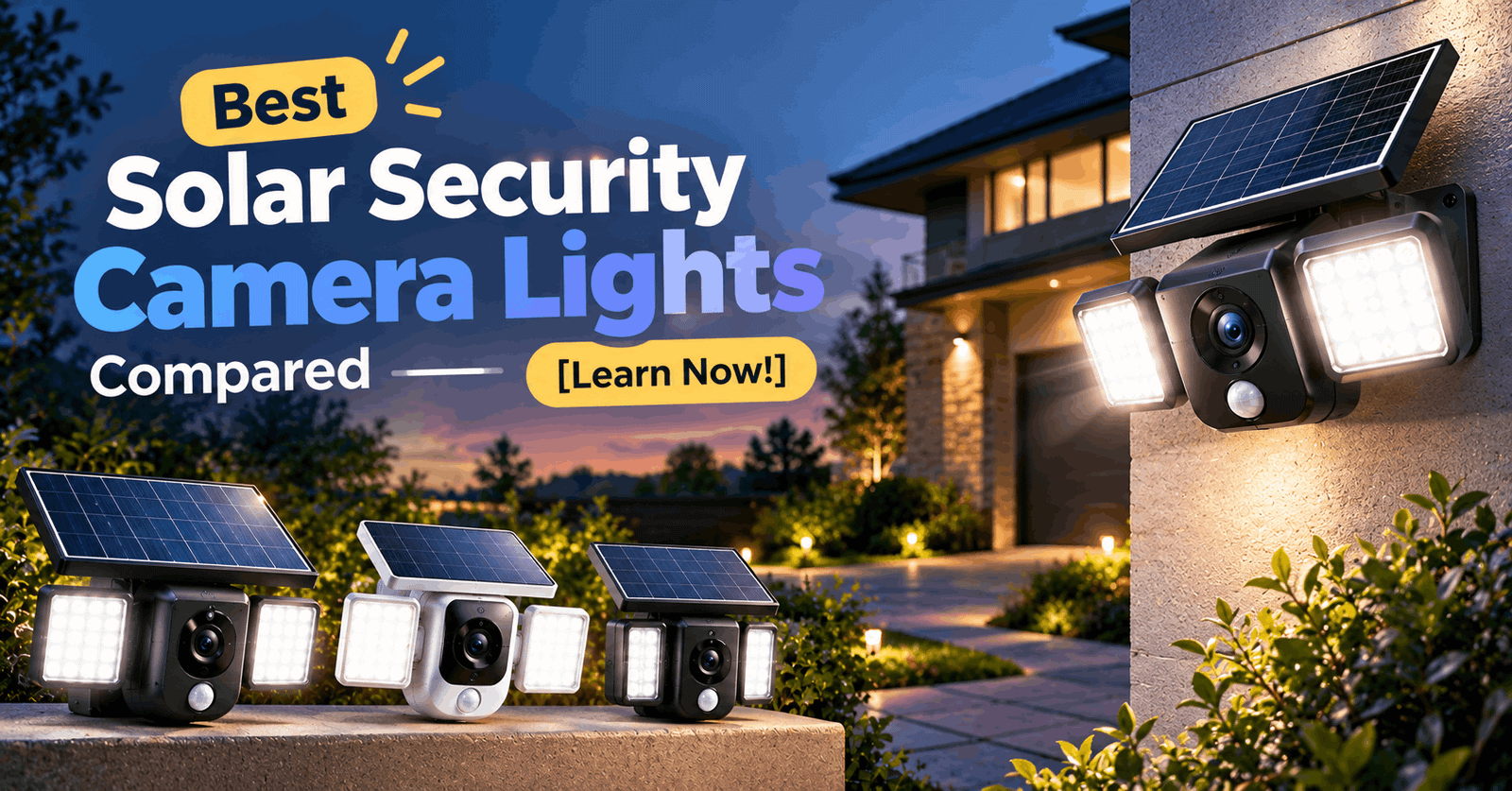
A solar security light has a small panel, a battery, an LED, and a motion sensor. The panel fills the battery by day. The battery runs the light at night.
A wired light skips all that. It pulls power straight from your home’s circuit, so it never “runs out.”
That one difference explains almost everything below.
Brightness: What the Numbers Mean
Lumens measure how much light a fixture puts out. There’s no single official target, and guides disagree. One electrician’s guide suggests 400 to 600 lumens for a front door and 1,000 to 1,500 for driveways and garages. Another says most outdoor security lights fall between 700 and 2,500 lumens. Some contractors say 700 to 1,300 is plenty for a home.
Treat that as a rough range, not a rule. Also check the beam angle and the sensor range on the box.
Solar adds one wrinkle. The light spends its day filling a small battery. Cloudy days mean less energy reaches the panel, so the light can run dimmer or shorter. A light that’s dead at 2 a.m. is just a garden ornament with trust issues.
Winter, Clouds, and Power Cuts
Manufacturers say most solar lights need about 6 to 8 hours of direct sun for a full charge. A spot under a tree or behind a wall won’t get that. One manufacturer’s instructions warn that solar lights work poorly in winter and on cloudy days.
Wired lights shrug off the weather. Their weak spot is the grid. When the power goes out, they go out with it, unless you add a battery backup.
What Each Type Really Costs
Wired: you pay once to install, then a little each month. National home service cost guides put professional installation of a motion sensor light at $350 to $500.
Running cost is small. A reviewer describes modern wired security lights as using around 25 to 30 watts. EIA data show the US residential average at 18.34 cents per kWh in June 2026. Here’s my own math from those two numbers:
- A 30-watt light on motion for 1 hour a night uses about 11 kWh a year. That’s roughly $2.
- The same light on for 10 hours every night uses about 110 kWh. That’s roughly $20.
Your rate and bulb will differ, so plug in your own.
Solar: no wiring bill and no power bill. The cost shows up later in batteries. Manufacturer figures vary. One lists NiMH batteries at 1 to 2 years and LiFePO4 at 3 to 5 years or more. Another puts NiMH at 2 to 3 years and LiFePO4 at 5 or more. A replacement runs about $10 to $30 per light.
Do Security Lights Actually Stop Burglars?
Partly. Be wary of anyone who promises more.
The strongest research covers street lighting, not home lights. A review of 13 US and UK studies tied improved street lighting to a 21 percent drop in crime. An updated review cut that figure to 14 percent. Researchers also note the evidence is mixed.
For home lights, criminologist Marcus Felson says lights help but won’t stop a break-in alone. A motion light works best when it lights up the intruder’s face. In an Australian study of convicted burglars, 22.8 percent said sensor lights deterred them.
So pick the light that will actually be on and aimed at the approach. Add locks, cameras, and nosy neighbors. That’s the real deterrent.
Where Each Type Earns Its Keep
Use wired lights where failure costs you: the front door, the garage, the driveway. One electrical contractor suggests solar for decorative features and pathways, and mains power for driveways, patios, and security.
Use solar where running a cable is a pain: the shed, the back gate, a far fence line. A dim solar light there beats no light.
That’s the hybrid setup. You get steady light at the doors and cheap coverage at the edges.
Common Mistakes
- Putting the panel in shade. It charges less, so the light runs shorter.
- Aiming at the wall. Point it at where a person would walk.
- Skipping the battery type. A cheap cell may need replacing within a couple of years.
- Treating the box as a lab test. Compare lumens, beam angle, and sensor range across brands.
FAQs
Are solar security lights as good as wired ones?
For brightness and consistency, no. For easy placement and zero running cost, yes.
Do solar security lights work in winter?
Yes, but for fewer hours. Shorter days and lower sun mean less charge, so expect shorter runtime.
How long do solar light batteries last?
Roughly 1 to 3 years for NiMH and 3 to 5 or more for LiFePO4, going by manufacturer figures.
Can I use solar and wired lights together?
Yes, and it’s often the smartest option. Put wired lights on the main entry points and solar on the far corners.
Summary
Choose wired where you need certainty. Choose solar where you need flexibility. If you have a front door and a back shed, you probably need both.
Sources
- U.S. Energy Information Administration, Electric Power Monthly, Table 5.6.A (June 2026): https://www.eia.gov/electricity/monthly/epm_table_grapher.php?t=epmt_5_6_a
- Campbell Collaboration, street lighting and crime: https://www.campbellcollaboration.org/review/effects-of-improved-street-lighting-on-crime/
- Welsh and Farrington update (Swedish National Council for Crime Prevention): https://bra.se/download/18.47bb43da192711ebb374ea5/1729505968738/2022_Effectiveness_of_Street_Lighting_in_Preventing_Crime_in_Public_Places.pdf
- Burglar deterrence: criminologist Marcus Felson and the Australian study of convicted burglars he references
- Installation, battery, and lumen figures: published manufacturer specifications and national home service cost guides, 2026