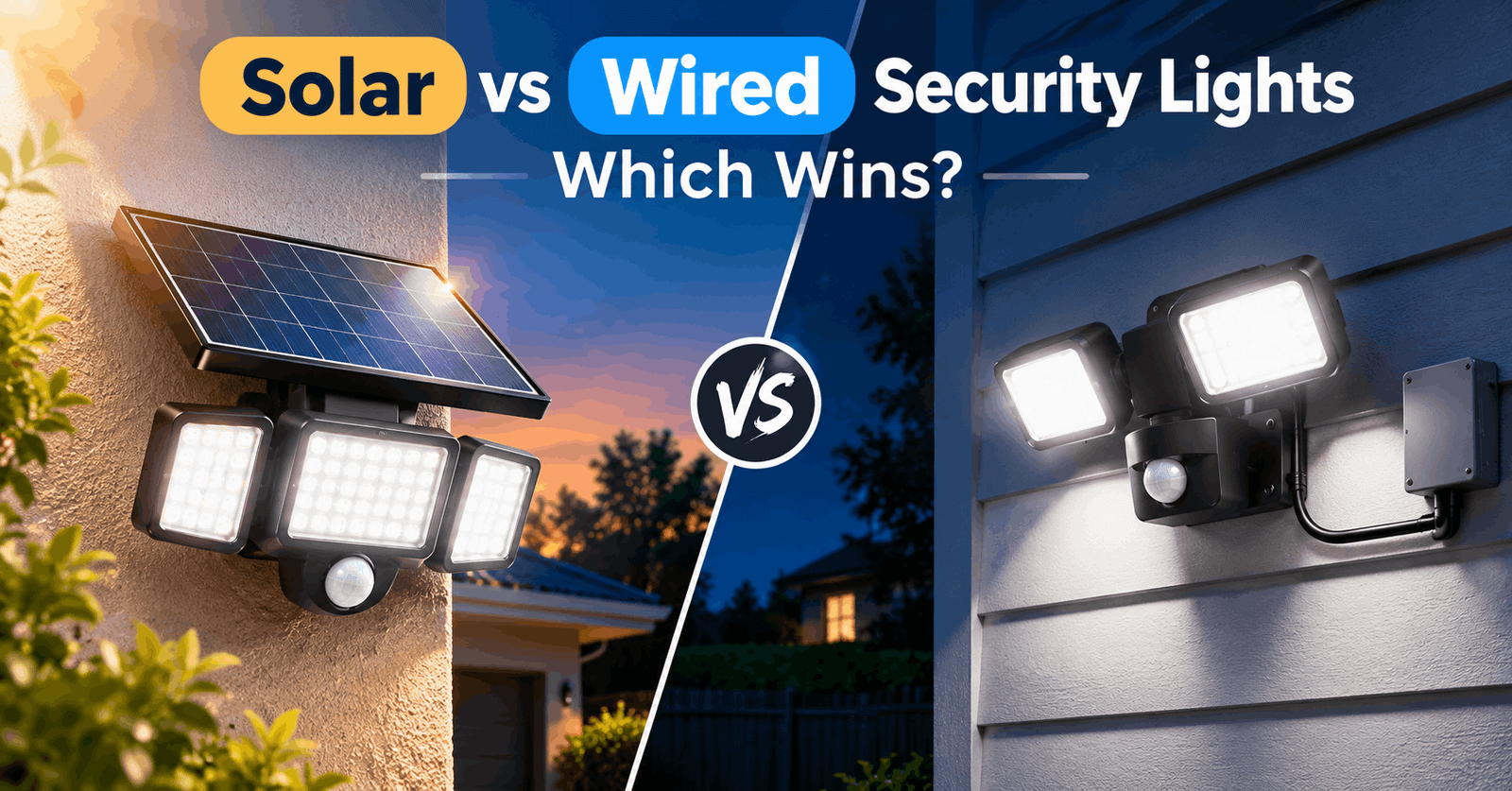
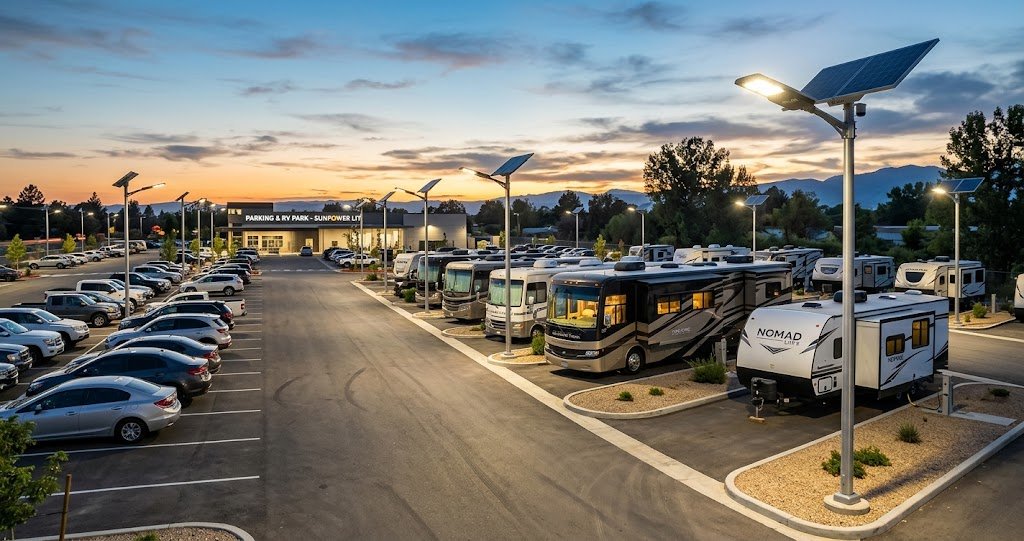
Quick Answer: The best solar lights for parking lots and RV parks are shielded, pole mounted area lights for lots, and dimmable, warm color fixtures for RV roads and paths. Size them for your darkest month of sun, not by headline wattage. Check panel watts, battery capacity, lumens and autonomy days.
Search for the best solar lights for parking lots and RV parks, and you get a wall of listings promising 10,000 watts for the price of a pizza. Useful, they are not.
This guide skips the hype. It covers how bright your lot needs to be, how to size for winter, which battery to pick, and where solar is the wrong call.
Quick Decision Table
| Best for | Fixture type to look for | Why |
|---|---|---|
| Large open commercial lots | Pole-mounted solar area light, fully shielded | Covers wide areas without trenching |
| Small lots and side areas | All-in-one solar area light | Panel, battery and controller sit in one unit, so installation is simpler |
| Entrances and corners | Motion-sensing solar flood light | Directed light where you need it |
| RV park roads | Shielded post-top or pole light, warm color, dimmable | Safe driving without a “runway” glow |
| Campsite paths and restrooms | Low bollards or dimmable fixtures with timers or motion sensors | Guests find the restroom without lighting up the sky |
How This Guide Was Built
I didn’t field-test products for this guide, so it won’t hand you a ranked list of brands. It compiles published standards, government guidance and manufacturer-reported figures, and each section names its source type. Check the numbers against your local code before you buy.
Do Solar Lights Work for Parking Lots?
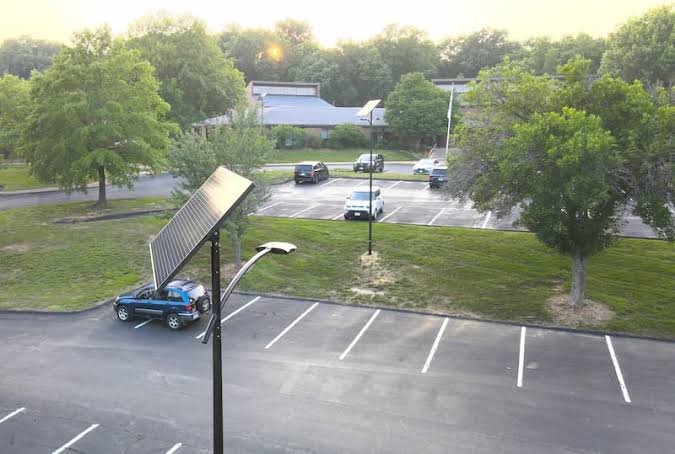
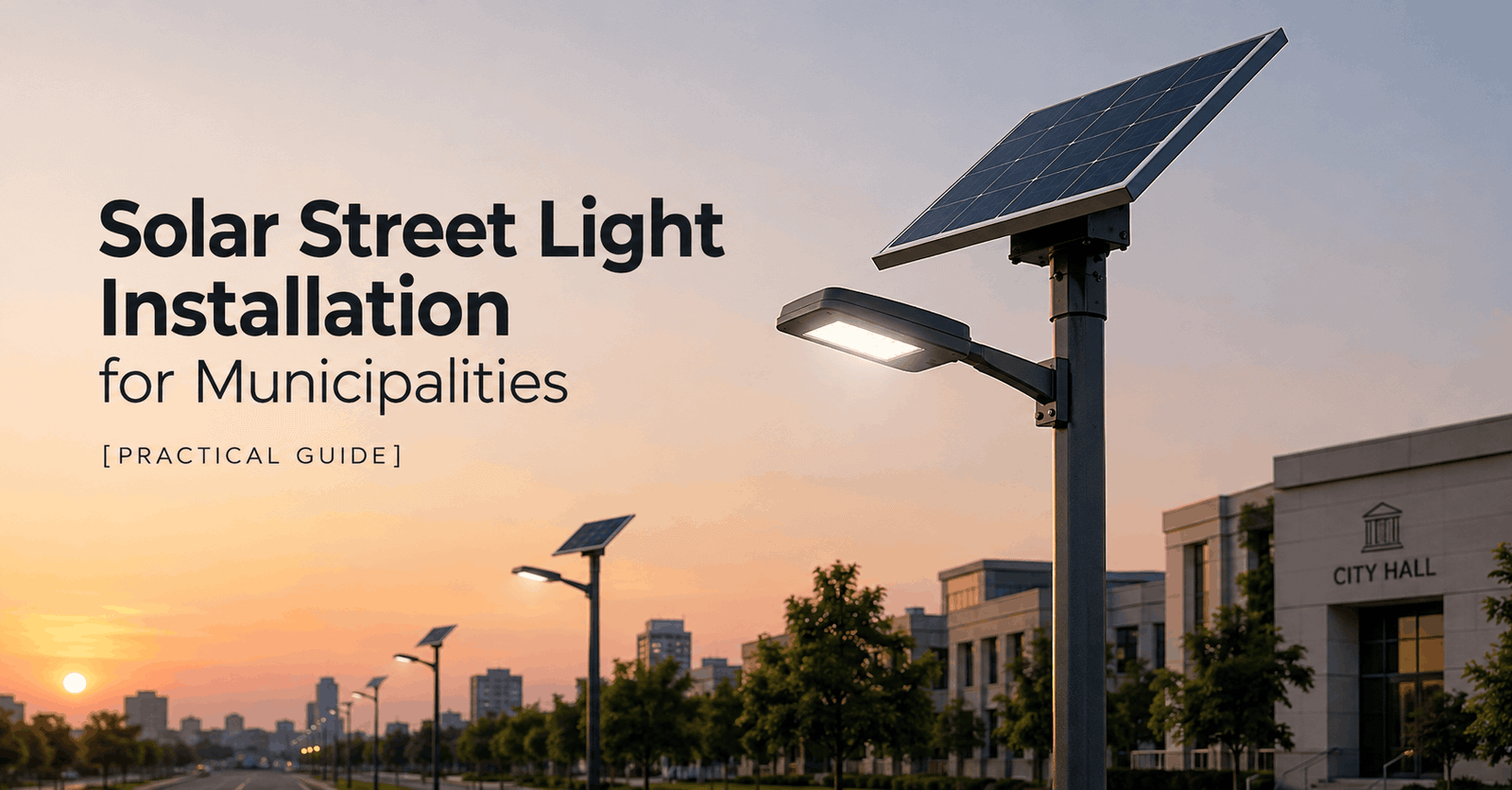
Yes, when someone sizes them properly. The big win is skipping the trench. Bringing grid power to a pole can involve trenching, conduit, wiring, panel work and surface restoration. A solar pole carries its own power instead.
The catch: solar lighting fails when the buyer shops by headline number. We’ll fix that below.
How Bright Should a Parking Lot Be?
Start with footcandles. One footcandle is one lumen spread over one square foot.
The Illuminating Engineering Society’s RP-20 is the main reference for commercial parking lot lighting. Published summaries of it vary by lot type and edition. One security-industry summary puts the minimum for regular lots at 0.2 footcandles horizontal, and 0.5 for lots needing enhanced security. Other publishers list higher averages, and busy sites such as hospitals and hotels often target more.
Ask your lighting designer or local authority which number applies to you.
Uniformity matters as much as brightness. A lot can hit its average target and still hide dark pockets between fixtures. That’s why a photometric layout beats guessing.
Peak Sun Hours: Size for Winter, Not July
A peak sun hour is one hour of sunlight at 1,000 watts per square meter. It isn’t the same as daylight hours.
Seasons swing wildly. NREL-based figures for Austin, Texas show about 2.73 peak sun hours in December against 6.77 in July. A light that glows all night in July can sputter in December.
Size the system for your worst month. Your batteries will thank you.
Battery Basics
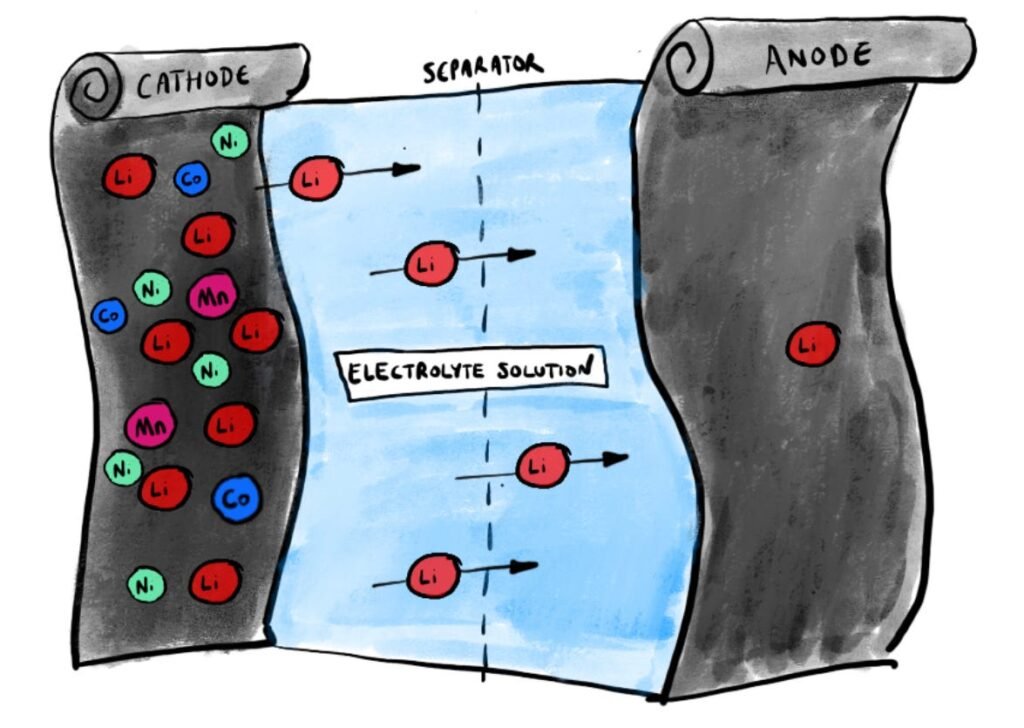
Most commercial solar lights use lithium iron phosphate (LiFePO4) or lead-acid batteries. Manufacturer-reported figures put lead-acid at roughly 300 to 800 cycles and LiFePO4 at 3,000 to 5,000 or more. Treat those as ranges, not promises.
Cold is the catch. Charging LiFePO4 below 0°C (32°F) without protection can damage it permanently, so cold-climate lots should ask about built-in heating or a low-temperature charge cutoff.
The “10000W” Problem
Marketplace listings show solar parking lot lights with claims of 8,000W, 10,000W and even 18,000W.
Here’s my arithmetic. Panels get rated at 1,000 watts per square meter in standard tests. One manufacturer advertises panels with up to 22% conversion efficiency. That’s roughly 220 watts per square meter at best.
A real 10,000-watt array would need about 45 square meters (roughly 490 square feet) of panel. That doesn’t fit on a pole.
Those numbers are likely marketing figures for the LED side, not real solar capacity. Ask for panel wattage, battery capacity in watt-hours, lumens and autonomy days. If a seller can’t give all four, move on.
Decode the IP Rating
IP ratings come from IEC 60529. IP65 means dust-tight and protected against water jets, and IP67 adds protection against temporary immersion up to 1 meter for 30 minutes. For most poles, IP65 covers rain. IP67 matters more where water pools.
Dark-Sky Rules and RV Parks
Guests come to RV parks for the stars. Don’t ruin the view.
DarkSky’s Five Principles say outdoor lighting should be useful, targeted, low level, controlled and warm-colored. DarkSky Approved fixtures cannot exceed 3000K. Also note that “dark sky friendly” on a product page isn’t the same as official certification.
The National Park Service asks a smart first question: does the area need lighting at all? It notes that campground visitors often bring flashlights. For restrooms, it recommends the lowest light level that still works.
For pathways, timers or motion sensors keep lights on only when someone needs them. Solar fixtures with dimming and motion sensing suit this well, because they also stretch battery life.
Solar vs Hardwired: The Cost Picture
Cost sources disagree, so treat these as ranges. A consumer cost guide lists trenching at $5 to $12 per linear foot, and directional boring at $10 to $30. Conduit adds about $4 to $8 per foot. One solar vendor cites far higher numbers for cutting through pavement, up to $80 to $150 per foot.
Illustration: a 300-foot run at the consumer-guide trenching rates costs about $1,500 to $3,600 for the trench alone. Wire, conduit, repaving and permits come on top.
On the solar side, one manufacturer estimates installing a commercial solar pole at roughly $500 to $2,500 or more, depending on the site. That excludes the fixture itself.
Be wary of promises of fast payback. A 2008 Penn State student analysis of a school parking lot found solar lights would have taken 26 years to pay for themselves. That’s one old case with older prices, but it shows why you should run your own numbers.
When Solar Is Not the Right Choice
- Deep shade. Panels need sun, and trees can wreck the math.
- Long snow cover. An electrician in a forum thread asked about snow covering panels for long stretches in northern Illinois.
- Strict all-night brightness. The same thread flags that spec-grade solar fixtures, panels and batteries can cost far more than expected.
- Healthy existing wiring. If you already have working power, solar may not save you anything.
FAQs
How bright do solar lights for a parking lot need to be?
It depends on lot type and local code. IES RP-20 is the usual reference. Ask a lighting designer for a photometric layout.
How long do solar parking lot lights run each night?
It depends on battery capacity, dimming and sun hours. Ask for autonomy days, and size for your darkest month.
Are solar lights good for RV parks?
They suit roads, paths and restrooms well, especially with shielding, warm color and motion sensing.
Do I need a 3000K light?
Not by law everywhere, but DarkSky Approved fixtures cap at 3000K, and many dark-sky-minded parks prefer it.
Final Checklist
- Get the target footcandle level from your designer or local code.
- Check peak sun hours for your worst month.
- Ask for panel watts, battery watt-hours, lumens and autonomy days.
- Match the IP rating, battery chemistry and cold-charging protection to your climate.
- Choose shielded fixtures at 3000K or lower.
- Compare quotes against real trenching costs.
Sources
- Illuminating Engineering Society, Recommended Practice 20 (RP-20), Lighting for Parking Facilities
- DarkSky International, Five Principles for Responsible Outdoor Lighting and the Approved Luminaires program
- U.S. National Park Service, Night Skies guidance
- International Electrotechnical Commission, IEC 60529 ingress protection standard
- National Renewable Energy Laboratory (NREL), National Solar Radiation Database
- Penn State architectural engineering thesis, solar parking lot lighting analysis
- A security industry magazine summary of IES parking facility recommendations
- A published consumer cost guide for trenching and conduit
- Manufacturer-reported figures for panel efficiency, battery cycle life and installation cost
- An electrician trade forum discussion on solar parking lot lights