Table of Contents
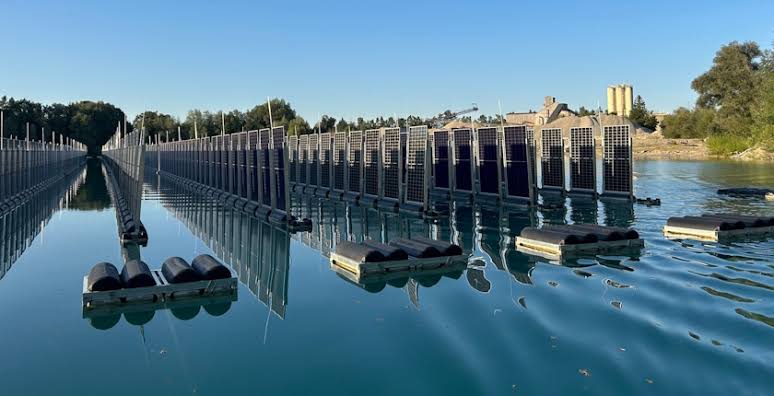
Sinn Power, a German renewable energy company, built the world’s first vertical floating solar power plant on a flooded gravel pit in Bavaria. Unlike traditional floating solar, which lays tilted panels flat across the water, Sinn Power’s patented SKipp system stands its panels upright, facing east and west, floating on open water. Each panel is bifacial, capturing sunlight from both sides at once. The plant delivers 1.87 megawatts of capacity and produces an estimated 2 gigawatt-hours of electricity a year, enough to cover most of the local gravel operation’s power needs.
That’s the short version. Here’s everything else worth knowing about vertical floating solar and how Sinn Power built it.
Who Is Sinn Power
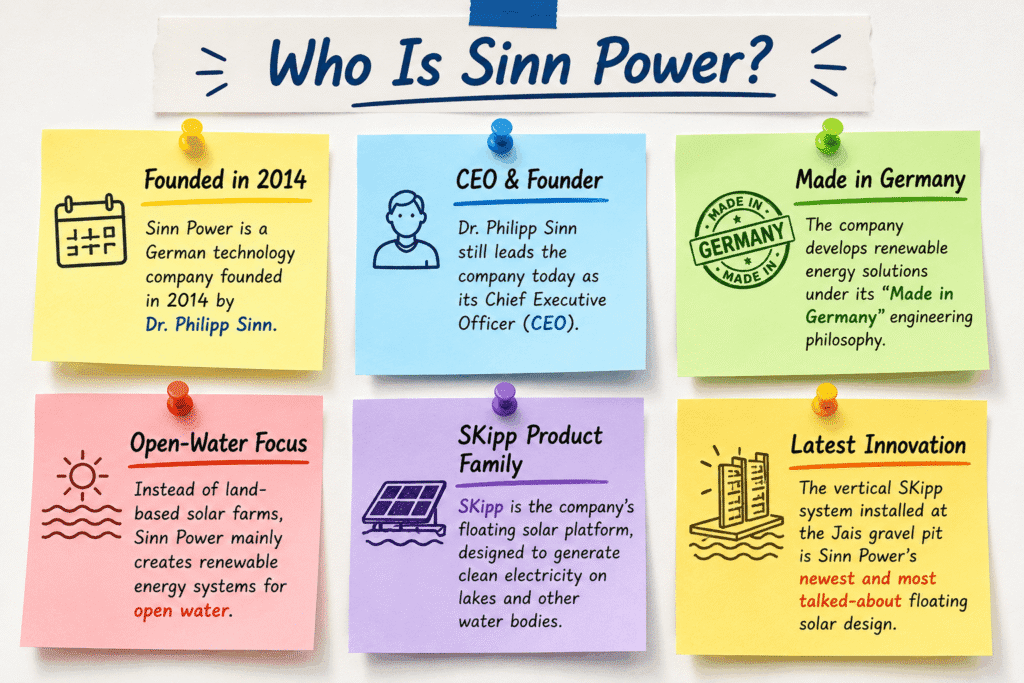
Sinn Power is a German technology company founded in 2014 by Dr. Philipp Sinn, who still leads the company as CEO. The business builds renewable energy systems under a “Made in Germany” banner, with most of its work centered on generating power from open water rather than land. SKipp is the name of its floating solar product family, and the vertical version built at the Jais gravel pit is its newest, most talked-about design so far.
How the SKipp System Actually Works
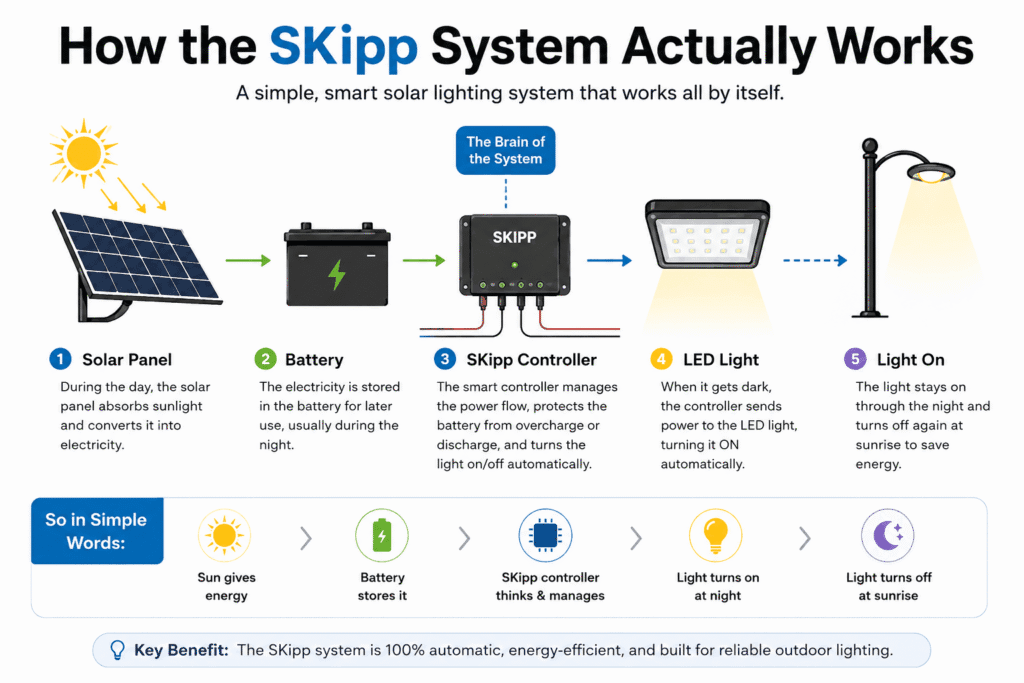
Picture a standard floating solar farm. Rows of tilted panels lie flat across the water, angled toward the sun like a row of sunbathers.
Sinn Power flipped that layout. SKipp panels stand upright and face east-west instead of south. Rows sit apart from each other, separated by open water corridors at least four meters wide. Those corridors do more than look tidy. They let boats through for maintenance, keep water circulating underneath the array, and stop the whole lake from disappearing under one solid raft of panels.
A keel-like structure anchors each row about 1.6 meters below the surface. That keel lets the whole platform flex and shift when wind picks up, then settle back into place once conditions calm down, rather than fighting the wind head-on the way a rigid structure would.
The panels themselves are bifacial, meaning they capture sunlight on both sides. The front collects direct sunlight, and the back picks up light reflecting off the water. Regular flat panels only get one shot at the sun. These get two.
The whole system connects to the power grid through a floating cable that runs to a feed-in point on shore, and anchoring happens only at the shoreline, not on the lakebed. That keeps the design modular, so a plant can scale up, scale down, or move with relatively little disruption.
Vertical orientation also solves a problem regular floating solar handles poorly: snow slides straight off instead of piling up and blocking the panels through winter.
Vertical vs Traditional Floating Solar
Traditional floating solar has been around since the mid-2000s, and it works the way you’d expect solar to work: tilted panels, packed tightly, angled south to catch the most direct sun at midday. It’s a proven approach, and it’s why floating solar has scaled into a genuine global industry already.
Sinn Power’s vertical design isn’t trying to replace that approach everywhere. It’s solving a different set of problems. Here’s how the two stack up side by side.
| Feature | Vertical Floating Solar (SKipp) | Traditional Floating Solar |
|---|---|---|
| Panel orientation | Upright, facing east-west | Tilted, facing south |
| Surface coverage needed | Lower, with open water corridors between rows | Higher, panels packed closer together |
| Daily output pattern | Stronger output in morning and evening, steadier through the day | Peaks hard at midday, drops off at the edges |
| Wind handling | Flexes and resettles under load | Rigid structure, higher stress on anchors |
| Ecological footprint | Lower, more open water and light reach the surface below | Higher, denser shading of the water underneath |
| Snow handling | Sheds snow automatically | Collects snow, needs clearing |
| Best suited for | Deep water bodies, colder climates with snowfall | Shallow to medium ponds and reservoirs, milder climates |
The trade-off comes down to timing. A traditional array is going to out-produce a vertical one at exactly midday, no argument there. But a vertical array holds a more even output curve across the whole working day, which matters more for a site like a gravel plant or factory running standard daytime shifts rather than needing one big afternoon spike.
Coverage is the other real difference. Traditional floating solar tends to pack panels tightly to maximize output per square meter, which shades more of the water underneath. Sinn Power’s corridor system trades some panel density for a lighter ecological footprint, something regulators are already paying attention to, given that Germany’s Water Resources Act caps how much of a water body can be covered at all.
Neither approach wins everywhere. The right one depends on the site, the climate, and what a facility actually needs its power curve to look like.
Could This Work at a US, UK, or Australian Water Body?
Sinn Power built its first plant in Germany, but the underlying technology doesn’t have to stay there. The requirements are specific enough to check off a list.
A water body qualifies for this kind of system if it:
- Sits at least 1.6 meters deep
- Counts as artificial or semi-artificial, such as a quarry, reservoir, or irrigation pond, rather than a protected natural lake
- Has grid access nearby
- Offers enough open surface area for the array plus service corridors
That checklist fits a long list of sites across the US, UK, and Australia. Disused quarries, mining pits, irrigation dams, and industrial reservoirs show up all over these countries, and plenty of them already sit next to a business that could use the power directly, the same way Sinn Power’s first customer does at the Jais gravel pit.
The broader floating solar market is already proving this kind of site works at scale, even with the traditional tilted design. Global floating solar capacity grew from 3 gigawatts in 2020 to 13 gigawatts in 2022, well ahead of an earlier forecast of 10 gigawatts by 2025, with the World Bank estimating close to 6,600 water bodies worldwide suitable for floating solar. Asia-Pacific is leading the expansion, with the regional market projected to reach $37.11 billion by 2034 as countries like India, China, and Japan scale up, according to Saur Energy. India’s Omkareshwar Floating Solar Park, at 600 megawatts, currently ranks as the country’s largest, though it uses the traditional tilted-panel approach rather than Sinn Power’s vertical one.
That global momentum sets the stage for vertical floating solar specifically, even though Sinn Power hasn’t broken ground outside Germany yet. The company has stated plans to extend the concept toward open water and offshore projects, which points toward wider use down the line. For now, treat this as a technology to watch rather than one already available to order for a site in Ohio or Queensland.
The Numbers: Sinn Power’s Jais Gravel Pit Project
The plant sits at the Jais gravel pit in Gilching, in Germany’s Starnberg district. Construction began in November 2024, and the plant came online in October 2025, an event significant enough to draw Bavaria’s Minister-President Markus Söder and regional utility executives to the launch, as PV Magazine reported.
The finished system delivers 1.87 megawatts of capacity and an estimated 2 gigawatt-hours of power a year. It covers only 4.65 percent of the lake’s surface, well under the 15 percent limit set by Germany’s Federal Water Resources Act. The plant cut the gravel operation’s grid electricity use by close to 60 percent in its first phase, with a target of 70 percent once the system settles into a steady routine, according to Offshore Energy. A second phase, adding another 1.7 megawatts, is already planned.
Sinn Power reports the project has stayed under regulatory coverage limits while improving, rather than harming, water quality, with early signs of fish and waterfowl activity around the platform.
Last verified: figures reflect the plant’s October 2025 launch reporting. Sinn Power has stated plans for a second construction phase, so these numbers may change as that phase moves forward.
What’s Still Unproven
One project doesn’t make a technology bulletproof. The Jais plant has been running for months, not years, so there’s no long-term data yet on how the platform holds up over multiple winters, or how maintenance costs compare to a standard floating array over time.
An offshore version doesn’t exist yet either. Sinn Power has named that as a goal, not a finished product, and open water brings challenges a sheltered gravel pit never has to deal with, like wave action and saltwater exposure. Worth knowing before anyone calls this a fully proven category rather than a promising first step still finding its footing.
FAQs
What is vertical floating solar?
Vertical floating solar is a floating solar power system that mounts panels upright instead of tilted flat, letting them face east and west while floating on water rather than sitting on land.
How is Sinn Power’s SKipp system different from regular floating solar?
SKipp uses vertical, bifacial panels with open water corridors between rows, instead of the tightly packed, tilted panels used in most floating solar farms. That trades some midday output for a steadier curve through the day and a lighter footprint on the water below.
Does floating solar harm fish or water quality?
Sinn Power reports improved water quality and new fish and waterfowl activity around its plant, though this data comes from a single project in its first year of operation, so it’s early evidence rather than a settled answer.
Can vertical floating solar be installed on a quarry or reservoir?
Yes, as long as the water is at least 1.6 meters deep, the site counts as artificial or semi-artificial, and grid access sits nearby.
Is vertical floating solar coming to other countries?
Sinn Power has stated plans to expand toward open water and offshore applications, though its only operating plant so far is in Germany, so nothing outside that first project has been built yet.
Summary
Sinn Power built the world’s first vertical floating solar plant on a gravel pit lake in Bavaria using its patented SKipp system. Unlike traditional floating solar, SKipp panels stand upright and face east-west, catching sunlight on both sides while leaving open water corridors between rows. The 1.87 MW plant cuts the site’s grid electricity use by nearly 60 percent. This article breaks down how the technology works, compares it directly to traditional floating solar, and looks at whether the same approach could work on water bodies in the US, UK, or Australia.