Last updated on November 6th, 2026 at 02:48 pm
Qucik Answer: Yes, rain affects solar panels, but only slightly. Gray skies cut output to roughly 10–40% of normal, while rain cleans light dust and cools the panels. Certified, sealed panels aren’t damaged. For rainy and cloudy climates, the top U.S. picks are the REC Alpha Pure-R (best overall for clouds), Qcells Q.TRON BLK (best made-in-USA value) and Silfab SIL-440 (30-year performance warranty).
Table of Contents
Myth: rain ruins solar panels. Fact: rain slightly lowers output because clouds block light, but it also cleans and cools the panels. Sealed, certified modules shrug off rain. So, does rain affect solar panels? Yes, a little, and often for the better once the sky clears.
Quick Answer
- Output: Gray skies cut production to roughly 10–40% of normal, depending on cloud thickness.
- Damage: Certified panels pass moisture and hail tests. Rain alone does not harm them.
- Cleaning: Rain rinses loose dust. It does not remove sticky pollen or bird droppings.
Quick picks for rainy and cloudy weather
| Best For | Product |
|---|---|
| Cloudy, rainy and cool regions | REC Alpha Pure-R |
| Made-in-USA value | Qcells Q.TRON BLK |
| Longest warranty and Pacific Northwest manufacturing | Silfab SIL-440 series |
How Does Rain Affect Solar Panel Output?
Direct vs. Diffuse Sunlight: Why Panels Still Work in Rain
Panels run on light, not heat. Clouds scatter sunlight, so it arrives from many angles instead of one beam. That scattered light is called diffuse light, and panels can still turn it into electricity.
Think of clouds as a dimmer switch, not an off switch. Thin clouds trim output a little, while dense storm clouds cut it much more.
Light Rain vs. Heavy Rain: How Much Power Do You Lose?
Industry guidance says gray skies usually deliver about 10% to 40% of normal output, depending on how thick the clouds are. Heavy overcast often lands near 10–25% of rated peak output. Rainy days tend to look like heavy overcast days.
Why do the numbers differ? Because clouds differ. A thin, high layer is not a thick storm deck. Treat these as ranges, not promises.
Why Output Can Rise Right After Rain
Rain leaves two gifts behind: cleaner glass and cooler cells. Cloudy weather often brings cooler panel temperatures, which partly offsets the loss from weaker sunlight. Once the clouds break, a rinsed, cool panel can produce nicely.
Key Takeaways
- Panels keep working in rain, just at a lower level.
- Expect a range, not one fixed number.
- Cool, clean glass helps once the sun returns.
Rain vs. Cloudy vs. Foggy vs. Sunny: Output Comparison
| Weather | Approx. share of normal output | Notes |
|---|---|---|
| Clear sun | Near 100% | Best real-world output |
| Partly cloudy | About 30–60% | Published guidance gives this range. |
| Thin, high clouds | About 30–40% | Thin cloud keeps output higher. |
| Steady rain / heavy overcast | About 10–25% | Matches heavy overcast guidance. |
| Fog | Varies | Treat it like overcast. Density decides. |
These are ranges from published industry guidance. Your roof, tilt and local sky will shift them.
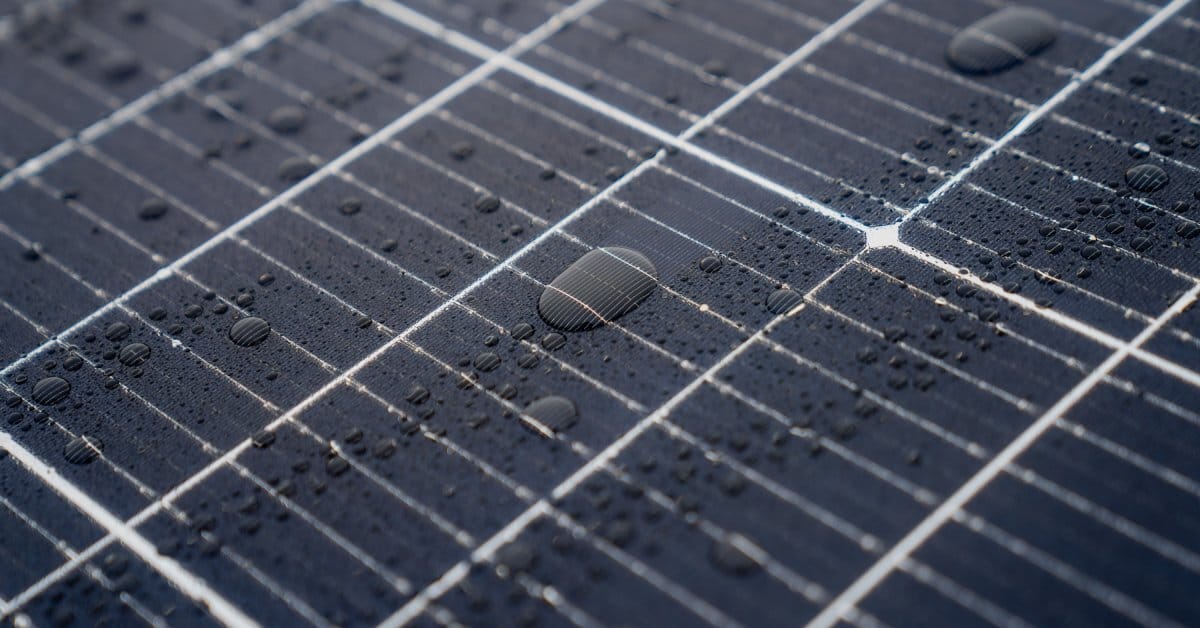
Does Rain Clean Solar Panels?
What Rain Removes (and What It Leaves Behind)
Rain rinses loose dust. It struggles with sticky stuff. Bird droppings, heavy pollen and construction dust can form stubborn soiling that a light shower will not shift.
The U.S. National Renewable Energy Laboratory (NREL) tested this in North Carolina. Rainfall washed away some pollen but not enough to restore full performance. Researchers estimated annual losses near 10% without planned cleaning, and wet-brush cleaning raised output 5% to 11% at plants that had never been cleaned.
Why Light Drizzle Can Smear Dust
A sprinkle may move dirt around without removing it. Modeling work notes that not every cleaning rain fully resets panels to a clean state. Heavy rain does a better job than a quick drizzle.
When You Still Need Manual Cleaning
Clean when you see:
- Thick pollen after spring bloom
- Bird droppings or tree sap
- Long dry spells with dusty roads nearby
Skip the ladder. Hire a pro, and check your warranty for cleaning rules first.
Best Solar Panels for Rainy and Cloudy Climates (Top 3 Picks)
How We Picked These Panels
We compared manufacturer datasheets and published 2026 comparisons. We did not run our own lab tests. Our criteria: cell technology, temperature coefficient, warranty, certifications, and U.S. availability.
Home-roof panels like these usually sell through installers, so you get a quote, not an add-to-cart button.
1. REC Alpha Pure-R (HJT): Best for Rainy and Cold Climates
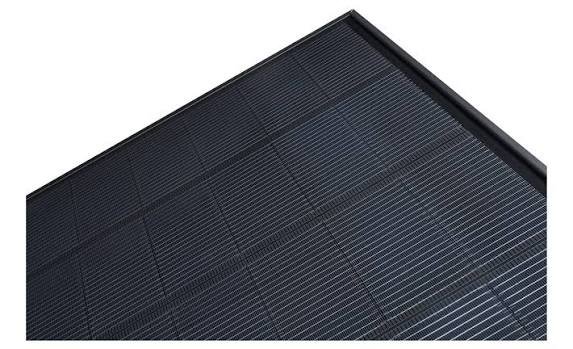
Best for: Frequent clouds, cool weather, small roofs.
Spec block
- Heterojunction technology, 400–430 Wp, and at least 92% power in year 25.
- Efficiency listed at 22.3% on the U.S. datasheet.
- Temperature coefficient shows as -0.26%/°C on some datasheets and -0.24% on others. Check the latest sheet for your model.
- Datasheet lists the IEC 61215 hailstone test at 35 mm.
Pros
- Strong power guarantee over 25 years
- Design splits the panel into four sections to make more power in shade.
Cons
- Sits in a higher price tier, and the full warranty needs a REC-certified installer.
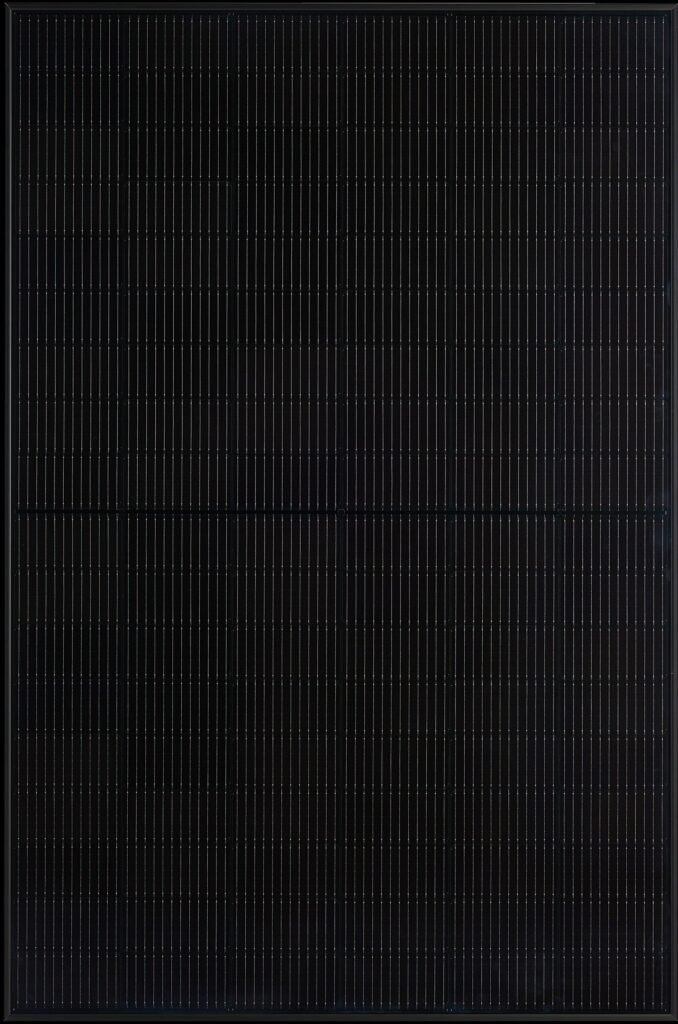
2. Qcells Q.TRON BLK (N-Type TOPCon): Best Made-in-USA Value
Best for: Homeowners who want domestic manufacturing at a mid-range price.
Spec block
- About 22.0% efficiency, 430 W, a temperature coefficient near -0.3%/°C, and a 25-year product and performance warranty with 90.6% output at year 25.
- Built at Qcells’ Georgia factories in Dalton and Cartersville.
- Uses N-type TOPCon cells.
Pros
- U.S. manufacturing
- Solid efficiency and a clean all-black look
Cons
- Slightly weaker temperature coefficient and year-25 output than REC
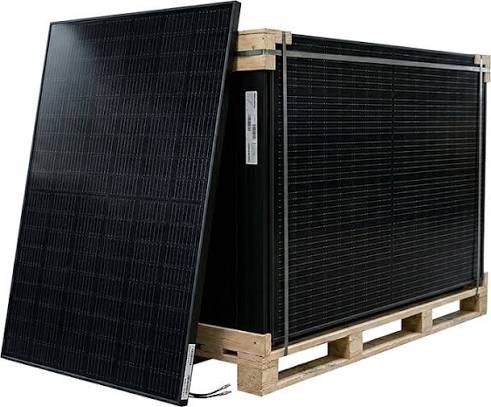
3. Silfab SIL-440 Series (N-Type): Best Warranty
Best for: Buyers who want the longest performance warranty.
Spec block
- Listed at 22.6% efficiency and 440 W, with a 25-year product warranty, a 30-year performance warranty, and 91.1% output at year 25.
- Temperature coefficient around -0.29%/°C in one ranking, and -0.26%/°C for a related model in another. Confirm the exact model.
- Silfab produces panels in Burlington, Washington.
Pros
- 30-year performance warranty
- Made in a famously cloudy, rainy corner of the U.S.
Cons
- Averages a higher installed price per watt than the other two in published rankings.
Quick Comparison Table
| Panel | Technology | Efficiency | Temp. coefficient | Warranty | Best for |
|---|---|---|---|---|---|
| REC Alpha Pure-R | HJT | 22.3% | -0.24 to -0.26%/°C | 92% at year 25 | Cloudy, cool regions |
| Qcells Q.TRON BLK | N-type TOPCon | 22.0% | About -0.3%/°C | 25 yr, 90.6% at year 25 | U.S.-made value |
| Silfab SIL-440 | N-type | 22.6% | -0.26 to -0.29%/°C | 30-yr performance | Longest warranty |
Always match specs to the datasheet for the exact model your installer quotes.
Does the Panel Brand Really Matter in Rain?
Less than you might hope. Better cell technology helps a bit in weak light. One report says heterojunction panels can make 5–10% more energy than standard PERC panels in cloudy, diffuse light. That is a reported gain, not a guarantee.
Cloud cover itself can cut output by 60–90%. Brand choice moves the needle by a few percent. Installation quality, roof angle and shade matter more.
Other Upgrades That Improve Rainy-Season Output
- Panel-level electronics: Microinverters or optimizers limit the damage when one section gets shaded.
- Roof modeling: Ask your installer to model tilt and direction for your zip code.
- Battery storage: A battery saves sunny-day extras for gray evenings and outages.
Does Rain Cool Solar Panels and Improve Efficiency?
Temperature Coefficient Explained in Simple Terms
Heat hurts solar panels. The temperature coefficient tells you how much power a panel loses for each degree Celsius above 25°C.
Here is an example. A panel running 20°C above that mark loses about 5.2% with a -0.26%/°C rating. It loses about 6% at -0.30%/°C. Small gap, real money over 25 years.
Rain and clouds cool the roof. That helps, though it will not erase the loss from dim light.
Are Solar Panels Waterproof?
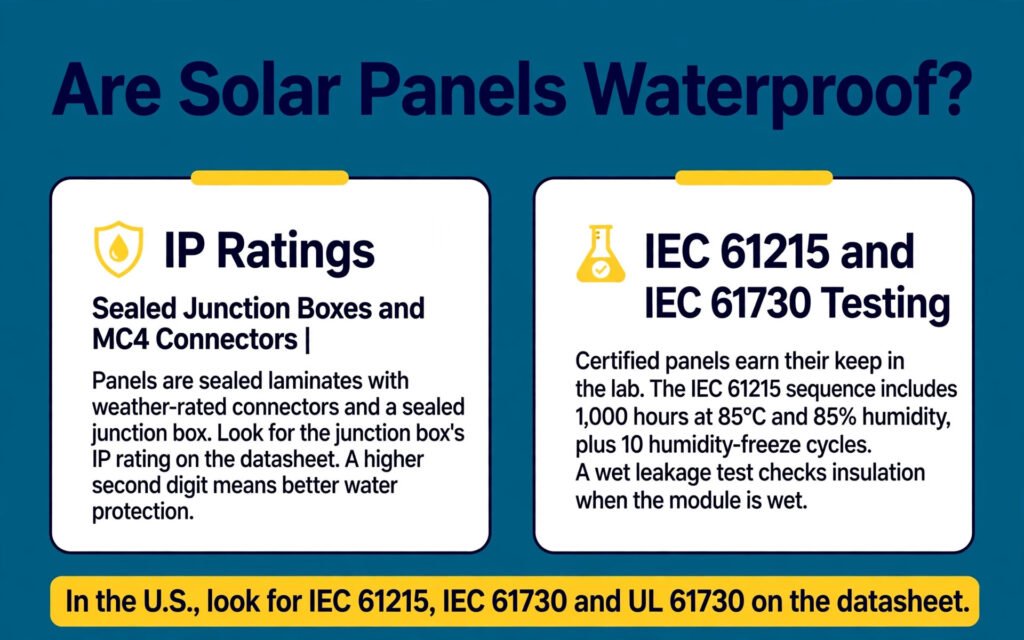
IP Ratings, Sealed Junction Boxes and MC4 Connectors
Panels are sealed laminates with weather-rated connectors and a sealed junction box. Look for the junction box’s IP rating on the datasheet. A higher second digit means better water protection.
IEC 61215 and IEC 61730 Testing
Certified panels earn their keep in the lab. The IEC 61215 sequence includes 1,000 hours at 85°C and 85% humidity, plus 10 humidity-freeze cycles. A wet leakage test checks insulation when the module is wet. In the U.S., look for IEC 61215, IEC 61730 and UL 61730 on the datasheet.
Can Heavy Rain, Storms or Hail Damage Solar Panels?
Wind-Driven Rain and Lightning
Water itself is rarely the problem. Loose mounting and poor grounding are. Ask your installer how the array is attached and grounded, and whether surge protection is included.
Hail Impact Ratings
The standard hail test fires a 25 mm ice ball at 23 m/s at 11 spots on the module. Bigger hail can still crack glass. Check that your homeowners insurance covers solar equipment.
What to Do After a Flood
Treat flooded solar gear as live. Panels keep producing power during a flood, even if the grid is off and the switchboard is shut down. Safety agencies advise assuming wet equipment is dangerous and not touching components or wiring. Have a licensed solar specialist inspect the system before anyone reconnects it.
Why Do Some Solar Systems Leak When It Rains?
When a roof leaks under a solar array, the culprit is usually the roof penetration, not the panel. Poor flashing or mount sealing lets water in. Ask your installer how they seal each mount, and get a workmanship warranty in writing.
Rainy-Day Solar Output Estimator
Here is a quick way to size up a gray day.
Gray-day output = your normal sunny-day kWh × 10% to 40%.
Illustration only: if your system makes 30 kWh on a sunny day, a gray day might give you about 3 to 12 kWh. Want a number for your own roof? Try this solar calculator.
Safety Checklist During and After Storms
- Shut down the system with your installer’s procedure if a storm or flood is coming and it is safe to do so.
- Stay off the roof. Never touch wet panels or wiring.
- Treat any flooded part as live.
- Photograph damage for insurance.
- Call a licensed solar electrician before restarting.
Curious about living with panels overhead? Read our guide on whether it’s safe to sleep near solar panels.
How to Maintain Solar Panels in Rainy Seasons
- Check your monitoring app for sudden drops after storms.
- Look from the ground for cracked glass, debris or loose wiring.
- Clear fallen branches only if you can do it from the ground.
- Book a yearly inspection with your installer.
Common Myths About Rain and Solar Panels
| Myth | Fact |
|---|---|
| Panels stop working in rain. | They keep producing, at a lower level. |
| Rain damages panels. | Certified panels pass moisture and hail tests. |
| Rain cleans panels completely. | It rinses dust, not sticky pollen or droppings. |
| Leaks come from the panels. | Leaks usually trace to roof mounts and flashing. |
| Solar is pointless in cloudy states. | Output drops, but high electricity rates can still make it work. |
FAQs
Is solar worth it in rainy climates?
Often, yes. Output drops on gray days, but high electricity rates in many wet states raise the value of each kWh. Get a production estimate for your roof before you decide.
Which solar panels work best in rain?
High-efficiency N-type and heterojunction panels handle weak light well. REC Alpha Pure-R, Qcells Q.TRON BLK and Silfab SIL-440 are strong U.S. options. Brand matters less than installation quality.
Should I clean my panels after rain?
Usually no. Clean only if you see pollen, droppings or sap, or if your monitoring shows a persistent drop. Use a professional.
Do solar panels work during a storm?
Yes, at lower output, if the system is intact. Shut it down if a storm or flood threatens damage, and never touch wet equipment.
Does rain clean solar panels completely?
No. Rain rinses loose dust. NREL found it did not fully remove pollen, and pollen losses reached about 10% a year without cleaning.
Does rain damage solar panels?
Rain alone does not. Certified panels handle it. Problems come from flooding, hail beyond test limits, or poor installation.
Are solar panels waterproof?
Certified panels are sealed and tested for moisture. IEC 61215 includes a 1,000-hour damp heat test at 85°C and 85% humidity. Check the datasheet for IP ratings.
Do solar panels work in heavy rain?
Yes, at reduced output. Heavy rain brings thick clouds, so expect roughly 10–25% of rated peak. Production returns quickly once the clouds thin.
Conclusion
Rain trims output while clouds hang around. It also cleans and cools. It rarely hurts a certified, well-installed system. Flooding and big hail are the real threats, so plan for those.
Want a number for your own home? Run a rainy-season estimate with the solar calculator, then ask your installer to confirm it.
Sources
U.S. Energy Information Administration; National Renewable Energy Laboratory (NREL); Solar Energy Industries Association and Wood Mackenzie; IEC 61215 test standard; REC, Qcells and Silfab manufacturer datasheets; electrical safety regulators’ flood guidance.