Last updated on October 30th, 2026 at 05:56 pm
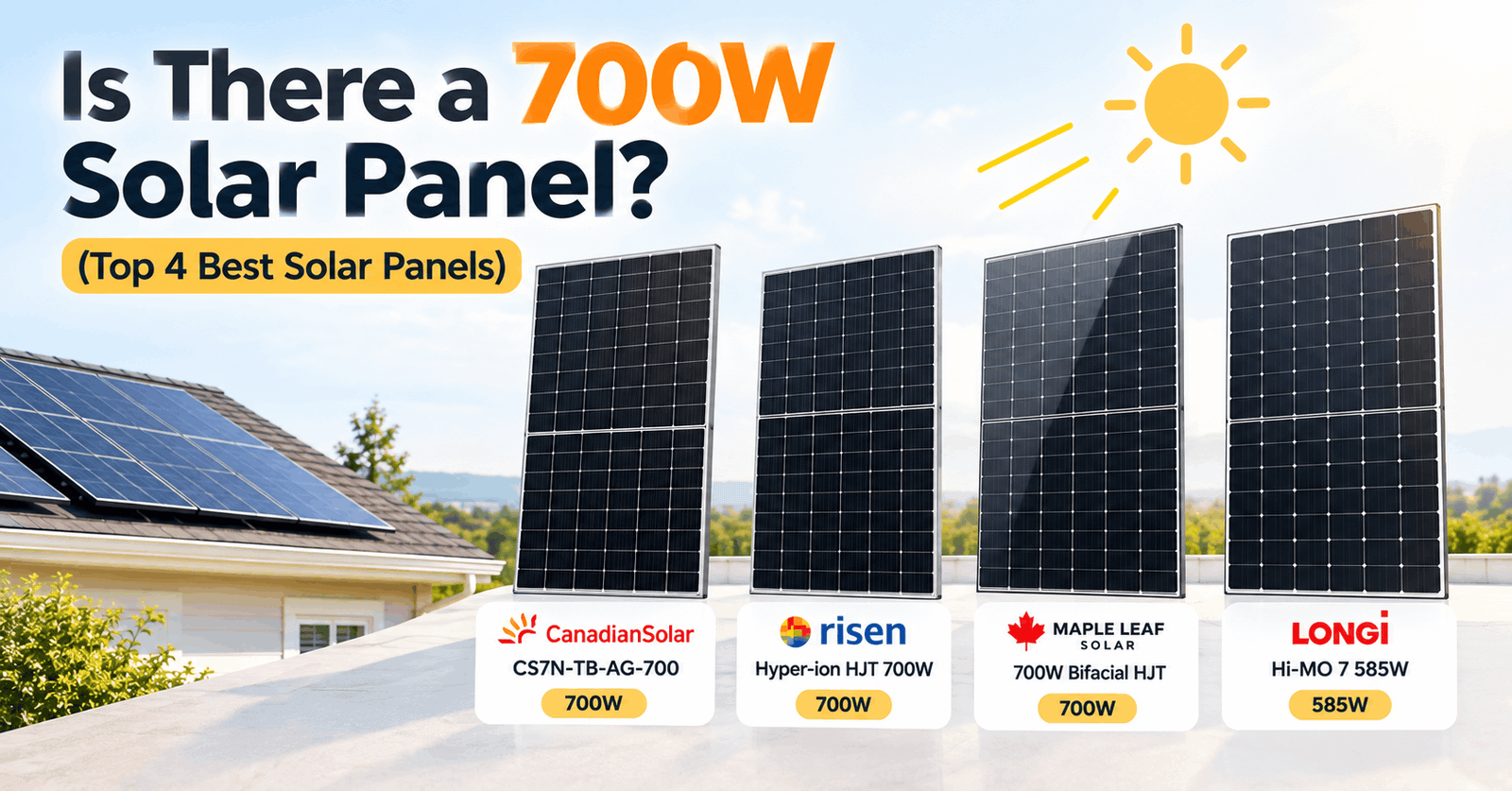
Quick answer: Yes. 700W solar panels exist, such as the Canadian Solar CS7N-TB-AG-700 and the Risen Hyper-ion HJT 700W, but they are built for commercial and utility-scale projects, not typical homes. A 700W module is about 7.8 ft (2.4 m) long and weighs 78 lb (35 kg), so most U.S. homes still use 400–460W panels.
Table of Contents
els exist, such as the Canadian Solar CS7N-TB-AG-700 and the Risen Hyper-ion HJT 700W, but they are built for commercial and utility-scale projects, not typical homes. A 700W module is about 7.8 ft (2.4 m) long and weighs 78 lb (35 kg), so most U.S. homes still use 400–460W panels.
Wattage keeps climbing. Roofs don’t. That gap explains most of this guide.
Quick Answer: Yes, 700W Panels Exist, But Not for Most Rooftops
Think pickup truck, not city car. A 700W panel hauls a lot of power, but it needs space, muscle and the right parking spot. You can order one today, mostly by the pallet through commercial distributors.
Short verdict by use case
| Use case | Use a 700W panel? | Why |
|---|---|---|
| Pitched home roof | Usually no | About 7.8 × 4.3 ft and 78 lb, with racking and inverter limits |
| Ground mount (large lot, farm) | Often yes | Space is cheap, and you mount fewer modules |
| Commercial flat roof or carport | Yes | Heavy racking and crews are standard |
| Utility-scale project | Yes | It is the market these panels were built for |
| Off-grid cabin or RV | Rarely | A kit of smaller panels is easier to carry |
Best for… (picks at a glance)
| Best for | Pick | Key specs | Watch out for |
|---|---|---|---|
| Commercial roof or ground mount | Canadian Solar CS7N-TB-AG-700 | 700W, 132-cell TOPCon bifacial, Voc 47.9 V | Sold by the pallet or truckload; a U.S.-assembled version is listed |
| Highest efficiency at 700W | Risen Energy Hyper-ion HJT 700W | About 23%, 2384 × 1303 mm, 78 lb | Limited U.S. distribution in early 2026 |
| Small buyers who want a pallet | Maple Leaf 700W bifacial HJT | 23.66%, dual glass, pallet of 33 | Pre-order stock from a Canadian seller; confirm U.S. shipping |
| A lighter large-format panel | LONGi Hi-MO 7 585W | 585W, 70 lb, 22.6% efficiency | Still built for utility plants |
| A typical U.S. home roof | A 440–450W panel (Maxeon 6 440W, CW Energy 450W) | 22.8–23.0% efficiency | More panels per kilowatt |
What Is a 700W Solar Panel?
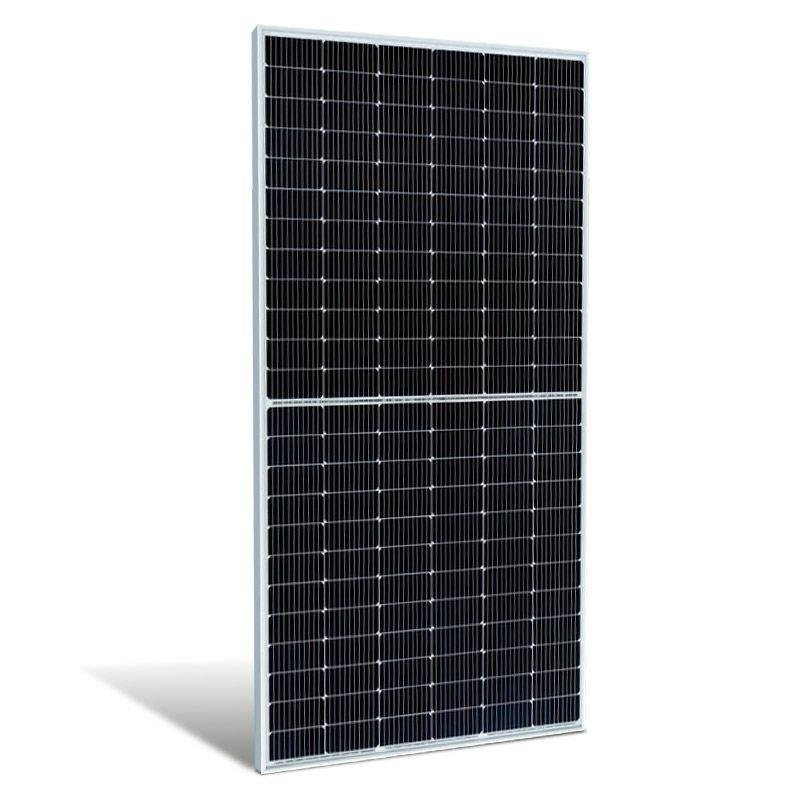
A 700W solar panel is one module with a rated peak output of 700 watts. It is not a kit, and it is not a system.
What “700W” means
The rating comes from standard test conditions: 1,000 W/m² of sunlight at a cell temperature of 25 °C. Real roofs run hotter and dirtier than a lab. A common planning assumption is that a working system delivers around 80% of nameplate power.
Why panels reached 700W
Manufacturers got there with bigger modules, not magic. Larger cells, more of them (the Canadian Solar model has 132 half-cut cells), bifacial dual-glass designs and n-type TOPCon or HJT cells all play a part.
Watts and efficiency are different things. A 700W panel can be bigger and no more efficient than a 450W one. The size comparison below shows how that works out.
700W panel vs 700W solar kit
A 700W kit usually bundles smaller panels with a charge controller. It ships in a normal box. A 700W panel arrives on a pallet. If the listing is cheap and includes a controller, it is almost certainly a kit.
700W Solar Panels Available Right Now
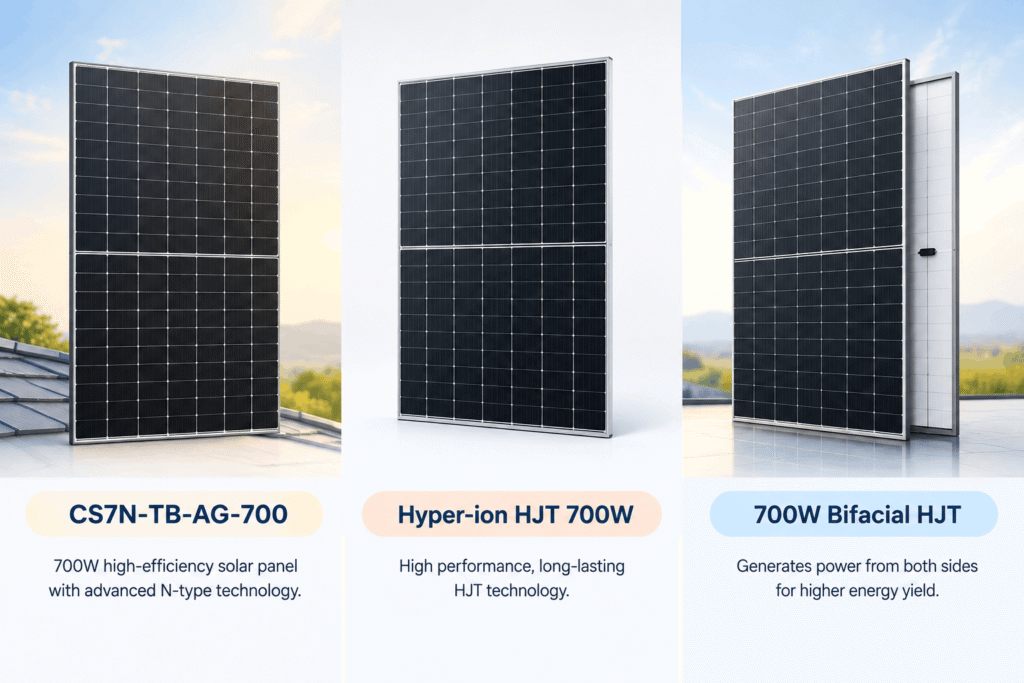
| Brand | Model | Technology | Size / weight | Efficiency |
|---|---|---|---|---|
| Canadian Solar | CS7N-TB-AG-700 | TOPCon bifacial, 132 cells, Voc 47.9 V | Check datasheet | Check datasheet |
| Risen Energy | Hyper-ion HJT 700W | HJT | 2384 × 1303 mm, 35.5 kg | About 23% |
| Maple Leaf | 700W bifacial HJT | HJT, dual glass | Check datasheet | 23.66% |
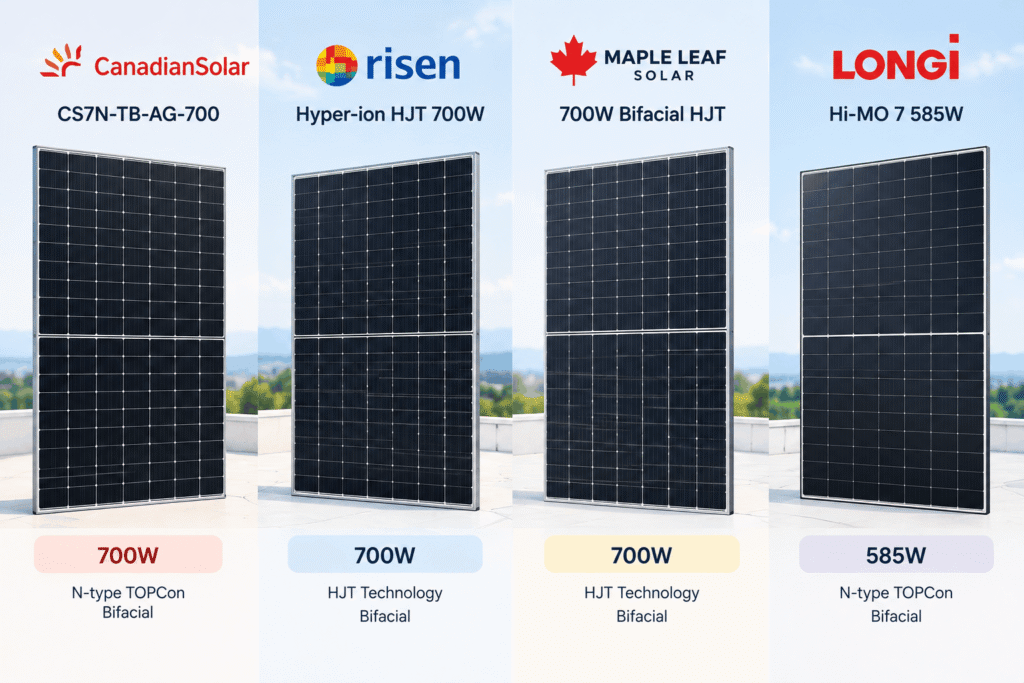
Here is how the picks stack up, plus the LONGi 585W as a lighter step down.
| Model | Pros | Cons |
|---|---|---|
| Canadian Solar CS7N-TB-AG-700 | Bifacial TOPCon; sold in truckload quantities (496 per container); U.S.-assembled version listed | Commercial minimum orders; the listing shows no size or efficiency |
| Risen Hyper-ion HJT 700W | About 23% efficiency; 5,400 Pa snow load and 15-year warranty listed | 78 lb; limited U.S. distribution in early 2026 |
| Maple Leaf 700W bifacial HJT | 23.66% listed; dual glass; pallet or smaller pre-orders | Pre-order lead times; sold in sets of two or more |
| LONGi Hi-MO 7 585W | 70 lb; 22.6% efficiency; 30-year power warranty | Still utility-class; 12-year product warranty |
TOPCon vs HJT at 700W
Both technologies reach 700W. The HJT modules above claim about 23–23.7% efficiency. A TOPCon 700W module from Jolywood lists 22.5%. TOPCon is more common and usually easier to source. Price, warranty and supplier support matter more than a one-point efficiency gap.
Availability by region (US, UK, Europe)
- United States: Canadian Solar lists a U.S.-assembled 700W variant, and Risen had limited U.S. distribution in early 2026. Expect commercial distributors, not hardware stores.
- United Kingdom and Europe: A UK installer guide ranks 750–795W models among the most powerful panels available to households, but stock varies. Ask local distributors before you plan around one.
How Big and Heavy Is a 700W Panel?
Dimensions and weight
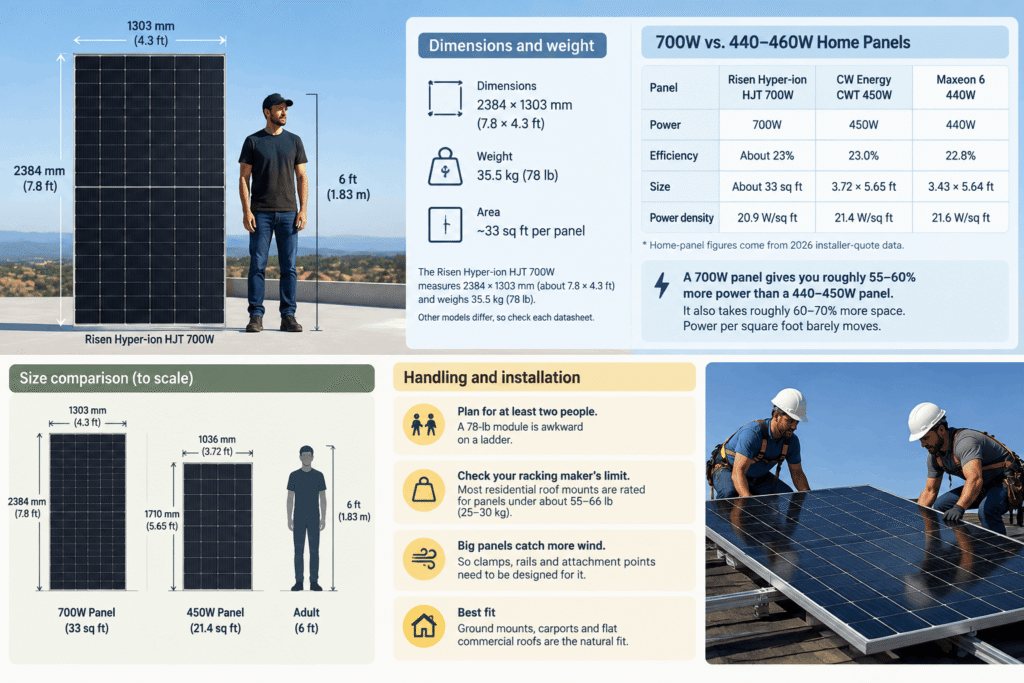
The Risen Hyper-ion HJT 700W measures 2384 × 1303 mm (about 7.8 × 4.3 ft) and weighs 35.5 kg (78 lb). That is roughly 33 sq ft per panel. Other models differ, so check each datasheet.
Size comparison with a 440–460W home panel
| Panel | Power | Efficiency | Size | Power density |
|---|---|---|---|---|
| Risen Hyper-ion HJT | 700W | About 23% | About 33 sq ft | 20.9 W/sq ft |
| CW Energy CWT | 450W | 23.0% | 3.72 × 5.65 ft | 21.4 W/sq ft |
| Maxeon 6 | 440W | 22.8% | 3.43 × 5.64 ft | 21.6 W/sq ft |
Home-panel figures come from 2026 installer-quote data. [Diagram: a 700W panel beside a 450W panel and a 6-ft adult, drawn to scale.]
A 700W panel gives you roughly 55–60% more power than a 440–450W panel. It also takes roughly 60–70% more space. Power per square foot barely moves.
Handling and installation
- Plan for at least two people. A 78-lb module is awkward on a ladder.
- One spec database says most residential roof mounts are rated for panels under about 55–66 lb (25–30 kg). Check your racking maker’s limit.
- Big panels catch more wind, so clamps, rails and attachment points need to be designed for it.
- Ground mounts, carports and flat commercial roofs are the natural fit.
700W Solar Panel Price
Price per watt vs price per panel
Compare by price per watt. Multiply it by 700 to get the cost of one panel.
Here is the U.S. twist. A Section 232 proclamation signed August 6, 2026 sets a $0.38 per watt minimum import price for solar modules, starting December 4, 2026. Importers must meet it or face extra duties. A separate 15% tariff applies to most origins.
At that floor, an imported 700W panel starts around $266 at the importer level, before freight, the tariff and tax. A 36-panel pallet (25.2 kW) comes to at least $9,576.
Wholesale, MOQ and retail prices
Sources disagree, so treat prices as ranges:
- One spec database listed Risen 700W pallets at about $0.28–0.35 per watt (roughly $196–245 per panel) in early 2026. That range sits below the new import floor.
- Supplier marketplace listings show $0.06–0.12 per watt, but with minimum orders from 1,000 W to 100,000 W. They typically exclude shipping, duties and U.S. compliance.
- Some retailers sell panels only in sets. One Canadian seller requires orders of two or more for shipping protection.
Shipping, handling and mounting costs
Budget for freight (pallet or container), liftgate or forklift delivery, sales tax, heavier racking and extra labor. Check the inverter or charge controller too. Higher-current modules can force a swap.
Why Most Homes Still Use 400–460W Panels
Installer quote data show the pattern. About 97% of home panels quoted through a national installer marketplace in the second half of 2025 were 400–460W. The highest-output home panels on that marketplace in 2026 were 440–450W.
Here is why homes stick to this band:
- Roof layout: vents, chimneys and edges break the roof into small areas that smaller panels fill better.
- Safety and handling: lighter panels are safer to carry up a pitched roof.
- Equipment: home racking, microinverters and string inverters are specified around this size.
- No space gain: as shown above, bigger panels don’t pack more watts into each square foot.
Can You Use a 700W Panel on a Home Roof?
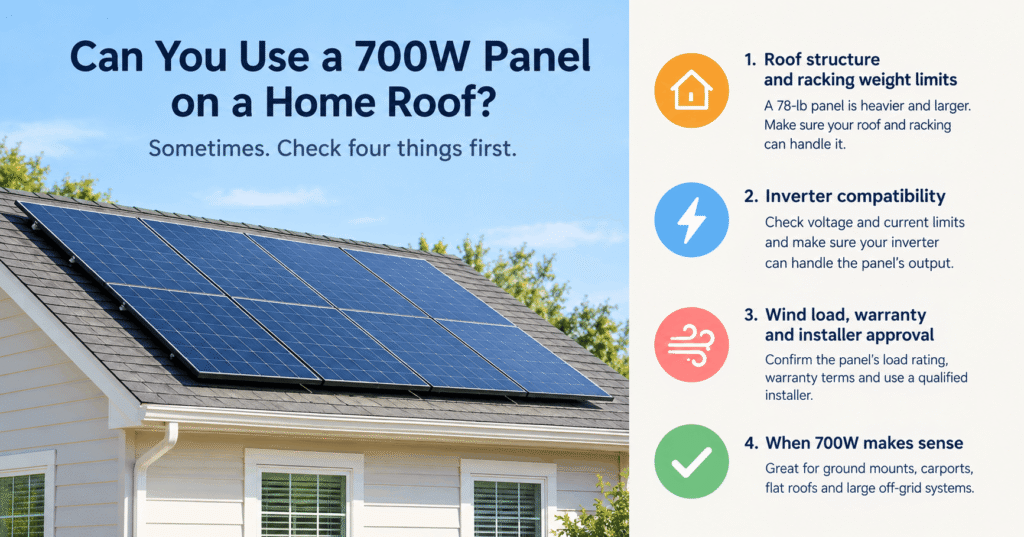
Sometimes. Check four things first.
Roof structure and racking weight limits
At 78 lb and 33 sq ft, each module loads its attachment points harder. Get the racking maker’s maximum module size and weight in writing. Have a roofer or engineer confirm the structure if you have any doubt.
Inverter compatibility: voltage and current limits
This is where projects stall. Compare these datasheet values with your inverter’s limits:
- Voltage: The National Electrical Code (Article 690.7) caps PV system voltage at 600V on one- and two-family homes and 1,000V on other buildings. Ground-mounted commercial and utility sites using listed 1,500V equipment can go higher. Cold weather raises Voc, so installers correct for the lowest expected temperature.
- Current: 700W-class modules typically carry more current than home panels. Check Isc against the inverter’s per-input limit. Code sizes circuits at 125% of Isc (Article 690.8).
- Microinverters: Check the maximum input power and current. Many are designed for much smaller modules.
Worked example (illustrative): Voc 47.9 V, a −0.25%/°C coefficient and a −10 °C low. Corrected Voc is about 47.9 × (1 + 0.0025 × 35) ≈ 52.1 V. A 600V home limit allows 11 panels per string (7.7 kW). A 1,000V commercial limit allows 19. Use your module’s real coefficient.
Some local building departments (the “AHJ”) treat a detached ground mount differently from a roof system. Ask yours before you buy.
Wind load, warranty and installer approval
- Check the module’s rated load. The Risen listing shows 5,400 Pa snow load and a 15-year warranty.
- Use an installer authorized by the brand. Warranty support depends on it.
- Confirm permits and utility rules. They are written around standard modules.
When 700W makes sense
- Ground-mounted arrays on farms, ranches and large lots
- Carports and parking canopies
- Flat commercial and industrial roofs
- Large off-grid sites with compatible controllers
Quick fit test: a 700W panel can work if your racking is rated for 78 lb modules, your inverter accepts the current, your string voltage stays under the NEC cap, and your installer has handled large modules before. Miss one and pick a smaller panel.
700W vs 450W vs 585W: Which Is Better?
Example: a 10 kW system.
| Panel | Panels needed | System size | Approx. area | Trade-off |
|---|---|---|---|---|
| 450W (CW Energy class) | 23 | 10.35 kW | About 485 sq ft | Easy to carry; fits roofs and inverters |
| 585W (LONGi Hi-MO 7) | 18 | 10.53 kW | About 500 sq ft | 70 lb each; needs larger racking and inverter checks |
| 700W (Risen class) | 15 | 10.5 kW | About 500 sq ft | Fewest modules; 78 lb each; best on ground mounts and commercial roofs |
Areas use each panel’s listed dimensions.
Does a bigger panel really save roof space?
No. Roof space follows watts per square foot, and all three panels land near 21 W/sq ft (20.9 for Risen, 21.0 for the LONGi 585W, 21.4 for CW Energy). Bigger panels cut the number of modules, clamps and connections. On a big flat site, that saves labor. On a house roof, it saves almost nothing.
If 700W feels like too much panel, the 585W class is the middle step. Our LONGi 585W price guide covers current U.S. pricing, including the tariff change.
Why 700W Solar Panels Help U.S. Buyers (and Who Should Skip Them)
The U.S. solar market runs on big projects. According to Wood Mackenzie and the Solar Energy Industries Association, the U.S. installed 11.4 GW of solar in the second quarter of 2026. Utility-scale projects supplied 9.6 GW of that. Wood Mackenzie expects utility-scale to add 217 GW through 2031. That is the 700W panel’s home turf.
The home market is under pressure. Residential installs weakened after the federal homeowner tax credit (Section 25D) ended on December 31, 2025. Homeowners who buy with cash or a loan now get no federal credit. Commercial and leased systems can still claim the Section 48E credit. Projects that did not begin construction by July 4, 2026 must be in service by December 31, 2027, and foreign-entity sourcing rules apply. Ask a tax professional about your case.
Fewer modules means fewer lifts. Fifteen 700W panels give you 10.5 kW. The same power from 450W panels takes 23. Eight fewer modules means fewer clamps, connections and ladder trips on a large flat roof or ground mount. With a tight deadline, that matters.
Electricity prices raise the stakes. The U.S. Energy Information Administration projects an average residential price of about 18.2¢ per kWh for 2026. State prices in July 2026 ranged from about 12.7¢ in Louisiana to 48¢ in Hawaii, based on EIA data. The higher your rate, the more every kilowatt-hour from a big array is worth.
Who should skip them: owners of typical suburban roofs. A 440–450W panel will serve you better. Everyone should also ask for origin documents, because tariffs and sourcing rules now affect price and credit eligibility.
Large modules also suit sites most people forget, like quarries and reservoirs. For one new layout in action, read our explainer on vertical floating solar.
How Much Electricity Does a 700W Panel Produce?
Formula: daily energy (kWh) = 0.7 kW × peak sun hours × system efficiency.
At about 80% system efficiency:
| Peak sun hours | No losses | Realistic (about 80%) | Per month (30 days) |
|---|---|---|---|
| 4 | 2.8 kWh | 2.2 kWh | About 67 kWh |
| 5 | 3.5 kWh | 2.8 kWh | About 84 kWh |
| 6 | 4.2 kWh | 3.4 kWh | About 101 kWh |
At the 2026 U.S. average of 18.2¢ per kWh, 2.8 kWh a day is worth about $186 a year per panel. Your rate and net-metering rules will change that number. Bifacial panels may add a little over reflective ground.
Want a whole-home number? Our solar calculator sizes panels, inverter and roof space from your electric bill. It lets you choose 400W, 450W or 550W panels.
What Comes After 700W? 760W, 795W and Beyond
- 760W: Trinasolar announced a 760W Vertex N G3 for Pakistan in April 2026, with availability from Q3 2026.
- 795W: A UK installer guide ranks AIKO’s 795W Neostar 2N+7 first, followed by two 750W models.
- Test results: Independent testing has verified a 768.9W HJT module, though not in full production.
- 1000W: We found no standalone 1000W module.
Tandem cells are the next technology to watch. For now, 700–800W panels remain a commercial product.
How to Choose a High-Wattage Panel (Checklist)
- Is the site a ground mount, flat roof or carport, not a pitched roof?
- Does the racking maker approve this module’s size and weight?
- Are Voc (cold-corrected), Isc and Imp within your inverter’s limits and the NEC voltage cap?
- Does the module carry UL 61730 and IEC 61215 certification?
- Who honors the warranty in the U.S., and for how long?
- Do you have country of origin, tariff treatment and foreign-entity paperwork in writing?
- Is the price per watt delivered, including freight, tariff and tax?
- Has your installer handled large modules before?
FAQs
How many 700W panels do I need for 10 kW?
No. Bigger panels cut the module count, but power per square foot stays near 21 W. They also weigh more and are harder to install on roofs. The same question comes up at the small end of the market, so see our guide to 100W vs 200W solar panels.
How many 700W panels do I need for 10 kW?
Fifteen panels give you 10.5 kW. They cover roughly 500 sq ft, about the same area as 23 panels of 450W.
Can I use 700W panels at home?
Usually not on a pitched roof, because of size, weight, racking and inverter limits. They can work on a ground mount, carport or flat roof if the racking and inverter are compatible.
What is the highest wattage solar panel?
It depends on how you count. A UK installer guide ranks AIKO’s 795W Neostar 2N+7 first among household-focused models. Independent testing has also verified a 768.9W HJT module that is not yet in full production.
Is there a 1000W solar panel?
We found no standalone 1000W module. You reach 1 kW by combining panels, such as two 500W panels or about 1.5 panels of 700W. Check for newer announcements before you buy.
Conclusion
Yes, 700W solar panels exist, and 750W-plus models are already appearing. But they are commercial and utility-scale products. For most U.S. homes, a 440–450W panel fits the roof, works with ordinary inverters and delivers the same power per square foot.
If you have a ground mount, carport or large flat roof, and an inverter that can handle the current, a 700W panel can cut your module count by a third. Check the datasheet, the racking rating, the NEC voltage cap and the tariff paperwork before you buy.
Sources and Methodology
This article was checked on October 30, 2026. Prices and policy change quickly, so we will refresh it as new data arrives.
- U.S. Energy Information Administration: Short-Term Energy Outlook (2026 residential price forecast) and monthly state price data (July 2026)
- Solar Energy Industries Association and Wood Mackenzie: US Solar Market Insight, Q3 2026
- Presidential Proclamation 11052, “Adjusting Imports of Polysilicon and Its Derivatives Into the United States,” August 6, 2026, and customs and law-firm advisories on it
- National Electrical Code (NFPA 70), Article 690, sections 690.7 and 690.8
- One Big Beautiful Bill Act (P.L. 119-21) provisions on Sections 25D and 48E, as summarized in tax advisories
- Manufacturer and distributor listings and datasheets: Canadian Solar, Risen Energy, Maple Leaf, LONGi, Jolywood, Maxeon, CW Energy
- Trinasolar newsroom, April 2026
- A UK installer guide to the most powerful household panels, and independent module-test reports
Methodology: Panel prices equal price per watt × wattage. Pallet totals equal panels × 700W × price per watt. The voltage example uses an assumed temperature coefficient, so replace it with your module’s datasheet value. Conflicting sources: older guides call 500W the home maximum and 700W the commercial ceiling. Newer listings show higher wattages. Where sources disagreed, this article gives a range and says so.