Quick Answer: Municipal solar street light installation means surveying sites, designing to a road-lighting standard, sizing panels and batteries for local sunshine, procuring against a clear specification, and funding maintenance from day one. Most failures come from skipped maintenance, not bad sunshine.
Table of Contents
What Municipal Solar Street Light Installation Involves
A solar street light is a self-contained power station on a pole. It has a PV panel, an LED luminaire, a battery, and a charge controller.
Municipal projects add layers a homeowner never faces. You deal with road classes, tenders, public budgets, and residents who will tell you exactly when a light goes out.
Why Cities Consider Solar Street Lighting
Two trends push councils this way.
First, solar power got cheap. IRENA reports that utility-scale solar averaged $0.043/kWh in 2024, a 90% drop from $0.417/kWh in 2010. That figure covers large solar plants, not street lights. It shows the direction of the technology, not your per-pole price.
Second, LED lighting cuts load. A U.S. Department of Energy demonstration in San Francisco found LED luminaires cut energy use by 50% to 70% against high-pressure sodium. A smaller load means a smaller panel and battery on every pole.
Solar also reaches roads the grid doesn’t. That alone settles the question for many rural and peri-urban councils.
Step-by-Step Installation Process
- Survey the site. Check shading, road width, and local solar data. Accurate site assessment is the foundation of solar lighting design.
- Design the lighting first. Choose the lighting class and pole spacing. A Romanian engineering paper describes two sizing stages: lighting needs first, then autonomy of the power system.
- Size the panel and battery. More on this below.
- Write the specification and tender. Spell out components, warranty, and maintenance.
- Build foundations and erect poles.
- Mount, wire, and commission. Test every light, not a sample.
- Hand over documents and train staff. Record locations, serial numbers, and battery install dates.
Sizing: Sun Hours and Autonomy Days
Sizing needs three inputs: solar resource, luminaire load, and nightly run time.
Then comes autonomy, the number of cloudy days a battery can cover. One lighting course notes that autonomy usually runs three to five days, and overcast Seattle needs more than sunny Phoenix.
A typical design example gives 8 to 12 hours of light with three to five days of battery autonomy. Treat that as a starting point. Your local irradiance data decides the real number.
Standards to Design Against
In Europe, the reference is EN 13201. It sorts roads into classes for motorised traffic (M), conflict areas (C), and pedestrian and low-speed areas (P). Part 5 adds energy indicators that compare different lighting solutions.
The standard is voluntary, yet it works as the default procurement baseline across Europe. Outside Europe, use your national road-lighting standard and name it in the tender.
What Does It Cost?
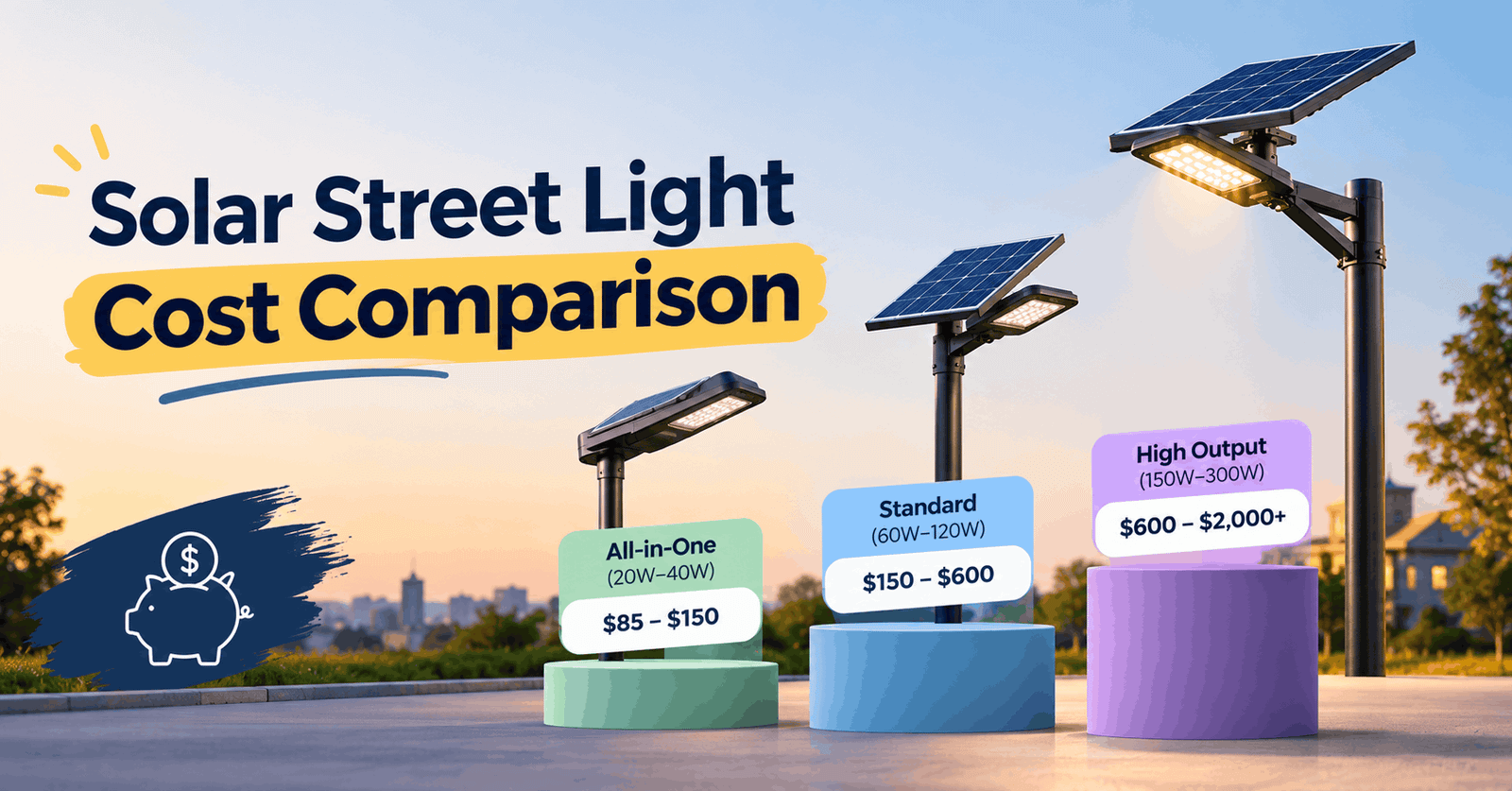
I’m not quoting a “cost per pole” here. Prices swing with battery chemistry, pole height, brightness, and region, and no trustworthy global benchmark exists. Any single number would be a guess.
Ask bidders for these instead:
- Price per complete installed pole
- Battery replacement cost and expected interval
- Annual maintenance cost per pole
- Warranty length for panel, battery, and controller
Compare the lifetime cost, not the sticker price. Lira City’s story below shows why.
Funding and Financing
Grants and pooled buying lower the entry price. Massachusetts ran a program that covered up to 30% of LED streetlight procurement and installation costs. In Pennsylvania, DVRPC’s pooled program helped 35 municipalities in round one and 27 more in round two convert to LED. Both examples are LED retrofits, but the funding models carry over to solar.
Cost of capital matters too. IRENA estimated it at 3.8% in Europe against 12% in Africa. A council in a high-rate region should model financing carefully.
Procurement Checklist
- Name the lighting standard and road classes
- State autonomy days and nightly run time
- Require battery chemistry, rated lifespan, and replacement terms
- Demand a maintenance contract, not just a warranty
- Inspect delivered components against the specification
India’s renewable energy ministry took this route after field problems. It required a minimum two-year warranty on complete systems including batteries, and five-year maintenance contracts.
Why Projects Fail
Sunshine rarely kills a solar street light project. Neglect does.
- Lira City, Uganda: Under a World Bank-funded program, 141 of 229 solar street lights stopped working. The city engineer said batteries reached the end of their lifespan, and that nobody inspected component specifications at installation.
- Ugandan cities more broadly: Reporters found that systems broke down for lack of a clear maintenance programme. One town official said no budget existed for maintaining the lights.
- Bihar, India: Official data shows 2.16 lakh of 10.59 lakh installed solar street lights are non-functional.
- Kathmandu Valley: A field study found about 34% of street lights dysfunctional, with no body responsible for repairs. That figure covers all street lights, though the study flagged dim solar units from unmaintained panels and batteries.
The pattern is blunt. Buy the pole, forget the battery, and wait for the dark.
Maintenance Essentials
- Assign one named owner for repairs
- Budget for battery replacement before installing
- Clean panels on a schedule
- Keep a register of battery install dates
- Set a repair deadline in the contract (Bihar’s agencies must fix faults within 72 hours)
FAQs
How long does installation take?
It depends on project size and site conditions. Ask each bidder for a written timeline by phase.
How many cloudy days should the battery cover?
Many designs target three to five days. Local weather data should set the final figure.
Do municipalities have to follow a standard?
EN 13201 is voluntary, but it is the usual procurement baseline in Europe. Elsewhere, cite your national standard.
Why do solar street lights fail?
Based on the cases above, the usual causes are battery end-of-life, unchecked specifications, and missing maintenance budgets.
Is solar cheaper than grid lighting?
It depends on grid access, trenching distance, and battery replacement costs. Model both options over the full lifetime.
Glossary
- LiFePO4: Lithium iron phosphate, a common battery chemistry for solar lights.
- MPPT: Maximum power point tracking, a controller type that draws more power from the panel.
- Lux: A measure of light reaching a surface.
- Autonomy days: Cloudy days a fully charged battery can power the light.
- Peak sun hours: Daily sunshine expressed as hours of full-strength sun.
- IP rating: Ingress protection against dust and water.
Conclusion
Good municipal solar street lighting is 30% sunshine and 70% planning. Design to a standard, size for your climate, tender with maintenance included, and fund the battery before it dies.