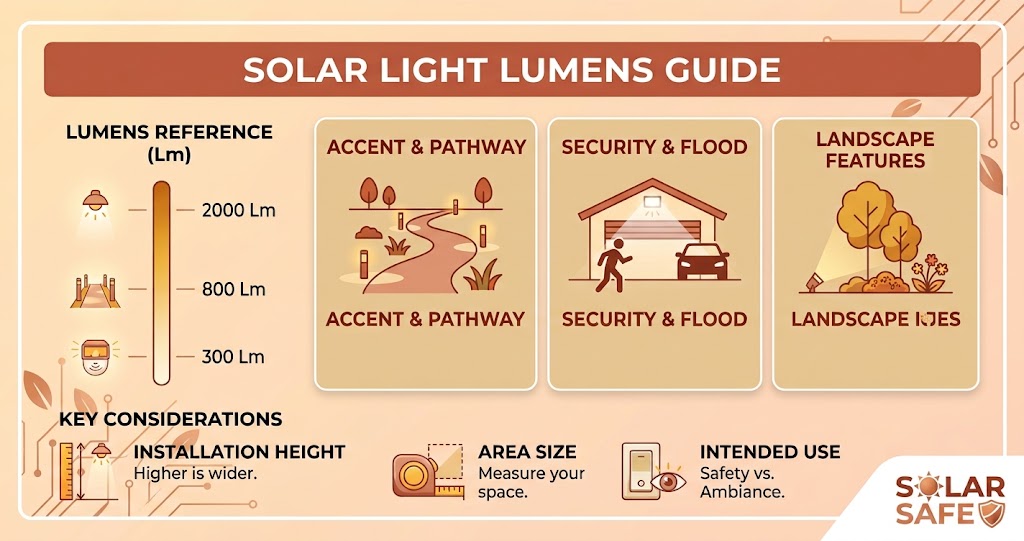
Quick Answer: Most solar lights need 50 to 300 lumens for pathways, 300 to 700 lumens for entryways and driveways, and 700 to 2,000 lumens for security and motion-sensor lighting.
Table of Contents
Key Takeaway: Most solar lights don’t need thousands of lumens. Pathways want 50–300, entryways want 300–700, and security lights top out around 700–2,000. Anything above that, especially the “50,000 lumen” listings you see online, is marketing fiction, not physics.
Somewhere on the internet right now, a solar light is being sold with a “50,000 lumens” sticker on it.
That number is not real. It’s not even close to real. And if you’ve been shopping for solar lights and feel confused about which number actually matters, you’re not the problem, the packaging is.
This guide breaks lumens down the boring, honest way, no inflated claims, no guesswork, just the numbers you actually need for your yard, patio, or driveway.
What Are Lumens (And Why Watts Don’t Matter Anymore)
Here’s the mistake almost everyone makes: judging a light by its wattage.
That made sense in the old incandescent bulb days. It doesn’t anymore.
Watts measure the electricity a bulb uses. Lumens measure the actual brightness you get. The U.S. Department of Energy puts it simply, think lumens, not watts, when you’re comparing lights.
The gap between the two got a lot bigger once LEDs took over. A 60-watt incandescent bulb produces about 800 lumens, but a modern LED can hit that same 800 lumens using only 6 to 7 watts.
So when a solar light lists its wattage instead of its lumens, that’s usually a sign the brightness number wouldn’t have impressed anyone.
Key Takeaway: Lumens equal brightness. Watts equal power draw. For solar lights, only lumens tell you how much light you’ll actually see.
How Many Lumens Do You Need? (Quick Reference Table)
Here’s the range that actually matches real-world use, based on manufacturer lighting charts and outdoor lighting standards used across the industry.
| Use Case | Recommended Lumens |
|---|---|
| String / fairy lights | 10–50 lm |
| Garden & landscape accent | 50–250 lm |
| Pathway & walkway lights | 50–300 lm |
| Deck, fence & pergola lights | 5–250 lm |
| Post & pillar lights | 100–400 lm |
| Driveway & entry lights | 300–700 lm |
| Security & motion floodlights | 700–2,000 lm |
| Commercial pedestrian post lights | 500–2,000 lm |
These ranges line up with recommended outdoor lighting benchmarks: security lights typically fall between 700 and 1,400 lumens, decorative post lights between 100 and 400 lumens, and landscape or pathway lights between 50 and 250 lumens.
Pathway & Walkway Lights
Around 80 lumens is generally considered bright enough for most walkways, including commercial ones. You don’t need a runway lit up, you need to see where your feet are going.
Garden & Landscape Accent Lighting
For garden lights used as accent lighting, roughly 50 lumens is usually enough to add safety and visual interest without overpowering the space.
Security & Motion-Sensor Lights
This is the one category where more lumens genuinely helps. Recommended lumens for outdoor motion-sensor lights typically run 300 to 700, while floodlights sit in the 700 to 1,300 range. If your goal is deterring someone in the dark, stay near the top of that range.
Entry Areas & Driveways
Front doors and garages need enough brightness to unlock a door or find your keys without squinting, around 300 to 700 lumens is the usual sweet spot here.
Key Takeaway: Bigger space, more open exposure, or a security purpose means higher lumens. Ambient, decorative, or close-range lighting means lower lumens. It’s not complicated, it’s just rarely explained this plainly.
Why So Many Lumen Claims on Solar Lights Are Fake
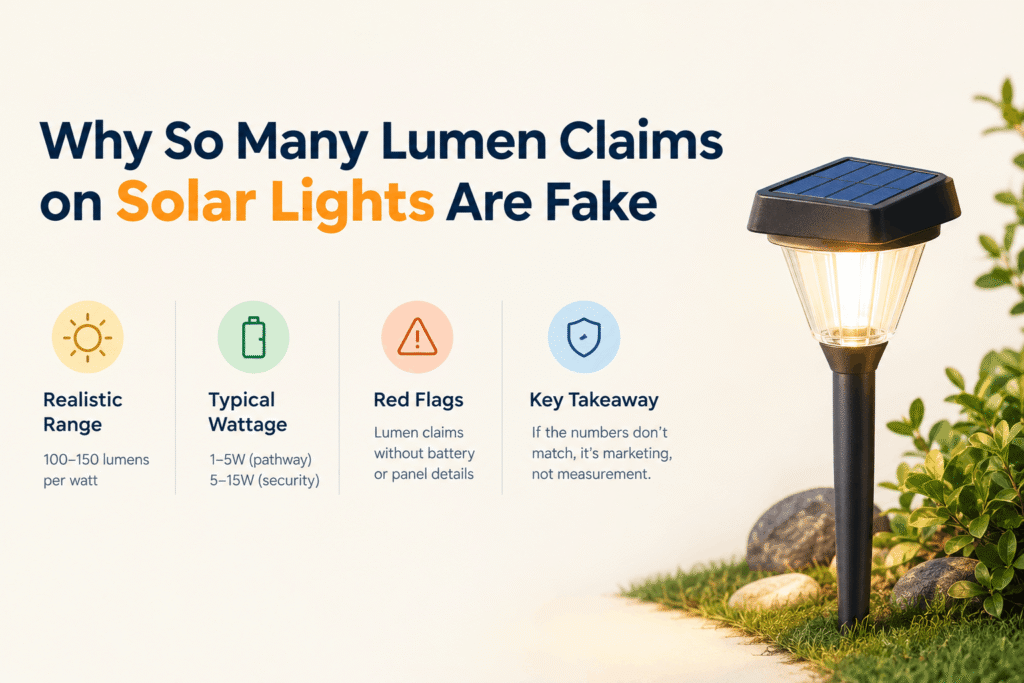
Let’s talk about the elephant in the yard, the “50,000 lumens” solar light.
That number would be roughly enough to light a small stadium section. A garden stake cannot produce that. It’s not a design flaw, it’s not physically possible with a battery that fits in your palm and a panel the size of a coaster.
Here’s the reality check: high-efficiency modern LEDs typically produce 100 to 150 lumens per watt, meaning even a genuine 10-watt LED tops out around 1,000 to 1,500 lumens, not 50,000.
Most consumer solar pathway and garden lights actually run on 1 to 5 watts of real LED power, while larger solar security floodlights use around 5 to 15 watts. That’s the honest range. Anything wildly beyond it is a red flag, not a feature.
How to protect yourself:
- If the listing only shows watts, not lumens, be suspicious
- If the lumens number sounds cinematic, it probably is
- Check for a listed battery capacity, mAh or Wh, a tiny battery can’t sustain a huge lumen claim all night anyway
Key Takeaway: If a solar light’s claimed lumens don’t match its battery size or panel size, the number is marketing, not measurement.
What Actually Affects Real-World Brightness
Lumens are the starting point, not the whole story. Two lights with identical lumen ratings can look completely different once they’re installed outside.
Sunlight hours. Solar lights only charge what the sun gives them. Cloudier regions or shaded yards mean shorter runtime, even from a correctly rated light.
Battery capacity. Higher ampere-hour batteries store more energy, which lets a light stay brighter for longer, even on overcast days. A high lumen rating paired with a small battery often just means a bright light for a short while, followed by dimming.
Mounting height and beam angle. A 200-lumen spotlight aimed downward at a path feels brighter than a 200-lumen light scattering upward into open air.
Distance from the light. Brightness fades the farther you are from the source, this is just physics, not a manufacturing defect.
Key Takeaway: Two lights can share a lumen number and still perform completely differently outdoors. Battery size and sun exposure matter almost as much as the lumen figure itself.
Glossary
Lumen (lm): The unit that measures total visible brightness a light produces.
Lux: Brightness measured at a specific distance, lumens spread over an area. Two lights with the same lumens can have very different lux depending on distance and angle.
Watt (W): A unit of electrical power consumption, not brightness.
mAh (milliamp-hour): A measurement of battery capacity, higher mAh generally means longer runtime.
IP Rating: A rating, like IP65, showing how resistant a fixture is to dust and water. An IP65 rating means the light is built to handle rain or snow.
Beam Angle: How wide or narrow the light spreads from its source.
FAQs
Is 1,000 lumens bright for an outdoor solar light?
Yes. That’s well into security-light territory, bright enough to illuminate a driveway or backyard, and more than most pathway or accent lights need.
How many lumens do I need for a backyard?
For general backyard or security-style lighting, 700 to 1,500 lumens is a reasonable working range, depending on how large and open the space is.
Do more lumens drain the battery faster?
Yes, higher brightness pulls more stored energy per hour, which is why very bright solar lights often run on motion-sensor mode instead of staying on all night at full output.
What’s a good lumen count for solar string lights?
Around 10 to 50 lumens per bulb is typical, string lights are meant to create ambiance, not visibility.
Summary
You don’t need the biggest lumen number on the shelf. You need the right one for the space you’re lighting.
Match the use case to the range, ignore any number that sounds too dramatic to be true, and check the battery size before you check the marketing copy.
Sources referenced: U.S. Department of Energy (energy.gov), Energy Rating Australia (energyrating.gov.au), manufacturer outdoor lighting specification charts.
![Best Solar Lights at Walmart & Home Depot [2026]](https://storyofsolar.com/wp-content/uploads/2026/09/Best-Solar-Lights-at-Walmart-Home-Depot-2026.jpg)

![Solar Light Waterproof Rating Chart [IP Guide]](https://storyofsolar.com/wp-content/uploads/2026/09/Solar-Light-Waterproof-Rating-Chart-IP-Guide.jpg)