Table of Contents
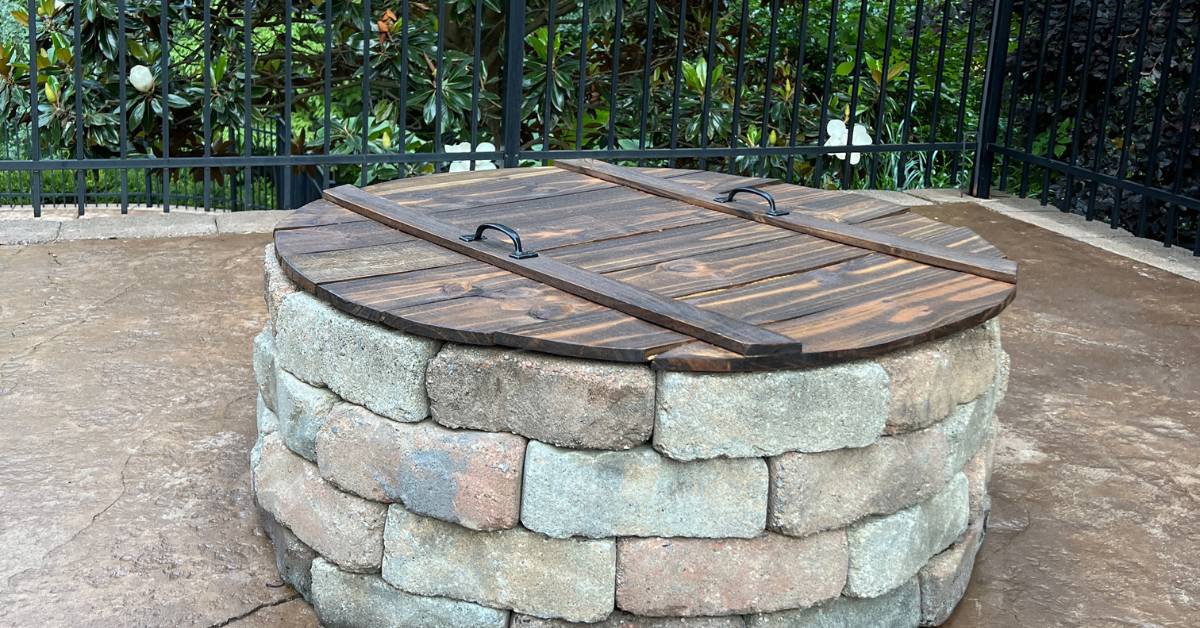
A fire pit brings people together, but once the flames burn low, the surrounding area can quickly become too dark to enjoy safely. The best solar lights for backyard fire pit area add just the right amount of visibility and ambiance without overpowering the natural glow of the fire.
Choosing the right ones isn’t always easy. This guide explains what to look for before you buy, covering light types, brightness, battery performance, build quality, and safety using trusted guidance and real product specifications, not marketing hype.
What to Know Before Buying Solar Lights for Your Fire Pit Area
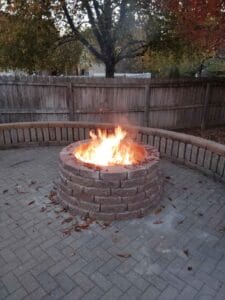
Most people buying solar lights for a fire pit area run into one of two problems. Either the space feels flat and dark once the fire burns low, or it feels unsafe because cords, stakes, and lanterns are scattered too close to the flame.
Solving both means treating this purchase differently than lights for a driveway or a flower bed. A fire pit area needs light that works with an open flame, not against it, which means paying attention to heat exposure, glare, and how the light behaves once the fire becomes the brightest thing in the yard.
Solar lights are a genuinely good fit here. They need no wiring near an active flame, they run on stored daytime energy, and modern LED versions last far longer than old incandescent options. The trick is picking the right type, brightness, and build quality for a space that gets hot, gets bumped, and gets used after dark.
Types of Solar Lights That Work Best Around a Fire Pit
Not every solar light belongs near a fire pit. Four types consistently perform well in this setting.
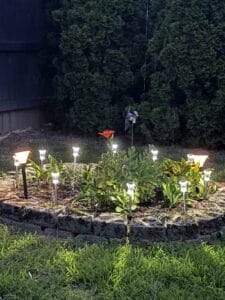
Stake lights push into the ground around the seating area, marking the edge of the patio or gravel bed so nobody trips en route to the marshmallows. Keep them a reasonable distance from the flame, since most use plastic housings not built for radiant heat all evening.
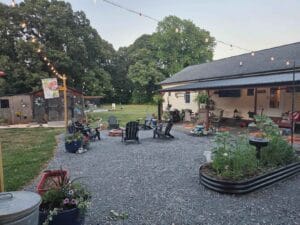
String lights wrap around a pergola, fence, or nearby railing, adding a soft glow overhead without competing with the fire itself. They work best strung well above head height and away from drifting sparks.
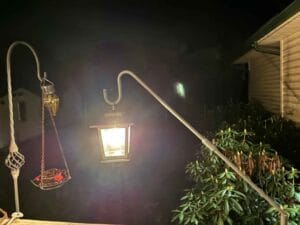
Lanterns sit on a side table or hang from a shepherd’s hook, giving off a warm, contained glow that pairs naturally with fire pit ambiance. Many battery-powered versions can be moved around as needed.
Spotlights aim at a specific feature nearby, like a tree, low wall, or water feature. They’re the workhorse option for visibility without stealing attention from the fire.
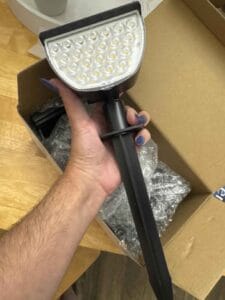
A mix of two or three types usually beats relying on just one. Layered light, the same principle professional landscape lighting designers use, reads as intentional rather than accidental.
How Bright Should Your Solar Lights Be?
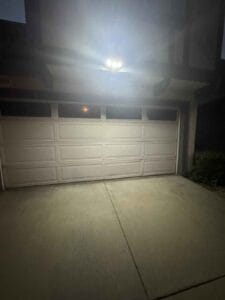
This depends entirely on what job the light is doing. A fire pit area usually needs two kinds of light working together: ambiance and function.
For ambiance, lower is better. String lights typically run in the 40 to 100 lumen range per bulb, and that’s by design. The goal is a soft glow, not competition with the fire pit as the visual centerpiece.
For function, like lighting the path to the seating area or marking a step, aim higher. Pathway and stake lights in the 100 to 200 lumen range strike a good balance between visibility and glare-free comfort. Landscape spotlights aimed at a nearby tree or wall generally fall between 50 and 300 lumens, depending on what they’re highlighting.
A simple rule: if the light’s job is to help people feel the space, keep it dim and warm. If its job is to help people see a hazard, size it up.
Safety Considerations When Placing Lights Near an Open Flame
An open flame changes the rules for where lighting can safely go.
The National Fire Protection Association recommends keeping fire pits at least 10 feet away from anything combustible, and that guidance applies to more than house siding. Plastic-housed solar lights, fabric lanterns, and low-hanging string lights all count as combustible material inside that radius.
A few practical guardrails follow:
- Keep stake lights and lanterns outside the direct heat zone of the fire pit, not just outside the flame’s reach.
- Avoid running string lights directly over the pit, since rising heat and drifting embers can reach surprisingly far on a breezy night.
- Choose lights with heat-resistant or metal housings for anything placed near the seating ring.
- Keep cords and low stakes clear of walking paths around the fire, since tripping near an open flame is a much bigger problem than tripping anywhere else in the yard.
None of this means solar lights and fire pits don’t mix. It just means placement deserves a few extra minutes of thought.
What Affects Battery Life and Charging Performance?
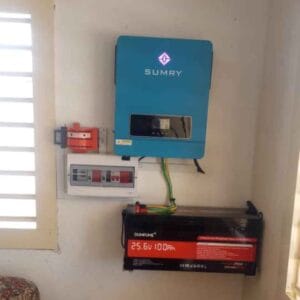
Two things drive how long a solar light lasts each night: the battery chemistry and how much direct sun the panel actually gets.
Most budget solar lights ship with nickel-metal hydride (NiMH) batteries. They’re affordable and reasonably eco-friendly, but typically last two to three years before performance drops off, and cold weather cuts their capacity noticeably. Higher-end lights use lithium-ion or lithium iron phosphate (LiFePO4) batteries, which hold charge longer, handle temperature swings better, and last through more charge cycles.
The panel matters just as much as the battery. Monocrystalline panels are the standard choice for outdoor solar lighting because they perform better in partial shade and low light than polycrystalline panels, which need more direct, uninterrupted sun to charge fully.
That’s worth noting for a fire pit area specifically: patios are often partially shaded by trees, pergolas, or the house for part of the day. A panel that needs a full, unobstructed 6 to 8 hours of sun may underperform right where fire pits usually sit.
Signs of Good Build Quality vs Cheap Lights
A few details separate a light that survives a season from one that fails by August.
IP rating. This two-digit code (like IP44 or IP65) shows how well a fixture resists dust and water. IP44 suits covered, sheltered spots, but anything fully exposed near a patio or fire pit should carry at least IP65.
Panel type and spec sheet. Legitimate manufacturers list panel type (monocrystalline or polycrystalline) and battery capacity on the packaging. Missing specs usually mean the manufacturer doesn’t want you comparing.
Housing material. Metal or heavy-duty polycarbonate holds up better near heat and repeated handling than thin, brittle plastic.
LED quality. Cheaper lights often dim unevenly or shift color over time. A steady, consistent warm white glow after a few months is a good sign the components are solid.
Tips from Real Backyard Setups
A few patterns show up again and again in backyards that get this right.
People who like their setup tend to angle solar panels toward the clearest patch of sky available, even if that means the panel sits a few feet from the light on a separate stake. Mixing lumens also works better than uniform brightness; a dim string light overhead paired with a slightly brighter stake light along the walkway reads as more polished than everything set to the same output.
Cleaning the panel every few weeks, especially after pollen season, makes a bigger difference to nightly runtime than most people expect. Keeping a spare light or two on hand saves a scramble when one battery finally gives out mid-summer.
Mistakes to Avoid Before You Buy
- Buying without checking the IP rating. A light with no water resistance won’t survive its first real rainstorm.
- Placing lights too close to the fire pit’s heat zone. Even without direct flame contact, prolonged heat exposure warps plastic and shortens battery life.
- Overlighting the space. Too many bright fixtures compete with the fire pit itself and wash out the atmosphere people are trying to create.
- Ignoring the battery type. A NiMH-powered light in a cold climate will disappoint by winter.
- Skipping a test run. Set up new lights for a few nights before committing to a full layout, since shade patterns and charging performance vary more than most packaging suggests.
FAQs
Do solar lights work well in a fire pit area with lots of shade?
Not as reliably as in full sun. Monocrystalline panels handle partial shade better than polycrystalline ones, but any solar light still needs several hours of direct light daily to charge fully.
How close can solar lights safely sit to a fire pit?
Keep them outside the 10-foot combustible-material clearance that fire safety guidance recommends, and further back if the light has a plastic housing.
Can solar lights handle winter weather?
Some can. Lights with lithium-ion or LiFePO4 batteries handle cold better than NiMH-powered lights, which lose capacity noticeably below freezing.
How many solar lights does a typical fire pit patio need?
It depends on size, but a mix of two to four stake or path lights plus one or two lanterns or a short string of lights usually covers a standard patio without overdoing it.